Hi, I’m Mushtaq, and I’ve been looking into Tarziq.com because its website content raises a few fair questions. It presents itself as a food website, but some of its articles cover topics that have little to do with cooking.
If you found this site through Google, you might be wondering the same things I did while checking the available information: What does it actually do? Is it safe to visit? And can you trust what it publishes?
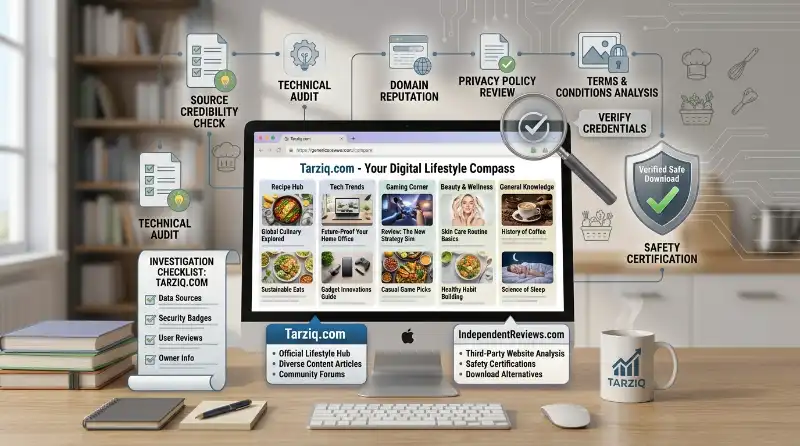
In this article, I’ll explain three things: what the website offers, what public safety and ownership information tells us, and how to judge its content before relying on it. I’ll keep it simple, so you can make up your own mind without guessing.
What Is Tarziq.com, and Why Are People Searching for It?
The first thing I noticed while reviewing the site was the difference between its stated purpose and the topics shown on its homepage.
The About page describes it as a food-focused blog. It says readers can find recipes, healthy meal ideas, drinks, cooking tips, and everyday food inspiration.
That sounds like a regular cooking website. But the homepage also displays articles about family history, beauty, technology, restaurants, and other subjects.
So, what is the site really about?
Here’s the simplest way to look at it:
- Its stated purpose: sharing food ideas, recipes, and cooking advice.
- Its visible content: food-related posts mixed with articles on several other topics.
- What that means for readers: you shouldn’t assume every article follows the same subject focus or level of expertise.
The site’s homepage identifies Sophia Turner with a short description about sharing quick, healthy, and easy recipes. That tells us how the website presents itself, but it doesn’t independently prove who owns the domain or who is responsible for every article.
You can check the site’s own About page to see how it describes its purpose.
What Kind of Content Can You Find?
The website includes food categories such as Meal Planning & Kitchen, Diet Styles, and Healthy Recipes. At the same time, its homepage has shown posts about family-tree privacy, Michelin-starred dining, logo creation, beauty products, and gaming laptops.
Honestly, that mix can be confusing if you arrived expecting a site dedicated to recipes.
It doesn’t automatically mean the website is dishonest. Publishers can cover more than one topic, and websites sometimes change direction. The key is to look at what the site actually publishes instead of relying only on its description.
Why Are People Looking It Up?
People usually search for a website like this because they want to understand what it does before spending time on it.
They may also want to know whether the site is active, whether its articles are useful, and whether there are any security concerns.
Those are sensible questions. A website’s name and appearance don’t tell you everything about its content or reliability.
The best starting point is to separate what the site claims about itself from what you can check independently.
Why Does the Website Publish So Many Different Topics?
Let’s say you visit a website for cooking ideas and find an article about gaming laptops. You’d probably pause and wonder whether you’ve opened the right page.
That’s the kind of mismatch visitors may notice here.
The homepage has included food-related posts alongside content about family history, beauty, technology, and other subjects. These topics don’t all fit neatly under a food-focused identity.
There could be several reasons for this. The publisher may have expanded into new categories, or the site may be using a broader publishing strategy. The visible content alone doesn’t tell us which explanation is correct.
Does a Mixed Topic List Mean Something Is Wrong?
Not by itself.
A website can cover several subjects and still publish useful information. What matters is whether individual articles are accurate, clear, properly sourced, and written with the right level of knowledge.
For example, a cooking post should give sensible ingredients and instructions. An article about technology should provide accurate technical details. A post making health claims needs stronger evidence than a simple opinion about a recipe.
One website doesn’t automatically have the same level of expertise in every field.
How Should You Read These Articles?
I think the easiest approach is to judge each page on its own merits.
Before relying on an article, ask yourself:
- Does it explain who wrote it?
- Does it link to useful sources?
- Are its claims clear and specific?
- Does the information seem current?
- Is the topic one that requires specialist knowledge?
If an article makes a big claim but gives you no way to check it, take a moment before accepting it as fact.
For another example of how to assess a website’s purpose and content, you can read this related review: https://meaningexplainer.com/glossywise-com/.
Also read: – https://meaningexplainer.com/glossywise-com/
Is Tarziq.com an Active Website?
A website can remain online for years without receiving new content, so it’s fair to ask whether this one is still active.
The homepage has displayed published articles, food categories, an About page, and a Contact Us link. It has also shown posts with dates from 2026, including an article dated October 21, 2026.
Those are signs of a functioning website with published content. They don’t, however, tell us how often the site will continue to update or how much editorial work goes into each article.
What Do We Know About Its Domain History?
According to Gridinsoft’s website reputation report, the domain was registered on March 30, 2026.
That makes its domain history relatively short as of October 2026.
A new domain isn’t automatically suspicious. Plenty of legitimate websites start out recently. The difference is that a new site has less history for visitors to use when judging its reputation.
Does Being Active Mean It’s Reliable?
No, and this is an easy point to miss.
A site can publish new articles regularly without proving that every article is accurate. On the other hand, a new website isn’t automatically unreliable just because it hasn’t been around for long.
In this case, the available information supports describing it as an active content website with a short domain history. It doesn’t settle every question about its quality or reputation.
For another website-focused example, see https://meaningexplainer.com/vocalnewsmedia-com/.
Also read: – https://meaningexplainer.com/vocalnewsmedia-com/
Is Tarziq.com Safe to Visit?
This is where it’s worth slowing down a little. When people ask whether a website is safe, they can mean two different things.
First, they may want to know whether visiting it could expose their device to malware or phishing. Second, they may be asking whether the information on the site is trustworthy.
Those aren’t the same question.
What Does the Independent Safety Report Say?
Gridinsoft published a report about the domain on May 11, 2026. At the time of that assessment, it reported no major malware or phishing detections, but it also pointed to cautionary signals, including the domain’s young age and limited independent reputation data.
The report gave the site a score of 55 out of 100 when I checked the available report. These scores and scan results can change, so they shouldn’t be treated as a permanent verdict.
You can read the details directly in the Gridinsoft report for the domain.
The balanced takeaway is that the report didn’t identify the site as a confirmed scam, but it also didn’t provide enough evidence to call it fully established or unquestionably safe.
What Does HTTPS Actually Mean?
You may see a padlock icon or HTTPS at the beginning of a website address. This means the connection uses encryption, which helps protect information sent between your browser and the site.
That’s useful, but it doesn’t prove that the website owner is honest or that every article is correct.
Think of it this way: a secure connection can help protect data while you’re browsing, but it can’t fact-check an article for you.
What Should You Do Before Visiting or Using a Site?
Use basic online safety habits:
- Pay attention to browser security warnings.
- Don’t download unexpected files.
- Avoid sharing passwords or sensitive personal information without a clear reason.
- Be careful if a website asks you to pay or provide private details.
- Check more than one source if you’re unsure about a site’s reputation.
A useful extra resource is Support the Truth’s guide to evaluating website credibility. It explains why you should look at evidence and ownership details instead of trusting a site’s appearance alone.
Also read: – https://meaningexplainer.com/simplifydiggs-com/
Can You Trust the Information Published on Tarziq.com?
Here’s the main thing I’d keep in mind: a website can be active and have no major security detections in a particular scan, yet still publish information that needs checking.
The reliability of an article depends on what it says and what evidence supports it. You shouldn’t assume that every page is equally reliable just because it appears on the same domain.
Check the Author and Supporting Sources
Start by looking for an author name and checking whether the article provides useful sources.
An author name gives you a starting point, but it doesn’t prove expertise on its own. Look for relevant experience, clear explanations, and references that actually support the claims being made.
If a post discusses a topic that affects your health, money, or safety, take extra care. It’s worth checking the claim against a qualified source instead of relying on one article.
Look at the Date and the Details
Some information changes quickly. Technology advice, product details, and recommendations may become outdated, while a cooking technique may remain useful for years.
Check the publication or update date when it’s available. Then consider whether the information makes sense for the question you’re trying to answer.
If an article makes a strong claim but doesn’t explain where it came from, don’t treat that claim as confirmed.
Does the Whole Website Have to Be Good or Bad?
No. You don’t need to label an entire website as either completely trustworthy or completely unreliable based on one detail.
A recipe may be useful even if another post on the same site covers a subject outside the site’s main focus. Likewise, a well-designed homepage doesn’t prove that every claim is accurate.
For a similar example of checking a site’s purpose and the information it offers, you can read https://meaningexplainer.com/zavalio-com-explained/.
Also read: – https://meaningexplainer.com/zavalio-com-explained/
Who Owns the Website?
It’s reasonable to want to know who is behind a website, especially if you’re planning to rely on its advice.
The homepage identifies Sophia Turner and presents her as someone who shares easy, healthy recipes. The site’s About page also describes its food-focused purpose.
Those details show how the website presents itself. They don’t independently establish the full legal ownership of the domain or confirm who is responsible for every article.
What Does the Domain Record Tell Us?
Gridinsoft’s report lists March 30, 2026, as the domain registration date and says the registrant’s personal information is withheld.
Private registration details aren’t proof of wrongdoing. Many website owners use privacy services to keep their personal information out of public domain records.
Still, the available information doesn’t give visitors a complete, independently verified picture of the site’s legal ownership.
What Should Readers Take From This?
Keep the difference between a site’s public description and independently verified information in mind.
The website identifies a person associated with its recipe content, but the public details reviewed here don’t establish the complete ownership structure.
That’s a reason to check important claims carefully, not a reason to make an accusation without evidence.
For another example of a website review that considers what is publicly known, see https://meaningexplainer.com/techslassh-com-what-is-this-website/.
Also read: – https://meaningexplainer.com/techslassh-com-what-is-this-website/
What If You Find Food or Health Advice on the Site?
Not every article needs the same level of checking.
If you’re reading a recipe for dinner, you can look at the ingredients, measurements, cooking time, and method to decide whether it suits your needs.
But if an article claims that a food can treat an illness, replace medication, or guarantee a health result, that’s a different situation.
Everyday Recipes and Cooking Tips
For ordinary cooking ideas, look for clear measurements and instructions. Check cooking times and food-handling advice, especially when preparing meat, seafood, or other foods that need safe cooking temperatures.
You can use a recipe as a starting point and compare it with other recipes if something seems unusual.
Nutrition and Medical Claims
Be more careful with claims about diseases, supplements, weight loss, allergies, or other health issues.
Look for evidence from qualified medical professionals, government health services, or established medical organizations. If the advice could affect your treatment or a health condition, ask a qualified professional before acting on it.
The point isn’t that every health-related article on a general website is wrong. It’s that a claim with serious consequences deserves stronger evidence.
Final Thoughts From Me, Mushtaq
So, what should you make of Tarziq.com?
From the information available, it’s an active content website that presents itself as a place for recipes, healthy food, drinks, and cooking ideas. Its homepage has also displayed articles on several unrelated subjects, and its domain was registered relatively recently.
The security report I reviewed didn’t identify major malware or phishing detections at the time of its assessment, but it raised enough questions that I wouldn’t treat that result as a guarantee of safety. And technical safety is separate from whether an article is accurate.
My advice is simple: look at the page, check its evidence, and match your level of caution to the information you’re using. A recipe idea and a medical claim shouldn’t be judged by the same standard.
You don’t have to assume the worst about a new website, but you don’t have to trust every word on it either. Check the facts that matter, use reliable sources for important decisions, and make your own call based on what you can actually verify.