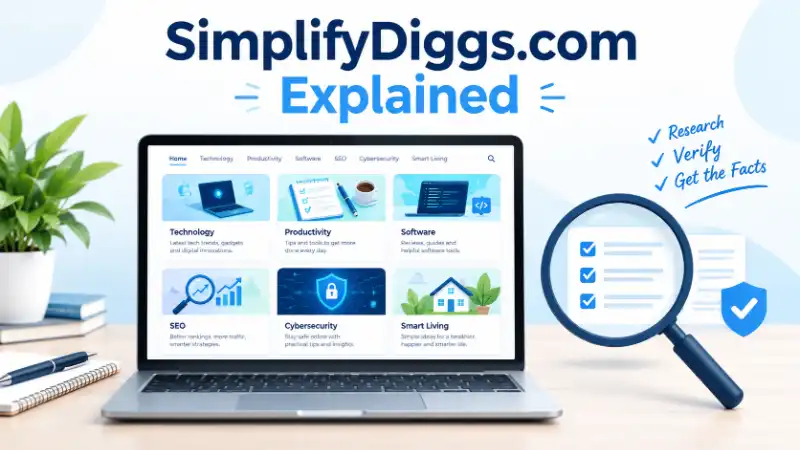
If you searched for SimplifyDiggs.com, you may be trying to figure out something very simple: what is this website, and why does it appear in searches about so many different topics? The name can also create confusion because SimplifyDiggs is sometimes discussed alongside technology, productivity, software, lifestyle, SEO, and other subjects.
Based on current search results and available information, SimplifyDiggs.com appears to be a broad informational website rather than a single-purpose software tool or specialized platform. Its content is associated with multiple general-interest and digital topics, which helps explain why people may encounter the domain while searching for very different subjects.
What Is SimplifyDiggs.com?
SimplifyDiggs.com appears to operate as a multi-topic content website. Instead of focusing on one narrow subject, it publishes or is associated with articles covering different areas of technology, productivity, lifestyle, business, and other general-interest topics.
That distinction is important if you first encountered the name while searching for a specific product, app, or online service.
SimplifyDiggs.com should not automatically be treated as the software or service described in one of its articles. A website can publish information about software, artificial intelligence, cybersecurity, cloud computing, or productivity without actually being the company that provides those products.
For example, imagine you searched for a particular productivity tool and found a SimplifyDiggs article in the results. The presence of the SimplifyDiggs domain does not by itself mean that SimplifyDiggs created that tool. It may simply be the publisher of an article explaining it.
Is SimplifyDiggs a Website, Software Platform, or Online Service?
The available descriptions of the domain characterize it primarily as an informational/content website, rather than a dedicated software application or task-management platform.
This matters because the wording surrounding a domain can sometimes make a website sound like a product.
If you are looking for:
- a software download,
- a task-management application,
- an AI tool,
- cloud infrastructure,
- cybersecurity software, or
- another specific digital service,
you should identify the actual provider of that product rather than assuming that the publisher of an article is the provider.
A simple rule helps:
The website publishing information about a product is not necessarily the company that makes or operates that product.
That distinction can prevent confusion when researching unfamiliar websites.
What Does SimplifyDiggs.com Cover, and Why Does It Appear in Different Searches?
One of the easiest ways to become confused about SimplifyDiggs is its broad subject range.
Current third-party descriptions associate the website with areas including technology, productivity, business, lifestyle, travel, finance, automotive topics, gaming, and other digital or general-interest subjects.
Your Search Console data also shows searches connecting the domain with terms such as task management, productivity, software, technology, cybersecurity, cloud computing, artificial intelligence, smart living, decluttering, SEO, optimization, and safety.
However, there is an important distinction:
A search query containing “SimplifyDiggs.com” does not automatically prove that the website has a dedicated category or specialist service for that topic.
For instance, a query such as:
“cybersecurity simplifydiggs com”
shows that Google users are searching for a connection between the domain and cybersecurity. It does not, by itself, establish that SimplifyDiggs is a cybersecurity company.
The same principle applies to searches involving:
- productivity
- software
- artificial intelligence
- cloud computing
- SEO
- task management
- smart living
Search behavior can reveal what users associate with a domain, but it should not be treated as direct evidence of the site’s business identity.
What Topics Are Associated With SimplifyDiggs?
The available information suggests that the site’s subject range is broader than a traditional single-niche publication. Technology and digital subjects appear alongside productivity, lifestyle, business, and other general-interest areas.
You can think of the content in broad groups:
| Topic area | What a reader may be looking for |
|---|---|
| Technology | Explanations of digital products, tools, and concepts |
| Productivity | Task management, workflows, and ways to organize work |
| Software | Information about applications and digital tools |
| AI and digital trends | Basic explanations of emerging technologies |
| Lifestyle | Everyday ideas and practical topics |
| Business | General business and online-work information |
| Home and living | Organization, living spaces, and related subjects |
| Other general topics | Articles covering additional areas of reader interest |
The important point is not that every article belongs to all of these categories. Rather, the domain has a broad informational footprint, which explains why different readers may encounter it for completely different searches.
Why Can One Broad Website Appear for Unrelated Searches?
This becomes easier to understand if you separate website identity from individual article relevance.
Suppose one reader searches for a productivity topic while another searches for a technology concept. If both searches return articles from the same multi-topic website, that does not mean the website itself has suddenly become a productivity company or a technology company.
It simply means the domain has published content relevant to both subjects.
The same idea applies to your GSC data. The appearance of terms such as productivity, cybersecurity, cloud computing, SEO, and smart living alongside the domain indicates different search associations. It does not mean that all of those subjects should be treated as the site’s primary identity.
This is why the safest description is:
SimplifyDiggs.com appears to be a broad informational website with content spanning multiple subject areas.
That description explains the search pattern without turning individual keyword associations into unsupported claims about the site’s business or expertise.
What the Search Pattern Actually Tells You
If you discovered SimplifyDiggs through Google rather than by visiting the domain directly, the search query can provide useful context.
For example:
- “simplifydiggs com” suggests the user is looking for the domain itself.
- “productivity simplifydiggs com” suggests the user encountered or is looking for productivity-related content associated with the domain.
- “software simplifydiggs com” points toward software-related content or discussion.
- “seo value simplifydiggs com” reflects an SEO-focused interest in the domain.
- “safety simplifydiggs com” suggests a user is evaluating safety or trust-related concerns.
These are different questions, even though they contain the same domain name.
That is why simply answering “SimplifyDiggs is a website” is not enough for someone who has arrived from one of these more specific searches.
The useful next step is to understand what the particular article says and how much confidence you should place in its claims.
That evaluation is separate from identifying the website itself, and it is where the next part of this guide becomes important.
How Should You Evaluate Information From SimplifyDiggs.com?
Finding an article on SimplifyDiggs.com does not automatically tell you whether every statement in that article is correct, current, or suitable for an important decision.
The better approach is to evaluate the specific article and the specific claim you are interested in.
This is especially important when an article discusses software features, security, money, health, legal requirements, technical specifications, or other information that can change over time.
Check the Article’s Author and Date
Start with the basic publishing information.
Look for:
- the author’s name or editorial attribution
- the publication date
- the last updated date, if one is provided
- references or links supporting important claims
A recent article can still contain an unsupported claim, while an older article can contain useful background information. The date simply helps you understand whether the information may need another check.
For fast-changing topics, the date matters even more.
For example, a software feature may exist today but be removed or changed later. An article explaining that feature should therefore be compared with the software provider’s current documentation when the exact feature matters.
Look for Evidence Behind Important Claims
A useful article should give you enough context to understand where important information comes from.
When reading a SimplifyDiggs article, ask:
“How does the article know this?”
If it makes a specific claim, look for supporting evidence such as:
- links to official websites
- documentation
- company announcements
- government sources
- research papers
- clearly identified primary sources
Be more cautious when a strong claim appears without supporting evidence.
This does not mean that an article without many links is automatically wrong. It means that the strength of the evidence should match the importance of the claim.
Compare Important Information With the Primary Source
If an article is explaining a product, company, service, software feature, or technical requirement, check the original source whenever possible.
For example, if SimplifyDiggs explains what a particular software product can do, the software company’s official documentation may provide the most current information about:
- features
- pricing
- system requirements
- account rules
- supported devices
- security settings
- availability
The same principle applies outside technology.
For government rules, check the relevant government source.
For product specifications, check the manufacturer’s information.
For academic claims, look for the original research or a reputable research source.
The goal is not to distrust every third-party article. The goal is to match the source to the importance of the information.
When Should You Use an Official Source Instead?
An official or primary source becomes particularly important when getting the answer wrong could cause a meaningful problem.
For example, use the relevant primary source when you need:
- an exact product specification
- current pricing
- official eligibility requirements
- legal or regulatory information
- security instructions
- medical guidance
- financial terms
- software documentation
- an official company policy
A general informational article can help you understand the topic, but the primary source may be better for confirming the exact detail.
That distinction gives you a practical way to use SimplifyDiggs without treating every article as either completely trustworthy or completely useless.
A Simple Check Before You Rely on an Article
You can use this four-step process:
Read → Check → Verify → Use
Read: Understand what the article is actually claiming.
Check: Look at the author, date, evidence, and supporting references.
Verify: Confirm important or changeable claims with an appropriate primary source.
Use: Apply the information when the evidence is strong enough for your purpose.
This approach is more useful than trying to give an entire website a simple “trustworthy” or “untrustworthy” label.
What Does SimplifyDiggs.com Mean for SEO Research?
The SEO-related searches in your GSC data show that some users are interested in SimplifyDiggs from an SEO and website-analysis perspective, not just as readers looking for an article.
Queries such as “seo value simplifydiggs com” and “optimization simplifydiggs com” indicate this secondary intent.
If you are researching the domain for SEO, it helps to separate several different concepts.
Why Its Broad Content Footprint Matters
A website that publishes across many subjects can build visibility for a wide range of search terms.
That can create a broad keyword footprint.
However, a large number of topics or search appearances does not automatically establish strong expertise in every subject.
For SEO research, you should therefore examine the actual pages ranking for the terms you care about, rather than judging the entire domain from its name alone.
Look at:
- the page’s search intent
- topical relevance
- content quality
- original information
- supporting sources
- internal linking
- external references
- search visibility for relevant queries
This gives you a more useful picture than simply asking whether the domain has “SEO value.”
Why Search Visibility Is Not the Same as Authority
A page appearing in Google means that the page is being surfaced for a particular search. It does not, by itself, prove that the page is the best source for every aspect of the subject.
For example, a website might rank for a software-related query because its article explains the topic clearly enough to satisfy some searchers.
That does not automatically make the website the official source for that software.
Likewise, a page ranking for a cybersecurity term does not automatically make the publisher a cybersecurity authority.
For SEO research, keep these concepts separate:
Search visibility ≠ official ownership
Search visibility ≠ specialist expertise
Search visibility ≠ automatic factual authority
This distinction is particularly important when analyzing broad multi-topic websites.
What to Examine When Evaluating a Website for SEO
If your reason for searching SimplifyDiggs is SEO research, examine the individual pages rather than relying only on domain-level assumptions.
A practical review can include:
- Relevance — Does the page genuinely match the query?
- Content usefulness — Does it answer the searcher’s actual question?
- Original value — Does it provide something useful beyond generic information?
- Evidence — Are factual claims supported?
- Topical consistency — Is the page relevant to the subject it targets?
- Search performance — Is it actually gaining visibility for meaningful queries?
- Page quality — Is the content clear, readable, and useful?
This produces a much more informative SEO assessment than assigning the entire domain a simple numerical score.
FAQ About SimplifyDiggs.com
Does SimplifyDiggs.com appear to be a software product?
Available descriptions characterize SimplifyDiggs primarily as a broad informational/content website rather than a dedicated software product. If you are looking for a particular application mentioned in one of its articles, identify the actual product provider separately.
Why does SimplifyDiggs appear next to technology and productivity searches?
Its broad content footprint means that articles associated with the domain can appear around different subjects. Your GSC data also shows search associations involving productivity, technology, software, AI, cloud computing, cybersecurity, and related topics.
Does a Google result prove that a SimplifyDiggs article is authoritative?
No. Search visibility tells you that a page is being surfaced for a query. It does not independently establish that every claim on the page is authoritative or officially verified.
Should I use SimplifyDiggs as my only source?
For ordinary background reading, an informational article can help you understand a subject. For important, current, or high-stakes information, compare the relevant claims with appropriate primary or official sources.
How can I check whether information from a SimplifyDiggs article is current?
Check the article’s publication or update date, then compare changeable information with the relevant current source. This is especially useful for software features, pricing, policies, regulations, and other information that can change.
Conclusion: What Should You Understand About SimplifyDiggs.com?
If you searched “SimplifyDiggs.com” because you were unsure what the domain represents, the key point is that it appears to be a broad informational website rather than a single-purpose software or service platform.
Its wide range of subject associations helps explain why you may encounter SimplifyDiggs while searching for productivity, technology, software, SEO, cybersecurity, smart living, or other topics.
But there is an important second step: do not judge an individual claim solely from the domain name or its Google ranking.
Instead, look at the specific article, check its date and supporting evidence, and verify important or changeable information with the appropriate primary source.
That gives you a practical way to understand SimplifyDiggs.com without making an overly broad assumption about every article it publishes:
Identify the website → understand the article → check the evidence → verify important claims → then decide how to use the information.