Zavalio.com Explained: What Is It, What Does It Do, and Is It Legit?
Hi, I’m Mushtaq, and I spend time researching websites that people find confusing through Google searches. I wanted to look into Zavalio.com because some searches make it sound like an online store, while others point to a website that publishes articles.
When I checked the available information, I found that the current website presents itself as a digital publishing platform. That raised a few questions worth answering: What can you do there? Can you trust its articles? And what should you know before using information from the site?
In this post, I’ll break it down in simple words, no fancy stuff. You’ll learn what the website does, how to check its credibility, and why some searches connected to its name can be misleading.
What Is Zavalio.com Actually?
The simplest answer is that Zavalio.com presents itself as an online publication that covers different subjects. Instead of focusing on just one topic, it publishes articles about business, finance, technology, health, education, lifestyle, travel, and more.
When I first looked into the name, I could see why someone might mistake it for a shopping website. Search phrases like “Zavalio Com sale” and “Zavalio Com hats” sound like someone is looking for products.
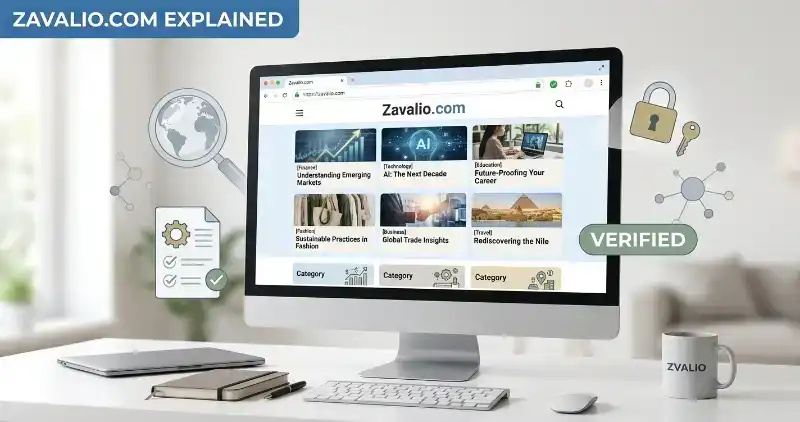
But the website’s current presentation tells a different story. Its homepage and About page describe a digital publication built around articles, explainers, and general information.
What Kind of Website Is It?
Think of a website where you can read about business in one visit and explore technology or lifestyle topics the next time you open it.
That’s the basic idea behind a multi-topic publishing platform. It brings different subjects together instead of making every page about one product or service.
The website also has a page for people who want to contribute articles. That supports its stated role as a publishing platform, although it doesn’t automatically prove that every article meets the same quality standard.
What Topics Can You Find There?
The website covers several broad categories, including:
- Business: Company topics, business ideas, and workplace information.
- Finance: Money-related subjects and financial education.
- Technology: Digital tools and technology-related topics.
- Health: General health and wellness information.
- Education: Learning, careers, and related subjects.
- Lifestyle: Everyday interests, travel, fashion, and other practical topics.
- Real estate and home improvement: Information related to property and homes.
The available categories can change as the site publishes new content. So, if you want to know what’s available right now, check the actual website rather than relying on an older description.
Why Does the Website’s Purpose Matter?
Let’s say you searched for a hat and landed on a page about business or finance. You’d probably wonder whether you’d opened the right website.
That’s why checking the actual homepage matters. A search phrase tells you what someone wanted to find, but it doesn’t prove that the website provides it.
The same rule applies to any unfamiliar website you discover through Google.
What Can You Actually Do on Zavalio.com?
If you’re wondering how the site works, the main activity is reading and exploring published articles.
You can browse the available topics, open individual posts, and look for information that matches your interests. You can also check the site’s contributor information if you’re interested in submitting your own writing.
Read Articles on Different Subjects
One thing I like about multi-topic websites is that they let you explore different subjects in one place.
For example, imagine you’re researching a business term for school or work. You might find an article that explains the term in simple language, then browse related topics to learn more.
The same idea applies to technology, education, lifestyle, and other categories.
Just remember that finding an article doesn’t automatically mean every statement in it is correct. You still need to judge the information based on the topic and the evidence provided.
Explore the Site’s Categories
Categories can make browsing easier when you already know what you’re looking for.
If you’re interested in finance, start with finance-related articles. If you’re researching technology, look for posts in that area.
This saves time because you don’t have to search the entire website for every new question.
Can You Submit a Guest Article?
Yes. The website has a dedicated Write for Zavalio page that explains its contributor guidelines.
The page says submissions should be original, relevant, fact-checked, and clearly organized. It also describes rules for contextual links and says that sending an article doesn’t guarantee publication.
If you’re a writer, read the guidelines carefully before submitting anything. Check the current requirements and contact details on the site itself, since submission policies can change.
Also read: Blue Flame Publishing Blog: What Is It?
Why Do Different Searches Describe Zavalio Differently?
Honestly, this is where the confusion starts.
When people search for a website, they don’t always use its name for the same reason. One person may want to read an article, another may be checking whether the website is legitimate, and someone else may be looking for a product.
Search results can reflect those different goals. They don’t necessarily describe the website’s actual services.
What Do Searches for Sales, Hats, and Men’s Products Mean?
Phrases like these may appear in keyword tools or search suggestions:
- “Zavalio Com sale”
- “men Zavalio Com”
- “Zavalio Com hats”
- “Zavalio Com fashion”
These phrases suggest commercial interest, but they don’t prove that the website sells those products.
I wouldn’t assume that a website has an online store just because a search query includes the word “sale.” I’d open the exact domain and look for product listings, prices, shopping carts, and checkout options.
If those features aren’t present, there’s no reason to describe the site as a conventional online store based on the keyword alone.
Always Check the Exact Domain
This is one of the easiest ways to avoid a mix-up.
Make sure the address is spelled exactly as intended. A different domain ending, an extra word, or a slightly different spelling may lead to another website.
For example, a page using a similar brand name on a different domain doesn’t automatically belong to the same operator as Zavalio.com.
If you find conflicting descriptions, check which exact domain each page is discussing before deciding that the information applies to the site you’re researching.
Don’t Treat Search Results as Official Confirmation
Imagine two blogs describe the same website in different ways. That doesn’t mean both descriptions are accurate.
One page may be discussing an older version of a site, while another may be referring to a similarly named domain. Sometimes, the writer may simply have misunderstood what the website does.
My approach is to start with the official domain, read its own description, and compare important claims with independent evidence.
Also read: WallpostMedia.com: What It Is and What It Publishes
Is Zavalio.com Legit and Safe to Browse?
If you’re asking whether the website is legitimate, I’d separate two questions: Does it operate as a real website, and should you trust everything it publishes?
Those aren’t the same thing.
The current site has published articles, topic categories, contact information, and pages covering its terms and policies. These are observable signs of an operating publication, but they don’t prove that every article is accurate or that every claim has been independently checked.
What Signs Should You Look For?
When I check an unfamiliar publication, I look for a few basic things:
- An About page: Does the website explain what it does?
- Contact information: Is there a clear way to contact the publisher?
- Editorial content: Are there actual articles rather than just vague promises?
- Privacy information: Does the site explain how it handles personal data?
- Terms and disclaimers: Does it explain the limits of its content and services?
Zavalio has pages covering these areas, including an About page and a Terms and Conditions page.
You can use those pages to understand how the publication describes itself. Just keep in mind that a website’s own statements aren’t independent proof of its quality.
Does Having a Privacy Policy Mean a Website Is Trustworthy?
Not by itself.
A privacy policy tells you what the website says about its data practices. It doesn’t automatically prove that every practice is safe or that the site follows every statement in its policy.
Before sharing personal details, check what information is being requested and why. If you’re only reading articles, you generally shouldn’t need to provide unnecessary sensitive information.
Is It Safe to Read the Articles?
For general reading, you can evaluate the website and its content in the same way you’d evaluate any online publication.
Be more careful when an article covers money, health, legal matters, or other subjects that could affect an important decision. In those cases, check the information against reliable sources before acting on it.
I wouldn’t call a website a scam just because it publishes different types of content. I’d look for specific evidence of misleading claims, suspicious requests, or unsafe behavior before making that judgment.
Also read: Prconnecthive.com Explained: What Is This Website?
Can You Trust Information Published on Zavalio.com?
My answer is to evaluate each article on its own merits.
A website can publish useful information in one category and have an article that needs better evidence in another. That’s especially worth remembering when a publication covers many different subjects.
Check the Author and Publication Date
Start by looking at the article itself.
Ask yourself:
- Is an author identified?
- Is there a publication or update date?
- Does the article explain where its information comes from?
- Are its claims supported by evidence?
- Does it distinguish facts from opinions?
These checks won’t guarantee that an article is correct, but they can help you spot missing information.
The publication date matters, too. An article about a basic concept may stay useful for years, while information about prices, regulations, or technology can become outdated much faster.
Verify Health, Legal, and Financial Information
For high-stakes topics, don’t rely on one article alone.
If a post discusses a legal requirement, compare it with the relevant government or legal source. For health information, check reputable medical or public-health sources. For financial claims, look for reliable information from the relevant regulator or financial institution.
This doesn’t mean you have to question every sentence you read. It means you should match the level of checking to the importance of the decision.
When Is the Website Useful?
A multi-topic publication can be a helpful starting point when you want to:
- Learn the basics of an unfamiliar subject.
- Find a simple explanation of a term.
- Discover topics you want to research further.
- Explore related articles.
- Get background information before checking more detailed sources.
The key is knowing what you’re using the article for. General background reading and professional advice aren’t the same thing.
Also read: RapidPressReach.com: What Is It and What Does It Do?
What Should You Check Before Relying on a Zavalio.com Article?
You don’t need to run a full investigation every time you open a webpage. A few simple checks can help you decide whether an article is useful for your needs.
1. Confirm the Website Address
Start by checking the exact domain.
Make sure you’re reading content on the website you intended to visit, not a similarly named site that appeared in search results.
This is particularly useful when your search includes commercial terms such as “sale,” “hats,” or “men’s products.” Those words don’t establish what the current website actually offers.
2. Read the Article Carefully
Don’t judge an article by its title alone.
Check whether the main text answers your question, explains its claims, and provides enough context to make sense of the subject.
If the title promises a specific answer but the article never provides it, look for another source.
3. Compare Important Claims With Other Sources
If an article includes a figure, rule, or claim that matters to you, look for supporting evidence elsewhere.
For example, an article about a legal rule should point you toward the relevant law or official guidance. A claim about a product should be checked against reliable product information.
For important decisions, the original source is often more useful than another blog repeating the same statement.
4. Be Careful With Personal Information
If a page asks you to create an account, submit a form, or provide payment details, stop and check why that information is needed.
Read the relevant privacy information and confirm that you’re using the correct website.
Don’t provide sensitive information just because a page looks professional or uses a familiar name.
5. Decide Whether the Article Meets Your Needs
Finally, ask yourself one simple question: Does this article give me enough reliable information to do what I came here to do?
If you’re just learning a new term, a clear introductory article may be enough. If you’re making a medical, legal, or financial decision, you’ll need stronger evidence.
That’s a practical way to use online information without blindly trusting it or dismissing it without a reason.
Also read: PlusStories.com: What Is This Website?
Frequently Asked Questions About Zavalio Com
What is Zavalio.com used for?
The current website presents itself as a multi-topic digital publication. It publishes articles and informational content covering subjects such as business, finance, technology, health, education, and lifestyle.
Is Zavalio.com an online shopping website?
The current website is presented primarily as a publishing platform rather than a conventional online store. Search phrases involving hats, sales, or men’s products don’t prove that the domain sells those items.
Does Zavalio.com accept guest posts?
Yes. The website has a contributor page explaining its submission guidelines. Read the current requirements before sending an article, and remember that submitting content doesn’t guarantee publication.
Is Zavalio.com safe to use?
The website has observable features of an operating publication, but that alone doesn’t guarantee the accuracy of every article or establish the safety of every possible interaction. Check the specific page and verify important claims before relying on them.
Can I trust its health and finance articles?
Treat them as information to evaluate, not as automatic professional advice. Check important health claims against reputable medical sources and financial claims against reliable financial sources before making decisions.
Why do search results describe Zavalio in different ways?
Searches may reflect different user goals, third-party descriptions, or similarly named websites. Check the exact domain and the actual content before assuming every result refers to the same service.
Final Thoughts From Me, Mushtaq
Honestly, the biggest thing I want you to take away is that a website’s name and its search results don’t always tell the whole story.
Zavalio.com currently presents itself as a digital publishing platform covering several subjects. If you want to read its articles, explore its categories, or learn about its contributor guidelines, start with the actual website rather than relying on a keyword or a third-party description.
I’d also avoid making a blanket judgment about the site’s trustworthiness based on its appearance alone. Check the author, look at the evidence, and verify important claims when the subject matters.
And if you searched for Zavalio because you wanted to buy a product, make sure you’ve found an actual product listing before assuming the site is a store.
My advice is simple: check the exact website, understand what it really offers, and trust the evidence more than the name. That’s the approach I’d use myself, and it can save you a lot of confusion when researching unfamiliar websites.


1 thought on “Zavalio Com: What Is Zavalio.com and What Does It Do?”