
If you searched for rapidpressreach com, you probably want a simple answer. You may have seen the domain in a search result, on another website, or inside an article and wondered what it actually is.
That can be confusing when a website does not have a clear identity in search results. You may wonder whether RapidPressReach is simply a content website, a publisher, or something connected to guest posting. Another question is what to make of information that links back to the domain. Before you rely on it, it helps to understand what the site appears to do and how its content can be checked.
This guide focuses on those exact questions. We will look at what RapidPressReach appears to be, why other websites mention it, what those mentions actually prove, and how you can judge the information you find there. The goal is simple: identify the site, understand its role, and help you decide what to do next.
What Is RapidPressReach Com Actually Used For?
If you are asking this question, you probably do not want a long description of the domain name. You want to know what kind of website you have actually found.
The first thing to understand is that RapidPressReach is associated online with published content across different subjects. References to the domain appear in articles about topics such as travel, photography, and other general-interest subjects.
That tells us something useful, but it does not automatically tell us everything about the company or people behind the domain. A website can be used as a content source without that alone proving who operates it or how its publishing system works.
So, instead of guessing from the name, it is better to look at what the domain is actually being used for.
What the Website Appears to Offer
RapidPressReach appears to be connected with general informational content rather than one narrow service such as banking, shopping, or software.
Online references connect the domain with articles covering different subjects. For example, other websites have referred readers to RapidPressReach for travel-related information and destination ideas.
That broad subject range is an important clue.
If you expected RapidPressReach to be a single-purpose service, the content references may look confusing at first. But the wider pattern suggests that the domain is being used around informational publishing.
Still, there is a difference between saying “the domain is associated with published content” and saying “this is definitely a particular type of company.”
The first can be supported by what appears online. The second needs stronger evidence.
What Kind of Content or Information Is Associated With the Domain?
The references we can find are mostly connected with general-interest articles.
For example, RapidPressReach is mentioned in travel content involving destinations, photography, and travel planning. In one article about Indian cities, RapidPressReach is referenced in connection with Hampi and travel photography. Another travel article mentions RapidPressReach when discussing travel stories and planning information.
This gives you a practical answer if your main confusion is:
“Why does this name keep showing up in articles?”
It appears to be used as a source or reference for informational content.
But there is an important warning here.
A website being mentioned as a source does not automatically mean every claim connected to that website has been independently verified. The reference tells you that another publisher used or cited the domain. It does not, by itself, prove that every piece of information is accurate.
What This Tells You About the Site’s Main Purpose
At this point, the safest description is that RapidPressReach is associated with general online publishing and informational content.
That is more useful than trying to give the domain a label that the available evidence does not fully support.
If you searched the domain because you wanted to know whether it is a specific product, app, bank, shopping store, or other specialized platform, the available references do not point strongly in that direction.
So your first problem is solved:
RapidPressReach appears to be connected with online informational publishing, but its exact business identity should not be assumed from the domain name alone.
That distinction matters because the next question is usually, “Then why am I seeing it on other websites?”
Why Does RapidPressReach Com Appear on Other Websites?
If you found RapidPressReach through another article, you may be wondering whether that website is officially connected to it.
That is not necessarily the case.
A domain can appear on another website for several reasons. It may be cited as a source, used as a reference, linked for additional information, or included as part of a publishing relationship.
So the right way to solve this confusion is to look at how the domain is being mentioned, not simply whether its name appears.
Where RapidPressReach Is Being Mentioned
Current online references show RapidPressReach appearing inside articles published by other websites.
The subjects are not limited to one narrow area. Travel-related pages, for example, mention the domain when discussing destinations, photography, travel planning, or similar topics.
That pattern is useful because it shows that RapidPressReach is not appearing only as an isolated domain name. Other publishers are using or referring to it in their content.
However, the exact reason can change from one page to another.
One link may be a simple reference. Another may point readers toward additional content. A different page could be using the domain as part of a wider publishing arrangement.
You should therefore judge the individual link instead of assuming that every mention has the same meaning.
Why Other Websites May Link to or Reference It
Think about it this way.
If an article says that a certain website has travel information, that does not mean the two websites are owned by the same person. It simply means the writer chose to point readers toward that source.
The same idea applies to RapidPressReach.
A mention can show that another publisher considers the domain relevant to a particular topic. But it does not automatically prove ownership, partnership, editorial approval, or business affiliation.
This is where many website searches go wrong.
People see one domain mentioned several times and then assume there must be a large company or formal network behind it. You should not make that jump without direct evidence.
What Those Mentions Actually Tell You About RapidPressReach
The mentions are useful as clues, not as complete proof.
They can help you understand that RapidPressReach has been used in connection with informational content. They can also show the kinds of topics associated with the domain.
But they cannot answer every question about the website.
For example, a third-party article cannot by itself prove:
- who owns RapidPressReach
- whether the site has a formal editorial team
- whether every article is independently researched
- whether a publishing relationship exists
- whether the website guarantees accuracy
- whether the domain should be treated as an authority on a subject
So if you came here wondering, “Does another website mentioning RapidPressReach mean I can automatically trust it?”, the answer is no.
The mention is a reason to investigate the source. It is not a replacement for that investigation.
Is RapidPressReach Com a Publisher, Content Site, or Guest-Post Platform?
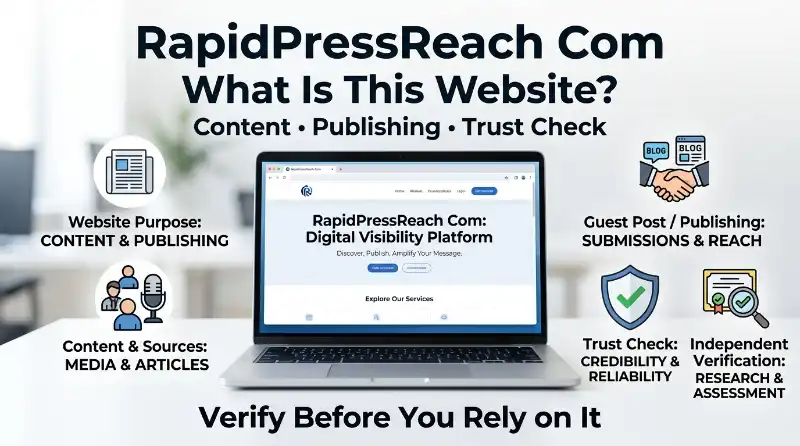
This is where the search can become confusing.
You may find RapidPressReach listed alongside websites that are offered for publishing or guest-post purposes. That can make it look like the domain has one clear business model.
But a listing is not the same thing as proof of the site’s full identity.
What the Available Evidence Shows About Its Role
One current guest-post marketplace catalog lists rapidpressreach.com among its website inventory. The listing places it under Finance, Health, and Technology categories and gives it third-party SEO metrics and a listed publishing price.
That is useful evidence because it shows that the domain is being marketed in the context of publishing opportunities.
But notice the wording.
It shows that a marketplace lists the domain. It does not, by itself, establish every detail of RapidPressReach’s own business operations.
This difference is important if you are considering using the site for publishing.
You should separate:
“A third party lists this website for publishing.”
from:
“The website itself officially operates a guest-post service with these exact terms.”
Those are not the same claim.
Why It Appears in Publishing or Guest-Post Listings
Websites that sell or arrange publishing opportunities often maintain large catalogs of domains.
RapidPressReach appears in one such catalog. The same catalog contains many other domains across broad categories.
That makes the listing relevant to the question, but it should not be treated as the final answer.
If you are looking at RapidPressReach because you want to publish an article, place a link, or promote a business, you should check the actual terms before doing anything.
Look for information such as:
- who accepts submissions
- what type of content is allowed
- whether payment is required
- what links are allowed
- whether content is edited
- whether published content can later be removed
- what happens after payment
Do not assume these details just because a marketplace has listed the domain.
What You Can Confirm—and What You Cannot Confirm Yet
You can reasonably confirm that RapidPressReach is publicly associated with informational content and that a third-party publishing marketplace currently lists the domain.
What you cannot safely confirm from those facts alone is the full ownership structure, editorial process, business relationship, or publishing terms.
That is the point where you should stop guessing.
If your goal is simply to understand the website, you already have enough to know that it is connected with online content publishing.
If your goal is to work with the site, you need another layer of verification before making a decision.
Can You Trust Information You Find on RapidPressReach Com?
Now we reach the question that matters most if you are planning to use information from the site.
Finding an article online does not automatically make the information reliable. The same rule applies to RapidPressReach.
The useful approach is not to ask only, “Is this website trustworthy?”
Instead, ask:
“Can I verify this specific information?”
That gives you a much better answer.
Start With the Specific Article, Not Just the Domain
Suppose you find an article on RapidPressReach about travel, technology, health, finance, or another subject.
Do not judge the article only from the domain name.
Open the actual page and look at what it says.
Ask yourself:
- Who wrote it?
- When was it published?
- Has it been updated?
- Does it provide sources?
- Are important claims supported?
- Does the information match reliable sources elsewhere?
This matters because one website can contain many different articles.
A domain-level judgment cannot tell you whether one particular article is well researched.
Check the Author, Date, Sources, and Evidence
If the information could affect an important decision, take a few extra minutes.
Look for a named author and publication date. Check whether the article gives links to original sources. If it makes a strong claim, search for that claim somewhere more direct.
For example, if an article gives a travel rule, check an official tourism or government source.
If it discusses a health issue, look for a medical or public-health source.
If it discusses money or financial rules, look for the relevant official or primary source.
The idea is simple: use the article to understand the topic, but verify important claims at the source level.
Honestly, this habit is useful for almost every website, not just RapidPressReach.
Compare Important Claims With Independent Sources
A claim becomes easier to trust when you can confirm it independently.
Imagine RapidPressReach says a particular destination has a certain travel requirement. Instead of stopping there, search for the current information from an official travel authority or another reliable primary source.
If both sources agree, you have stronger support.
If they disagree, do not simply choose the version you like. Find out why they differ and which source has the authority to answer that question.
This is especially important when information can change over time.
A travel recommendation may become outdated. A business detail may change. A rule may be updated.
So the real solution is not:
“Trust RapidPressReach.”
It is:
“Check the specific information you need and confirm important claims before relying on them.”
That approach gives you a much clearer answer than a simple label such as “trusted” or “not trusted.”
Is RapidPressReach Com Legit for What You Want to Do?
If you are asking whether RapidPressReach is “legit,” the answer depends on what you plan to do with it.
You may only want to read an article. You may want to use information from the site. Or you may be thinking about publishing content there.
Those are three different situations.
Instead of giving you a simple label without enough evidence, it makes more sense to look at what can actually be confirmed and then match that information to your purpose.
What Can Be Verified About the Website
RapidPressReach has an identifiable domain and appears in online content as a source or reference. It is also listed by a third-party guest-post marketplace.
That gives you some evidence that the domain is being used publicly for content and publishing-related activity.
But those facts do not prove that every claim made about the website is correct.
A third-party listing should be treated as evidence of the listing itself. It should not automatically be treated as an official statement from RapidPressReach.
This distinction can save you from making a decision based on someone else’s description of the site.
Which Important Details Remain Unclear
Some questions require direct evidence from the website itself.
For example, you should not assume that a marketplace listing tells you:
- who owns the website
- who manages its editorial content
- what its official publishing rules are
- whether every listed service is currently available
- how submitted content is reviewed
- what happens to published articles later
If those details matter to you, look for direct information from the website before taking action.
The absence of a clear answer does not automatically prove something is wrong. It simply means you should not fill the gap with a guess.
How the Answer Changes Depending on Your Purpose
When you only want to read an article, focus on the article itself and look at its author, date, sources, and evidence.
For anyone planning to use the information, important claims should be checked against stronger or more direct sources before taking action.
Those considering publishing content should first review the actual publishing terms, including the price, link policy, editorial rules, and payment process.
So “Is RapidPressReach legit?” is not really one question.
The better question is:
“Is RapidPressReach suitable and sufficiently verified for what I am about to do?”
That gives you a much more useful answer.
Should You Use RapidPressReach Com as a Source for Important Information?
Maybe you found an article that seems useful and now you want to quote it, share it, or use its information somewhere else.
Before you do that, there is one important distinction:
A website can be useful without being the best final source for every claim.
That is especially true for topics where facts change or where official sources exist.
When Its Content May Be Useful as a Starting Point
RapidPressReach can be useful when you are trying to understand a topic, discover ideas, or find another direction for your research.
An article can help you learn what questions to ask next.
For example, if you are reading a travel article, you might use it to discover a destination, activity, or planning idea.
At that point, the article is serving as a starting point.
You do not need to treat every sentence as a confirmed fact simply because it is published online.
When You Should Go to a Primary or More Direct Source
For important information, go closer to the original source whenever possible.
For an official rule, go to the government agency or official organization responsible for it.
Current business information is best checked through the company’s own official website or published materials.
With health-related information, rely on recognized medical organizations and public-health authorities.
For financial or legal questions, look for information from the relevant official authority or a qualified professional.
This is not a special warning about RapidPressReach. It is a good research habit in general.
The closer you get to the original source, the easier it is to check whether the information is current and accurate.
How to Confirm Information Before Acting on It
Use a simple three-question test:
What is the claim?
Write down exactly what the article is telling you.
Who is in the best position to confirm it?
Find the official organization, original study, company, government source, or other direct authority.
Does the current source still support the claim?
Check the date and context.
If the information matches, you have much stronger support for using it.
If it does not match, stop and investigate before acting.
This small process can prevent a lot of confusion.
What Should You Do If You Are Considering a Publishing or Guest-Post Opportunity?
This is a different problem from simply reading RapidPressReach.
If you are considering paying for a publication, submitting an article, or getting a link from the domain, you need to verify the actual offer.
A listing on a marketplace is not enough.
Confirm What Is Actually Being Offered
Start by finding the exact offer.
Do not rely only on a short marketplace description.
Find out:
- What type of article can be published?
- How much does publication cost?
- Are links allowed?
- Are sponsored or commercial links accepted?
- How long will the article remain online?
- Is the content edited?
- Who has final approval?
- Are there refund or cancellation terms?
Write down the answers before you pay or submit anything.
This prevents a common mistake: agreeing to a service before understanding what you are actually buying.
Review the Site, Content, and Publishing Terms
Look at several recent pages on the site.
Do they have clear topics? Do articles appear to have authors and dates? Does the site publish a wide mix of unrelated material? Are the articles useful to real readers, or are they mainly built around links?
You are not trying to create a perfect score.
You are simply trying to understand what kind of publishing environment you are entering.
Also compare the terms shown by the marketplace with any information provided directly by the website.
If the two descriptions do not match, pause and ask for clarification.
Verify the Opportunity Before Paying or Submitting Content
Before sending money, content, or sensitive information, make sure you know who you are dealing with and what you will receive.
If the offer comes from a third-party marketplace, confirm whether the marketplace is acting as an intermediary.
If someone contacts you directly, verify that person and the publishing arrangement separately.
Do not assume that because a domain appears in a catalog, every person offering a service connected with that domain is authorized to represent it.
That extra check is simple, and it can prevent a bad misunderstanding.
What Should You Do If You Found RapidPressReach Through Another Website?
Maybe RapidPressReach was not what you originally searched for.
Instead, another website linked to it and sent you there.
Now your question may be:
“Why did they send me here, and do I actually need this website?”
You can solve that without guessing.
Identify Why the Other Site Sent You There
Go back to the original page and read the sentence around the link.
Look at what the writer was trying to support.
First, identify the purpose of the link. Did it provide a source, serve as an example, offer additional reading, or simply appear as part of a website list?
The surrounding text often gives you the answer.
Do not judge a link by the domain name alone.
Check Whether the Linked Information Matches the Original Claim
Now open the RapidPressReach page.
Compare the actual information with what the first website claimed it contained.
If the original article says the link provides a particular fact, make sure the linked page really says that.
If it does not, you may have found an outdated link, a weak reference, or simply a mismatch between the two pages.
This takes only a minute, but it can prevent you from following a chain of information that does not actually support the original claim.
Decide Whether You Need RapidPressReach or a More Direct Source
Once you understand why the link exists, decide what you actually need.
For background information, RapidPressReach may help you continue your research.
When an official fact matters, go directly to the primary source.
Anyone considering a publishing service should verify the offer, terms, and payment details directly before proceeding.
The goal is not to visit every website mentioned in an article.
The goal is to reach the source that can actually answer your question.
What Does RapidPressReach Com Mean for Your Specific Search?
By now, you can see why a single yes-or-no description can be misleading.
The useful answer depends on what brought you to the domain in the first place.
If You Are Only Trying to Understand the Website
If you searched “rapidpressreach com” because you simply wanted to know what the domain is, the available evidence points toward a website associated with general informational publishing.
You do not need to assume that it is a shopping site, banking platform, app, or specialized service simply because the domain name sounds like a brand.
Start with what can actually be seen and verified.
If You Want to Read or Use Its Content
If you found an article that answers your question, you can read it and use it as part of your research.
But for important claims, use the source-checking process from earlier in this guide.
Look at the author and date. Check the evidence. Compare important facts with independent or primary sources.
That gives you a better basis for deciding whether a particular piece of information is useful.
If You Want to Work With or Publish Through the Site
If your goal is publishing, guest posting, or getting a link, slow down before making a payment or sending content.
A third-party listing shows that the domain is being offered in a publishing context, but you still need to confirm the actual terms and the person or service handling the arrangement.
Get the important details in writing.
That way, you know what you are agreeing to instead of relying on assumptions.
Final Takeaway
If you searched for RapidPressReach Com because you were confused about the website, the main answer is fairly simple.
RapidPressReach is associated online with general informational content and is also listed by a third-party marketplace in a publishing-related context. Other websites have referenced the domain in articles, including travel-related content.
But those facts should not be stretched into claims that the available evidence does not prove.
If you want to read its content, judge the specific article.
If you want to use its information for something important, verify the key claims with independent or primary sources.
And if you are thinking about a guest-post or publishing opportunity, confirm the actual terms before paying, submitting content, or sharing sensitive information.
That is the safest way to deal with a website when you know some facts about it but still have unanswered questions.


