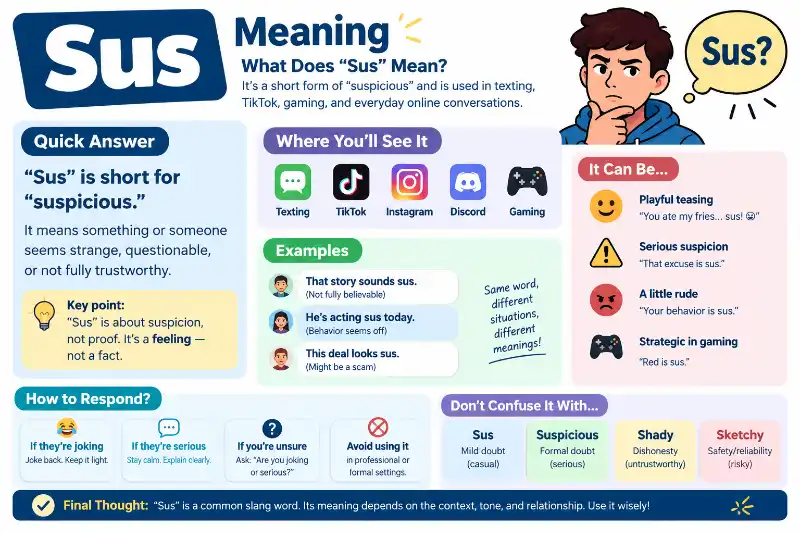
If you’ve seen the word “sus” in a text message, TikTok comment, or gaming chat and felt confused about what it means — you’re not alone. “Sus” has become one of the most common slang words on the internet, but its meaning isn’t always obvious because it can change depending on the situation.
Simply put, “sus” means something or someone seems suspicious, strange, or not quite right. But here’s the thing: it’s not always a serious accusation. Sometimes it’s a joke, sometimes it’s playful teasing, and sometimes it’s a quick reaction to something that feels “off.”
Knowing the definition is only half the battle. The real challenge is understanding what someone actually means when they call you “sus,” whether they’re joking or serious, and how you should respond. That’s exactly what this guide will solve for you — step by step.
Are You Trying to Figure Out What “Sus” Means and How to Respond?
Have you seen “sus” in a text, TikTok comment, or gaming chat and weren’t sure what it meant?
Have you been called “sus” and couldn’t tell if it was a joke, an insult, or a real accusation?
Do you want to use this word yourself but don’t want to sound awkward or offend anyone?
If you’re looking for clear, practical answers to any of these questions, you’ve come to the right place.
This guide will walk you through exactly what “sus” means, how to interpret it in any situation, how to respond when someone says it to you, and how to use it correctly yourself — step by step.
By the end of this article, you will:
- ✅ Know exactly what “sus” means and what someone is implying when they say it
- ✅ Understand whether “sus” is a joke, an insult, or a serious accusation in any context
- ✅ Know exactly how to respond when someone calls you “sus”
- ✅ Be able to use “sus” correctly without sounding awkward or offensive
Let’s solve your confusion, one step at a time.
What Does “Sus” Mean, and What Does It Mean When Someone Calls You Sus?
If you’ve ever seen “sus” and wondered what it actually means — or worse, if someone has called you “sus” and you didn’t know how to take it — this section gives you the clarity you need.
What Is “Sus” Short For?
“Sus” is simply short for “suspicious.”
There’s no hidden meaning, no acronym, no complex backstory. It’s just a shortened, casual way of saying “suspicious.”
- Full word: Suspicious
- Shortened slang: Sus
Think of it like how “cool” became “coo” in some chats, or how “obvious” became “obvi.” Internet culture loves to shorten words for speed and style.
What Does “Sus” Mean in Simple Words?
In the simplest terms, “sus” means something or someone seems strange, questionable, or not fully trustworthy.
It’s a feeling or an impression — not a proven fact.
| If you say… | You mean… |
| “That story sounds sus.” | The story doesn’t feel fully believable. |
| “His behavior is sus.” | His actions seem odd or questionable. |
| “This deal looks sus.” | The deal feels like it might be a scam. |
| “She’s acting sus.” | Her behavior seems off or unusual. |
Key point: “Sus” is about suspicion, not proof. When you say something is “sus,” you’re saying it feels wrong or questionable — but you don’t necessarily have evidence.
What Is Someone Implying When They Call You “Sus”?
This is the question that bothers most people. If someone calls you “sus,” what are they actually saying about you?
When someone calls you “sus,” they are implying one of these things:
| Implication | Meaning |
| “You seem dishonest.” | They think you’re not telling the truth or hiding something. |
| “Your behavior is weird or off.” | You did something that didn’t seem normal or natural. |
| “I don’t fully trust you in this moment.” | They have a gut feeling that something isn’t right. |
| “You’re acting guilty.” | Your reactions or words made them suspect you of something. |
Important: Being called “sus” does NOT mean:
- ❌ You are guilty of something
- ❌ You have been proven to be lying
- ❌ Everyone thinks badly of you
- ❌ You are a bad person
It simply means someone noticed something that made them pause and think, “That seems a little off.”
Example:
- You tell a friend you’re “busy” but they see you posting on Instagram.
- They might say: “That’s sus, you’re clearly online.”
- What they mean: “I don’t fully believe you’re busy because your actions don’t match your words.”
Takeaway: Being called “sus” is feedback about how your behavior is being perceived. It’s not a final judgment — it’s an observation.
Does “Sus” Mean Someone Is Guilty?
No. Absolutely not.
“Sus” means someone is suspected — not proven guilty. There’s a huge difference.
| Term | Meaning |
| Sus | “I suspect something is off” — no proof, just a feeling |
| Guilty | “Someone is considered responsible for wrongdoing” — a judgment or finding |
Think about it this way:
- In a game of Among Us, when players say “Red is sus,” Red hasn’t been caught. They’re just a suspect. They could be innocent.
- In real life, when someone says “That guy is sus,” they’re expressing doubt or concern — not declaring that the person has done something wrong.
So if someone calls you “sus,” don’t panic. They’re not saying you’re guilty. They’re saying something about your behavior made them raise an eyebrow.
What Does “Sus” Mean When It Describes a Person, Situation, or Behavior?
“Sus” can describe people, situations, or behaviors. Here’s how it applies in each case.
| What’s Being Described | What “Sus” Means | Example |
| A person | They seem dishonest, untrustworthy, or like they’re hiding something | “That new guy at work is sus.” |
| A situation | Something doesn’t add up; details feel questionable | “This job offer looks sus.” |
| A behavior | The action seems unusual or raises questions | “Why did you leave so fast? That was sus.” |
Key point: The meaning stays the same — “questionable” — but it applies differently depending on what’s being described.
What Does “Sus” Mean in Texts, Chats, and Social Media?
Now that you know what “sus” means in general, let’s look at how it’s used across different platforms. The word itself stays the same, but the context, tone, and audience can change how it feels.
What Does “Sus” Mean in a Text Message?
In texting (SMS, iMessage, WhatsApp, etc.), “sus” is used to quickly express doubt or react to something.
Common usage in texts:
- Someone says something that doesn’t fully add up
- A friend does something unexpected
- You want to tease someone lightly
Examples:
| Text Message | What It Really Means |
| “You didn’t reply for 5 hours… sus 👀” | “I’m teasing you — why did you disappear?” |
| “That excuse sounds sus, but okay” | “I don’t fully believe you, but I’m not going to fight about it.” |
| “Why are you being so sus today?” | “You’re acting weird — what’s going on?” |
Texting principle: In texts, “sus” can be playful or serious — the surrounding context and emojis determine which one.
What Does “Sus” Mean on TikTok and Instagram?
On TikTok and Instagram, “sus” is often humorous and meme-like — but it can also be used seriously depending on the context.
Common usage:
- Commenting on funny or unusual videos
- Reacting to someone’s behavior in a lighthearted way
- Joking about something that seems “off”
Examples:
| Platform | Example | What It Means |
| TikTok comment | “That dance move was sus 😭” | “That move was weird/funny.” |
| Instagram comment | “The way you looked at the camera was sus lol” | “I’m joking about your expression.” |
| Serious comment | “This whole situation is sus” | Genuine doubt or concern |
Key point: On these platforms, “sus” is usually playful, but context matters. A serious comment with no emojis may indicate genuine concern.
What Does “Sus” Mean on Snapchat?
On Snapchat, “sus” is used in casual, everyday chats between friends. It’s often playful and accompanied by emojis.
Common usage:
- Reacting to a friend’s story or snap
- Playfully calling out a friend’s behavior
- Light teasing in streaks or group chats
Examples:
| Snapchat Context | Example | What It Means |
| Friend posts a blurry snap | “That pic looks sus 👀” | “That photo is questionable/funny.” |
| Friend leaves you on read | “Leaving me on read is sus lol” | “I’m teasing you about ignoring me.” |
| Friend sends a weird snap | “Sus behavior tbh” | “That was weird/funny.” |
Snapchat principle: “Sus” here is usually playful, but the tone depends on your relationship with the person.
What Does “Sus” Mean on Discord?
On Discord, especially in gaming servers, “sus” is used in gameplay and real-time conversations.
Common usage:
- Calling out suspicious behavior in games (especially Among Us)
- Questioning someone’s strategy or move
- Reacting to something weird in voice chat
Examples:
| Discord Context | Example | What It Means |
| Among Us gameplay | “Blue is sus — they were near the body.” | “I suspect Blue might be the impostor.” |
| Strategy discussion | “That push was sus, ngl.” | “That move seemed questionable.” |
| Voice chat | “Your mic went quiet right when we asked — sus.” | “Your timing was odd.” |
Discord principle: “Sus” can be more serious in gaming contexts because it directly affects gameplay. But even then, it’s about suspicion, not certainty.
How Does Context Change What “Sus” Means?
Here’s the most important thing to understand: “Sus” means different things in different contexts.
| Context | What “Sus” Usually Means |
| Text with friends | Playful teasing or mild doubt |
| Gaming (Among Us) | Strategic suspicion — “I think you might be the impostor” |
| TikTok/Instagram | Often humorous, but can be serious |
| Work chat | Risky — can sound unprofessional |
| Serious conversation | Potentially serious doubt or concern |
| With strangers | Unclear — they might not know you well enough to read the tone |
The golden rule: The same word can be a joke, an accusation, or something in between — it all depends on who is saying it, how they’re saying it, and the relationship between the people talking.
Is “Sus” a Joke, an Insult, or a Serious Accusation?
This is one of the most common questions people have — and for good reason. Because “sus” can feel like all three depending on the situation.
When Is “Sus” Just Playful Teasing?
Most of the time, especially among friends and in casual online spaces, “sus” is playful and harmless.
Signs it’s just playful teasing:
- ✅ Emojis are used (😂, 👀, 😭, lol)
- ✅ You have a close, friendly relationship with the person
- ✅ The situation is obviously not serious
- ✅ They move on quickly without pressing the issue
Examples of playful “sus”:
| Situation | What They Say | Why It’s Playful |
| You eat the last slice of pizza | “You’re so sus for that 😂” | They’re joking about you sneaking the pizza. |
| You show up late to a group chat | “Sus timing 👀” | They’re teasing you about being late. |
| You post a blurry selfie | “That pic is sus lol” | They’re joking about the photo quality. |
When it’s playful, just laugh it off or joke back. Don’t take it personally.
How to respond playfully:
- “Haha, you caught me 😂”
- “Sus? Me? Never 👀”
- “You’re the sus one, not me!”
When Does “Sus” Show Genuine Suspicion?
Sometimes, “sus” is genuinely expressing doubt or concern. This happens more in serious conversations, gaming contexts, or when trust is at stake.
Signs it’s genuine suspicion:
- ⚠️ No emojis or jokes
- ⚠️ They ask follow-up questions
- ⚠️ The tone is serious (in person, voice, or text)
- ⚠️ They seem genuinely concerned, not laughing
Examples of genuine suspicion:
| Situation | What They Say | Why It’s Serious |
| You gave a questionable excuse | “That’s sus — can you explain?” | They genuinely doubt your explanation. |
| In a game, you were near the body | “Blue is sus — watch them.” | They suspect you might be the impostor. |
| You made an unusual purchase | “This order looks sus — let me check.” | They’re concerned about fraud. |
When it’s genuine, don’t get defensive. Stay calm and respond with clarity.
How to respond to genuine suspicion:
- “I can see why that looks sus. Here’s what actually happened…”
- “That’s fair — let me explain.”
- “I understand the concern. Let me clear it up.”
When Can Calling Someone “Sus” Sound Rude?
Even if you don’t mean it rudely, “sus” can come across as disrespectful or accusatory in certain situations.
Situations where “sus” can sound rude:
- ❌ In a professional or work setting
- ❌ With someone you don’t know well
- ❌ In a serious conversation where trust is important
- ❌ When the other person is already upset or defensive
Examples of rude “sus”:
| Situation | What You Say | Why It’s Rude |
| Work meeting | “Your numbers look sus.” | Unprofessional — sounds like you’re accusing them. |
| With a new acquaintance | “You’re acting sus.” | They don’t know you well enough to know if you’re joking. |
| Serious discussion | “That excuse is sus.” | Dismissive — shuts down the conversation. |
The rule: If you wouldn’t say “suspicious” in the same situation, don’t say “sus” either.
How Can You Tell Whether “Sus” Is a Joke or Serious?
Here’s a quick checklist to help you decide:
| Clue | Playful | Serious |
| Emojis | ✅ Yes (😂, 👀, 😭) | ❌ No or minimal |
| Relationship | Close friends | Strangers, colleagues, or distant acquaintances |
| Tone | Light, humorous | Serious, questioning |
| Follow-up | They move on | They ask more questions |
| Context | Casual chat, memes | Trust-based situations, gaming, serious discussions |
If you’re still unsure — just ask.
- “Are you joking or serious?”
- “Wait, are you actually sus of me or just messing around?”
There’s nothing wrong with clarifying. It shows emotional intelligence.
Why Do Emojis, Tone, and Context Matter?
Text has no tone. That’s the biggest challenge with words like “sus.”
Without emojis or context:
- “You’re sus.” → Could be a joke OR a serious accusation.
With emojis:
- “You’re sus 👀😭” → Clearly playful.
- “You’re sus.” (no emojis, short reply) → Might be serious.
With context:
- Said in a group chat after you made a joke → Playful.
- Said in a private message after a disagreement → Possibly serious.
Key takeaway: The word “sus” signals suspicion, but the tone, emojis, relationship, and context determine whether that suspicion feels playful, serious, or accusatory.
How Should You Respond When Someone Calls You “Sus”?
This is the most practical part of this guide. If someone calls you “sus,” what should you actually do?
The answer depends on whether they’re joking or serious.
What Should You Say If They Are Joking?
If it’s playful teasing, the best response is to joke back. Don’t take it seriously — lean into the humor.
Step-by-step response (when it’s playful):
- Smile or laugh (in person) or send a laughing emoji (in text).
- Acknowledge the joke — don’t get defensive.
- Joke back — flip it on them or lean into it.
- Move on — don’t overthink it.
Examples of playful responses:
| What They Said | How to Respond |
| “That’s sus 😂” | “Sus? Me? Never 👀” |
| “You’re acting sus lol” | “You caught me… or did you? 😂” |
| “Sus behavior tbh” | “Look who’s talking 😭” |
| “That’s kinda sus ngl” | “Ngl? That’s sus of YOU to say 👀” |
The goal: Keep it light, show you’re not offended, and keep the conversation fun.
What Should You Say If They Seriously Suspect You?
If the person seems genuinely suspicious, your response should be calm, clear, and honest.
Step-by-step response (when it’s serious):
- Stay calm — don’t get defensive or angry.
- Acknowledge their concern — show you understand why they might feel that way.
- Explain clearly — provide context or evidence without making excuses.
- Ask clarifying questions — understand what specifically made them suspicious.
- Offer a solution — if there’s a misunderstanding, offer to clear it up.
Examples of serious responses:
| What They Said | How to Respond |
| “That’s sus — can you explain?” | “I can see why you’d think that. Here’s what actually happened…” |
| “Your story is kind of sus.” | “That’s fair — let me go through it again and clear up any confusion.” |
| “I’m getting sus vibes from you.” | “I hear you. Can you tell me what specifically seems off? I want to address it.” |
| “That excuse is sus, ngl.” | “I understand it sounds questionable. Let me give you the full context.” |
The goal: Address the concern directly, clear up the misunderstanding, and move forward without conflict.
What NOT to do:
- ❌ Get angry or defensive
- ❌ Dismiss their concern
- ❌ Say “It’s just a joke” when they’re clearly serious
- ❌ Avoid answering the question
Should You Ignore It, Joke Back, or Explain Yourself?
Here’s a simple decision-making guide:
| Situation | What to Do |
| They’re joking with emojis and laughter | Joke back. Keep it light. |
| They seem serious but you’re not sure | Ask: “Are you joking or serious?” Then respond accordingly. |
| They’re clearly serious | Explain yourself calmly and clearly. |
| They said it once and moved on | Ignore it — it wasn’t important. |
| They keep bringing it up | Address it directly: “You keep saying that — can we talk about what’s going on?” |
| They said it in a group setting | Respond casually but don’t over-explain. If they want details, they’ll ask privately. |
When Should You Take “Sus” Seriously?
Not every “sus” needs a response. But sometimes, you should pay attention.
These clues can suggest the person is serious, especially when several appear together:
| Sign | Why |
| ✅ They say it repeatedly | It’s not a one-off — something is bothering them. |
| ✅ They ask follow-up questions | They genuinely want clarification. |
| ✅ The situation involves trust or safety | Work, relationships, finances, etc. |
| ✅ It comes from someone you respect | Their opinion matters. |
| ✅ They’re not laughing or using emojis | Tone indicates seriousness. |
| ✅ They say it in private | They might be being careful about how they bring it up. |
If multiple signs are present, take it seriously. Address the concern directly.
How Can You Respond Without Making the Situation Worse?
When someone calls you “sus,” the wrong response can escalate the situation. Here’s how to avoid that.
Do’s and Don’ts:
| Do ✅ | Don’t ❌ |
| Stay calm | Get defensive or angry |
| Acknowledge their concern | Dismiss it immediately |
| Ask clarifying questions | Shut down the conversation |
| Provide context calmly | Make excuses or lie |
| Use a neutral tone | Be sarcastic or passive-aggressive |
| Offer to clear up the misunderstanding | Accuse them back |
Example of a good response:
“I hear you. Can you tell me what specifically seems suspicious? I want to make sure there’s no misunderstanding.”
Example of a bad response:
“What? That’s not sus. You’re being ridiculous.”
The principle: Staying calm can help keep the conversation from escalating while you clarify what caused the suspicion.
How Do You Use “Sus” Correctly Without Sounding Awkward?
Now that you understand what “sus” means and how to interpret it when someone says it to you, let’s talk about how you can use it yourself — correctly, naturally, and without sounding awkward or offensive.
How Do You Use “Sus” Naturally in a Sentence?
Using “sus” is simple once you understand the pattern. It’s used just like the word “suspicious” — but in a more casual way.
Basic sentence structure:
| Structure | Example |
| [Person] is sus | “He’s acting sus today.” |
| [Thing] is sus | “That deal sounds sus.” |
| [Behavior] is sus | “Leaving early was sus.” |
| That’s sus | “That’s sus, not gonna lie.” |
| This feels sus | “This whole situation feels sus.” |
Natural examples in conversation:
| Scenario | What to Say |
| Friend gives a weird excuse | “That excuse is sus, but okay.” |
| You see something questionable online | “This website looks sus — I’m not clicking.” |
| Someone’s behavior seems off | “Why are you being so sus all of a sudden?” |
| A deal seems too good to be true | “This offer is sus. I’m not trusting it.” |
The rule: Use “sus” the same way you’d use “suspicious” in casual conversation — just shorter and more informal.
How Do You Use “Sus” in Gaming and Among Us?
If you’re a gamer, especially if you play Among Us or similar social deduction games, “sus” is part of your everyday vocabulary.
How to use “sus” in gaming:
| Situation | What to Say | Why |
| You suspect a player | “Green is sus — they were near the vent.” | You’re pointing out suspicious behavior. |
| You’re defending yourself | “I’m not sus — I was doing tasks.” | You’re claiming innocence. |
| You’re joking with teammates | “That play was sus, ngl.” | You’re teasing about a questionable move. |
| You’re calling out a strategy | “That push was sus — why did you do that?” | You’re questioning someone’s decision. |
Among Us-specific examples:
| What You Say | What It Means |
| “Red is sus” | “I suspect Red might be the impostor.” |
| “That was a sus vent” | “Someone vented suspiciously.” |
| “I’m clear — check my tasks” | “I’m not sus — verify my tasks.” |
| “Blue was acting sus near the body” | “Blue’s behavior around the dead body seemed questionable.” |
Gaming principle: In games, “sus” is strategic. You’re not insulting anyone — you’re playing the game. Keep it in the game context.
When Should You Use “Sus” With Friends or Online?
“Sus” works best in casual, relaxed environments where everyone understands the slang.
Good times to use “sus”:
| Situation | Why It Works |
| ✅ Texting with close friends | They know you’re joking or being casual. |
| ✅ Social media comments (TikTok, Instagram) | The platform is casual and meme-friendly. |
| ✅ Gaming chats (Discord, in-game) | Everyone understands gaming slang. |
| ✅ Group chats with people your age | Shared cultural understanding. |
| ✅ Playful teasing | It’s lighthearted and fun. |
Examples of appropriate usage:
- “You disappeared for 3 hours… sus 👀” (text to a friend)
- “That outfit change was sus 😂” (TikTok comment)
- “Bro, your aim is sus today” (gaming chat)
When Should You Avoid Using “Sus”?
Just as important as knowing when to use “sus” is knowing when not to use it.
Use “sus” when the setting is informal and the audience is likely to understand the slang. Choose a clearer word when the situation is formal, sensitive, or requires precision.
Avoid “sus” in these situations:
| Situation | Why to Avoid |
| ❌ Professional emails or messages | Sounds unprofessional and immature. |
| ❌ Work meetings or presentations | Can make you seem unserious or disrespectful. |
| ❌ With people who may not know the slang | They might misunderstand what you mean. |
| ❌ Serious conversations | Dismissive and can escalate conflict. |
| ❌ Formal writing (reports, essays) | Inappropriate tone. |
| ❌ When you’re making a serious accusation | “Sus” is too casual for serious claims. |
Examples of what NOT to say:
| Wrong (Avoid) | Better Alternative |
| “Your report is sus.” | “I have some concerns about this report.” |
| “That excuse is sus.” | “I’m not fully convinced by that explanation.” |
| “His behavior is sus.” | “His behavior seems questionable to me.” |
| “This deal is sus.” | “This deal seems too good to be true — I’m skeptical.” |
What Words Should You Use Instead in Formal or Serious Situations?
When “sus” doesn’t fit, here are better alternatives:
| Instead of “sus”… | Use This | Context |
| “That’s sus.” | “That seems questionable.” | Professional |
| “He’s sus.” | “I have doubts about him.” | Formal |
| “This deal is sus.” | “This deal seems unreliable.” | Business |
| “Your story is sus.” | “Your story doesn’t fully add up.” | Serious conversation |
| “That behavior is sus.” | “That behavior raises concerns.” | Professional/Formal |
| “She’s acting sus.” | “Her behavior seems unusual.” | Polite/Neutral |
Quick comparison:
| Situation | Casual (“Sus”) | Formal/Professional |
| Doubting a story | “That’s sus.” | “I’m not fully convinced.” |
| Questioning behavior | “He’s acting sus.” | “His behavior raises some questions.” |
| Skeptical of a deal | “This offer is sus.” | “This offer seems too good to be true.” |
| Expressing doubt | “Sus, not gonna lie.” | “I have some reservations.” |
The takeaway: Match your language to the situation. “Sus” is for casual chats — not for the boardroom.
What Is the Difference Between “Sus,” “Suspicious,” “Shady,” and “Sketchy”?
These words are often confused — and using the wrong one can change your meaning completely.
Sus vs. Suspicious — What Is the Difference?
“Sus” and “suspicious” mean the same thing — but the difference is in tone and formality.
| Sus | Suspicious | |
| Meaning | Doubt, something feels off | Doubt, something feels off |
| Tone | Casual, informal | Formal, serious |
| Where to use | Texts, chats, memes, gaming | Reports, professional settings, serious conversations |
| Example | “That’s sus.” | “That seems suspicious.” |
When to use which:
| Situation | Use |
| Texting a friend | “Sus” ✅ |
| Writing a report | “Suspicious” ✅ |
| Gaming chat | “Sus” ✅ |
| Professional email | “Suspicious” ✅ |
| TikTok comment | “Sus” ✅ |
| Court testimony | “Suspicious” ✅ |
The rule: “Sus” is the casual, shortened version of “suspicious.” Use “suspicious” when you need to be taken seriously.
Sus vs. Shady — What Is the Difference?
“Shady” is typically stronger than “sus” and often implies dishonesty.
| Sus | Shady | |
| Typical Meaning | Something seems off or questionable | Someone or something seems dishonest or morally questionable |
| Tone | Mild doubt | Stronger implication of dishonesty |
| Implies | “I’m not sure” | “I don’t trust them” |
| Example | “That excuse is sus.” | “That guy is shady — I wouldn’t trust him.” |
Examples showing the difference:
| Sentence | What It Typically Means |
| “That deal is sus.” | “I’m skeptical — something feels off.” |
| “That deal is shady.” | “I think it’s a scam — someone is being dishonest.” |
| “His story is sus.” | “I’m not fully convinced.” |
| “His story is shady.” | “I think he’s lying.” |
The typical distinction: “Sus” is about doubt. “Shady” is often about dishonesty. Use “shady” when you’re suggesting someone is untrustworthy.
Sus vs. Sketchy — What Is the Difference?
“Sketchy” is typically about safety and reliability.
| Sus | Sketchy | |
| Typical Meaning | Something feels off or questionable | Something feels unsafe, unreliable, or poorly put together |
| Tone | Mild doubt | Concern about safety or quality |
| Implies | “I’m not sure” | “This doesn’t feel safe or trustworthy” |
| Example | “That story is sus.” | “That neighborhood looks sketchy.” |
Examples showing the difference:
| Sentence | What It Typically Means |
| “That website is sus.” | “I don’t trust it — something seems off.” |
| “That website is sketchy.” | “It looks unsafe — I wouldn’t enter my information.” |
| “That guy is sus.” | “His behavior seems questionable.” |
| “That guy looks sketchy.” | “He looks dangerous or unreliable.” |
The typical distinction: “Sus” is about doubt. “Sketchy” is about safety or reliability. Use “sketchy” when you’re concerned about danger or poor quality.
Which Word Should You Use in Different Situations?
Here’s a quick comparison chart to help you choose:
| Situation | Best Word | Why |
| A friend gives a weak excuse | Sus | Casual, playful doubt |
| You don’t trust a business deal | Shady | Implies dishonesty |
| A neighborhood feels unsafe | Sketchy | Implies safety concern |
| A report in a professional meeting | Suspicious | Formal and serious |
| A gamer’s behavior in Among Us | Sus | Gaming context |
| Someone’s behavior seems morally wrong | Shady | Stronger implication |
| A website looks poorly designed | Sketchy | Quality/safety concern |
| You’re not sure about someone’s story | Sus or Suspicious | Depends on formality |
Quick decision guide:
| You want to say… | Use this word |
| “I have mild doubt” | Sus |
| “I have formal doubt” | Suspicious |
| “I think they’re dishonest” | Shady |
| “This feels unsafe or unreliable” | Sketchy |
Where Did “Sus” Come From, and How Did It Become Popular?
You don’t need to know the full history to use “sus” correctly — but understanding where it came from can help you appreciate why it’s so widely used today.
What Word Did “Sus” Come From?
“Sus” comes from the word “suspicious.”
It’s simply a shortened, slang version — nothing more complicated than that.
- Full word: Suspicious
- Slang abbreviation: Sus
People have been shortening “suspicious” to “sus” in informal speech for decades. It wasn’t invented by the internet — the internet just made it global.
Did Among Us Invent the Word “Sus”?
No. Absolutely not.
“Sus” existed long before Among Us. People used it in casual speech long before the game existed.
What Among Us did:
- ✅ Made “sus” globally viral
- ✅ Turned it into a meme
- ✅ Spread it to millions of people who had never heard it before
- ✅ Gave it a specific gaming context
But Among Us did NOT invent it. The word was already there — the game just gave it a massive platform.
How Did Among Us Make “Sus” Popular?
Among Us became incredibly popular in 2020, and with it came the phrase:
“Red is sus.”
Players in the game constantly say “sus” to accuse others of being the impostor. This repetition — combined with memes, TikTok videos, and streaming — turned “sus” into a global phenomenon.
From there, “sus” spread beyond gaming into everyday internet language across TikTok, Instagram, Snapchat, Discord, and texting. Today, it’s a mainstream slang term used by millions worldwide.
FAQ — What Else Do People Want to Know About “Sus”?
This FAQ section contains only questions that haven’t been directly answered in the main body of the article. Each answer adds new value.
Q1: Why Do People Write “SUS” in All Caps?
When people write “SUS” in all caps, they’re adding emphasis, exaggeration, or a dramatic reaction.
| Writing | What It Typically Means |
| “sus” | Casual, normal |
| “SUS” | Emphasized — “I really mean this” |
| “SUSSS” | Exaggerated — playful or dramatic |
| “S U S” | Extra emphasis — often humorous |
Examples:
- “That’s SUS.” → Emphasized reaction.
- “SUSSS behavior.” → Exaggerated for effect.
The principle: All caps = emphasis. It doesn’t change the meaning — it just makes it stronger or more dramatic.
Q2: Is “Sus” Only Used by Gen Z?
No. While “sus” is strongly associated with internet and gaming culture, especially younger users, it is not exclusive to Gen Z.
Who uses “sus”:
- ✅ Gen Z (most common)
- ✅ Millennials (very common)
- ✅ Anyone active on the internet or in gaming communities
The truth: “Sus” is mainstream internet slang. Anyone who spends time on social media, gaming, or texting likely knows what it means — regardless of age.
Q3: Can “Sus” Be Used Playfully?
Yes — in fact, it’s most often used playfully.
| Usage | Tone | Example |
| Playful teasing | Humorous | “You ate my fries again… sus 😂” |
| Friendly banter | Light | “Sus behavior from you today lol” |
| Meme context | Funny | “That dance was sus 😭” |
| Gaming strategy | Neutral | “Blue is sus — watch them.” |
| Serious accusation | Negative | “Your explanation is sus.” (can sound accusatory) |
The principle: “Sus” is usually playful when used with friends, emojis, and in casual contexts. It becomes more serious when used without context or in a serious tone.
Conclusion: What Should You Remember About “Sus”?
Here’s what you need to remember:
1. “Sus” = suspicious. It means something or someone seems off, questionable, or not fully trustworthy.
2. “Sus” is about suspicion, not proof. Being called “sus” doesn’t mean you’re guilty — it means someone has doubts.
3. Context is everything. “Sus” can be playful, serious, rude, or strategic — it all depends on tone, emojis, relationship, and situation.
4. Respond appropriately. If someone jokes, joke back. If they’re serious, explain yourself calmly. Don’t get defensive.
5. Use “sus” casually, not professionally. Avoid it in work emails, formal writing, and serious conversations.
6. Know the differences. “Sus” is mild doubt, “shady” is often about dishonesty, and “sketchy” is about safety or reliability.
Final takeaway:
“Sus” is not just slang — it’s a reflection of how people communicate online today: fast, casual, and heavily dependent on tone and context.
The word itself is simple. What makes it tricky is the situation you see it in, who is saying it, and how they’re saying it.
But now you know exactly how to handle it — whether you’re reading it, hearing it, or saying it yourself.
You’ve gone from confused to confident.



8 thoughts on “Sus Meaning: What Does “Sus” Mean in Text, Chat, and Social Media?”