If you have ever received a text, email, or workplace message that starts with “FYI,” you may have wondered what it means or whether the sender expects you to do something.
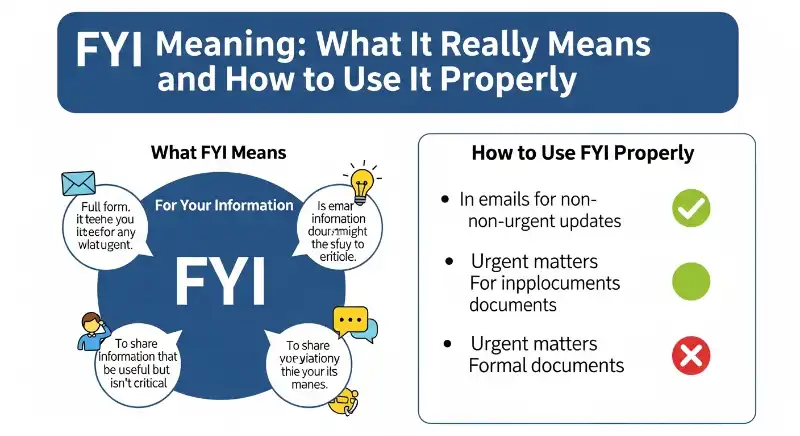
FYI stands for “For Your Information.” It is commonly used to share information with someone so they are aware of it, usually without requiring them to take action.
For example:
FYI, the meeting has been moved to 3 PM.
In simple words, this means:
“Just letting you know that the meeting has been moved to 3 PM.”
FYI is widely used in text messages, emails, workplace communication, group chats, and online conversations. Although its basic meaning is straightforward, its tone can change depending on the context. A friendly FYI can sound helpful and informative, while a short or critical FYI can sometimes feel cold or passive-aggressive.
What Does FYI Mean?
FYI means “For Your Information.”
It is used when someone wants to give you information or make you aware of something without necessarily asking you to do anything.
FYI = For Your Information = Just letting you know.
For example:
FYI, the office will be closed on Friday.
The sender is simply sharing the information. They are not necessarily asking you to reply or take action.
What Does FYI Stand For?
What Is the Full Form of FYI?
The full form of FYI is “For Your Information.”
The abbreviation comes from the first letters of each word:
- F = For
- Y = Your
- I = Information
FYI is generally pronounced by saying the individual letters: “F-Y-I.”
You may see it written at the beginning of a sentence, in an email subject line, or in a workplace chat.
For example:
FYI, the client approved the proposal.
The sender is providing an update so the recipient knows what happened.
What Does FYI Mean in Simple Words?
In simple English, FYI means “just letting you know.”
It is a convenient way to share information without making the message sound like a direct request.
For example:
FYI, I’ll be home late tonight.
This usually means:
“I just wanted you to know that I’ll be home late.”
Another example:
FYI, your package arrived.
Here, the sender is simply giving you an update.
The important point is that FYI itself does not contain a hidden request or emotion. The tone comes from the rest of the message and the situation in which it is used.
What Does FYI Mean in Texting and Chat?
FYI Meaning in Text Messages
In text messages, FYI usually has the same meaning as “For Your Information” or “just letting you know.”
People often use it to share:
- Updates
- Changes to plans
- Reminders
- Useful information
- Quick announcements
- Details someone may need to know
For example:
FYI, I’ll be there around 7.
Or:
FYI, they changed the restaurant location.
Or:
FYI, the movie starts at 8 PM.
In each example, the sender is giving information rather than making a direct request.
How Is FYI Used in Casual Chats?
FYI can be used naturally between friends, family members, coworkers, and people in group chats.
For example:
FYI, Sarah is coming with us tonight.
This simply tells the other person about a change or additional detail.
Another example:
FYI, I already ordered the tickets.
This means the sender wants the recipient to know that the tickets have already been ordered.
Can FYI Sound Different in a Text Message?
Yes. Because text messages do not provide facial expressions, voice tone, or body language, a short message can sometimes be interpreted differently than the sender intended.
Compare these two messages:
FYI, I already sent it.
and:
Just FYI, I already sent it earlier, so you don’t need to worry about it.
The first message is shorter and may sound slightly blunt depending on the situation. The second provides more context and may feel warmer.
This does not mean FYI is rude. It simply shows why context matters when interpreting short digital messages.
What Does FYI Mean in Email?
FYI Meaning in Email
FYI is extremely common in email communication.
Someone may write:
FYI, the updated report is attached.
Or:
FYI, the deadline has been moved to Friday.
Or:
FYI, the client has approved the proposal.
In these examples, FYI tells the recipient that the information is being shared for their awareness.
It often suggests that no immediate action is required.
What Does FYI Mean in a Professional Email?
In professional communication, FYI is often used to keep someone informed without assigning them a task.
For example:
FYI, the meeting has been rescheduled to Monday.
This tells the recipient about the schedule change.
If you actually need the person to do something, it is better to state the action clearly:
FYI, the meeting has been rescheduled to Monday. Please confirm your availability.
The first sentence provides information, while the second clearly communicates what the recipient needs to do.
What Does FYI Mean in an Email Subject Line?
You may also see FYI in an email subject line.
For example:
Subject: FYI — Updated Project Schedule
This generally means that the email contains information the recipient should be aware of.
It does not automatically mean that the recipient needs to complete a task or respond immediately.
Other examples include:
FYI — Office Closure on Friday
FYI — Updated Company Policy
FYI — Client Meeting Notes
In each case, FYI signals that the message is primarily informational.
What Does FYI Mean at Work?
FYI Meaning in Workplace Communication
At work, FYI commonly means:
“I am sharing this information so you are aware of it.”
It is often used between coworkers, managers, clients, and teams.
Examples include:
FYI, the client approved the proposal.
FYI, the deadline has been extended.
FYI, I’ve attached the revised document.
FYI, the team will start at 10 AM tomorrow.
These messages generally communicate information rather than assigning a task.
When Should You Use FYI at Work?
FYI can be useful when you want to:
- Keep a coworker informed
- Share an important update
- Forward useful information
- Notify someone about a change
- Give someone visibility into a situation
- Share information that may be relevant later
For example:
FYI, the customer confirmed the appointment for Thursday.
The recipient may not need to do anything immediately, but knowing the information could be useful.
When Should You Avoid Using FYI at Work?
FYI may not be the best choice when you are making a direct request or discussing a sensitive issue.
For example:
FYI, please finish this report today.
This combines an informational abbreviation with a request, which can make the message less clear.
A better version would be:
The report is due today. Please send it by 5 PM.
Similarly, using FYI before criticism can make a message sound unnecessarily sharp:
FYI, you were supposed to know this already.
A more professional approach would be:
I wanted to clarify this point because it was discussed earlier.
The goal is not to avoid FYI completely. It is to use it when the message is genuinely informational.
Is FYI Rude?
Is FYI Considered Rude?
No, FYI is not inherently rude.
The abbreviation itself is neutral. However, the way it is used can affect how the message feels.
For example:
FYI, your package arrived.
This sounds helpful and neutral.
But:
FYI, that’s not how this works.
may sound corrective or dismissive.
The difference comes from the surrounding words and situation, not from the abbreviation itself.
Can FYI Sound Cold?
Yes, especially when it is used in a very short message without any additional context.
For example:
FYI, I already sent that.
Depending on the relationship and previous conversation, the recipient might interpret this as:
“You should already know this.”
Adding a little context can make the message easier to understand:
Just FYI, I sent that earlier today, so you should have it in your inbox.
The second version gives the recipient more information and reduces the chance of misunderstanding.
Can FYI Sound Passive-Aggressive?
Why Can FYI Sometimes Feel Passive-Aggressive?
FYI can sometimes be interpreted as passive-aggressive when it appears alongside criticism, correction, or a statement that makes the recipient feel blamed.
For example:
FYI, this was already explained yesterday.
The sender may intend to provide information, but the recipient could interpret the message as:
“You should have known this already.”
Another example is:
FYI, I already sent you the information.
Depending on the conversation, this could sound like a simple update or a subtle criticism.
How Can You Make FYI Sound More Polite?
If you are concerned that FYI might sound too direct, add context and use friendly wording.
Instead of:
FYI, this was already discussed.
you could write:
Just to clarify, this was also discussed in yesterday’s meeting.
Instead of:
FYI, I already sent the file.
you could write:
Just FYI, I sent the file earlier today in case you haven’t seen it yet.
The additional context makes the purpose of the message clearer.
FYI vs. ICYMI: What’s the Difference?
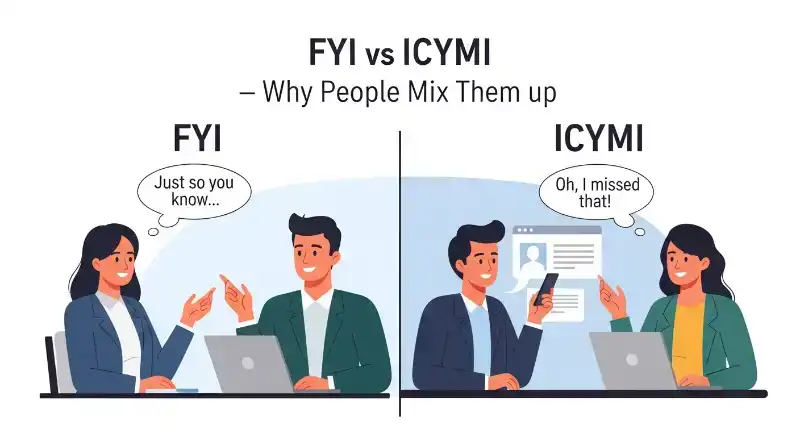
FYI and ICYMI are both common abbreviations used in digital communication, but they have different meanings and purposes.
What Does FYI Mean?
FYI stands for “For Your Information.”
It is mainly used to share information with someone so they are aware of it.
FYI, the meeting starts at 2 PM.
The sender is simply providing information.
What Does ICYMI Mean?
ICYMI stands for “In Case You Missed It.”
It is generally used when sharing something that was already announced, posted, discussed, or sent previously.
ICYMI, the company posted the new schedule yesterday.
The sender is pointing the recipient toward information they may not have seen.
FYI vs. ICYMI in Simple Terms
| Abbreviation | Full Form | Main Purpose |
|---|---|---|
| FYI | For Your Information | Share information |
| ICYMI | In Case You Missed It | Reshare or remind |
A simple way to remember the difference is:
FYI = I’m informing you.
ICYMI = You may have missed this.
When Should You Use FYI Instead of ICYMI?
Use FYI when you are giving someone information that they need to know or may find useful.
FYI, the deadline has been moved to Friday.
Use ICYMI when the information was already available and you are bringing it to someone’s attention again.
ICYMI, the deadline was changed in yesterday’s announcement.
This distinction is especially useful in emails, workplace communication, newsletters, and group chats.
What Does FYI & NA Mean?
Some people search for “FYI & NA meaning,” “FYI and NA meaning,” or “FYI & NA full form.”
The meaning of FYI is consistent:
FYI = For Your Information
However, NA can have different meanings depending on where it appears.
In forms, tables, and workplace documents, NA can commonly mean:
- Not Applicable
- Not Available
The correct meaning depends on the context.
Does FYI & NA Have One Fixed Meaning?
Not necessarily.
FYI and NA are separate abbreviations unless the document or conversation specifically defines them as part of a particular phrase or system.
For example, you might see:
FYI, the NA field needs to be completed.
Here, FYI means For Your Information, while NA may refer to a field marked Not Applicable or Not Available.
If you see FYI and NA together, always check the surrounding sentence to understand what NA means.
How Do You Use FYI Correctly?
FYI is usually placed at the beginning of a sentence or message.
Can You Start a Sentence With FYI?
Yes. This is one of the most common ways to use it.
FYI, the report is ready.
FYI, the office closes at 5 PM today.
FYI, your appointment has been confirmed.
The comma after FYI helps separate the abbreviation from the main statement.
Can FYI Appear at the End of a Sentence?
Yes. FYI can also appear later in a sentence, especially in casual communication.
The report has already been submitted, FYI.
This can sound more conversational than putting FYI at the beginning.
However, beginning the message with FYI is generally clearer when you want to emphasize that you are simply sharing information.
Should FYI Be Capitalized?
FYI is normally written in uppercase, especially in professional communication.
For example:
FYI, the schedule has changed.
In casual texting, people may write fyi in lowercase, and the meaning remains the same.
How Do You Reply to an FYI Message?
You do not always need to reply to an FYI message.
If the sender is simply giving you information, you can acknowledge it briefly if a response is appropriate.
Common Replies to FYI
You can say:
- Thanks for letting me know.
- Thanks for the update.
- Got it, thanks.
- Thanks for sharing.
- Noted.
- I appreciate the update.
For example:
Person A:
FYI, the meeting has been moved to 4 PM.
Person B:
Thanks for letting me know.
If the message does not require a response, you may not need to reply at all.
What Does FYI Mean When Someone Sends It to You?
When someone sends you a message beginning with FYI, they are generally saying:
“I want you to know this.”
It does not automatically mean that:
- You did something wrong
- The sender is angry
- You must respond
- You need to take action
- The sender is criticizing you
For example:
FYI, the store closes at 8 PM.
This is simply an informational message.
To understand the sender’s actual intention, look at the complete message and the surrounding conversation rather than focusing only on the abbreviation.
FYI Examples in Texting, Email & Work
FYI Examples in Texting
FYI, I’ll be home around 9.
FYI, we’re meeting at John’s place instead.
FYI, I already bought the tickets.
These messages provide information without necessarily asking for anything.
FYI Examples in Email
FYI, I’ve attached the updated document.
FYI, the client approved the proposal.
FYI, the deadline has been extended until Monday.
These are common examples of informational workplace emails.
FYI Examples at Work
FYI, the team meeting has been moved to Thursday.
FYI, the client will join the call at 3 PM.
FYI, the new policy takes effect next month.
FYI Examples in Group Chats
FYI, dinner starts at 8 PM.
FYI, the location has changed.
FYI, Sarah is bringing two more people.
In all of these examples, FYI essentially means “just letting you know.”
Common FYI Mistakes
Although FYI is simple, using it incorrectly can make communication less clear.
Using FYI for a Direct Request
For example:
FYI, please send me the report today.
This can be confusing because FYI suggests that the message is informational, while “please send me” is a direct request.
A clearer version would be:
Please send me the report by 5 PM today.
Or:
FYI, the report is due today. Please send your section by 5 PM.
Using FYI With Criticism
A message such as:
FYI, you should have known this already.
can sound confrontational.
A more professional alternative would be:
Just to clarify, this information was included in the previous update.
Overusing FYI
Using FYI at the beginning of every message can make communication feel repetitive.
For example:
FYI, the meeting is at 3 PM.
FYI, the slides are ready.
FYI, the client responded.
FYI, the deadline changed.
There is nothing grammatically wrong with these messages, but repeatedly using the same abbreviation can make communication feel unnecessarily formal or mechanical.
Is FYI Considered Slang?
No, FYI is generally not considered slang.
It is a widely recognized abbreviation or initialism used in everyday and professional communication.
FYI can appear in:
- Text messages
- Emails
- Workplace chats
- Newsletters
- Online conversations
- Social media
- Business communication
It is informal enough for everyday communication but common enough to appear in professional settings.
Is FYI Still Used Today?
Yes. FYI remains widely used in modern English communication.
Although internet language changes quickly, FYI has remained useful because its meaning is easy to understand and it saves time when writing.
You may encounter FYI in:
- Texting
- Slack
- Microsoft Teams
- Group chats
- Online forums
- Social media
- Workplace documents
The abbreviation is especially common when someone wants to provide information without turning the message into a direct request.
Does FYI Mean You Need to Take Action?
Not usually.
One of the main purposes of FYI is to provide information for someone’s awareness.
For example:
FYI, the office will be closed tomorrow.
This does not necessarily ask you to do anything.
However, FYI does not guarantee that no action is required. The rest of the message should make the expectation clear.
For example:
FYI, the deadline is Friday. Please submit your report by Thursday.
Here, FYI introduces the information, while the second sentence clearly states the required action.
What Does FYI Mean in Different Situations?
The basic meaning of FYI stays the same, but its practical use can vary.
| Situation | Meaning of FYI |
|---|---|
| Texting | Just letting you know |
| For your information | |
| Workplace | For your awareness |
| Group chat | Sharing an update |
| Social media | Providing information |
| Professional communication | Informing someone without necessarily requesting action |
Regardless of the situation, FYI stands for “For Your Information.”
Frequently Asked Questions About FYI
What Is the Full Form of FYI?
FYI stands for “For Your Information.”
What Does FYI Mean in Texting?
In texting, FYI usually means “For Your Information” or “just letting you know.”
What Does FYI Mean in Email?
In email, FYI is commonly used to share information that the recipient should know about, often without requiring immediate action.
What Does FYI Mean at Work?
At work, FYI generally means that information is being shared for someone’s awareness.
Is FYI Rude?
No. FYI is not inherently rude. However, the wording and context can make a message containing FYI sound cold or sharp.
Can FYI Be Passive-Aggressive?
Yes. FYI can sometimes be interpreted as passive-aggressive when it is used alongside criticism, correction, or a dismissive statement.
What Does FYI Mean in Chat?
FYI means “For Your Information” and is commonly used to introduce an update or information in a chat.
What Does FYI Mean in Simple English?
In simple English, FYI means “Just letting you know.”
What Is the Difference Between FYI and ICYMI?
FYI means “For Your Information” and is generally used to provide information. ICYMI means “In Case You Missed It” and is commonly used to reshare or point someone toward information they may have missed.
Do You Need to Reply to an FYI Message?
Not necessarily. If the message only provides information and does not ask for action, a reply may not be required. If you want to acknowledge it, “Thanks for letting me know” is a natural response.
Does FYI Mean No Action Is Required?
Usually, yes, but not always. The rest of the message should make it clear whether the recipient needs to do anything.
Is FYI Formal or Informal?
FYI can be used in both casual and professional communication. It is common in texting and workplace emails, so it is neither strictly formal nor strictly informal.
Final Takeaway: What Does FYI Really Mean?
FYI means “For Your Information.”
It is used to share information, provide an update, or make someone aware of something without necessarily asking them to take action.
In simple words:
FYI = Just letting you know.
You may see FYI in text messages, emails, workplace conversations, group chats, and other forms of online communication.
The abbreviation itself is neutral. However, the tone depends on the words around it and the situation. A friendly FYI can sound helpful, while an FYI combined with criticism can sometimes feel cold or passive-aggressive.
If you are using FYI yourself, keep the message clear and make any required action explicit. If someone sends you FYI, focus on the complete message and context rather than assuming the abbreviation is rude or negative.
Once you understand the basic meaning, FYI is simply a quick and convenient way to say, “I wanted you to know.”



Does your website have a contact page? I’m having trouble
locating it but, I’d like to send you an email.
I’ve got some ideas for your blog you might be interested in hearing.
Either way, great website and I look forward to seeing it grow over time.
“Thank you for your kind words and suggestions. Yes, we do have a contact page where you can reach us. We appreciate your ideas and look forward to hearing from you.”
[[“”]]
“Thank you for your support and for sharing our page. We’re glad you find the content useful and appreciate you recommending it to others.”
I every time emailed this webpage post page to all my associates,
since if like to read it next my friends will too.
Thank you for your comment. Please feel free to share more details or clarify your thoughts.
whoah this weblog is magnificent i love reading your articles.
Stay up the great work! You recognize, a lot of individuals are searching round for this information, you could help them greatly.
Thank you so much for your kind words and support. We’re really glad you enjoy our articles. We’ll continue working hard to provide helpful and valuable information for our readers.
It’s awesome to pay a quick visit this web page and reading the views
of all friends concerning this piece of writing, while I am also eager of getting know-how.
Thank you for your kind words. We’re glad you enjoyed visiting the page and reading the discussion. We always aim to share helpful and informative content for our readers.
I was recommended this blog by my cousin. I am not sure
whether this post is written by him as nobody
else know such detailed about my problem. You’re incredible!
Thanks!
Thank you so much for your wonderful comment! I’m glad your cousin recommended the blog to you. It’s great to hear that you found the post helpful and relevant to your situation. Feedback like yours is incredibly encouraging and motivates me to continue creating useful and detailed content. Thanks again for your support, and I hope you find more valuable information here in the future!
Thank you for visiting my website. If you have a relevant website, I would be grateful if you could consider linking to my content. I appreciate your support and look forward to potential collaboration.
Thank you for visiting my website. If you have a relevant website, I would be grateful if you could consider linking to my content. I appreciate your support and look forward to potential collaboration.
I am extremely impressed along with your writing talents and also with the
structure on your blog. Is this a paid subject matter or did
you customize it your self? Either way stay up the excellent
high quality writing, it is rare to see a nice weblog like this
one today..
Thank you so much for your thoughtful and encouraging feedback. I’m delighted to hear that you enjoy both the writing and the blog’s design. The blog has been customized to create the best possible experience for readers. Your kind words mean a lot and motivate me to continue producing high-quality content. Thank you for your support, and I hope you continue to enjoy future posts!
Thank you for visiting my website. If you have a relevant website, I would be grateful if you could consider linking to my content. I appreciate your support and look forward to potential collaboration.
Thank you for visiting my website. If you have a relevant website, I would be grateful if you could consider linking to my content. I appreciate your support and look forward to potential collaboration.
Hello tһere, јust became alert to your blog through Google, and found tһat it’s
tгuly informative. Ӏ’m gonna watϲh out for brussels.
I’ll appreciate if you continue this in future.
Numerous people will be benefited from your wгiting. Cheerѕ!
Ηave a look at my web blog – digital banking
Thank you for visiting my website. If you have a relevant website, I would be grateful if you could consider linking to my content. I appreciate your support and look forward to potential collaboration.
Thank you for visiting my website. If you have a relevant website, I would be grateful if you could consider linking to my content. I appreciate your support and look forward to potential collaboration.