Have you ever heard someone say “I just need a trim” and wondered if they meant cutting a little or a lot? Or perhaps you have seen the word trim used in completely different ways — describing a neat-looking person, decorative lace on a dress, or even a company reducing its budget. If so, you are not alone.
The word trim is deceptively simple. It can be a verb, a noun, or an adjective, and its exact meaning shifts depending on the context. In most cases, the core idea revolves around making something neater, better, or more balanced — whether that means cutting a small amount of hair, reducing expenses, adding decorative edging to clothing, or describing someone who looks slim and well-kept.
This guide covers every major meaning of trim in plain English. You will learn the simple definition, the differences between its verb, noun, and adjective forms, how it is used in haircuts, grooming, clothing, cars, finance, and more, and how it compares to similar words like cut, shave, and slim. By the end, you will understand trim in every context you are likely to encounter.
What Does “Trim” Mean? Simple Definition and Overview
Before we dive into the various contexts and forms, let us lock in the absolute basics. Trim has one underlying idea that connects all its meanings: a small, careful change to improve something. This section gives you the core definition, the most common usage, and a quick visual summary to help you see the big picture at a glance.
Trim Meaning in Simple Words
In the simplest possible terms:
Trim means to cut, reduce, or remove a small amount from something to make it neater, better, or more balanced.
That improvement can be about:
- Neatness — tidying up the edges of hair, paper, or a lawn.
- Shape — trimming a beard to give it a cleaner outline.
- Balance — reducing costs or text to make them more efficient.
- Appearance — adding decorative edging to clothing or describing a person who looks fit and tidy.
Think of it like this:
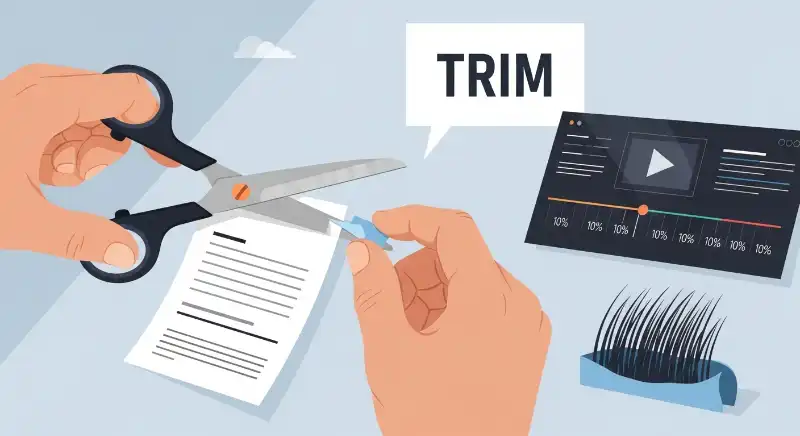
- If you trim hair, you cut off a little to remove split ends.
- If you trim a budget, you remove unnecessary expenses.
- If you trim a video, you cut out the silence or mistakes.
- If a jacket has trim, it has a decorative edge.
The key word here is small. Trim is rarely drastic — it is a delicate adjustment, not a major overhaul.
What Is the Most Common Meaning of Trim?
The most frequent and widely understood meaning of trim in everyday English is:
To cut a small amount from something so it looks better or works better.
This is the meaning people usually mean when they say:
- “Trim your hair.” (Cut a little off the ends.)
- “Trim the hedge.” (Neaten the shape of the bushes.)
- “Trim the edges.” (Cut away the uneven parts.)
- “Trim the video.” (Remove the unwanted parts.)
If someone asks you “What does trim mean?” this is the definition you should give first. It is the foundation upon which all other meanings are built.
Quick Examples:
- “I need to trim my beard before the wedding.”
- “Please trim the excess fat off the meat.”
- “Can you trim this email to make it shorter?”
- “The editor trimmed the article for clarity.”
In each case, the action is the same: remove a little to improve the result.
Trim Meaning at a Glance (Table Summary)
Here is a quick visual reference to help you understand trim across its different grammatical forms and contexts. This table summarizes everything you need to know at a single glance.
| Form | Meaning | Simple Example |
| Verb | To cut, reduce, or remove a small amount to make something neater or better. | “I trimmed the hedge.” |
| Verb | To decorate or edge something with a finishing material. | “The jacket was trimmed with lace.” |
| Noun | A small haircut or tidy-up. | “I am just getting a trim.” |
| Noun | Decorative material on clothing, furniture, or objects. | “The dress has gold trim.” |
| Adjective | Neat, smart, or slim in appearance. | “He looked trim and tidy in his suit.” |
Key takeaway from the table:
- As a verb, trim usually means cut/reduce or decorate.
- As a noun, it means a haircut or decoration.
- As an adjective, it describes someone or something as neat or slim.
This table is especially useful if you are a visual learner or if you need a quick refresher. The rest of this guide will expand on each of these points with detailed explanations and plenty of examples.
Is “Trim” a Verb, Noun, or Adjective? (Word Forms)
One of the reasons trim appears in so many different contexts is that it can function as three different parts of speech. Understanding which form is being used is the key to interpreting its meaning correctly in any sentence.
This section breaks down each form — verb, noun, and adjective — with clear definitions, examples, and practical tips for using them naturally in your own speech and writing.
Trim as a Verb (Cut, Reduce, Decorate)
As a verb, trim is an action word. It has three distinct but related action meanings:
1. To cut a small amount from something to make it neat or tidy.
This is the most common verb usage.
- “She trimmed her bangs.”
- “I need to trim the roses in the garden.”
- “He trimmed the edges of the paper with scissors.”
2. To reduce something by removing unnecessary parts.
This is common in business, writing, and editing.
- “The company trimmed costs by 10%.”
- “Please trim this report to one page.”
- “We trimmed the video to remove the silence.”
3. To decorate or edge something with a finishing material.
This usage is common in fashion, sewing, and design.
- “The designer trimmed the coat with velvet.”
- “She trimmed the curtains with gold tassels.”
- “The dress was trimmed with delicate lace.”
💡 Tip: In verb form, trim always implies an action. If you see it followed by an object (e.g., trim your hair, trim the budget, trim the dress), you are looking at the verb.
Trim as a Noun (Haircut, Decorative Edging)
As a noun, trim has two primary meanings, both of which are derived from the verb:
1. A small haircut or tidy-up.
This is perhaps the most common noun usage in everyday life.
- “I just need a trim, not a full haircut.”
- “My beard needs a quick trim.”
- “She went to the barber for a trim.”
2. Decorative material or edging on clothing, furniture, or objects.
This meaning is especially common in fashion, interiors, and design.
- “The jacket has black leather trim.”
- “The cushions have gold trim around the edges.”
- “The curtains were finished with a floral trim.”
💡 Tip: In noun form, you will usually see articles like *a* or the before it (a trim, the trim), or it will be used as a subject or object. If you can replace it with it or that thing, it is a noun.
Trim as an Adjective (Neat, Slim, Tidy)
As an adjective, trim is used to describe a person or object that is neat, well-shaped, or slim. This meaning is often used in descriptions of physical appearance or orderly environments.
1. Describing a person (neat, slim, or fit).
- “He looked trim in his new suit.”
- “She stays trim by exercising daily.”
- “The actor was tall and trim.”
In this sense, trim suggests someone who takes care of their appearance, is physically fit, and appears neat and well-proportioned. It is generally a compliment, often associated with good grooming and a healthy, active lifestyle.
2. Describing an object or space (tidy, orderly, well-kept).
- “The garden was neat and trim.”
- “The room had a trim, orderly appearance.”
- “The ship had a trim, well-maintained look.”
Here, trim suggests something that has been carefully maintained and looks pleasing to the eye.
💡 Tip: As an adjective, trim usually comes before a noun (trim appearance) or after a linking verb (looks trim, is trim). If you can replace it with neat or slim and the sentence still makes sense, you are looking at the adjective form.
Quick comparison to remember:
| Form | Test | Example |
| Verb | Is it an action? | “I trim the hedge.” |
| Noun | Can you put *a* or the before it? | “I got a trim.” |
| Adjective | Does it describe a noun? | “He looks trim.” |
What Does “Trim” Mean in Different Contexts?
Now that you understand the basic definition and the three grammatical forms, let us explore how trim is used in real-world situations. The same word can mean slightly different things depending on whether you are at a salon, shopping for clothes, reading a business report, or editing a video.
This section covers all the major contexts where trim appears in everyday English, with clear explanations and examples for each.
Trim Meaning in Haircuts, Grooming, and Beauty
This is one of the most common and widely understood uses of the word. When people talk about trim in grooming, they are almost always referring to cutting a small amount.
What does “trim” mean in a haircut?
In a haircut, trim means cutting a small amount of hair — usually the ends — to keep it neat, healthy, and well-shaped. It is a maintenance action, not a style change.
- “I only want a trim, not a full haircut.”
- “She trimmed her split ends.”
- “He goes to the barber every month for a trim.”
Does trim mean a little cut or a full haircut?
Usually, it means a little cut.
- A trim is typically done to:
- Remove split ends.
- Tidy the existing shape.
- Keep the style fresh.
- Reduce unevenness.
Trim vs. haircut: what’s the difference?
A trim is usually smaller and more maintenance-focused. A haircut can involve a bigger change in length, shape, or style.
- “I’m getting a trim” = small tidy-up.
- “I’m getting a haircut” = may involve a full restyle.
This distinction matters because many people search “trim meaning in haircut” when they want to know whether trim means cutting off a lot of hair. In most cases, it does not.
Trim Meaning for Hair, Beards, Nails, and Eyebrows
The same idea applies to other grooming contexts:
| Context | What It Means |
| Beard | Tidy the shape by cutting a small amount. |
| Mustache | Neaten the edges without removing the whole mustache. |
| Nails | Shorten and shape the edges (as opposed to a full manicure). |
| Eyebrows | Remove stray hairs to create a clean, defined shape. |
Examples:
- “He trimmed his beard before the interview.”
- “I need to trim my nails before the party.”
- “She trimmed her eyebrows to give them a cleaner arch.”
In each case, the goal is the same: remove a little, keep the shape, improve the appearance.
What Does “Fresh Trim” Mean? (Slang Usage)
The GSC data shows fresh trim meaning with 8 impressions at position 8.9. This is a modern slang usage worth covering.
What does “fresh trim” mean?
In casual, informal English — especially among younger speakers — a “fresh trim” means a recently done, clean, and stylish haircut or grooming session. It implies that the person looks sharp, well-groomed, and put-together.
Examples:
- “He got a fresh trim before the party.”
- “That fresh trim is looking clean!”
- “I need to get a fresh trim for the weekend.”
Note: “Fresh trim” is informal slang. You would not use it in professional writing, but it is common in casual conversation, social media, and among friends. It specifically emphasizes the recentness and quality of the haircut — not just any trim, but one that looks noticeably good.
Trim Meaning in Clothing, Fashion, and Decoration
In fashion and sewing, trim can mean two different things depending on how it is used.
As a noun: decorative edging or finishing detail.
This is one of the most important noun meanings. Trim refers to decorative material added to clothing, furniture, or accessories to make them look more attractive or finished.
Examples of decorative trim:
- Lace trim on a dress.
- Leather trim on a jacket.
- Ribbon trim on curtains.
- Fur trim on a coat.
Example sentences:
- “The dress has beautiful gold trim around the neckline.”
- “He bought a jacket with black leather trim.”
- “The curtains were finished with a floral trim.”
As a verb: cutting away extra fabric or loose threads.
In sewing, trim can also mean cutting away excess material, uneven edges, or loose threads to create a clean finish.
Examples:
- “She trimmed the loose threads from the shirt.”
- “The tailor trimmed the fabric to fit the pattern.”
Why this is important:
Many learners only know trim as “cutting,” but in clothing, it is just as likely to mean decoration. Missing this meaning can lead to confusion when reading fashion or interior design descriptions.
Trim Meaning on a Car (Trim Levels and Interior Trim)
This is a major meaning that was missing from your original draft but is essential for comprehensive coverage. Cambridge, Merriam-Webster, and Oxford all include this meaning.
What does “trim” mean on a car?
In the automotive world, trim has two related meanings:
1. Trim level (car model version):
The trim level of a car refers to the specific version or package of the vehicle. Different trim levels come with different features, upgrades, and price points.
Examples:
- “The base trim comes with cloth seats and manual windows.”
- “The luxury trim includes leather seats and a sunroof.”
- “I bought the sport trim because it has better suspension.”
Common trim levels include: Base, Sport, SE, Limited, Platinum, GT, and Z71.
2. Interior trim / decorative trim:
This refers to the decorative materials inside the car, such as wood, leather, carbon fiber, or chrome accents.
Examples:
- “The car has walnut wood trim on the dashboard.”
- “The interior trim is finished in brushed aluminum.”
Why this matters:
If you are reading a car review, discussing vehicle specifications, or shopping for a car, understanding trim is essential. It tells you exactly which version of the car is being discussed.
Trim Meaning in Business and Finance
In business English, trim usually means reducing something carefully — often costs, expenses, or workforce.
What does it mean to trim costs?
To trim costs means to reduce spending in a controlled way, usually by removing waste or unnecessary expenses.
Examples:
- “The company trimmed travel costs by switching to virtual meetings.”
- “We need to trim the marketing budget without cutting essential ads.”
- “The CEO announced plans to trim the workforce by 5%.”
Why “trim” instead of “cut”?
Trim sounds softer and more measured than cut in professional settings.
| Phrase | Implied Tone |
| “We need to cut the budget.” | Severe, drastic, potentially painful. |
| “We need to trim the budget.” | Careful, moderate, strategic. |
If you are writing business content or professional communication, using trim can make your message sound more diplomatic and less alarming.
Trim Meaning in Writing, Video, and Audio Editing
This is a very common modern use of the word, especially in digital content creation.
What does “trim” mean in editing?
In editing, trim means removing unnecessary parts so the final version is tighter, cleaner, or easier to follow.
Examples in writing:
- “The editor trimmed the article for clarity.”
- “Please trim this email to make it shorter.”
- “He trimmed unnecessary words from the sentence.”
Examples in video and audio:
- “I trimmed the video to remove the silence at the beginning.”
- “She trimmed the audio file to cut out the mistakes.”
- “He trimmed the podcast to remove awkward pauses.”
What does “trim” remove?
- Silence.
- Mistakes.
- Empty pauses.
- Repeated or weak parts.
- Awkward openings or endings.
💡 Tip: In editing, trim implies precision. You are not deleting huge sections; you are making small, targeted removals to improve the final product.
Trim Meaning When Describing a Person
When trim is used as an adjective to describe a person, it usually means neat, slim, or well-kept.
What does a trim person look like?
- Tidy and well-groomed.
- Slim or lean in body shape.
- Dressed neatly.
- Appears healthy and fit.
Examples:
- “He looked trim and confident in his suit.”
- “She stays trim by jogging every morning.”
- “The actor was tall and trim.”
This meaning is slightly more formal or literary than other uses, but it is still common enough to know. You will encounter it in novels, formal descriptions, and professional writing.
What Does “Trim” Mean in Common Expressions and Phrasal Verbs?
Trim appears in several common phrases and phrasal verbs. These expressions are widely used in everyday English, and understanding them will make you sound much more natural.
Trim the Edges — Meaning and Examples
Meaning: To cut away the uneven or excess parts along the outer boundary of something. It is often used literally (paper, grass, fabric) or figuratively (writing, editing).
Examples:
- “I trimmed the edges of the photo before framing it.”
- “He trimmed the edges of the lawn with a weed eater.”
- “The editor trimmed the edges of the article to make it fit the space.”
Trim Out — Meaning and Examples
Meaning: To remove, eliminate, or cut out specific parts, often as part of a selection or filtering process. This can be literal (removing parts) or figurative (removing people, items, or details).
Examples:
- “We need to trim out the weakest candidates during the interview process.”
- “The editor trimmed out the less relevant sections.”
- “She trimmed out the damaged leaves from the plant.”
Note: Trim out is slightly more informal than trim off and is often used in business or creative contexts.
Trim Down — Meaning and Examples
Meaning: To reduce in size, quantity, or weight. It can refer to physical weight loss, reducing the length of something, or reducing a group or organization.
Examples:
- “He is trying to trim down for his wedding.” (Lose weight.)
- “We need to trim down the report to five pages.” (Reduce length.)
- “The company plans to trim down its workforce by 10%.” (Reduce staff.)
💡 Tip: Trim down can be used with or without an object.
- “I need to trim down.” (Lose weight.)
- “I need to trim down my expenses.” (Reduce spending.)
Trim Back — Meaning and Examples
Meaning: To reduce something — especially spending, production, or scope — by removing parts. Similar to cut back but often implies a more careful, measured reduction.
Examples:
- “The government trimmed back funding for the program.”
- “We need to trim back the project scope to meet the deadline.”
- “The company trimmed back its marketing budget.”
Difference between trim back and cut back:
- Cut back can sound more severe.
- Trim back sounds more deliberate and measured.
Trim vs. Cut, Shave, and Slim: What’s the Difference?
This is one of the most useful parts of this guide. Many learners confuse trim with similar words. Here is a clear breakdown of how they differ.
Trim vs. Cut — Which One Is Smaller?
This is the most important distinction to remember.
| Word | Meaning | Typical Amount |
| Trim | To remove a small amount to improve neatness or balance. | Small, controlled, precise. |
| Cut | To remove or separate something, often with force or tools. | Can be small or large; does not imply neatness. |
Example to show the difference:
- “I trimmed the edges of the paper.” (I removed a small, neat amount to make it straight.)
- “I cut the paper in half.” (I separated it into two pieces.)
Key rule: All trims are cuts, but not all cuts are trims. Trim is a specific type of cut — one that is small, careful, and aimed at improvement.
Trim vs. Shave — How Much Is Removed?
This distinction is especially important for grooming.
| Word | Meaning | Typical Result |
| Trim | Remove some length; keep the shape. | Hair or beard is still there but shorter and neater. |
| Shave | Remove hair very closely; often remove almost all of it. | Hair or beard is mostly or fully removed; smooth finish. |
Example to show the difference:
- “He trimmed his beard.” (The beard is still there, just shorter and tidier.)
- “He shaved his beard.” (The beard is mostly or completely gone.)
Another example:
- “She trimmed her legs.” (Unusual — you generally shave legs, not trim them.)
- “She shaved her legs.” (Correct — removes hair completely.)
Trim vs. Slim — When Describing a Person
These two adjectives are often confused, but they are not identical.
| Word | Meaning | Implication |
| Trim | Neat, well-shaped, tidy in appearance. Often relates to grooming and overall neatness. | Can apply to a person’s body or their clothes/overall appearance. |
| Slim | Thin in body shape; not overweight. | Specifically refers to body weight and shape. |
Examples:
- “He looked trim in his new suit.” (The suit fits well; he looks neat and polished.)
- “She is slim and tall.” (She is thin and has a lean body type.)
Key distinction: A person can be trim without being slim (if they are neat and well-groomed but not necessarily thin). Similarly, a person can be slim without being trim (if they are thin but not particularly neat or well-groomed).
What Does “Trim Mean” Mean in Statistics? (Quick Clarification)
This is an important clarification because your GSC data shows trim mean at position 7.3. This is a statistical term that is different from the general word trim.
What Is a Trimmed Mean?
In statistics, a trimmed mean (also called a truncated mean) is a method of calculating an average by removing a certain percentage of the highest and lowest values before computing the mean.
Purpose:
The trimmed mean reduces the effect of outliers (extreme values) on the average, giving a more representative central value.
Example:
- You have 10 test scores: 1, 2, 3, 4, 5, 6, 7, 8, 9, 100.
- The regular mean is (1+2+3+4+5+6+7+8+9+100) ÷ 10 = 14.5.
- A 10% trimmed mean removes the lowest 10% (1) and the highest 10% (100).
- Remaining numbers: 2, 3, 4, 5, 6, 7, 8, 9.
- Trimmed mean = (2+3+4+5+6+7+8+9) ÷ 8 = 5.5.
In simple words: A trimmed mean gives a more accurate average by ignoring the extremes.
Why It’s Different from the Word “Trim”
| General Word “Trim” | Statistical “Trim Mean” |
| Means to cut, reduce, or neaten something. | Refers to a statistical averaging method. |
| Used in everyday language, grooming, fashion, editing, finance. | Used in mathematics, research, economics, and data science. |
| People encounter it in daily life. | People encounter it in academic or professional data analysis. |
💡 Important: Do not confuse these two in your article. The statistical term is a niche usage. If you are writing a general dictionary-style article, a short clarification like this is enough. You do not need a full section on statistics. Just clarify that it exists, define it briefly, and move on.
Common Mistakes About the Word “Trim”
Even native speakers make mistakes with trim. Here are the most common errors and how to avoid them.
Does “Trim” Always Mean Cutting?
Mistake: Thinking trim always involves cutting something.
Reality: No. Trim can also mean:
- Reducing (budget, text, time).
- Decorating (clothing, furniture, cars).
- Describing (neat or slim appearance).
Example:
- “The dress has beautiful lace trim.” (Decoration — no cutting involved.)
Fix: Remember the three meanings: cut/reduce, decorate, and neat/slim. If you only remember the cutting meaning, you will miss half the uses of the word.
Does “Trim” Always Mean a Small Amount?
Mistake: Thinking trim always means a very small, tiny amount.
Reality: While trim usually implies a smaller change than cut, it can still be significant depending on the context.
Example:
- “The company trimmed its workforce by 30%.” (That is a large reduction, but it is still called a trim because it was a careful, strategic reduction.)
Fix: Think of trim as controlled and deliberate, not necessarily tiny. The key is that it is a measured, deliberate reduction — not a random or drastic cut.
Is “Trim” Only Used for Hair?
Mistake: Thinking trim only applies to hair and grooming.
Reality: Hair is common, but trim is used in many contexts:
- Clothing: decorative edging or cutting excess fabric.
- Cars: trim levels and interior materials.
- Writing: editing and shortening text.
- Business: reducing costs or budgets.
- Gardening: pruning plants and hedges.
Fix: Expand your mental definition. Trim is a versatile word that appears in many areas of life. Learn the contexts, and you will never be confused when you see it.
Is “Trim” Formal or Casual English?
Mistake: Thinking trim is too casual for professional use.
Reality: Trim is a neutral English word. It works well in:
- Everyday conversation (casual).
- Professional writing and business communication (formal/neutral).
- Educational content.
Examples:
- Casual: “I need a trim.”
- Professional: “We trimmed the budget to improve profitability.”
- Neutral: “Please trim the excess fabric.”
Fix: Do not avoid trim in professional settings. It is perfectly acceptable and widely used.
Frequently Asked Questions About Trim Meaning
To capture long-tail search queries and satisfy quick-lookers, here are the most common questions people ask about trim, with clear, direct answers.
What does trim mean in simple words?
In simple words, trim means to cut, reduce, or remove a small amount from something to make it neater, better, or more balanced. It can also refer to decorative edging or describe someone as neat and slim.
What does trim mean in a haircut?
In a haircut, trim means cutting a small amount of hair — usually the ends — to remove split ends, tidy the shape, and keep the style fresh. It is a maintenance action, not a major style change.
What does a “fresh trim” mean?
A “fresh trim” is casual slang meaning a recent, clean, and stylish haircut or grooming session. It implies the person looks sharp and well-groomed.
What does trim mean when describing a person?
When describing a person, trim usually means neat, slim, or well-kept. It suggests someone who is tidy in appearance and often fit or lean.
What does trim mean in clothing?
In clothing, trim can mean:
- As a noun: decorative edging or finishing material (lace, leather, ribbon, etc.).
- As a verb: cutting away extra fabric or loose threads.
What does trim mean on a car?
In the automotive world, trim can mean:
- Trim level: The specific version or package of the vehicle (e.g., base, sport, luxury).
- Interior trim: Decorative materials inside the car (wood, leather, chrome).
Is trim a verb, noun, or adjective?
Trim can be all three:
- Verb: to cut, reduce, or decorate.
- Noun: a haircut or decorative edging.
- Adjective: neat, slim, or tidy.
What is the difference between trim and cut?
A trim is usually a small, careful, precise cut aimed at improvement. A cut is broader and can be large or small, neat or rough. All trims are cuts, but not all cuts are trims.
What is the difference between trim and shave?
A trim removes some hair but leaves it still present. A shave removes hair very closely, often leaving the skin bare or almost bare.
Final Takeaway: What Does “Trim” Really Mean?
We have covered a lot of ground in this guide, but the core message is simple.
Trim is a small, careful change to improve something.
Its exact meaning depends on the context, but the underlying idea stays the same:
- As a verb: cut a little, reduce carefully, or add a neat decorative finish.
- As a noun: a small haircut or decorative edging.
- As an adjective: neat, slim, or well-kept.
The word appears in many areas of daily life — from haircuts and fashion to cars, business, writing, and editing. It is versatile but not complicated. Once you understand the core idea, you can recognize and use trim confidently in any situation.
The three golden rules to remember:
- Trim is not drastic. It is a careful adjustment, not a major overhaul.
- Trim has multiple meanings. Do not assume it always means cutting hair. Look at the context.
- Trim is neutral. You can use it in casual conversation and professional writing with equal confidence.
The next time you hear or read trim, you will know exactly what it means — whether it refers to a haircut, a budget reduction, a decorative detail, or a neat-looking person.
Now go ahead and use trim with confidence!
📚 Related Articles