Have you ever looked at the green music app on your phone and wondered, “Why is it called Spotify?”
You are not alone. Millions of people use Spotify every day, but very few know the actual story behind its unusual name. Most people assume “Spotify” is just a random tech brand name, like Google or Yahoo. However, the word was carefully crafted to represent the core idea of music discovery.
In this guide, we will uncover the real Spotify meaning, explore the fascinating origin of its name, and explain exactly what this global platform is and how it works.
What Does “Spotify” Mean? (Name Origin)
Before we dive into how the app works, let’s answer the most fundamental question: What does the word Spotify actually mean?
Is Spotify a Real Word or a Brand Name?
Strictly speaking, “Spotify” is not a traditional English word. You won’t find it in older dictionaries as a noun or verb. It is a coined brand name, invented specifically for this music streaming service.
However, like many successful tech brands (e.g., “Google” becoming a verb), it has become a household name recognized worldwide. The company created the word to be unique, memorable, and meaningful in the context of music.
The Popular “Spot” + “Identify” Explanation
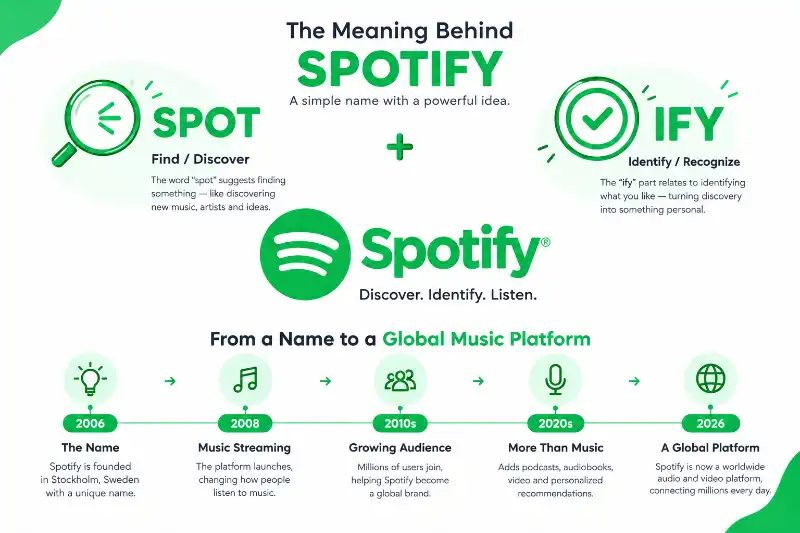
The most widely circulated explanation for the Spotify meaning is that the name is a combination of two words:
- “Spot” – meaning to discover, locate, or pick out.
- “Identify” – meaning to recognize or know something.
Put them together, and you get “Spot + Identify” → Spotify.
The founders intentionally blended these concepts to represent the app’s core mission: helping users spot and identify new music they love. It makes perfect sense—Spotify is all about discovering songs you haven’t heard before and identifying artists that match your taste.
Why the Origin Story Is More Complicated
While the “Spot + Identify” explanation is beautiful and logical, the real story behind the name is a bit more human—and slightly messy.
In early interviews, co-founder Daniel Ek explained that the name didn’t come from a perfect, calculated formula. It actually came from a brainstorming session where the team was throwing random ideas around. Someone misheard another suggestion, and the word “Spotify” emerged from that confusion.
Later, the company leaned into the “Spot + Identify” meaning because it perfectly fit their branding of music discovery. So, while the popular explanation is not false, the origin involves a lucky accident followed by brilliant marketing.
Where Did the Name Spotify Come From?
Now that we know the breakdown of the word, let’s look at the actual historical story behind how it was chosen.
The Story Behind How Spotify Got Its Name
The founding story begins in 2006 in Stockholm, Sweden, with two ambitious entrepreneurs: Daniel Ek and Martin Lorentzon. They had a vision to create a legal music streaming service that would be faster and easier than piracy.
During a late-night brainstorming session, they were discussing potential names. Ek later recalled that they were shouting out ideas, and Lorentzon suggested a name that Ek misheard. From that misheard sound, the word “Spotify” popped out.
Ek realized the name had a certain ring to it. It sounded energetic, modern, and digital. It was short enough to be memorable and unique enough to stand out in a crowded market.
How a Misheard Suggestion Became a Global Brand
The founders didn’t just pick the name blindly. They checked if the domain was available, ensured it didn’t mean anything offensive in other languages, and tested it with friends. The feedback was overwhelmingly positive.
From that point, “Spotify” was no longer just a random sound; it became the identity of a revolutionary platform. While the “Spot + Identify” story makes a great tagline for the company’s mission, the accidental origin makes the brand feel surprisingly human.
Why Was the Name Spotify Chosen for a Music App?
The name “Spotify” wasn’t chosen randomly—it was specifically aligned with the future of music consumption.
Connecting the Name to Music Discovery
Think about how we used to discover music. Before Spotify, you had to rely on the radio, MTV, or recommendations from friends. You might hear a great song on the radio but struggle to catch the artist’s name.
Spotify solved this problem. The app allowed users to search for any song, instantly play it, and explore related artists. The name implies: “Spot it. Identify it. Play it.” It encourages exploration and curiosity.
Why “Spot” and “Identify” Fits the Streaming Concept
In the early days, the biggest challenge for music fans was not having access to music, but finding it. Spotify’s algorithm, playlists, and search bar are all designed to help users spot new tracks and identify new artists.
Even the famous green logo and the “Discover Weekly” playlist are extensions of this concept—spotting what you love before you even know it exists.
What Is Spotify Today?
While the name origin is a fascinating story, the platform itself has grown far beyond a simple idea. Here is what Spotify represents in 2026.
Spotify as a Digital Music, Podcast, and Video Service
According to Spotify’s official description, it is a digital music, podcast, and video service. This means it is no longer just about songs.
Today, you can use Spotify to:
- Stream millions of songs.
- Listen to thousands of podcasts on every topic imaginable.
- Access audiobooks (in select markets).
- Watch video podcasts and short-form video clips.
Spotify has transformed from a simple music player into the world’s largest audio ecosystem.
How Streaming Differs From Buying or Downloading Music
Before Spotify, people had to buy physical CDs or download MP3 files. Your music collection was limited by your hard drive space and your budget.
Spotify changed this forever. Instead of owning a song, you rent access to it. You pay a subscription (or listen with ads) to stream the song from Spotify’s cloud servers. This means you can listen to almost any song ever recorded without worrying about storage space. The shift was from ownership to access.
How Does Spotify Work?
Understanding the name and the concept is one thing, but how does the magic actually happen on your phone or laptop?
Searching, Streaming, and Playing Audio
At its core, Spotify works like a giant digital library. When you open the app, you search for an artist, song, album, or podcast. When you press play, Spotify’s servers send the audio data to your device in real-time over the internet.
This process is called streaming. The audio plays directly from the internet, which is why you need a stable Wi-Fi or mobile data connection (unless you download songs for offline listening, which is a Premium feature).
Recommendations Based on Your Listening Habits
Spotify isn’t just a passive jukebox—it’s a smart one. It actively listens to what you play, save, and skip.
The algorithm tracks specific signals:
- Songs you play on repeat.
- Tracks you skip within the first few seconds.
- Playlists you save and share.
- Artists you follow.
Over time, Spotify builds a detailed profile of your taste. It then uses this data to curate personalized playlists like Discover Weekly and Release Radar. It suggests new music that matches your unique vibe, making the app feel like it truly understands you.
Is Spotify Free or Paid?
One of the first questions new users ask is simple: Is Spotify free? The answer is yes, but with important limits.
What You Get With the Free Version
Anyone can create a Spotify account and start listening without paying a single penny. The free version includes:
- Access to millions of songs, podcasts, and playlists.
- Personalized recommendations and Discover Weekly.
- The ability to create and share playlists.
- Listening on mobile, desktop, web player, and other devices.
However, the free version comes with trade-offs:
- Ads: Audio and visual advertisements play between songs.
- Limited Skips: You can only skip a limited number of tracks per hour.
- Shuffle Mode: On mobile, you cannot always play specific songs on-demand; you often have to shuffle playlists.
Despite these limits, the free version is a great way to experience Spotify’s core features without commitment.
What Spotify Premium Unlocks (Offline, Ad-Free, High Quality)
For users who want a smoother, more powerful experience, Spotify Premium removes nearly all restrictions. Premium features include:
- Ad-Free Listening: No interruptions between songs.
- Offline Downloads: Download songs, albums, and podcasts to your device and listen without an internet connection.
- On-Demand Playback: Play any song, anytime, in any order.
- Higher Audio Quality: Enjoy better sound quality (up to 320kbps, and lossless in select markets).
- Cross-Device Syncing: Seamlessly switch playback between devices without losing your place.
Why Features and Plans Can Vary by Region
Spotify offers several plan types depending on the country:
- Individual Plan: For one person.
- Student Plan: Discounted pricing for verified students.
- Duo Plan: For two people living together (in some regions).
- Family Plan: For up to 6 family members with shared playlists and Parental Controls.
Pricing, features, and even the availability of audiobooks and lossless audio depend on your location. The best way to check is to visit Spotify’s official pricing page in your account settings.
Why Is Spotify So Popular?
Spotify didn’t become the world’s leading audio platform by accident. Several key features helped it dominate the streaming industry.
Personalized Music Discovery
Spotify’s biggest advantage is its ability to help users find new music they actually enjoy. Features like Discover Weekly (a fresh playlist every Monday) and Release Radar (new releases from artists you follow) are powered by Spotify’s recommendation engine.
The algorithm studies your listening habits and predicts what you might like next, making the app feel smarter the more you use it.
Playlists and Music Sharing
Music has always been social. Spotify made it easier to share songs, albums, and playlists with friends. Users can create collaborative playlists where multiple people can add tracks.
Features like Blend (creating a shared playlist with a friend based on both your tastes) and Jam (real-time group listening) have turned Spotify into a social music ecosystem. Sharing a playlist is now as common as sharing a photo.
Listening Across Multiple Devices
Spotify is available on smartphones, tablets, laptops, smart TVs, gaming consoles, smart speakers, car dashboards, and smartwatches.
The Spotify Connect feature allows you to start listening on one device and seamlessly continue on another. For example, you can start a podcast on your phone during your commute and finish it on your laptop at home without missing a beat. This flexibility is a major reason users stay loyal to the platform.
Frequently Asked Questions (FAQs) About Spotify Meaning
What does the word Spotify mean?
Spotify is a coined brand name. It is most commonly explained as a combination of “spot” (to discover) and “identify” (to recognize), representing the app’s mission to help users discover and identify new music.
Where did the name Spotify come from?
The name was created during a brainstorming session by co-founders Daniel Ek and Martin Lorentzon in 2006. It reportedly emerged from a misheard suggestion during a late-night naming discussion. While the “Spot + Identify” story is the popular explanation, the original origin was more accidental.
Does Spotify mean “spot and identify”?
Yes, that is the most popular and widely accepted explanation. The founders adopted this interpretation because it perfectly aligns with the platform’s core purpose of music discovery.
Why is it called Spotify?
It was chosen because it was short, unique, memorable, and did not have any negative meanings in major languages. It sounded modern and digital, fitting for a revolutionary music platform.
Is Spotify a real word?
No, it is a coined brand name, not a traditional English dictionary word. However, it is now recognized globally as a household name synonymous with music streaming.
Is Spotify free to use?
Yes, Spotify offers a free version with ads, limited skips, and shuffle-only listening on mobile. A Premium subscription unlocks ad-free listening, offline downloads, and full on-demand playback.
Final Takeaway: Why the Name “Spotify” Matters
The Spotify meaning goes far beyond a simple dictionary definition or a random tech name.
It represents a shift in how humanity experiences audio: from owning physical collections to accessing endless music instantly. The name itself—born from a brainstorming accident but polished with the beautiful meaning of “spot and identify”—perfectly captures the thrill of discovering your next favorite song.
What started as a small idea in Sweden has become the soundtrack for millions of people’s lives. Whether you use the free version or subscribe to Premium, Spotify is not just an app. It is a gateway to new artists, new stories, and new moods.
So, next time you press play, remember the story behind the name. You are not just listening to music—you are spotting and identifying the sounds that make life better.
📚 Related Articles……. Temu Meaning (2026 Update): Is Temu Legit, What It Really



yes sar