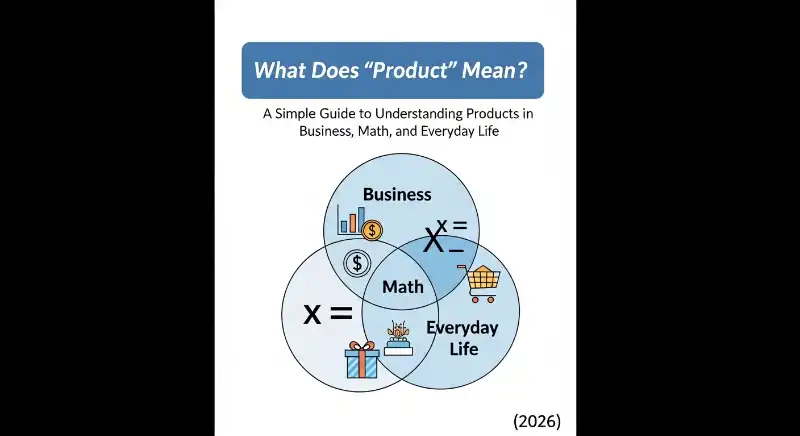
What is a product in math? A product is the answer you get when you multiply two or more numbers. For example, in 6 × 4 = 24, the numbers 6 and 4 are the factors, multiplication is the operation, and 24 is the product.
The word product can sound more complicated than it really is. Once you connect it to multiplication, the idea becomes simple: multiply the factors, and the result is the product.
In this guide, you’ll learn what product means in math, how multiplication creates a product, how factors and products are related, and how to recognize products in different types of math problems.
What Is a Product in Math?
Simple Definition of Product
In mathematics, a product is the result of multiplication.
For example:
5 × 3 = 15
Here:
- 5 is a factor.
- 3 is a factor.
- × is the multiplication sign.
- 15 is the product.
So, if someone asks, “What is the product of 5 and 3?”, the answer is 15.
A quick way to remember it is:
Factors × multiplication = product
More precisely, the factors are the numbers being multiplied, while the product is the result of that multiplication.
What Does “Product” Mean in Mathematics?
The mathematical meaning of product is the result produced by multiplying quantities.
For example:
- 2 × 7 = 14
- 8 × 5 = 40
- 9 × 6 = 54
- 10 × 12 = 120
In each equation, the number on the right is the product.
This is different from words such as sum, difference, and quotient, which describe the results of other arithmetic operations.
What Is the Product of Two Numbers?
To find the product of two numbers, simply multiply them.
For example:
7 × 8 = 56
Therefore, the product of 7 and 8 is 56.
Another example:
12 × 4 = 48
So, the product of 12 and 4 is 48.
The numbers you multiply are called factors, and their result is called the product.
How Does Multiplication Produce a Product?
Multiplication and Equal Groups
One of the easiest ways to understand multiplication is to imagine equal groups.
Suppose you have 4 bags, and each bag contains 3 apples.
Instead of counting every apple one by one, you can write:
4 × 3 = 12
There are 4 equal groups of 3 apples, giving you a total of 12 apples.
Therefore, 12 is the product.
This is why multiplication is especially useful when the same quantity appears repeatedly.
Multiplication as Repeated Addition
For whole numbers, multiplication can often be understood as repeated addition.
For example:
4 × 3 = 3 + 3 + 3 + 3 = 12
This means there are four groups of three.
However, repeated addition is only a beginner-friendly way to visualize multiplication. Multiplication is a broader mathematical operation that also works with fractions, decimals, negative numbers, and algebraic expressions.
For example:
0.5 × 8 = 4
There is no need to think of 0.5 as being added eight times to understand the calculation. Multiplication can also describe scaling a quantity.
What Are Factors and a Product?
Factors are the numbers that are multiplied together.
Consider:
6 × 7 = 42
The relationship is:
- 6 = factor
- 7 = factor
- 42 = product
You can think of the factors as the ingredients of a multiplication problem and the product as the final result.
This relationship becomes even more useful when you start working with larger numbers, fractions, decimals, and algebra.
Product vs. Other Math Terms
Product vs. Sum
A product comes from multiplication, while a sum comes from addition.
Compare these examples:
4 + 5 = 9
Here, 9 is the sum.
4 × 5 = 20
Here, 20 is the product.
The operation changes, so the name of the result changes too.
Product vs. Difference
A difference is the result of subtraction.
For example:
10 − 4 = 6
The number 6 is the difference.
But:
10 × 4 = 40
The number 40 is the product.
Product vs. Quotient
A quotient is the result of division.
For example:
20 ÷ 5 = 4
Here, 4 is the quotient.
Compare that with:
20 × 5 = 100
Here, 100 is the product.
Quick Comparison
| Operation | Example | Result |
|---|---|---|
| Addition | 4 + 5 = 9 | Sum |
| Subtraction | 10 − 4 = 6 | Difference |
| Multiplication | 4 × 5 = 20 | Product |
| Division | 20 ÷ 5 = 4 | Quotient |
Knowing these four terms makes word problems much easier because the wording often tells you which operation to use.
Product in Multiplication Examples
Whole Number Examples
Whole numbers provide the simplest examples of products.
3 × 4 = 12
The factors are 3 and 4, and the product is 12.
Another example:
9 × 7 = 63
So, 63 is the product of 9 and 7.
Product of Zero
Multiplying any number by zero gives a product of zero.
For example:
15 × 0 = 0
0 × 250 = 0
This is known as the zero property of multiplication.
No matter how large the other factor is, multiplying it by zero produces zero.
Product of One
Multiplying a number by 1 leaves that number unchanged.
For example:
8 × 1 = 8
1 × 35 = 35
This is called the identity property of multiplication.
The product is the same as the original number.
Product of Negative Numbers
Products can also be negative.
For example:
−4 × 3 = −12
When a negative number is multiplied by a positive number, the product is negative.
But when two negative numbers are multiplied, the product is positive:
−4 × −3 = 12
Understanding the signs becomes important as multiplication moves beyond basic whole numbers.
Product of Fractions
The word product is also used when multiplying fractions.
For example:
1/2 × 4 = 2
So, 2 is the product.
With two fractions:
1/2 × 3/4 = 3/8
Therefore, 3/8 is the product.
The word product does not change simply because the numbers are fractions.
Product of Decimals
Decimals also have products.
For example:
2.5 × 4 = 10
Therefore, 10 is the product.
Another example:
1.2 × 3 = 3.6
Here, 3.6 is the product.
The same basic idea applies: multiply the factors to find the product.
How to Find the Product
Multiply the Factors
The simplest way to find a product is to multiply the factors together.
For example:
7 × 6 = 42
The two factors are 7 and 6, and their product is 42.
For larger numbers, the same idea applies:
24 × 5 = 120
So, the product of 24 and 5 is 120.
Finding a Product Step by Step
Suppose you need to find the product of 8 and 12.
Start with the multiplication:
8 × 12
Break 12 into smaller parts:
8 × (10 + 2)
Then multiply each part:
8 × 10 = 80
8 × 2 = 16
Add the results:
80 + 16 = 96
Therefore:
8 × 12 = 96
The product is 96.
This method is useful when mental multiplication becomes difficult.
Finding the Product of More Than Two Numbers
A multiplication problem can contain more than two factors.
For example:
2 × 3 × 4 = 24
You can multiply the first two numbers:
2 × 3 = 6
Then multiply the result by 4:
6 × 4 = 24
Therefore, the product of 2, 3, and 4 is 24.
The order in which you group the factors can change the calculation steps without changing the final product. This is related to the associative property of multiplication.
For example:
(2 × 3) × 4 = 2 × (3 × 4)
Both sides equal 24.
Product in Algebra
What Does Product Mean in Algebra?
The word product is not limited to basic arithmetic. It is also used in algebra whenever quantities are multiplied.
For example:
3 × x = 3x
Here, 3 and x are factors, and 3x is the product.
Another example is:
2x × 4 = 8x
The product is 8x.
This is one reason understanding multiplication and products early is important: the same concept continues into algebra.
Product of Variables
Variables can also be multiplied together.
For example:
x × y = xy
Here, x and y are factors, while xy is their product.
If the expression is:
3x × 2y
multiply the numbers and the variables:
3 × 2 × x × y = 6xy
Therefore, the product is:
6xy
Product in Algebraic Expressions
Consider:
(x + 2)(x + 3)
The two expressions being multiplied are called factors. When you multiply them and simplify, you get their product:
x² + 5x + 6
So, the word product continues to have the same basic meaning in algebra: the result of multiplication.
Important Properties of Multiplication
Commutative Property
The commutative property means that changing the order of the factors does not change the product.
For example:
3 × 5 = 15
and
5 × 3 = 15
The grouping interpretation may look different, but the product remains the same.
Associative Property
The associative property allows factors to be grouped differently without changing the product.
For example:
(2 × 3) × 5 = 2 × (3 × 5)
Both sides equal 30.
Distributive Property
The distributive property connects multiplication with addition or subtraction.
For example:
4 × (5 + 2)
First, you can add inside the parentheses:
4 × 7 = 28
Or distribute 4:
(4 × 5) + (4 × 2)
20 + 8 = 28
Both methods produce the same product.
Identity Property
Multiplying any number by 1 leaves it unchanged.
For example:
27 × 1 = 27
The product is 27.
Zero Property
Multiplying any number by zero gives zero.
For example:
27 × 0 = 0
This property is especially useful when simplifying mathematical expressions.
Product in Word Problems
Recognizing a Multiplication Problem
Word problems often describe situations involving equal groups, repeated quantities, rates, or scaling.
For example:
A classroom has 6 rows with 5 chairs in each row. How many chairs are there?
There are 6 equal groups of 5:
6 × 5 = 30
Therefore, the product is 30 chairs.
Shopping Example
Suppose one notebook costs $4, and you buy 7 notebooks.
You can calculate the total with multiplication:
7 × 4 = 28
The product is 28, so the total cost is $28 before any applicable tax or discount.
Area Example
Multiplication is also used to calculate the area of a rectangle.
If a rectangle is 8 meters long and 3 meters wide:
Area = length × width
8 × 3 = 24
So, the area is 24 square meters.
The number 24 is the product of the length and width.
Common Mistakes About Products
Confusing Product With Factor
A common mistake is calling every number in a multiplication equation a product.
For example:
5 × 6 = 30
5 and 6 are factors.
30 is the product.
Remember:
Factors are multiplied; the product is the result.
Confusing Product With Sum
Students sometimes see two numbers and assume their result is always called a product.
That is not correct.
4 + 6 = 10
10 is the sum.
4 × 6 = 24
24 is the product.
The operation determines the mathematical term.
Thinking Product Always Means a Larger Number
A product does not always have to be larger than the numbers being multiplied.
For example:
10 × 0.5 = 5
The product is 5, which is smaller than 10.
Similarly:
8 × 0 = 0
And:
6 × 1 = 6
Multiplication can increase, decrease, or leave a quantity unchanged depending on the factor.
Forgetting Negative Signs
Sign rules also matter.
For example:
−5 × 2 = −10
But:
−5 × −2 = 10
So, before calculating a product involving negative numbers, check the signs of the factors.
Product vs. Multiplication: What Is the Difference?
Multiplication Is the Operation
Multiplication is the mathematical operation used to combine or scale quantities.
For example:
4 × 6
This tells you to multiply 4 by 6.
Product Is the Result
The product is what you get after performing that multiplication.
For example:
4 × 6 = 24
Here:
- 4 = factor
- 6 = factor
- × = multiplication
- 24 = product
A simple memory trick is:
Multiplication is what you do; the product is what you get.
This distinction is useful in both basic arithmetic and advanced mathematics.
Does Product Mean Multiply?
Product and Multiply Are Closely Connected
Yes, in mathematics, product refers to the result of multiplication, while multiply describes the action or operation.
For example:
9 × 4 = 36
You multiply 9 by 4.
The product is 36.
So the two words are closely related, but they are not interchangeable.
Why the Difference Matters
Understanding this difference helps when reading math questions.
If a question says:
Find the product of 7 and 8.
It is asking you to multiply:
7 × 8 = 56
Therefore, the answer is 56.
If a question says:
Multiply 7 by 8.
It is asking you to perform the same operation.
Both questions lead to the same calculation, but one asks for the product, while the other gives an instruction to multiply.
Key Takeaways About Product in Math
The Simple Rules to Remember
A product is the result of multiplication.
For example:
6 × 5 = 30
- 6 and 5 are factors
- × represents multiplication
- 30 is the product
The same terminology works with whole numbers, decimals, fractions, negative numbers, and algebraic expressions.
The most important distinction is:
Addition → Sum
Subtraction → Difference
Multiplication → Product
Division → Quotient
Once you understand this pattern, many math questions become much easier to read and solve.
Frequently Asked Questions About Product in Math
What is product in math?
A product is the result of multiplying two or more numbers. For example, in 4 × 7 = 28, the number 28 is the product.
What does product mean in math?
In math, product means the result obtained through multiplication. The numbers being multiplied are called factors.
What is a product example?
An example is 8 × 3 = 24. The numbers 8 and 3 are factors, and 24 is the product.
Does product mean multiplication?
Not exactly. Multiplication is the operation, while the product is the result of that operation. For example, in 5 × 6 = 30, multiplication is the operation and 30 is the product.
What is the product of two numbers?
The product of two numbers is the result you get after multiplying them. For example, the product of 9 and 4 is 36.
What is the difference between a factor and a product?
A factor is a number or expression being multiplied. A product is the result. In 3 × 8 = 24, 3 and 8 are factors, while 24 is the product.
Can a product be a fraction or decimal?
Yes. Products can be whole numbers, fractions, decimals, negative numbers, or algebraic expressions.
For example:
1/2 × 4 = 2
and
2.5 × 2 = 5
In both cases, the final answer is called the product.
Can a product be smaller than the numbers being multiplied?
Yes. When multiplying by a number between 0 and 1, the product can become smaller.
For example:
10 × 0.2 = 2
The product is 2, which is smaller than 10.
What is the product of zero and any number?
The product is always zero.
For example:
125 × 0 = 0
This is the zero property of multiplication.
What is the product of a number and one?
The product is the original number.
For example:
45 × 1 = 45
This is the identity property of multiplication.
Final Thoughts: Why Understanding Product Matters
The word “product” may seem simple, but it plays a central role across multiple fields.
From business and marketing to economics and mathematics, it represents value creation in different forms.
In everyday life, products are everywhere:
- the devices we use
- the apps we rely on
- the services we consume
Understanding product meaning helps you:
- think like a business owner
- understand markets
- recognize value in everyday life
As we move further into 2026, products are becoming more digital, more intelligent, and more integrated into daily experiences.
And at the core of every successful product is one simple idea:
👉 Solve a real problem — and people will value it.
tags
Here are short, SEO-optimized tags (comma-separated):
Looking for more useful tools? Check out our free online image converter — perfect for optimizing product photos before uploading to any marketplace.



Super useful content, well done!
I like that Best 401k Calculator is lightweight and doesn’t require any setup. It’s convenient for quick checks whenever needed.
“Thank you for your feedback. We’re glad you found it useful and easy to use. We always aim to provide simple and helpful resources for our users.”