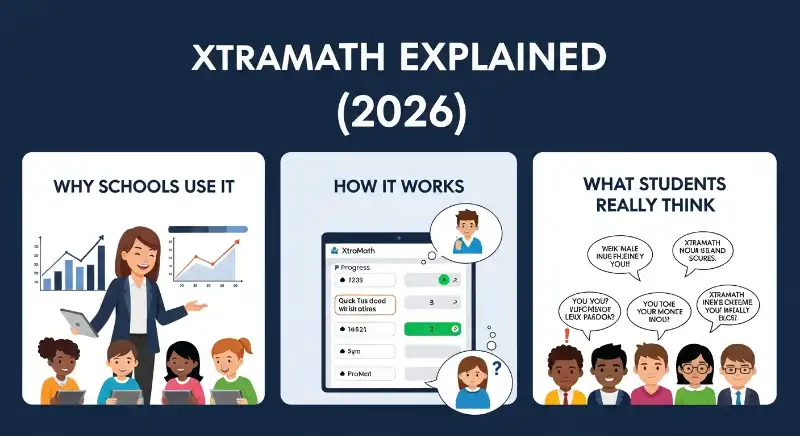
Have you ever heard your child mention XtraMath and wondered what it actually is, why schools use it, or why students seem to have such strong opinions about it? You may have also searched for XtraMath login, XtraMath student login, extra math, extramath, or even the “XtraMath guy” after seeing the program for the first time.
XtraMath is an online math practice program designed specifically to help students build math fact fluency in addition, subtraction, multiplication, and division. Its basic program is free, and the traditional student experience is built around short, daily practice sessions.
However, XtraMath is more than a website where kids answer timed questions. It is designed around a simple, powerful idea: when students can recall basic math facts accurately and efficiently, they free up mental capacity for harder mathematical thinking.
Whether you are a parent trying to understand your child’s homework, a student looking for the login page, or a teacher considering XtraMath for classroom practice, this guide explains how it works, what it costs, why students sometimes dislike the timer, and whether it is actually worth your time in 2026.
What Is XtraMath? (Its Core Purpose)
XtraMath is an online learning program focused exclusively on math fact fluency. Instead of trying to teach every area of mathematics, it concentrates on the fundamental arithmetic facts that students need to recall instantly. These include:
- Addition
- Subtraction
- Multiplication
- Division
The official XtraMath website describes the program as a way to help students build fluency in these core operations. It is not a replacement for a full math curriculum; rather, it acts as a supplementary practice tool that sharpens a student’s mental arithmetic.
What Does Math Fact Fluency Mean?
Math fact fluency means being able to recall basic mathematical facts accurately, efficiently, and with increasing automaticity.
For example, a student who has mastered multiplication facts should not need to count repeatedly or use repeated addition to solve 7 × 8 = 56. The goal is to make that answer instantly retrievable so the student’s attention can move toward more complicated problems.
This skill becomes increasingly critical as students encounter fractions, ratios, multi-step word problems, expressions, equations, and more advanced mathematics. XtraMath’s 2026 materials emphasize this strong connection between basic fact recall and the mental capacity required for complex mathematical reasoning.
XtraMath Pros and Cons (2026 Review)
Before integrating any educational tool, it is essential to look at both sides of the coin. While XtraMath has millions of users, it also has its fair share of critics. Here is an honest, neutral evaluation of its strengths and weaknesses.
Benefits of XtraMath (Why Use It?)
- Short Daily Routine: XtraMath is built around a quick daily commitment, generally taking about 10 minutes or less. This short format makes it easy to fit into morning work, math centers, homework, or intervention periods without overwhelming the child.
- Adaptive Practice: The system uses student performance data to adapt the difficulty of questions. If a student struggles with a specific fact (e.g.,
8×7), the program will present that fact more frequently until it is mastered. - Comprehensive Progress Tracking: Teachers and parents receive automated, detailed reports. These reports highlight exactly which operations (addition, subtraction, etc.) a student excels at and where they need additional support.
- Completely Free Core Version: As of 2026, the standard version of XtraMath remains free. It does not display distracting commercial advertisements, making it classroom-friendly. So if you are wondering “is XtraMath free?” – Yes, absolutely.
- Accessibility Features: The platform includes auditory and visual cues, making it easier for students with special needs or learning differences to engage with the material.
Drawbacks of XtraMath (What Are the Weaknesses?)
To answer the common query “is XtraMath bad?” – No, it is not bad, but it has limitations.
- The Timer Can Induce Stress: The most common complaint among students is the timer. The pressure to answer quickly can cause anxiety. A student might know the correct answer but take 4–5 seconds to recall it. During that time, the ticking clock can make them panic, leading to careless mistakes.
- Monotonous Repetition: Because the program relies on repetition to build automaticity, some students find the practice sessions boring. Children who prefer game-based or visually dynamic learning often lose interest quickly.
- Focus on Speed Over Understanding: XtraMath drills recall but does not teach concepts. A child might memorize that
36 ÷ 6 = 6, but they might not understand that division means splitting into equal groups. If used in isolation, this can create a gap in conceptual knowledge. - Encourages Guessing: In an attempt to beat the timer, some students start guessing randomly just to get through the session, which can actually harm their accuracy and long-term learning.
How to Login: XtraMath Student Login and Sign In Guide
One of the most searched queries regarding this platform is related to logging in, specifically “xtramath student login” and “xtra math student login”. The process has become significantly more flexible and streamlined in recent years.
How to Login to XtraMath (Google, Clever, ClassLink)
Students can access XtraMath through its official student sign-in page. Depending on how the student’s school or teacher has configured access, the current sign-in page supports several methods:
- Google Sign-In: If the school uses Google Workspace, students can log in directly using their school-provided Google account credentials.
- Clever or ClassLink Integration: Many schools use these Single Sign-On (SSO) platforms. XtraMath integrates seamlessly with them, meaning teachers do not have to create separate usernames and passwords for each student.
- Student Code/Email: In traditional setups, the teacher provides a specific class code. The student enters this code along with their first name or a unique PIN to access their personalized practice sessions.
Troubleshooting: What to Do If XtraMath Login Isn’t Working
If the XtraMath student login isn’t functioning, here is a step-by-step troubleshooting guide:
- Check the URL: Ensure you are on the official website (
xtramath.org) and not a third-party phishing site. - Verify Internet Connection: A weak or unstable connection can prevent the site from authenticating.
- Browser Cache and Cookies: Clear your browser’s cache or try opening the page in an “Incognito/Private” window to rule out stored data issues.
- Third-Party Service Status: If you are using Google, Clever, or ClassLink, check if those specific services are currently experiencing an outage.
- Teacher Confirmation: If all the technical steps fail, the teacher might have changed the class code or deactivated the account. Contact the teacher for a fresh sign-in code.
Why Is XtraMath Beneficial for Schools and Teachers?
XtraMath is not just a home-schooling tool; it is heavily utilized in traditional classroom settings. The reasons, however, differ depending on whether you are looking at it from an administrative level or a hands-on teaching level.
The Administrative Perspective: Why Schools Adopt XtraMath
School administrators, such as principals and curriculum directors, look for tools that improve standardized test outcomes and provide data-driven insights.
- XtraMath provides detailed progress reports at the school and grade level, allowing administrators to identify learning gaps across classrooms.
- It fits neatly into MTSS (Multi-Tiered System of Supports) or RTI (Response to Intervention) frameworks. It helps flag students who are falling behind in arithmetic, allowing the school to allocate intervention resources effectively.
- The fact that the core program is free makes it a highly cost-effective solution for districts with tight budgets.
Practical Classroom Tools (Benefits for Teachers)
For the classroom teacher, XtraMath is a massive time-saver.
- Automated Grading: Teachers do not need to manually grade hundreds of math facts. The system automatically tracks accuracy and speed.
- Easy Differentiation: With a single click, a teacher can assign addition practice to a group of struggling students while assigning multiplication to advanced learners. The program handles the delivery automatically.
- Parent-Teacher Communication: Teachers can print or email progress reports directly to parents, making it easier to communicate specific academic needs during parent-teacher conferences.
The Daily Practice Routine and Timer Mechanism
Understanding how the daily session works is crucial to managing a child’s expectations and reducing frustration. This section answers “how does xtra math work?” in detail.
How Long Does a Daily Practice Session Take?
XtraMath is specifically designed for a short, daily burst of practice. The official program promotes a routine of approximately 10 minutes a day. This brevity is intentional; it is long enough to reinforce neural pathways but short enough to prevent cognitive fatigue and burnout.
Timer: Friend or Foe? (Managing Speed vs. Anxiety)
The timer is arguably the most polarizing feature of XtraMath.
- The Intended Purpose: The timer pushes students to move away from “counting on fingers” and towards “automatic recall.” It is designed to simulate the speed required for higher-level math, where pausing to calculate basic facts breaks the flow of problem-solving.
- The Reality for Students: For anxious students, the timer triggers a “fight or flight” response. If a child knows
9 × 6 = 54but takes 6 seconds to retrieve it, the timer moving quickly can cause them to freeze, type the wrong number, or give up entirely. - Available Adjustments: In 2026, XtraMath has introduced accessibility settings that can give beginning learners additional time to answer. If a child is struggling with anxiety, teachers and parents should look for these settings to adjust the experience.
The “XtraMath Guy” and Mr. C
If your child has used XtraMath, you have likely heard them refer to a character with a distinctive voice. This has become a significant part of internet culture among students.
Who Is Mr. C on XtraMath?
In the current XtraMath student experience, Mr. C is the teacher character who appears during the practice activities. He provides instructional guidance, encouragement, and feedback during the student’s daily sessions.
It is important to clarify a common misconception. Older articles often incorrectly identify the “XtraMath guy” as the platform’s founder. However, the founder was not the character students see on screen. XtraMath’s official materials clearly identify Mr. C as the virtual teacher character used in the student interface.
Who Founded XtraMath? (The Creator David Jeschke)
To directly answer the search query “who made xtramath”: The platform was founded by David Jeschke. He created XtraMath with the vision of providing a free, accessible tool to help children master basic arithmetic. While students rarely see him, his technology powers the entire program that millions of students use daily.
Why Do Students Joke About the XtraMath Guy?
Students hear the same instructional voice and see the same character repeatedly while completing their practice. This repetition has turned Mr. C into a lighthearted internet meme. Students often joke about:
- Mr. C appearing every day without fail.
- Hearing his voice in their heads during other classes.
- Feeling like he is “watching” their progress.
- Trying to finish the session before his timer runs out.
These reactions are mostly harmless student humor and online culture rather than evidence that the program is ineffective or damaging.
XtraMath Reviews: What Are Parents and Teachers Saying in 2026?
Searching for “xtramath reviews” brings up a mix of passionate opinions. Here is an aggregated summary based on thousands of parent and teacher discussions in 2026.
Parent Reviews: The Good and the Frustrating
- Positive: Most parents love the free access and the noticeable improvement in their child’s speed. They appreciate that they don’t have to sit and drill flashcards manually.
- Negative: Many parents report their children crying or getting frustrated with the timer. The lack of games is a frequent complaint among parents of younger (K-2) students.
Teacher Reviews: A Classroom Staple
- Positive: Teachers overwhelmingly praise the data reporting. One teacher review noted: “I can instantly see which student is struggling with 7s vs. 8s. It saves me hours of assessment time.”
- Negative: Some teachers note that it shouldn’t be used as a reward or punishment. They recommend it only for 5-10 minutes as a warm-up, not a main lesson.
XtraMath vs. Alternatives: A Comparison
Parents and teachers often wonder how XtraMath stacks up against other popular platforms. The truth is that these tools serve different purposes, and choosing the right one depends on the specific goal.
XtraMath vs. Khan Academy
- XtraMath: Focuses strictly on math fact fluency (addition, subtraction, multiplication, division).
- Khan Academy: Covers a massive range of math topics, from early math to calculus, complete with video lessons, explanations, and interactive exercises.
- The Verdict: They are complementary, not competitive. Use Khan Academy to learn a new concept. Use XtraMath to drill the basic arithmetic required to solve Khan Academy’s problems faster.
XtraMath vs. IXL
- XtraMath: Narrow focus on basic facts. Core version is free.
- IXL: Offers practice across thousands of math and ELA skills, categorized by grade level. It is a paid subscription.
- The Verdict: If your goal is “get faster at 3rd-grade multiplication,” XtraMath is better. If your goal is “practice 8th-grade geometry, algebra, and data analysis,” IXL is superior.
XtraMath vs. Reflex Math
- XtraMath: Straightforward, no-frills practice with a timer.
- Reflex Math: Takes a highly game-oriented approach. Students earn coins, unlock games, and level up characters by answering facts correctly.
- The Verdict: If your child is young, easily bored, and loves video games, Reflex Math might engage them better. If your child needs no-nonsense, quick repetitive practice to memorize facts, XtraMath is the efficient choice.
Is XtraMath Safe and Privacy-Friendly for Kids?
Parents understandably have concerns about their child’s data privacy when using online platforms. Since XtraMath is designed for K-12 education, it adheres to strict safety protocols.
XtraMath was created specifically for educational use and provides separate portals for schools, teachers, students, and families. The information required varies depending on how the child accesses the platform (e.g., through a school-cleared Google account or a family account).
The company provides a detailed privacy policy and student data policy on its official website. Key safety features include:
- No commercial advertising or pop-ups during the learning experience.
- The “Family” account allows parents to supervise progress without exposing sensitive personal information.
- Schools manage student data directly, ensuring compliance with FERPA and COPPA regulations (in the US).
Parents are always encouraged to review the platform’s current privacy information on the official site if they have specific concerns about their child’s account setup.
XtraMath Pro (2026 Update)
There is a notable development in 2026 worth mentioning.
In July 2026, XtraMath announced XtraMath Pro with Fluency Intelligence. This is an educator-focused system designed to analyze existing practice data and turn it into actionable instructional insights for teachers.
It is important to note that XtraMath Pro does not change the student practice routine. Students will not interact with an AI chatbot or perform different tasks. The analysis happens behind the scenes for the teacher. For the 2026–27 school year, XtraMath states that Pro will cost approximately $1–$2 per student per year, while the standard XtraMath remains free for families and schools who do not require the premium insights.
XtraMath Pro vs. XtraMath Free (2026 Deep Dive)
We briefly mentioned XtraMath Pro earlier, but here is a detailed, side-by-side comparison to help schools decide if the paid upgrade is worth the investment.
What Features Remain Free?
The core XtraMath experience will remain permanently free for students and families. This includes:
- Unlimited daily practice sessions.
- Access to all four operations (addition, subtraction, multiplication, division).
- Basic student progress reports.
- The standard Mr. C guided experience.
- Accessibility settings for extra time.
What Does XtraMath Pro Add for Schools?
The new XtraMath Pro with Fluency Intelligence is strictly a teacher/school administration upgrade. It does not alter the child’s screen. It provides:
- Fluency Intelligence Analytics: Instead of just showing accuracy, Pro uses AI to analyze patterns in student errors (e.g., identifies if a student consistently struggles with the number ‘8’).
- Instructional Grouping: Automatically groups students based on specific skill deficits, allowing teachers to form targeted small-group interventions instantly.
- Printable Activity Packs: Teachers receive downloadable, standards-aligned worksheets that complement the digital practice.
- Priority Support: Schools paying for Pro get dedicated customer support and onboarding assistance.
Frequently Asked Questions About XtraMath
While we have covered the core mechanics, parents and new teachers often have specific, practical questions that don’t fit into the main narrative. Here are the most common unique queries answered.
Can XtraMath Be Used Offline?
No. XtraMath is a cloud-based web application that requires a stable internet connection to function. The student’s progress data is synced in real-time to the teacher’s or parent’s dashboard. There is no offline desktop application available. However, once the page loads, the session data is processed locally, so a brief internet flicker mid-session usually does not cause a loss of progress, as long as the connection restores before the student submits the final answers.
Does XtraMath Have a Mobile App?
Yes, but with a caveat. XtraMath offers mobile applications for both iOS (Apple App Store) and Android (Google Play Store). These apps are essentially wrappers for the web experience, designed to make it easier for students to practice on tablets or smartphones without needing a desktop browser.
For the most current and secure download, parents and students should search for “XtraMath” directly in their device’s official app store rather than downloading third-party APK files from unknown websites. The app’s functionality mirrors the desktop version, including the timer, progress tracking, and Mr. C’s guidance.
What Is the Difference Between a Student Account and a Family Account?
This is a common point of confusion.
- Student Account: This is typically created by a teacher through a school roster. The student logs in with a class code or via Clever/Google. Their data is visible to the teacher, and the teacher controls which operations (e.g., multiplication only) the student practices.
- Family Account: This is created by a parent directly on the XtraMath website without involving a school. The parent acts as the “teacher” in this scenario. The parent has full control over the practice settings, can assign any operation, and receives all progress reports directly via email. The core practice experience is identical for the child; only the administrative control differs.
Final Verdict: Is XtraMath Right for Your Child?
XtraMath may look simple, but its purpose is highly specific. It is not trying to teach every mathematical concept a child will encounter. Instead, it focuses on a foundational skill that students repeatedly need throughout their education: quick and accurate recall of basic math facts.
For some children, a few minutes of consistent practice can make multiplication, division, subtraction, and addition feel much easier. For others, the timer or repetition may create frustration and anxiety.
Instead of asking “Is XtraMath good or bad?”, the better question to ask is: “Does XtraMath help this particular student become more confident and fluent with math?”
When XtraMath Makes Sense
- The student needs to memorize multiplication tables.
- The student struggles to recall basic facts quickly.
- The student responds well to short, structured routines.
- The student enjoys tracking their own progress and beating their personal scores.
When Another Tool May Be Better
- The student needs detailed explanations of why 8×7 equals 56 (they need conceptual understanding).
- The student has severe math anxiety triggered by timers (consider disabling the timer in settings first).
- The student learns best through vivid games, stories, and visual rewards.
Ultimately, the goal isn’t to beat the timer. The goal is to make math facts easier to remember, so when your child moves on to algebra, fractions, and test-taking, their brain is free to focus on the complex stuff, not the basics. If used correctly and with the right expectations, XtraMath remains one of the most effective and cost-efficient tools available in 2026.