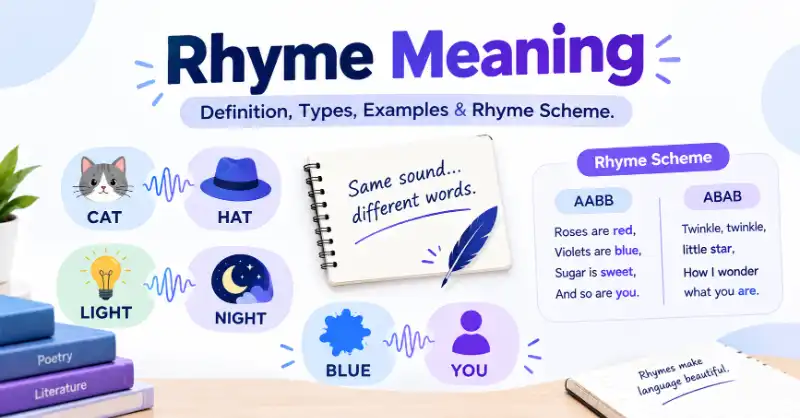
Rhyme is a simple but powerful part of language that you hear in poems, songs, nursery rhymes, advertisements, and even rap. It happens when words have matching or closely related sounds, usually near the end of the words.
For example, cat and hat rhyme because their ending sounds match. Light and night also rhyme, even though the words have different meanings.
But understanding rhyme is more than memorizing a definition. You also need to know how to recognize rhyming words, understand the different types, and see how poets use rhyme to make their writing easier to remember and more enjoyable to hear.
Are You Confused About What Rhyme Really Means?
Are you trying to understand the meaning of rhyme in simple words? Are you unsure whether two words actually rhyme because their spelling looks different? Do you need to identify rhyme in a poem, understand the different types, or tell the difference between rhyme and rhythm?
You may also be wondering why poets use rhyme, how a rhyme scheme works, or how you can use rhyming words in your own writing. If so, you are in the right place. This guide will take you through each problem step by step, using simple definitions, clear examples, comparisons, and practice so you can recognize and use rhyme with confidence.
What Does Rhyme Mean? Understand It in Simple Words
Rhyme Definition in Simple English
Rhyme means a similarity between the sounds of two or more words, especially their ending sounds.
For example:
- Cat → Hat
- Sun → Fun
- Light → Night
- Tree → Bee
- Play → Stay
The important point is that rhyme is mainly about sound, not meaning.
For example, cat and hat have different meanings, but they rhyme because their ending sounds match.
How Can You Tell If Two Words Rhyme?
The easiest way to check whether two words rhyme is to say them aloud and listen to the sounds.
Follow these steps:
- Say the first word.
- Say the second word.
- Listen to the ending sounds.
- Ignore whether the words have the same meaning.
- Do not judge only by their spelling.
- If the relevant ending sounds match closely, the words can rhyme.
For example:
Light → Night
When you say both words aloud, the -ight sound matches.
But:
Love → Move
These words look somewhat similar in spelling, but their vowel sounds are different. Therefore, they are an example of eye rhyme, not a perfect rhyme.
Rhyme Examples You Can Recognize Easily
Here are some simple rhyming pairs:
| Word | Rhyming Word |
|---|---|
| Cat | Hat |
| Dog | Log |
| Blue | You |
| Day | Way |
| Ball | Call |
| Rain | Train |
| Star | Car |
| Book | Look |
A useful trick is to read the words aloud instead of simply looking at them.
Does Rhyme Depend on Sound or Spelling?
Rhyme depends primarily on sound, not spelling.
This is one of the most important things to remember.
For example:
Blue → You
The spelling is different, but the ending sound is similar.
On the other hand:
Love → Move
The words look similar, but they do not have the same ending sound. This is why spelling alone cannot tell you whether two words rhyme.
So, whenever you are unsure, say the words aloud and listen to them.
What Is Rhyme in Poetry and Why Do Poets Use It?
Rhyme in poetry is the deliberate use of matching or related sounds to connect words, lines, or ideas.
Poets may use rhyme to make a poem:
- easier to remember
- more musical
- more organized
- more enjoyable to read aloud
- stronger in its emotional effect
For example:
The moon shines bright,
Throughout the night.
Bright and night rhyme. The repeated sound gives the two lines a stronger connection.
How Rhyme Works at the End of Poetry Lines
One of the most familiar forms of rhyme occurs at the end of lines.
Consider:
The little bird can fly,
Across the open sky.
Fly and sky rhyme at the ends of the lines.
This type of rhyme is called end rhyme.
However, poets do not have to place rhyming words only at the end. They can also place rhyming sounds inside a line.
How Rhyme Makes Poems More Musical and Memorable
Rhyme creates repeated sound patterns. When readers hear those patterns, the lines can feel more connected and easier to remember.
This is one reason children’s nursery rhymes are often so memorable. Repeated sounds give children a simple pattern to follow.
For example:
Twinkle, twinkle, little star,
How I wonder what you are.
The repeated sounds help make the lines recognizable and memorable.
How Rhyme Can Create Emphasis, Mood, and Structure
Rhyme can also influence how a poem feels.
A regular, predictable rhyme may make writing feel:
- neat
- playful
- cheerful
- musical
A less predictable rhyme can feel:
- natural
- conversational
- subtle
- unexpected
The effect depends on the words, sounds, rhythm, and overall context of the poem.
Does Every Poem Have to Rhyme?
No. Not every poem needs to rhyme.
Some poems use strong rhyme patterns, while others use little or no rhyme.
For example, free verse poetry can focus on imagery, ideas, emotion, and natural speech without following a regular rhyme scheme.
So rhyme is a poetic tool, not a requirement for every poem.
What Are the Different Types of Rhyme? Learn the Differences
Rhyme can appear in several forms. The easiest way to understand the types is to look at how closely the sounds match and where the rhyme appears.
What Is Perfect Rhyme?
Perfect rhyme occurs when the stressed vowel sound and the sounds that follow it match, while the beginning sounds are different.
Examples include:
- Cat → Hat
- Light → Night
- Play → Stay
- Dream → Stream
For example, cat and hat share the same ending sound while beginning with different consonant sounds.
Perfect rhyme often creates a clear and satisfying sound pattern.
What Is Slant, Near, or Imperfect Rhyme?
Slant rhyme, also called near rhyme or imperfect rhyme, occurs when the sounds are similar but do not match perfectly.
Examples can include:
- Shape → Keep
- Time → Line
- Room → Storm
The exact relationship depends on pronunciation and the type of rhyme being discussed, but the main idea is simple:
Perfect rhyme = closer sound match
Slant rhyme = partial or approximate sound match
Writers may use slant rhyme when they want their lines to sound connected without making the rhyme feel too obvious.
What Is End Rhyme?
End rhyme happens when rhyming words appear at the ends of two or more lines.
Example:
The stars are shining bright,
They guide me through the night.
Bright and night are end rhymes because they occur at the ends of the lines.
End rhyme is one of the easiest forms of rhyme to identify.
What Is Internal Rhyme?
Internal rhyme occurs when rhyming words appear within the same line or between an internal word and an ending word.
Example:
The light was bright across the room.
Here, light and bright rhyme within the same line.
Internal rhyme can make writing sound faster, more energetic, or more musical.
It is especially common in songs, rap, and poetry.
What Is Eye Rhyme?
Eye rhyme occurs when words look as though they should rhyme because of their spelling, but they do not sound alike when pronounced.
A common example is:
Love → Move
The written endings look similar, but the words are pronounced differently.
This is why you should not decide whether two words rhyme simply by looking at them.
Look at the spelling, but listen to the sound.
What Are Masculine and Feminine Rhyme?
These terms describe the number of syllables involved in the rhyming ending.
A masculine rhyme generally ends with a single stressed syllable.
Example:
Cat → Hat
A feminine rhyme generally involves a stressed syllable followed by an unstressed syllable.
For example:
Falling → Calling
The ending sounds of the words create a longer, two-syllable rhyme.
These terms are more advanced than perfect or end rhyme, so beginners do not need to memorize them before understanding the basic forms.
Quick Rhyme Check
Before moving on, use this simple test:
Do these words rhyme?
- Day → Play — Yes
- Moon → Spoon — Yes
- Book → Look — Yes
- Love → Move — Not as a perfect rhyme; this is an example of eye rhyme
- Cat → Dog — No
The key rule is:
Rhyme is determined by sound, not simply by spelling.
How Do You Identify a Rhyme Scheme Step by Step?
If you can recognize rhyming words, the next step is learning how those rhymes create a pattern in a poem. This pattern is called a rhyme scheme.
A rhyme scheme shows which lines rhyme with each other. Writers usually use letters such as A, B, C, and D to show the pattern.
What Is a Rhyme Scheme?
A rhyme scheme is the pattern created by the rhyming sounds at the ends of lines in a poem.
For example:
The sun is shining bright.
It fills the world with light.
The birds begin to sing.
The flowers bloom in spring.
The first two lines rhyme, so they receive the same letter:
- Bright → A
- Light → A
- Sing → B
- Spring → B
The rhyme scheme is therefore:
AABB
How to Mark Rhyming Lines With A, B, C, and D
You do not need to guess the pattern. Follow these steps:
Step 1: Read all the lines aloud.
Step 2: Look at the final words of the lines.
Step 3: Give the first ending sound the letter A.
Step 4: If the next line rhymes with it, give that line another A.
Step 5: If it has a different rhyme, give it B.
Step 6: Continue using a new letter whenever a new rhyme sound appears.
For example:
The little bird can fly.
It travels through the sky.
A rabbit runs through the grass.
It quickly watches people pass.
The pattern is:
fly = A
sky = A
grass = B
pass = B
So the rhyme scheme is AABB.
How to Identify an AABB Rhyme Scheme
An AABB pattern means:
- Line 1 rhymes with Line 2.
- Line 3 rhymes with Line 4.
- The first pair has a different rhyme from the second pair.
Example:
I see the shining moon. — A
It rises very soon. — A
The stars begin to glow. — B
The night moves soft and slow. — B
Answer: AABB
How to Identify an ABAB Rhyme Scheme
An ABAB pattern means:
- Line 1 rhymes with Line 3.
- Line 2 rhymes with Line 4.
Example:
The bird flies through the sky. — A
The flowers start to grow. — B
A cloud goes drifting by. — A
The gentle rivers flow. — B
Here:
sky → by = A
grow → flow = B
So the rhyme scheme is ABAB.
How to Identify an ABBA Rhyme Scheme
An ABBA pattern means:
- Line 1 rhymes with Line 4.
- Line 2 rhymes with Line 3.
Example:
The morning sun is bright. — A
The birds begin to sing. — B
I hear their voices ring. — B
The world is filled with light. — A
The pattern is:
A → B → B → A
So the rhyme scheme is ABBA.
What Should You Do When a Poem Does Not Follow a Regular Scheme?
Not every poem follows a neat pattern such as AABB or ABAB.
If a line does not rhyme with another line, give its sound a new letter.
For example:
The moon is shining bright. — A
I hear the ocean near. — B
The stars are full of light. — A
A quiet wind is here. — B
This is ABAB.
But if the final line has a completely different sound, it may introduce another letter.
The important rule is simple:
Do not force a rhyme scheme. Identify the sounds that are actually present.
What Is the Difference Between Rhyme and Rhythm?
Rhyme and rhythm are often mentioned together, but they are not the same thing.
If you are studying poetry, confusing these two can make it harder to understand how a poem works.
What Does Rhyme Control?
Rhyme focuses on repeated or matching sounds.
Example:
The moon is bright,
It shines at night.
Bright and night rhyme.
Rhyme connects words through sound.
What Does Rhythm Control?
Rhythm is the pattern of beats, stresses, and timing in language.
You can often feel rhythm when you read a poem aloud.
Think about music:
Rhyme = matching sounds
Rhythm = the beat or flow
A poem can have one without strongly using the other.
Easy Rhyme vs Rhythm Example
Consider:
The cat sat on the mat.
Cat and mat rhyme.
But the way you naturally stress and say the sentence creates its rhythm.
So:
- Rhyme asks: Which sounds match?
- Rhythm asks: How does the language move or beat?
Why Can a Poem Have Rhythm Without Rhyme?
A poem does not need rhyming words to have rhythm.
Free verse, for example, may use repeated stresses, sentence patterns, pauses, or natural speech patterns without following a regular rhyme scheme.
That means:
No rhyme does not mean no rhythm.
This distinction is especially useful when analyzing poetry.
How Can You Use Rhyme in Poems, Songs, and Writing?
Knowing what rhyme means is useful, but you may also want to know how to use it without making your writing sound forced.
How to Choose Rhyming Words Without Forcing Them
Start with the idea you want to express. Then look for words that naturally fit the meaning and sound.
For example, if your sentence is:
The stars shine in the night.
You might choose:
The stars shine in the night,
Their gentle glow is bright.
The rhyme supports the meaning.
Avoid choosing a strange word simply because it rhymes.
A good rule is:
Meaning first, rhyme second.
How to Use End Rhyme and Internal Rhyme
You can use end rhyme to connect separate lines:
I watched the falling rain,
Then sunshine came again.
You can use internal rhyme inside a line:
The bright moon filled the night.
You can also combine different rhyme techniques when the writing calls for it.
The goal is not to make every possible word rhyme. The goal is to create a sound pattern that helps the writing.
How Rhyme Works in Songs and Rap
Rhyme is widely used in songs and rap because repeated sounds can make lyrics easier to remember and can help create flow.
For example:
I came with the flame,
I’m changing the game.
Flame and game create a clear rhyme.
Rap can also use internal and multisyllabic rhymes, allowing several sounds to connect within a line.
This gives writers more opportunities for:
- wordplay
- flow
- emphasis
- memorability
- creative expression
Common Mistakes to Avoid When Using Rhyme
If you are writing your own poem or song, watch out for these mistakes:
1. Choosing a word only because it rhymes
The sentence may sound unnatural.
2. Ignoring meaning
A technically correct rhyme can still make a weak line if the word does not fit the idea.
3. Assuming similar spelling means rhyme
Always check pronunciation.
4. Forcing every line to rhyme
Some poems work better with irregular or no rhyme.
5. Repeating the same rhyme too much
Too much repetition can make writing sound predictable.
A strong writer uses rhyme as a tool, not as a rule that must control every sentence.
Can You Identify Rhyme Yourself? Practice With These Examples
Now that you know how rhyme works, test yourself before moving on.
Find the Rhyming Words
Which words rhyme in this sentence?
The little mouse ran through the house.
Answer:
Mouse → house
They rhyme because their ending sounds match.
Try another:
The rain fell on the train.
Answer:
Rain → train
Identify the Rhyme Scheme
Try this poem:
The sun is shining high.
A bird moves through the sky.
The flowers start to grow.
The gentle rivers flow.
Now mark the sounds:
- High → A
- Sky → A
- Grow → B
- Flow → B
Rhyme scheme = AABB
Check Whether the Words Really Rhyme
Look at these pairs:
Day → Play
Yes, they rhyme.
Light → Night
Yes, they rhyme.
Blue → You
Yes, they rhyme.
Love → Move
They look similar in spelling, but they do not form a perfect rhyme.
Book → Chair
No, they do not rhyme.
The lesson is simple:
Say the words aloud before deciding whether they rhyme.
Practice With Easy Examples for Students
Try completing these pairs:
Star → ______
Tree → ______
Ball → ______
Possible answers include:
Star → Car
Tree → Bee
Ball → Call
There can be more than one correct answer. What matters is whether the ending sounds create a valid rhyme.
Now try identifying the pattern:
I see a bird in the tree.
It looks down at me.
The clouds are drifting slow.
The winds begin to blow.
The answer is:
AABB
Tree → me = A
Slow → blow = B
Rhyme Meaning in Urdu: What Does Rhyme Mean?
If English poetry terms feel confusing, connecting the idea with Urdu can make the concept easier to understand.
Rhyme Meaning in Urdu (قافیہ)
In an Urdu learning context, rhyme can be explained as قافیہ (Qafiya)—words or sounds that create a matching sound pattern, particularly in poetry.
For a simple comparison:
رات → بات
دل → مل
These pairs have similar ending sounds, which makes them useful for understanding the basic idea of rhyme.
However, English and Urdu poetry have their own literary rules and traditions, so rhyme and قافیہ should not always be treated as perfectly identical technical terms.
Simple English and Urdu Rhyme Examples
English:
The light shines at night.
Urdu:
رات → بات
In both cases, the learner can focus first on the sound relationship between the words.
This makes the basic concept easier to understand before moving into more advanced poetry terminology.
Frequently Asked Questions About Rhyme
The questions below focus on additional problems that may still come up after learning the main concepts above.
Can two words rhyme if they are spelled differently?
Yes. Words can rhyme even when their spellings are different.
For example:
Blue → You
Their spellings are different, but their ending sounds match closely.
This is why pronunciation matters more than simply comparing written letters.
Can one word have more than one possible rhyme?
Yes. Depending on pronunciation and context, a word can have several rhyming possibilities.
For example, day can rhyme with words such as:
- way
- say
- play
- stay
- gray
The best choice depends on the meaning and sentence.
What is the hardest English word to rhyme?
There is no single objectively “hardest” word to rhyme because it depends on pronunciation, dialect, and whether you allow perfect, slant, or multisyllabic rhymes.
Some words have very few common perfect rhymes, which can make them challenging for poets.
Is rhyme necessary in a song?
No. A song can work without a regular rhyme scheme.
Songwriters may use rhyme because it can make lyrics memorable and musical, but melody, rhythm, repetition, word choice, and emotion can also carry a song.
Can prose use rhyme?
Yes. Although rhyme is strongly associated with poetry and songs, prose can also contain accidental or deliberate rhyme.
Writers may use repeated sounds in advertisements, speeches, children’s writing, slogans, or creative prose to make phrases more memorable.
Conclusion: Rhyme Is About Sound, Pattern, and Expression
Rhyme may begin with a simple idea—words that have matching or similar sounds—but it becomes much more useful once you know how to recognize and apply it.
You now know how to:
- identify rhyming words
- distinguish sound from spelling
- recognize major types of rhyme
- understand end and internal rhyme
- identify AABB, ABAB, and ABBA rhyme schemes
- separate rhyme from rhythm
- understand how poets, songwriters, and rappers use rhyme
- practice identifying rhyme for yourself
The most important rule to remember is simple:
Rhyme is about sound, not just spelling.
Once you start listening for those repeated sounds, you will notice rhyme everywhere—from poems and children’s rhymes to songs, rap, advertisements, and everyday creative language.