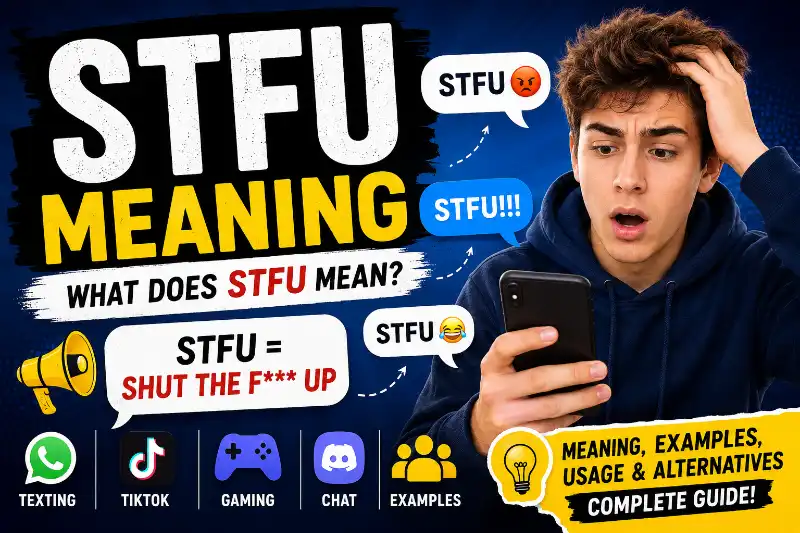
Have you ever received a message that simply said “STFU” and wondered what it actually meant?
If yes, you’re not alone.
Internet slang changes quickly, and new abbreviations appear almost every day across texting apps, social media, gaming platforms, and online communities. While some acronyms are friendly and harmless, others can sound much stronger depending on how they’re used. STFU is one of those expressions that often creates confusion because its meaning changes with the situation.
Sometimes it’s used during an angry argument. Other times, friends use it jokingly after hearing surprising news. On platforms like TikTok, Instagram, Discord, Reddit, WhatsApp, and online games, you may see people type “STFU” without intending to seriously insult anyone. Understanding the context is the key.
In simple terms, STFU means “Shut the F* Up.”** It is a slang abbreviation used to tell someone to stop talking. Because it contains a swear word, it is generally considered rude and should be used carefully. However, among close friends, it may occasionally be used humorously or as a reaction to shocking or unbelievable news.
In this complete guide, you’ll learn:
- The exact STFU meaning
- The full form of STFU
- How people use it in text messages
- STFU meaning on social media
- STFU meaning in gaming
- Whether it’s always offensive
- Real conversation examples
- Polite alternatives you can use instead
- Common mistakes people make
- Frequently asked questions
By the end of this article, you’ll understand not only what STFU means but also when it is appropriate—or inappropriate—to use it.
STFU Meaning
If you’re looking for a quick answer, here it is.
STFU means “Shut the F* Up.”**
It is an internet slang abbreviation people use to tell someone to stop talking or to become quiet. Because the phrase contains profanity, it is widely considered rude, aggressive, or disrespectful in most situations.
However, context matters.
Among close friends, STFU is sometimes used playfully to express surprise rather than anger.
Quick Examples
Example 1 (Angry)
Person A:
You’re wrong!
Person B:
STFU.
Meaning:
“Stop talking.”
Example 2 (Funny)
Friend:
I just won $10,000.
Friend:
STFU 😂 No way!
Meaning:
“I can’t believe it!”
STFU stands for “Shut the F* Up.” It is a popular internet abbreviation used in text messages, online chats, social media, and gaming. While it usually tells someone to stop talking, friends may also use it jokingly to express surprise or excitement. Because it includes profanity, it is generally considered rude in formal or professional conversations.**
What Does STFU Stand For?
Many people know the abbreviation but don’t know the words behind each letter.
Here’s the full form.
| Letter | Word |
|---|---|
| S | Shut |
| T | The |
| F | F*** |
| U | Up |
So,
STFU = Shut the F* Up**
Although the abbreviation hides the swear word behind a single letter, almost everyone online understands what it represents.
For that reason, writing STFU is usually considered just as offensive as writing the complete phrase.
The Literal Meaning
Literally, STFU is a command telling someone to stop speaking immediately.
It isn’t a question.
It isn’t a request.
It’s an order.
That’s why people often perceive it as rude, disrespectful, or aggressive.
For example:
STFU. I’m trying to concentrate.
Here, the speaker wants silence immediately.
Why Do People Use STFU?
Despite sounding harsh, people use STFU for several different reasons.
1. During Arguments
Someone becomes angry.
Example:
STFU! You’re lying.
2. To React to Shocking News
Friends sometimes exaggerate their surprise.
Example:
STFU! You met your favorite singer?
Here, they don’t literally want the other person to stop talking.
Instead, they mean:
“I can’t believe it!”
3. During Online Gaming
Competitive games often become emotional.
Players may type:
STFU and play.
This usage is usually toxic and should be avoided.
4. As a Joke Between Friends
Among close friends who understand each other’s humor, STFU can be playful rather than offensive.
Example:
Friend:
I ate the whole pizza.
Friend:
STFU 😂
Meaning:
You’re kidding!
Even then, it’s important to know your audience. A joke between close friends can sound insulting to someone else.
Is STFU a Bad Word?
This is one of the most common questions people ask.
The short answer is:
Yes—STFU is generally considered a rude expression because it contains a swear word.
Even though people usually write only the abbreviation, everyone understands its full meaning. Because of this, many people react to STFU the same way they would react to the complete phrase.
However, language is influenced by context. The same four letters can feel extremely offensive in one conversation and completely harmless in another.
Let’s understand why.
Formal vs. Informal Use
In professional environments, STFU is almost never appropriate.
Imagine using it in:
- A work email
- A meeting
- A classroom discussion
- A job interview
- Customer support
- Business communication
Doing so would likely be viewed as disrespectful and unprofessional.
By contrast, close friends sometimes use STFU casually while joking or reacting to surprising news. Even then, it’s only acceptable if everyone involved understands the humor and is comfortable with that kind of language.
A good rule is simple:
If you’re unsure how the other person will take it, don’t use STFU.
Is STFU Always Offensive?
Not always.
Tone changes everything.
Compare these examples.
Angry
STFU. Nobody asked you.
Clearly insulting.
Playful
STFU 😂 You actually won the lottery?
Here it means:
“No way!”
The intention isn’t to silence the person—it’s to show excitement or disbelief.
Sarcastic
Oh yeah, STFU… you’re hilarious.
This can still sound rude depending on the relationship.
Why Context Matters
Modern internet slang often carries emotional meaning beyond its dictionary definition.
The exact same abbreviation can express:
- Anger
- Surprise
- Excitement
- Disbelief
- Humor
- Frustration
- Sarcasm
That’s why you should never interpret STFU based only on the letters. Always consider:
- Who said it?
- Who received it?
- What happened before?
- What emojis were included?
- Was the conversation friendly or argumentative?
These clues help you understand the speaker’s real intention.
STFU Meaning in Text Messages
Text messaging is one of the most common places where people encounter STFU.
Whether you’re using WhatsApp, Messenger, Snapchat, iMessage, Telegram, or regular SMS, the abbreviation can have different meanings depending on the conversation.
Unlike face-to-face communication, text messages don’t include facial expressions or voice tone. Because of that, STFU can easily be misunderstood.
Let’s look at the most common situations.
STFU in Friendly Chats
Among close friends, STFU often expresses surprise instead of anger.
Example
Emma:
I got free concert tickets.
Liam:
STFU 😂 That’s amazing!
Meaning:
“Seriously? That’s incredible!”
The message sounds playful because of the friendly relationship and the laughing emoji.
STFU During Arguments
In heated conversations, STFU usually means exactly what it says.
Example
Person A:
You never listen.
Person B:
STFU.
Meaning:
“Stop talking.”
This use is direct, hostile, and likely to escalate the argument.
STFU as a Reaction
People also use STFU when hearing unbelievable news.
Example
Friend:
I met my childhood hero today.
Friend:
STFU!! 😲
Meaning:
“You’re kidding!”
“I can’t believe that happened!”
In this context, the phrase communicates shock rather than disrespect.
STFU in Group Chats
Group chats often mix humor with fast-paced conversations.
Someone might jokingly reply:
STFU 😂😂
if another friend shares an unbelievable story or funny achievement.
However, because group chats include multiple people with different personalities, what seems funny to one person may feel offensive to another. If you’re unsure how others will interpret it, it’s safer to choose a less aggressive response.
STFU Meaning on Social Media
Social media has changed the way people communicate. Instead of writing complete sentences, users often rely on abbreviations, emojis, GIFs, and internet slang to express emotions quickly. One of the most common examples is STFU.
Although the abbreviation always stands for “Shut the F* Up,”** its meaning on social media isn’t always literal. In many posts and comment sections, people use it to show excitement, disbelief, admiration, or playful sarcasm rather than telling someone to be quiet.
The biggest mistake people make is assuming STFU is always an insult. On platforms where friends interact casually, the phrase can simply be an emotional reaction.
Let’s see how it is used across different platforms.
STFU Meaning on TikTok
TikTok comments move incredibly fast, and users often react emotionally to videos.
For example:
Creator:
“I accidentally met my favorite celebrity today.”
Comment:
“STFU 😭 That’s impossible!”
In this situation, the commenter isn’t being rude.
Instead, STFU means:
- No way!
- You’re kidding!
- I can’t believe it!
TikTok users commonly pair STFU with emojis like:
- 😂
- 😭
- 💀
- 🤯
These emojis soften the tone and signal excitement instead of hostility.
STFU Meaning on Instagram
On Instagram, STFU frequently appears under:
- Reels
- Memes
- Celebrity posts
- Fashion photos
- Funny videos
Example:
“STFU you’re so pretty 😭”
This doesn’t mean:
“Stop talking.”
Instead, it means:
“You’re unbelievably beautiful.”
Among close friends, this has become a dramatic compliment.
STFU Meaning on Snapchat
Snapchat conversations are usually informal.
Friends often send:
STFU 😂
after hearing surprising news.
Example:
“I got front-row concert tickets.”
Reply:
“STFU!!”
Meaning:
“I can’t believe it!”
STFU Meaning on Reddit
Reddit discussions vary widely.
You’ll see STFU used:
- during debates
- inside memes
- sarcastically
- during arguments
Because Reddit conversations involve strangers, STFU is more likely to sound aggressive than it does between friends.
STFU Meaning on Discord
Discord communities include gaming servers, study groups, and hobby communities.
Examples include:
STFU I’m trying to hear footsteps.
or
STFU 😂 That’s hilarious.
The first example is rude.
The second is playful.
Again, context changes everything.
STFU Meaning on X (formerly Twitter)
People on X often react dramatically to viral news.
Example:
STFU…
They actually announced it?!
Meaning:
“I seriously can’t believe this happened.”
It expresses shock rather than disrespect.
Key Takeaway
Across social media, STFU rarely has one fixed emotional meaning. While its literal definition remains the same, users often employ it as exaggerated internet slang to react to surprising, funny, or unbelievable content.
Whenever you encounter STFU online, pay attention to the emojis, relationship between users, and overall conversation before deciding whether it’s offensive.
STFU Meaning in Gaming
Gaming communities have developed their own style of communication. Fast matches leave little time for complete sentences, so abbreviations dominate voice chat and text chat.
Unfortunately, STFU is also one of the most common toxic expressions in competitive games.
Players may use it after:
- losing a round
- blaming teammates
- arguing about strategy
- trash talking opponents
Examples:
STFU and play.
STFU, it’s your fault.
These uses are clearly disrespectful.
However, friends playing together may jokingly type:
STFU 😂 you actually hit that shot?
Here the meaning becomes admiration instead of hostility.
Competitive games where STFU commonly appears include:
- Fortnite
- PUBG
- Call of Duty
- Valorant
- Counter-Strike
- Minecraft
- Apex Legends
Healthy gaming communities encourage respectful communication because toxic language often ruins teamwork and enjoyment.
Different Meanings of STFU Based on Context
The same abbreviation can communicate very different emotions.
| Situation | Meaning |
|---|---|
| Angry argument | Stop talking immediately |
| Heated debate | Be quiet |
| Funny story | You’re kidding! |
| Amazing news | No way! |
| Close friends | I can’t believe it |
| Sarcasm | Yeah, right |
| Gaming | Stop distracting everyone |
| Meme reaction | That’s hilarious |
| Shock | Seriously?! |
| Excitement | That’s unbelievable! |
Lesson: Never interpret STFU without understanding the surrounding conversation.
30+ Real Chat Examples
Angry
- STFU.
- Just STFU already.
- STFU and listen.
- STFU, nobody asked.
- Seriously, STFU.
Funny
- STFU 😂STFU, that’s hilarious.
- STFU, you’re unbelievable.
- STFU 💀STFU, I can’t stop laughing.
Surprise
- STFU! You met him?
- STFU you won?
- STFU that’s real?
- STFU no way.
- STFU that’s unbelievable.
Excitement
- STFU 😭 I’m so happy.
- STFU that’s amazing.
- STFU you actually did it.
- STFU congratulations!
- STFU that’s incredible.
Friendly Banter
- STFU nerd 😂
- STFU loser 😂
- STFU you’re impossible.
- STFU bro.
- STFU bestie.
Gaming
- STFU and focus.
- STFU we can still win.
- STFU watch the map.
- STFU revive me.
- STFU just play.
Meme Reactions
- STFU 💀💀
- STFU I’m crying.
- STFU that’s the funniest thing today.
- STFU I wasn’t expecting that.
- STFU that’s wild.
STFU vs Shut Up
Many learners wonder whether these expressions are identical.
The answer is almost—but not completely.
| STFU | Shut Up |
|---|---|
| Contains profanity | No profanity |
| Usually stronger | Can be milder |
| Mostly internet slang | Everyday English |
| Often typed online | Spoken and written |
| Frequently considered offensive | Depends on tone |
Someone saying:
Shut up 😂
can sound playful.
Adding the swear word makes the expression much stronger.
Is STFU Ever Positive?
Surprisingly, yes.
Among close friends, STFU sometimes expresses admiration or disbelief.
Examples:
STFU you’re getting married?!
STFU that’s the cutest puppy ever.
STFU you actually bought it?
The speaker is expressing excitement—not anger.
However, this style belongs mainly to informal internet conversations. It shouldn’t be copied into professional communication.
Who Uses STFU Most?
Although anyone might know the abbreviation, it’s especially common among:
- Gen Z
- Millennials
- Online gamers
- TikTok users
- Reddit communities
- Discord users
- Meme pages
- Group chats
Older adults and professional workplaces generally avoid using it because of its offensive wording.
When You Should Never Use STFU
Even if your friends joke with this phrase, there are situations where it is inappropriate.
Avoid using STFU when speaking to:
- Parents
- Teachers
- Professors
- Employers
- Managers
- Clients
- Customers
- Interviewers
- Older adults
- New acquaintances
It should also never appear in:
- Emails
- Job applications
- Business messages
- School assignments
- Professional presentations
Choosing respectful language creates a better impression and prevents unnecessary misunderstandings.
Better Alternatives to STFU
If your goal is simply to ask someone to stop talking or give you a moment, there are many polite alternatives.
| Instead of STFU | Say This |
|---|---|
| STFU | Please be quiet. |
| STFU | Could you lower your voice? |
| STFU | Give me a second. |
| STFU | Let’s talk one at a time. |
| STFU | Please let me finish. |
| STFU | Can we change the topic? |
| STFU | Let’s stay calm. |
| STFU | I’d appreciate some quiet. |
These alternatives communicate your message without sounding aggressive.
Similar Internet Slang
If you’re learning online abbreviations, these are worth knowing as well.
| Acronym | Meaning |
|---|---|
| IDC | I Don’t Care |
| IDK | I Don’t Know |
| TBH | To Be Honest |
| IMO | In My Opinion |
| ICL | I Can’t Lie |
| FR | For Real |
| NGL | Not Gonna Lie |
| SMH | Shaking My Head |
| ISTG | I Swear To God |
| GTFO | Get The F*** Out |
Learning these expressions together makes online conversations much easier to understand.
Common Mistakes About STFU
Many English learners misunderstand this abbreviation. Here are some common myths and the facts behind them.
Myth 1: STFU is always offensive.
Reality: It is often offensive, but close friends sometimes use it playfully.
Myth 2: STFU always means “stop talking.”
Reality: In casual chats, it can also express surprise or excitement.
Myth 3: Writing “stfu” in lowercase makes it polite.
Reality: Lowercase changes the appearance, not the meaning.
Myth 4: Everyone is comfortable with STFU.
Reality: Many people find it disrespectful, especially in formal or unfamiliar settings.
Frequently Asked Questions
What does STFU mean?
STFU stands for “Shut the F* Up.”** It is an internet slang abbreviation used to tell someone to stop talking or, among close friends, to express surprise or disbelief.
Is STFU a bad word?
Yes. Because it contains profanity, it is generally considered rude and should be used carefully.
What does STFU mean in texting?
In text messages, STFU can mean either “stop talking” or “I can’t believe it,” depending on the relationship and context.
What does STFU mean on TikTok?
On TikTok, STFU is often used as an exaggerated reaction to funny, shocking, or unbelievable videos rather than as a literal insult.
Is STFU a swear word?
The abbreviation includes a swear word, so many people treat it the same as the full phrase.
Can friends say STFU jokingly?
Yes. Some close friends use it humorously, but only when everyone understands the joke and is comfortable with that style of communication.
What is the full form of STFU?
STFU = Shut the F* Up.**
What should I say instead of STFU?
Polite alternatives include:
- Please be quiet.
- Give me a second.
- Let’s stay calm.
- Please let me finish.
- Could you lower your voice?
These phrases communicate the same idea more respectfully.
Conclusion
STFU is one of the internet’s most recognizable slang abbreviations, but its meaning depends heavily on context. Literally, it stands for “Shut the F* Up,”** making it a strong and potentially offensive expression. In arguments, it is usually an insult or command to stop talking. Among close friends, however, it may simply express shock, excitement, or playful disbelief.
The safest approach is to think about who you’re talking to, where the conversation is happening, and how your words might be received. In professional, academic, or formal settings, it’s best to avoid STFU altogether and choose respectful alternatives instead.
Understanding both the literal meaning and the social context of internet slang will help you communicate more confidently and avoid misunderstandings—whether you’re texting a friend, scrolling through social media, or joining an online gaming session.