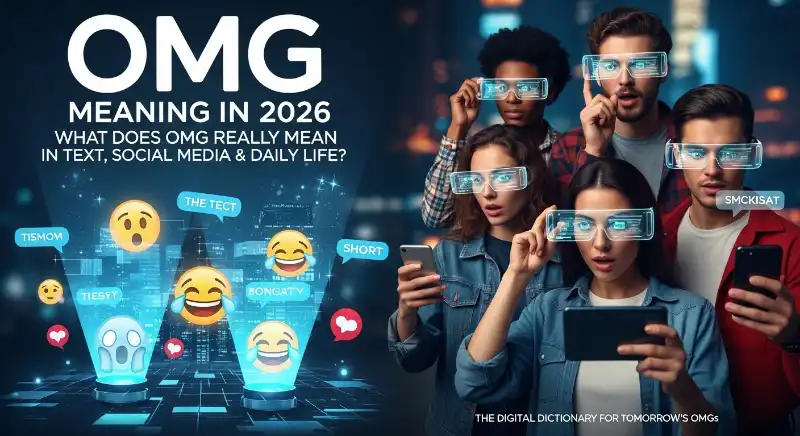
What does OMG meaning? “OMG” is one of the most searched internet abbreviations, frequently appearing in text messages, social media captions, comment sections, and everyday digital conversations.
People search omg meaning because they want more than just the full form. They want to understand tone, intention, and whether it’s okay to use in texting, Snapchat, TikTok, emails, or even real-life conversations. In 2026, short-form communication dominates digital culture and acronyms like OMG continue shaping how we express emotion online.
But here’s the interesting part.
Beyond its literal definition, many people are unsure whether saying “OMG” sounds rude, dramatic, flirty, sarcastic, or even religiously insensitive. Parents question how teens use it. Professionals hesitate before typing it in workplace chats. Non-native English speakers want clarity before adopting it.
Language is simple. Tone is not.
Quick Direct Answer
OMG stands for “Oh My God.”
It is an informal exclamation used to express surprise, excitement, shock, disbelief, or strong emotion in texting and online communication.
Example:
“OMG, I can’t believe you did that!”
It functions as an emotional reaction — not a complete sentence — and its meaning depends heavily on context.
In the sections that follow, we’ll explore when it feels natural, when it feels awkward, and how to use it confidently in 2026’s digital world.
What Does OMG Mean? Full Form & Simple Definition
What Is the Full Form of OMG?
OMG stands for “Oh My God.”
It’s not a full sentence. It’s an exclamation — a quick emotional reaction people use when they feel:
- Shock
- Excitement
- Surprise
- Disbelief
- Strong emotion
Think of it like dropping your phone and saying, “Oh my God!” — but in text form.
For example:
- “OMG, I can’t believe you won!”
- “OMG that movie ending was wild.”
It’s fast, expressive, and easy to type — which explains why people keep searching things like:
- what is omg mean
- what do omg mean
- whats omg mean
- what does omg mean?
Even if the grammar in the search varies, the curiosity is the same.
How Is OMG Used as an Exclamation?
OMG replaces longer emotional reactions.
Instead of writing:
“I am extremely surprised by this unexpected situation.”
Most people just type:
“OMG!”
It works alone or with punctuation:
- OMG!
- omg…
- Omg???
- OMG 😂
Capital letters usually show stronger emotion. Lowercase can feel softer or casual.
In texting, speed matters. And OMG delivers emotion instantly.
What Does OMG Mean in Text Messages & Online Chats?
How Is OMG Used in Casual Text Conversations?
In texting, OMG is often the first reaction in a conversation.
Imagine this chat:
Friend: “Guess what? I just met my favorite actor.”
You: “OMG NO WAY.”
Or:
Sibling: “I accidentally deleted the project.”
You: “OMG… are you serious?”
In quick chats, people don’t type full emotional paragraphs. They type reaction signals.
That’s why searches like:
- what does omg mean in text
- what does omg mean in a text
- what does omg mean in texting
continue trending.
It’s less about dictionary meaning — and more about tone.
What Does OMG Signal in Social Media Comments?
On social platforms, OMG works like a reaction button.
Under a viral video:
“OMG this is insane.”
Under a celebrity photo:
“OMG you look amazing.”
It’s short. It grabs attention. It signals shared emotion.
In 2026, short-form content dominates. Attention spans are shorter. Reactions are faster. And OMG fits perfectly into that culture.
People often pair it with emojis:
- OMG 😱
- OMG 😂
- OMG I’m crying
It’s emotional shorthand.
Is Saying OMG Rude, Disrespectful, or Offensive?
Why Some People Find OMG Offensive
Here’s where things get sensitive.
Because OMG stands for “Oh My God,” some people feel it uses God’s name too casually. In certain religious traditions, that can be seen as disrespectful.
Older generations may view it differently than Gen Z. What feels harmless to one person may feel inappropriate to another.
This is why some parents ask:
- can omg mean oh my gosh
- is omg bad to say
The concern isn’t about slang — it’s about reverence.
When OMG Is Considered Acceptable
In casual texting among friends? Completely normal.
In formal religious settings? Probably not appropriate.
In workplace emails? Best avoided.
Context matters more than the word itself.
For example:
- Text to friend: “OMG this is hilarious.” ✅
- Email to boss: “OMG the numbers dropped.” ❌
Language is social. And audience awareness is power.
OMG vs Oh My Gosh vs OML — What’s the Difference?
How Does OMG Compare to “Oh My Gosh”?
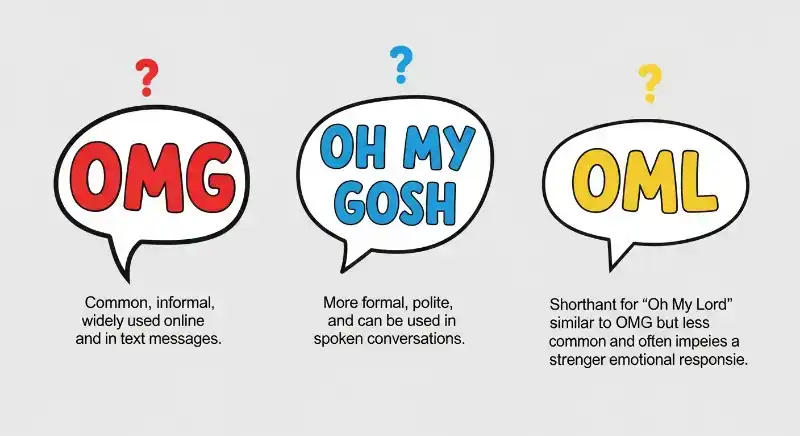
“Oh My Gosh” is a softer version.
It avoids religious sensitivity while keeping the emotion.
So yes — OMG can mean “Oh My Gosh” in practice, even though its literal full form is “Oh My God.”
Many parents encourage kids to use “gosh” instead.
Tone scale:
- Oh My God → Stronger, dramatic
- Oh My Gosh → Softer, neutral
- Oh My Goodness → Even more gentle
What Is OML and How Is It Different?
OML stands for “Oh My Lord.”
It’s similar emotionally but less common than OMG.
In 2026 slang cycles, OMG remains dominant. OML trends occasionally but hasn’t replaced it.
Example comparison:
- “OMG I can’t believe it.”
- “Oh my gosh, that’s amazing.”
- “OML this is chaos.”
They all show emotion — but with slightly different intensity.
How Should You Reply When Someone Says OMG?
Casual and Friendly Responses
When someone texts “OMG,” they’re signaling emotion.
You can respond by:
- Asking what happened
- Matching their energy
- Clarifying context
Examples:
- “What?? Tell me everything.”
- “Wait, why OMG?”
- “Good OMG or bad OMG?”
It keeps the conversation flowing.
Playful or Dramatic Comebacks
If it’s a fun moment, you can escalate playfully:
- “I KNOW RIGHT?!”
- “You’re not ready for this.”
- “Brace yourself…”
OMG often opens the door for storytelling.
In 2026, even toy collectors search:
- what does omg mean in lol surprise dolls
- what does omg mean in lol dolls
In that case, “OMG” is part of a doll product line — not an emotional reaction.
Baseball fans also ask:
- what does omg mean for ny mets
- what does the mets omg mean?
Sometimes slang becomes branding.
Language evolves. Context multiplies.
And three tiny letters keep surprising us.
Would you like me to continue with the second half of the article covering:
- Professional use boundaries
- Common mistakes
- Urdu meaning of OMG
- Why “OMG meaning” is trending again in 2026
- The psychology behind saying OMG
I’ll keep the same human, engaging tone.
Let’s continue and complete the second half of your 2026-ready, Discover-friendly article
Perfect — let’s continue and complete the second half of your 2026-ready, Discover-friendly guide.
Can You Use OMG in Professional or Academic Communication?
Why OMG Is Too Informal for Business Emails
Imagine opening an email from your manager that says:
“OMG the client hated the proposal.”
It feels… off, right?
In professional settings, tone carries weight. Words signal credibility. While OMG works beautifully in casual texting, it can sound:
- Too emotional
- Too dramatic
- Unpolished
- Lacking seriousness
Workplace communication prioritizes clarity over reaction.
In academic writing, it’s even more inappropriate. Research papers, formal emails, university assignments — these spaces value structured language, not expressive shorthand.
In 2026, even though digital communication is casual, professional standards haven’t disappeared.
What to Say Instead in Formal Writing
Instead of “OMG,” try:
- “This is unexpected.”
- “This development is surprising.”
- “We need to review this urgently.”
- “I was not anticipating this outcome.”
Notice the shift?
You move from emotional reaction to analytical response.
That’s the difference between texting a friend and writing to a client.
Common Mistakes People Make When Using OMG
Overusing OMG in Serious Conversations
Here’s a subtle problem.
If someone says “OMG” in every message, the impact disappears.
For example:
- “OMG I’m tired.”
- “OMG it’s raining.”
- “OMG I forgot my pen.”
- “OMG traffic again.”
Overuse creates emotional inflation.
It’s like using an exclamation mark in every sentence. Eventually, nothing feels urgent anymore.
Moderation makes expression powerful.
Misinterpreting Tone in Digital Messages
Text has no facial expression. No voice. No body language.
So when someone writes:
“OMG…”
Are they excited? Shocked? Annoyed? Disappointed?
Tone depends entirely on context.
A simple example:
Friend 1: “I just quit my job.”
Friend 2: “OMG.”
That could mean:
- “OMG I’m proud of you.”
- “OMG are you okay?”
- “OMG that’s risky.”
This is why digital communication requires emotional awareness.
Three letters can carry multiple meanings.
What Is the Meaning of OMG in Urdu and Other Languages?
Urdu Translation and Usage Context
In Urdu, OMG is often translated loosely as:
- “یا اللہ” (Ya Allah)
- “اوہ میرے خدا” (Oh Mere Khuda)
But here’s the interesting part.
Many Urdu speakers — especially younger users — simply type “OMG” in Roman English even while chatting in Urdu.
Example:
“OMG yeh kya ho gaya?”
(OMG what just happened?)
In 2026, bilingual digital culture is normal. Slang crosses languages faster than ever.
How Non-Native Speakers Interpret OMG
For English learners, confusion often starts with grammar.
Search queries like:
- what does omg mean
- what dose omg mean
- what omg mean
show that people are trying to understand structure and tone at the same time.
Non-native speakers often learn:
- Literal meaning first
- Emotional tone later
Because slang isn’t just vocabulary — it’s cultural behavior.
Understanding when and how to use OMG correctly builds confidence in digital communication.
Why Is “OMG Meaning” Trending Again in 2026?
Rise of Short-Form Communication
We live in the era of:
- Voice notes
- Reaction comments
- One-line captions
- Micro-messaging
Short-form language is dominant again.
Gen Z and Gen Alpha use fast reactions more than long explanations. Ironically, even though OMG is older internet slang, it’s cycling back into visibility.
Language trends are like fashion.
Some slang fades away. Some sticks around. And some makes a comeback.
OMG never fully disappeared — but in 2026, it feels refreshed by meme culture and reaction-driven platforms.
Search Intent Behind Slang Queries
Why are people searching “what does omg mean?” again?
Several reasons:
- Parents monitoring teen slang
- Professionals unsure about tone
- Non-native speakers learning English
- Brand names using OMG in products
- Sports fans asking what does the Mets OMG mean
When language appears across toys, sports, vapes, and social media, curiosity spikes.
Search engines reflect social confusion.
And slang curiosity is timeless.
The Psychology Behind Saying “OMG meaning” in Digital Communication
Why Humans Use Short Emotional Expressions
Our brains love efficiency.
Instead of typing:
“I am experiencing sudden excitement and surprise.”
We type:
“OMG!”
It’s cognitive compression.
Short emotional signals help us:
- Express feeling instantly
- Create connection quickly
- Reduce typing effort
- Maintain conversation rhythm
In fast-moving chats, speed equals engagement.
How OMG Strengthens Social Connection Online
Here’s something fascinating.
Shared reactions create bonding.
If two people watch the same viral video and both type:
“OMG 😂”
They’re aligning emotionally.
That alignment builds micro-connections.
Exaggeration online isn’t always drama — it’s social glue.
Small emotional bursts like OMG signal:
- “I feel this with you.”
- “We’re reacting together.”
- “We’re on the same page.”
In a digital world, that matters more than ever.
People Also Ask About OMG meaning
What does OMG mean?
OMG means “Oh My God.” It’s an informal expression used to show surprise, excitement, shock, or strong emotion in text messages, social media posts, and online chats.
Example:
“OMG, I can’t believe you did that!”
What does OMG mean in text?
When people ask what does OMG mean in text, they usually want to understand tone.
In texting, OMG signals an immediate emotional reaction. It can mean:
- “I’m shocked.”
- “That’s amazing.”
- “Are you serious?”
- “This is unbelievable.”
The exact meaning depends on the situation and the relationship between the people chatting.
What does OMG mean in texting vs real life?
In texting, OMG is quick emotional shorthand.
In real life, someone might actually say “Oh my God” out loud — but often with more voice tone and facial expression.
Online, it replaces those non-verbal cues.
Can OMG mean “Oh My Gosh”?
Yes. While OMG literally stands for “Oh My God,” many people use it to mean “Oh My Gosh” to avoid religious sensitivity. The emotional tone stays similar — the wording feels softer.
Is saying OMG rude or offensive?
It depends on the audience.
- Among friends: Usually harmless.
- In religious settings: Some may find it disrespectful.
- In professional environments: Too informal.
Context matters more than the letters themselves.
What does OMG mean in LOL Surprise dolls?
In LOL Surprise dolls, “OMG” is part of a product line name. It doesn’t function as an emotional expression there — it’s branding.
This is why some parents search:
- what does omg mean in lol dolls
- what does omg mean for lol dolls
It’s a name, not slang, in that context.
What does the Mets OMG mean?
When people search what does the Mets OMG mean, they’re usually referring to a slogan, chant, or fan expression tied to the New York Mets. In sports culture, OMG often becomes a hype reaction rather than a literal phrase.
Again, context changes meaning.
What does OMG mean on a vape?
Sometimes “OMG” appears as a flavor or brand name in vape products. In those cases, it’s marketing language — meant to signal excitement or intensity — not a conversational exclamation.
Conclusion: What Does OMG Meaning — And How Should You Use It?
Let’s bring it all together.
OMG stands for “Oh My God.” It’s an informal exclamation used to express surprise, excitement, shock, or strong emotion in texting and online communication.
It works beautifully in:
- Casual messages
- Social media comments
- Friendly chats
But it’s usually inappropriate in:
- Professional emails
- Academic writing
- Formal communication
Cultural sensitivity also matters. Some people prefer alternatives like “Oh my gosh.” Context determines comfort.
In 2026, OMG remains powerful because it’s simple, fast, and emotionally efficient. It adapts across languages, industries, and generations.
The real key isn’t just knowing what OMG means.
It’s knowing when, where, and how to use it.
And that awareness?
That’s modern digital fluency.
📚 Related Articles
[Why Are So Many Students Confused About Idiom Meaning?]
[What Is the Temu App & How Does It Work?]

Mush explores trending words, viral slang, and social media phrases, explaining them in simple English with fun examples for everyone.

1 thought on “OMG Meaning in 2026: What Does OMG Really Mean in Text, Social Media & Daily Life?”