You’re scrolling through your social media feed, and suddenly a post is blurred with a warning label: NSFW. Or maybe a friend texts you: “Careful, this link is NSFW.” You hesitate. Do you click it? Should you open it at work? What exactly does that acronym mean?
If you’ve ever found yourself confused by this four-letter warning, you’re not alone.
NSFW is everywhere — on Reddit, Discord, Twitter, TikTok, dating apps, and even in work emails. It’s one of the most common internet acronyms, yet surprisingly few people truly understand what it covers. Does it always mean porn? Can a violent video be NSFW? What’s the difference between NSFW and NSFL? And why do people even use this label in the first place?
Here’s the truth: NSFW isn’t just about sex. It’s a content warning — a digital safety net designed to protect you (and sometimes your job) from unexpected, inappropriate, or disturbing material.
In this complete guide, we’ll break down exactly what NSFW means, how it’s used across different platforms, what types of content it covers, and why context matters more than you think. Whether you’re a concerned parent, a curious internet user, or someone who just got their first NSFW tag, this article has everything you need to understand this essential internet label.
Let’s get into it.
What Does NSFW Mean?
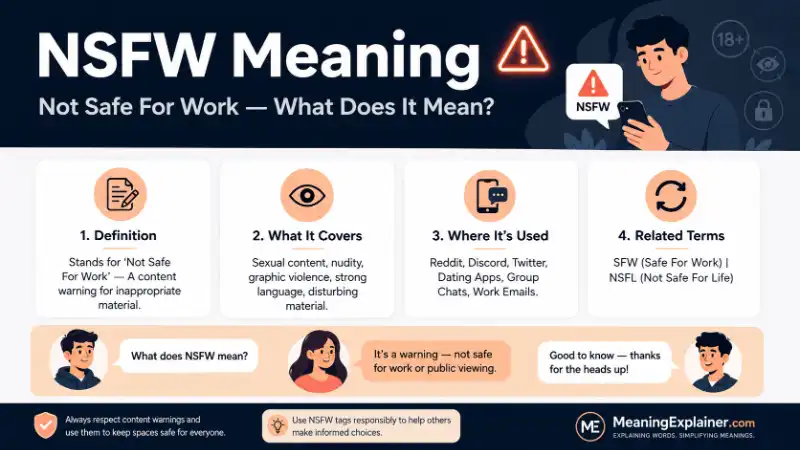
At its most basic level, NSFW stands for “Not Safe For Work.” It’s an internet shorthand used to flag content that might be inappropriate, offensive, or uncomfortable to view in a professional, public, or formal setting.
Think of it as a digital warning sign. When someone tags content as NSFW, they’re essentially saying: “Hey, before you open this, make sure you’re in a private space — because what’s inside might get you in trouble at work, embarrass you in public, or simply shock you.”
The term emerged in the early 2000s on internet forums and message boards, where users needed a quick way to warn others about sensitive content. Over time, it became a standard part of online vocabulary — used everywhere from corporate Slack channels to teenagers’ group chats.
But here’s the important part: NSFW isn’t just one thing. It covers a wide range of material, and its exact meaning depends heavily on context. Let’s break it down properly.
What Does NSFW Stand For?
NSFW is the abbreviation for “Not Safe For Work.” Sometimes you’ll also see it written as “Not Suitable For Work” — but the meaning is identical.
The acronym works like a label. Just like “Parental Advisory” on an album or “Viewer Discretion Advised” on a TV show, NSFW alerts you that the content you’re about to see might not be appropriate for certain environments.
NSFW Meaning in Simple Words
In simple terms, NSFW means:
“This content might be inappropriate to view in a workplace, public place, or formal setting.”
If you’re at work and someone sends you an NSFW link, opening it could lead to:
- An awkward conversation with your boss
- A formal HR warning
- Embarrassment in front of colleagues
- Your screen being seen by someone who shouldn’t see it
The label gives you a choice: Open it now and take the risk, or wait until you’re in a private space.
Where Did the Term NSFW Come From?
The term NSFW originated in the early 2000s on internet forums, especially sites like Something Awful and other early message boards. People needed a quick way to warn others before sharing potentially embarrassing, offensive, or explicit content.
Interestingly, the term isn’t legally or officially defined — it’s entirely community-driven. Over time, it was adopted by mainstream platforms like Reddit, Twitter, and YouTube, and eventually became a standard internet term. Today, it’s recognized globally across multiple languages and cultures.
The Dictionary.com entry for NSFW dates back to around 2000–2005, and by 2015, major dictionaries like Merriam-Webster officially recognized the acronym. That’s when NSFW truly became part of the English language.
How Do You Pronounce NSFW?
NSFW is almost always pronounced letter by letter: EN-ESS-EF-DUBLYOO.
You won’t usually hear it said as a single word (like “nis-foo” or “ness-fwuh”). In conversations, people say each letter individually:
“That link is N-S-F-W, so don’t open it here.”
What Does NSFW Mean in Text Messages?
In text messages and online chats, NSFW serves as a quick warning label before sharing sensitive content. It’s a polite (and sometimes necessary) heads-up that gives the receiver a moment to decide whether they want to see what’s coming.
Texting has its own shorthand culture — LOL, BRB, OMG, etc. — and NSFW fits right in. But unlike other acronyms that just express emotion, NSFW has a real, practical purpose: protection. It protects the sender from being accused of sharing inappropriate content, and it protects the receiver from seeing something they didn’t want to see.
How NSFW Is Used in a Text
Here are the most common ways NSFW appears in a text message:
1. Before sharing a link or image:
“I’m sending you something wild — NSFW, so wait until you’re home.”
“NSFW link incoming… open at your own risk.”
2. Describing content that was already shared:
“Dude, that video you sent was SO NSFW.”
“Did you see that meme? It was totally NSFW.”
3. Asking if something qualifies as NSFW:
“Is this picture NSFW? I don’t want to get in trouble.”
“Would sending this in the group chat be NSFW?”
4. Responding to NSFW content:
“I should have read the NSFW warning before opening that.”
“Thanks for the NSFW label — I’ll check it later.”
What Someone Means When They Say “This Is NSFW”
When someone texts “This is NSFW,” they’re giving you a warning. But what exactly are they warning you about?
- Don’t open this at work: The content could be seen by colleagues, bosses, or HR.
- Don’t open this in public: The content might be embarrassing if someone looks over your shoulder.
- Be mentally prepared: The content might be shocking, disturbing, or graphic.
- Wait for privacy: Open this when you’re alone or in a comfortable space.
It’s important to understand that “This is NSFW” isn’t an invitation to click immediately. It’s a signal to pause and consider your environment before proceeding.
How to Understand NSFW From the Conversation
The exact meaning of NSFW in a text depends heavily on the context of the conversation:
- In a professional chat (Slack, Teams): NSFW almost certainly means don’t open it at work. It could be offensive images, adult content, or even just a meme that’s too edgy for the office.
- In a group chat with friends: NSFW might mean adult humor, suggestive memes, or raunchy jokes. It’s usually playful rather than serious.
- In a family chat: NSFW might mean mild profanity, an awkward topic, or a slightly inappropriate joke.
- On a dating app: NSFW often means sexually suggestive or explicit content. It’s used to test boundaries or set expectations.
The same acronym can mean very different things depending on who you’re talking to and what the conversation is about. That’s why the follow-up question — “What kind of NSFW?” — is always a good idea.
Why Do People Use the NSFW Label?
The NSFW label exists for one primary reason: consent through awareness.
When someone shares content without a warning, they’re forcing the receiver to view something they might not want to see. NSFW restores the element of choice. It says: “This content might be sensitive. Here’s a warning. You decide if you want to continue.”
NSFW as a Content Warning
At its core, NSFW is a content warning — just like:
- “Graphic content” warnings on news sites
- “Trigger warning” labels on social media
- “Viewer discretion is advised” on TV shows
The label serves as a simple, effective way to:
- Protect people from seeing disturbing or unwanted material
- Help people avoid embarrassment or professional consequences
- Give people the choice to opt in or opt out
- Encourage responsible sharing online
Why Context Matters When Something Is Marked NSFW
Here’s where things get tricky: what counts as NSFW in one context might be completely fine in another.
At work:
- A slightly racy meme = definitely NSFW
- Strong profanity = probably NSFW
- Political content = NSFW (if it causes conflict)
Within a private group chat:
- The same racy meme = perfectly fine
- Strong profanity = normal conversation
- Political content = acceptable debate
Over in a family group chat:
- Sexual humor = highly NSFW
- Violent content = very NSFW
- Even mild profanity might be NSFW
The label isn’t absolute — it’s context-dependent. That’s why the same piece of content might get a “NSFW” warning in one setting and be considered perfectly fine in another.
Where You Might See an NSFW Warning
NSFW warnings have become so common that they’re now built into many platforms and communication tools:
- Reddit: Entire subreddits are marked NSFW; individual posts can be tagged too. Reddit’s blur filter automatically hides NSFW content until you click.
- Discord: Servers often have designated NSFW channels where explicit content is allowed. Users must confirm their age before entering.
- Twitter (X): Users can mark media as sensitive content, which creates a blur or warning screen.
- TikTok: Some videos are flagged for mature audiences, showing a content warning before playback.
- YouTube: Mature content warnings appear before potentially inappropriate videos.
- Slack / Teams: Some companies have policies requiring NSFW tags for anything that could offend colleagues.
- Email: People sometimes write “NSFW” in subject lines when sharing sensitive attachments.
What Kind of Content Can Be NSFW?
One of the biggest misconceptions about NSFW is that it only refers to pornography or sexual content. In reality, NSFW covers a much wider range of material.
Here are the most common categories of NSFW content:
Sexual or Adult Content
This is what most people think of when they see NSFW:
- Explicit sexual images or videos
- Pornography
- Sexually suggestive content
- Erotica or explicit written content
Nudity or Suggestive Material
Not all nudity is explicitly sexual, but it’s still often considered NSFW:
- Artistic nudity (photography, paintings)
- Suggestive or revealing clothing
- Semi-nude photos that aren’t explicit
- Lingerie or swimwear content in professional settings
Graphic Violence or Disturbing Images
This category is often overlooked but is equally important:
- Car accident images
- Crime scene photos
- Graphic injuries or medical procedures
- Videos of physical violence
- War or conflict footage
- Animal cruelty content
Strong Language or Offensive Material
Sometimes, NSFW has nothing to do with images at all:
- Extremely vulgar or offensive language
- Racial or discriminatory slurs
- Content that mocks serious topics
- Offensive political or religious humor
Other Inappropriate Content
- Extremely controversial opinions
- Content that could trigger intense emotional reactions
- Something that violates workplace norms (like a joke about your boss)
“This category includes explicit sexual acts, such as those referenced by slang like DATY meaning, which is almost always considered NSFW in professional or public settings.”
Does NSFW Always Mean Sexual Content?
No. And this is perhaps the most important thing to understand about NSFW.
The acronym itself — “Not Safe For Work” — never mentions sex. It mentions work. And there are plenty of things that aren’t safe for work that have absolutely nothing to do with sex.
Why NSFW Can Refer to More Than Adult Content
Think about it: if someone sends you a video of a horrifying car accident at work, is that safe to open? Absolutely not. It might make you physically sick, disturb your colleagues, or even land you in trouble for watching graphic content on company time.
The same goes for:
- A joke that’s extremely offensive to a specific group
- An article with a highly controversial political view
- A video that shows someone getting injured
- An audio recording with screaming or disturbing sounds
None of these are sexual — but all of them are NSFW.
When Violent or Disturbing Content Gets an NSFW Warning
Graphic and violent content is often tagged NSFW for practical reasons:
- Medical procedures: Videos of surgery, injury treatment, or autopsies
- Accidents: Car crash footage, workplace accidents, or natural disaster content
- Violence: Physical altercations, fights, or assault
- Death: Obituaries with graphic descriptions, death scene content
- Psychological distress: Material that could trigger anxiety, PTSD, or panic attacks
In many cases, content like this is more likely to cause workplace trouble than sexual content — especially if someone has a sensitive or empathetic reaction.
Why the Meaning Depends on Context
Let’s look at a quick example to see how context changes everything:
Scenario A: A friend sends you a meme with a swear word.
- At home: perfectly fine, not NSFW.
- At work: might be NSFW depending on workplace culture.
- In front of students (if you’re a teacher): definitely NSFW.
B: You’re watching a news story about a violent protest.
- Watching on TV at home: not NSFW.
- Viewing on your phone at work: could be NSFW if colleagues see it.
- Opening during a meeting: absolutely NSFW.
C: An artistic nude painting.
- Displayed in an art gallery: completely fine.
- Viewing on your phone during lunch: maybe NSFW.
- Emailing to a client: extremely NSFW.
The content hasn’t changed. The context has. And context is everything when it comes to NSFW.
What Does NSFW Mean on Different Platforms?
The meaning of NSFW doesn’t change across platforms — it always means “Not Safe For Work” — but how it’s used, enforced, and understood varies significantly depending on where you encounter it.
Some platforms have built-in NSFW filters and content warnings. Others rely entirely on users to add the label themselves. Understanding these platform-specific nuances can save you from awkward situations — or even getting banned.
NSFW on Social Media (Reddit, Discord, Twitter, TikTok)
Reddit:
Reddit is probably the most NSFW-friendly major platform. Entire subreddits are dedicated to NSFW content — and Reddit has a clear system for handling it:
- Subreddits can be marked as “NSFW” (18+), meaning all posts in that community are age-restricted.
- Individual posts can also be tagged NSFW, which blurs the image or video until clicked.
- Users must confirm they are 18+ before entering NSFW subreddits.
- Reddit’s NSFW filter can be toggled on or off in user settings.
Discord:
Discord takes a community-driven approach to NSFW content:
- Servers can create dedicated NSFW channels where explicit content is allowed.
- Users must confirm their age (18+) before viewing these channels.
- NSFW content is strictly prohibited in non-NSFW channels.
- Server owners are responsible for enforcing these rules, or they risk having their server reported or removed.
Twitter (X):
Twitter’s approach is more cautious:
- Users can mark their media as “sensitive content” in settings.
- When sensitive content is posted, Twitter adds a warning screen that blurs the image or video.
- Viewers must click “View” to see the content.
- Twitter’s algorithm also flags content automatically, though this system isn’t perfect.
TikTok:
TikTok has a more restrictive policy:
- NSFW content is generally against TikTok’s community guidelines (especially explicit sexual content).
- However, some mature content (dark humor, suggestive dancing, mild violence) may be age-restricted.
- Videos with mature themes show a warning screen before playing.
- TikTok’s algorithm heavily restricts NSFW content from appearing on the For You Page.
NSFW on Dating Apps
On dating apps like Tinder, Bumble, Hinge, and Grindr, NSFW takes on a slightly different meaning. Here, it’s often used to:
- Signal sexual openness: Users might mention “NSFW” in their bios to indicate they’re open to adult conversations or content.
- Test boundaries: Someone might say, “My profile is NSFW, so swipe left if that makes you uncomfortable.”
- Share explicit photos: Some apps allow users to share NSFW images in private messages — though this often violates terms of service, so proceed with caution.
- Set expectations: If someone says their conversations “get NSFW,” they’re telling you things might get spicy.
However, a word of caution: most mainstream dating apps prohibit explicit nudity and pornography in public profiles. Sending unsolicited NSFW content on these platforms can get you reported or banned. Always ask before sending anything explicit.
“If you’re navigating dating apps and see NSFW warnings, it often connects to casual relationship dynamics — like FWB meaning, where boundaries around sharing explicit content are frequently discussed.”
What Does NSFW Mean in AI and Online Tools?
This is one of the most modern and rapidly evolving aspects of NSFW. As AI tools become more common, the term has taken on new meaning in the tech world.
AI Content Moderation:
Many AI platforms (like ChatGPT, Claude, and image generators) use NSFW filters to automatically block certain types of content. If you ask an AI to create something “NSFW,” it will often refuse — or give you a safe, heavily censored version.
NSFW Filters in Image Generators:
AI image generators like DALL-E, Midjourney, and Stable Diffusion have built-in NSFW filters that prevent the creation of explicit, violent, or inappropriate images. This is done to:
- Comply with legal and ethical guidelines
- Prevent misuse of the technology
- Protect the platform from liability
NSFW Meaning in AI Tools:
When an AI tool mentions “NSFW,” it generally means:
“Content that violates our content policy — including explicit sexual material, extreme violence, hate speech, or harmful content.”
Why AI Platforms May Treat NSFW Content Differently:
- Some AI platforms (like open-source models) allow NSFW content if hosted locally.
- Mainstream AI tools strictly prohibit NSFW content to maintain a safe, professional image.
- The definition of NSFW in AI is often broader than on social media — it includes not just sex and violence, but also harassment, self-harm content, and dangerous instructions.
NSFW vs. SFW vs. NSFL
To fully understand NSFW, you need to know its two closest relatives: SFW and NSFL.
These three acronyms form a content-warning spectrum, each with its own specific purpose.
What SFW Means
SFW stands for “Safe For Work.” It’s the direct opposite of NSFW.
When someone tags content as SFW, they’re saying:
“This content is appropriate to view in any setting — including work, public spaces, and formal environments.”
Common uses of SFW:
- Content that is clean, professional, and inoffensive
- Links that are safe to open during a meeting
- Images and videos that won’t embarrass you or get you in trouble
Interestingly, SFW is used less frequently than NSFW. People usually only specify SFW when they’re explicitly contrasting it with NSFW — for example:
“Don’t worry, this version is SFW. The NSFW one is for later.”
What NSFL Means
NSFL stands for “Not Safe For Life.” Yes, it sounds dramatic — and that’s intentional.
NSFL is a step above NSFW. It warns about content that is not just inappropriate for work, but potentially traumatizing, deeply disturbing, or emotionally scarring.
Examples of NSFL content:
- Real gore and death footage
- Graphic crime scene images
- Videos of violence, torture, or accidents
- Content depicting extreme cruelty to animals or humans
- Material that could trigger severe PTSD, anxiety, or panic attacks
While NSFW is a warning, NSFL is a stronger, more serious warning. It says: “This content might genuinely upset you. Open it with extreme caution — or not at all.”
The Difference Between NSFW and NSFL
| Aspect | NSFW | NSFL |
|---|---|---|
| Stands For | Not Safe For Work | Not Safe For Life |
| Severity | Mild to moderate warning | Severe, strong warning |
| Primary Concern | Professional/social embarrassment | Emotional or psychological distress |
| Typical Content | Sexual content, nudity, profanity, mild violence | Gore, death, extreme violence, trauma |
| Viewer Reaction | Awkwardness, offense, mild discomfort | Shock, distress, nightmares, emotional harm |
| Who Uses It | General internet users | Reddit, gore forums, extreme content communities |
Important Note: NSFL is far less common than NSFW. When people use it, they typically mean it seriously. If someone says “NSFL,” it’s wise to take their warning at face value and think twice before clicking.
How to Use an NSFW Warning
Understanding NSFW is one thing. Knowing how to use it properly — and responsibly — is another.
Using the NSFW label correctly protects both you and the people you share content with. Here’s what you need to know.
When It Makes Sense to Add an NSFW Label
Here’s a simple rule of thumb: when in doubt, tag it out.
If you’re not sure whether something is NSFW, it’s usually better to add the warning anyway. A little extra caution never hurts.
Specific situations where you should definitely add an NSFW label:
- Before sending a link or image that contains nudity, sexuality, or suggestive material.
- Before sharing anything with strong profanity, offensive language, or crude humor.
- Before sending graphic content like violent videos, accident footage, or medical imagery.
- When the content might be embarrassing if viewed in a public setting.
- When you’re in a professional chat (Slack, Teams, etc.) — even if you think it’s harmless.
Why You Should Warn Before Sharing Sensitive Content
Adding an NSFW label isn’t just polite — it’s responsible. Here’s why:
- It gives people a choice: No one should be forced to see something they don’t want to see. NSFW restores that choice.
- It prevents professional consequences: Someone could lose their job if they open inappropriate content at work. A simple label prevents this.
- It avoids embarrassment: Opening racy content in public or in front of family can be humiliating. NSFW stops this from happening.
- It shows respect: Tagging content as NSFW shows you respect other people’s boundaries, comfort levels, and circumstances.
- It builds trust: People will trust your judgment more if you consistently warn them before sharing sensitive material.
What an NSFW Label Does Not Tell You
While NSFW is helpful, it’s also limited. Here’s what the label does not communicate:
- What kind of NSFW content it is: Is it sexual? Violent? Offensive? Disturbing? You won’t know until you click.
- How intense it is: Is it mild nudity or hardcore pornography? A slight gore or a full crime scene photo? The label doesn’t specify.
- Whether it’s NSFW for everyone: Something that’s NSFW in a conservative office might be fine in a creative agency. Context still matters.
- The user’s personal boundaries: Some people are okay with NSFW content; others are not. The label doesn’t tell you about the individual’s preferences.
That’s why best practice is: add a NSFW label and a brief description. For example:
- “NSFW: This is a graphic medical video.”
- “NSFW: Nudity ahead, just so you know.”
- “NSFW warning — violent content.”
A little extra context makes the warning much more useful.
NSFW Meaning Examples in Text and Chat
Sometimes the easiest way to understand a term is to see it in action. Here are realistic examples of how NSFW appears in everyday conversations.
Example of an NSFW Warning
Scenario: Someone is about to share an explicit meme in a group chat.
Alex: “I just found the funniest meme, but it’s super NSFW. Should I send it?”
Jordan: “How NSFW are we talking?”
Alex: “Nudity and some really dark humor.”
Jordan: “Skip it for this chat. My boss is next to me.”
Alex: “Good call. I’ll save it for later.”
Scenario: Someone sends a link with a warning.
Taylor: “Check out this link I found: [link] — careful, it’s NSFW.”
Morgan: “NSFW? What kind? Porn or something else?”
Taylor: “No, it’s actually a wild news story about a car chase. Just has a few swear words.”
Morgan: “Oh, I can open that now then. Thanks for the heads up.”
Example of Asking “Is This NSFW?”
Scenario: Someone isn’t sure if their content is appropriate for a professional chat.
Casey: “Hey, is this meme safe to send in the company Slack channel? [sends meme]”
Drew: “Oh, definitely not. That has a swear word in it. Nick (our boss) is in that channel. That’s NSFW.”
Casey: “Thanks, I’ll keep it for the group chat with friends.”
Scenario: Someone asks before clicking.
Riley: “Someone just sent me this link. Is it NSFW?”
Quinn: “Yeah, it’s a bit racy. Don’t open it at your desk.”
Riley: “Got it. I’ll wait until I’m on my phone at home.”
Example of Responding to an NSFW Message
Scenario: Someone accidentally opened NSFW content without realizing it.
Sam: “Oof, I just opened that video you sent at my desk.”
Jamie: “I said NSFW! Why did you open it at work?”
Sam: “I didn’t see the warning until after. Luckily no one saw.”
Jamie: “Lesson learned — always check for NSFW before clicking.”
Scenario: Someone thanks for the warning.
Alex: “That was hilarious, but thank you SO much for the NSFW label. I was in the middle of a meeting. Would have opened it otherwise.”
Chris: “Haha no problem. I always warn first. Boundaries matter.”
Frequently Asked Questions About NSFW
These are the most common lingering questions people have about NSFW — covering edge cases, common misconceptions, and practical scenarios.
Is NSFW the Same as Porn?
No. This is one of the biggest misconceptions about the term.
While pornography is certainly NSFW, not all NSFW content is pornographic. NSFW can refer to:
- Violent or disturbing content
- Graphic medical imagery
- Extremely offensive language
- Controversial political material
- Anything else that’s inappropriate for a workplace or public setting
Think of it this way: All porn is NSFW, but not everything NSFW is porn.
Is NSFW a Bad Word?
No. NSFW is not a swear word, an insult, or a derogatory term. It’s a label — a content warning. It’s no different from “Viewer Discretion Advised” or “Parental Advisory.”
Using the NSFW label is actually a sign of consideration. It means you care about other people’s comfort and boundaries, and you’re giving them the choice to opt in or out.
Can Something Nonsexual Be NSFW?
Absolutely. In fact, some nonsexual content is more NSFW than sexual content in certain environments.
Consider these examples:
- A video of someone getting seriously injured in a workplace accident — definitely NSFW, not sexual at all.
- A meme that mocks a sensitive political topic — could be NSFW in a politically mixed setting.
- An article with extremely graphic descriptions of violence — NSFW, zero sex.
- An audio clip with screaming or crying — NSFW, no sexual content at all.
The rule is simple: if it’s not appropriate for work or public viewing, it’s NSFW — regardless of what category it falls into.
What Should I Do If Someone Sends Me an NSFW Link?
Here’s a quick action plan for handling NSFW content sent to you:
- Don’t open it immediately. Check the warning and think about your environment.
- Ask clarifying questions if needed: “What kind of NSFW is this? Sexual? Violent? Just funny?”
- Wait until you’re in a private setting before opening, especially if you’re at work or in public.
- If you’re uncomfortable: It’s okay to say, “Thanks, but I’d rather not see this.”
- If it’s unsolicited and inappropriate: You have the right to ask the sender not to send NSFW content to you. If they persist, consider blocking them.
Final Takeaway: What NSFW Really Means
At the end of the day, NSFW is about communication and consent.
It’s a simple, powerful label that lets people navigate online spaces more safely. It protects jobs, preserves privacy, and gives people the freedom to choose what they see — and when they see it.
The key takeaways are:
- NSFW stands for “Not Safe For Work” — it’s a content warning, not a value judgment.
- It covers far more than just sexual content — violence, profanity, disturbing imagery, and more.
- Context is everything — what’s NSFW in one setting might be perfectly fine in another.
- Using the label is an act of responsibility — it shows you respect others and want to share content ethically.
Whether you’re sending a spicy meme, sharing a graphic news story, or just trying to understand why someone tagged their post “NSFW,” this label exists to make the internet a safer, more considerate place.
So the next time you see NSFW, pause. Think about your environment. Make a conscious choice. And if you’re the one sharing — always, always warn first.