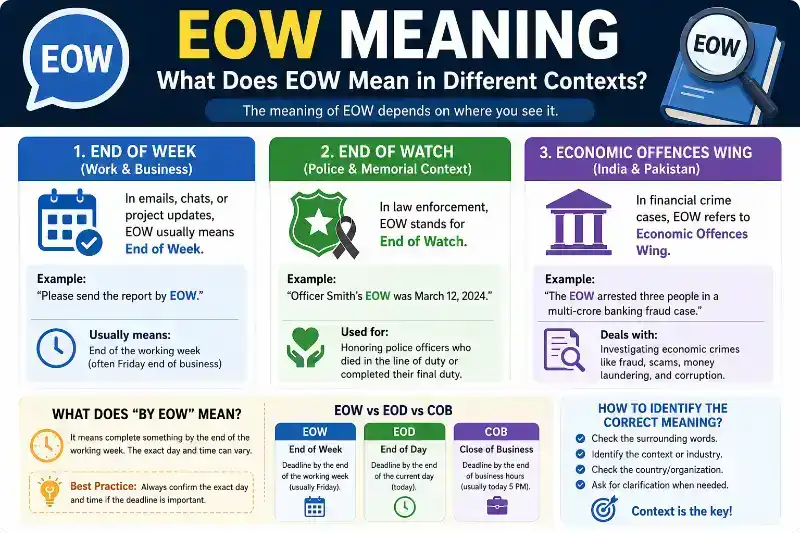
Have you seen EOW in an email, work message, project update, police record, or government document and wondered what it actually means?
You are not alone. The abbreviation EOW can have different meanings depending on where you see it. In one situation, it may mean End of Week. In another, especially in a police memorial, it may mean End of Watch. In some government and investigation contexts, particularly in India, it can also mean Economic Offences Wing.
This can create a real problem: you may know what the letters EOW stand for, but still not know which meaning applies to your situation.
Are you trying to understand an EOW deadline in an email? Are you confused about whether “by EOW” means Friday, the end of the working day, or the end of Sunday? Did you see EOW in a police or government context and want to know what it means there?
If so, you are in the right place.
This guide will help you identify where you saw EOW, understand the meaning that fits that context, and know what you should do next. Instead of giving you one vague definition, we will solve the confusion step by step.
What Does EOW Mean? The Quick Answer
The most common meaning of EOW in workplace and business communication is:
End of Week
For example:
“Please send me the report by EOW.”
This usually means the sender wants the report before the agreed end of the current working week.
However, EOW does not always mean End of Week.
Depending on the context, EOW may also refer to:
- End of Watch in police and law-enforcement memorial contexts.
- Economic Offences Wing in certain government and police investigation contexts, particularly in India.
So before assuming the meaning, the first step is simple:
Look at the context where EOW appears.
The Most Common Meaning: End of Week
If you see EOW in:
- a work email
- a Slack or Teams message
- a project update
- a task list
- a business deadline
- a manager’s request
it will usually mean:
End of Week
For example:
“Can you complete the presentation by EOW?”
The person is asking you to finish the presentation by the end of the week.
But there is still an important question:
Exactly when does the week end?
That depends on the company, country, work schedule, and the person using the abbreviation. We will explain how to solve that confusion later in this guide.
Why Can EOW Have Different Meanings?
EOW is an abbreviation, and abbreviations do not always have only one meaning.
The same three letters can represent different phrases in different industries and situations.
For example:
Workplace context → End of Week
Police memorial context → End of Watch
Certain investigation or government contexts → Economic Offences Wing
That is why searching only for:
“EOW meaning”
may not immediately solve your problem.
A better question is:
“Where did I see EOW?”
Once you know the context, finding the correct meaning becomes much easier.
Where Did You See EOW? Find the Right Meaning for Your Context
Use this section as a quick way to identify the meaning you need.
If You Saw EOW in an Email, Workplace Message, or Project Update
In most professional communication, EOW means:
End of Week
Example:
“Please share the final numbers by EOW.”
The sender is giving you a deadline that falls at the end of the working week.
Your next step should be to determine:
- Which week are they referring to?
- Which day counts as the end of the workweek?
- What exact time is expected?
Do not automatically assume that EOW means midnight on Sunday or 5:00 PM on Friday. If the deadline matters, confirm the exact expectation.
If You Saw EOW in a Deadline or Schedule
Again, EOW usually means:
End of Week
Example:
“The development team will complete testing by EOW.”
Here, EOW is being used to give a time limit.
The important thing to understand is that EOW is often less precise than a specific date and time.
For example, these instructions are clearer:
“Complete the task by Friday, September 4, at 5:00 PM.”
Compared with:
“Complete the task by EOW.”
The second sentence can create confusion if different people have different ideas about when the week officially ends.
If You Saw EOW in a Police Memorial or Officer Record
In this context, EOW usually means:
End of Watch
The phrase is used in law-enforcement contexts and can refer to the end of an officer’s duty.
However, it is especially associated with memorial and remembrance contexts involving officers who died while serving.
Example:
“Officer John Smith’s EOW was listed as May 15.”
In this type of context, EOW does not mean End of Week.
The words surrounding the abbreviation will usually make the meaning clear.
Look for references to:
- an officer
- police service
- line of duty
- memorials
- fallen officers
- dates of death
If those clues are present, EOW most likely means End of Watch.
If You Saw EOW in an Indian Government or Police Investigation Context
In some Indian government and police contexts, EOW can mean:
Economic Offences Wing
This generally refers to a unit involved in investigating serious financial and economic offences.
For example, the surrounding context may involve:
- fraud
- financial crimes
- corporate investigations
- cheating cases
- economic offences
- police investigations
In this situation, EOW is not referring to a deadline or the end of the week.
It refers to an organization or investigative unit.
When the Context Is Unclear: How to Identify the Correct Meaning
If you still do not know what EOW means, use this simple process.
Step 1: Look at the surrounding words.
If the sentence mentions:
Report, task, Friday, deadline, project
EOW probably means End of Week.
If it mentions:
Officer, police, memorial, fallen, line of duty
EOW probably means End of Watch.
If it mentions:
Fraud, investigation, police case, financial crime
EOW may mean Economic Offences Wing, depending on the country and organization involved.
Step 2: Identify the industry or source.
Ask:
Is this from a workplace, police organization, government document, or news report?
The source often tells you the correct meaning.
Step 3: If the meaning affects your action, confirm it.
This is particularly important with work deadlines.
If someone tells you:
“Please complete this by EOW.”
and you are unsure about the exact deadline, asking for clarification is better than making an incorrect assumption.
What Does “By EOW” Mean?
The phrase “by EOW” usually means:
Complete something before the end of the week.
Example:
“Please submit the proposal by EOW.”
The person expects the proposal to be submitted before the current week’s agreed ending point.
However, “by EOW” can still be unclear.
The biggest questions are:
- Does EOW mean Friday?
- Does it mean the end of business hours on Friday?
- Does it mean Friday at midnight?
- Does it include Saturday or Sunday?
- Does the company have a different workweek?
These questions matter when you are dealing with an important deadline.
What Day Does EOW Usually Refer To?
In many professional workplaces, EOW commonly refers to the end of the standard workweek.
For many organizations, that means:
Friday
However, you should not treat Friday as a universal rule.
Workweeks can differ depending on:
- the country
- the organization
- company policy
- industry
- individual work schedules
For example, a company may operate from Monday to Friday, while another organization may have a different weekly schedule.
The safest approach is:
Use the organization’s normal working week as your starting point, then confirm if necessary.
StatusDraft
Does “By EOW” Usually Mean Friday?
In many business environments:
Yes, EOW often means Friday.
But there is an important difference between:
“By Friday”
and:
“By EOW”
“By Friday” identifies a specific day.
“By EOW” depends on what the sender considers the end of the working week.
That is why EOW can create unnecessary confusion.
If you are sending an important deadline, it is better to write:
“Please send it by Friday at 5:00 PM.”
instead of:
“Please send it by EOW.”
The first version leaves much less room for misunderstanding.
What Time Does an EOW Deadline End?
There is no single universal time that automatically applies to every EOW deadline.
The deadline might mean:
- the end of normal business hours
- the end of the employee’s working day
- a specific company cutoff time
- midnight, depending on the system or agreement
That is why you should never assume the exact time when the task is important.
For example, if someone says:
“Please submit it by EOW.”
a professional clarification could be:
“Just to confirm, would you like this submitted by the end of business on Friday?”
This protects both you and the other person from misunderstanding.
Does EOW Include the Weekend?
This depends on how the person or organization defines the end of the week.
In many office environments, EOW refers to the end of the business week, which is often Friday.
In other contexts, someone may use “end of week” to mean the calendar week’s end.
Because of this difference, the safest rule is:
Do not assume. Confirm the deadline if the exact day matters.
What Should You Do If Someone Gives You an EOW Deadline?
If someone gives you an EOW deadline, do not panic and do not immediately guess.
Use this simple process.
How to Confirm the Exact Day and Time
First, check whether the message already provides additional information.
For example:
“Please finish this by EOW Friday.”
In this case, Friday is clearly identified.
But if the message only says:
“Please finish this by EOW.”
and the deadline is important, clarify it.
You can ask:
“Just to confirm, should I have this completed by the end of business on Friday?”
This is clear, professional, and prevents confusion.
What to Ask When “EOW” Is Ambiguous
You can use simple questions such as:
“Could you please confirm the exact deadline for EOW?”
Or:
“When you say EOW, do you mean the end of business on Friday?”
Or:
“Would you like this completed by Friday, or does the deadline extend through the weekend?”
These questions are especially useful when:
- the task is urgent
- multiple time zones are involved
- your company has an unusual workweek
- the deadline affects a client or project
- late submission could create a problem
Professional Ways to Respond to an EOW Deadline
If you understand the deadline and can complete the task, you can respond:
“Understood. I will send the completed report by the end of the week.”
If you want to confirm the exact timing:
“Understood. Just to confirm, should I submit this by the end of business on Friday?”
If you need more time:
“I understand the EOW deadline. Based on the remaining work, would it be possible to extend the deadline until Monday morning?”
The key is simple:
Never remain silent if the abbreviation creates genuine deadline confusion.
Clarifying the deadline early is usually much easier than explaining a missed deadline later.
EOW vs EOD vs COB: What Is the Difference?
EOW is often confused with other workplace abbreviations.
The three most common are:
- EOW
- EOD
- COB
Understanding the difference can help you avoid missing a deadline.
EOW vs EOD
EOW = End of Week
This refers to the end of the working week.
EOD = End of Day
This refers to the end of the current working day.
Example:
“Please send the document by EOD.”
This usually requires action sooner than:
“Please send the document by EOW.”
EOD is day-based.
EOW is week-based.
EOW vs COB
COB = Close of Business
This usually refers to the end of the normal business day.
The exact time can depend on the company.
For example:
“Please reply by COB Friday.”
This usually provides more clarity than simply saying:
“Please reply by EOW.”
However, even COB may require clarification when people work in different time zones.
Which Term Should You Use for a Clear Deadline?
If precision matters, abbreviations are not always the best option.
Instead of writing:
“Please complete this by EOW.”
Write:
“Please complete this by Friday, September 4, at 5:00 PM PKT.”
Or, when working internationally:
“Please complete this by Friday, September 4, at 5:00 PM Eastern Time.”
A specific date, time, and time zone removes most of the confusion.
This is especially important when working with:
- international teams
- remote employees
- clients in other countries
- contractors
- time-sensitive projects
What Does EOW Mean in Police and Memorial Contexts?
If you saw EOW in a police memorial, officer biography, tribute, or law-enforcement record, it usually does not mean End of Week.
In this context, EOW commonly means:
End of Watch
The correct meaning becomes clear from the surrounding context.
For example, if you see:
“Officer James Smith’s EOW was May 15, 2023.”
The sentence is referring to End of Watch, not the end of a working week.
Understanding “End of Watch”
In law-enforcement usage, a watch refers to a period of duty or service.
Therefore, “End of Watch” literally refers to the end of an officer’s watch or duty.
However, the phrase has a special meaning in memorial contexts.
When an officer dies in the line of duty or is being honored after death, EOW may be used together with a date to refer to the officer’s final day of service.
This is why you may see phrases such as:
“End of Watch: May 15, 2023”
in:
- police memorials
- tributes to fallen officers
- officer biographies
- law-enforcement remembrance pages
- official memorial records
How EOW Is Used When Honoring Fallen Officers
In a memorial context, EOW is often used respectfully to mark the date associated with an officer’s final watch.
If the abbreviation appears next to information about:
- a police officer
- law enforcement
- a line-of-duty death
- a memorial
- a fallen officer
then the correct meaning is usually:
End of Watch
How to Avoid Confusing End of Watch With End of Week
Use the surrounding words as your guide.
If the sentence says:
“Please submit the report by EOW.”
EOW most likely means:
End of Week
But if the sentence says:
“Officer Brown’s EOW was listed as June 10.”
EOW means:
End of Watch
The abbreviation is the same, but the context completely changes the meaning.
That is why the safest rule remains:
Never interpret EOW without first looking at the situation in which it appears.
What Does EOW Mean as “Economic Offences Wing”?
In certain government and law-enforcement contexts, particularly in India, EOW can mean:
Economic Offences Wing
This meaning is completely different from both End of Week and End of Watch.
Instead of referring to time or a memorial, EOW in this context refers to an investigative unit dealing with economic or financial offences.
The exact role and structure of such a unit can vary depending on the government organization or jurisdiction.
How the Term Is Used in India
When EOW appears in news reports, legal documents, or police-related discussions involving India, it may refer to an Economic Offences Wing.
The surrounding discussion may involve issues such as:
- financial fraud
- cheating
- corporate fraud
- financial investigations
- economic offences
- business-related crime
For example:
“The case was transferred to the EOW for further investigation.”
Here, EOW does not mean a deadline.
It refers to an investigative authority or unit.
How to Avoid Confusing EOW With Other Government Agency Abbreviations
This is particularly important when reading international news or legal information.
Do not assume that an abbreviation has the same official meaning in every country.
For example:
- In a workplace email, EOW will usually mean End of Week.
- In a police memorial, EOW may mean End of Watch.
- In certain Indian government or investigation contexts, EOW may mean Economic Offences Wing.
In Pakistan, a similar financial-crime function may use a different official name or abbreviation rather than automatically being called EOW.
So, if you see EOW in a government document, ask:
Which country and organization produced this document?
That question can help you identify the correct meaning.
Examples of EOW in Real Sentences
The easiest way to understand an abbreviation is to see how it changes meaning in real sentences.
The examples below show how the same letters can mean completely different things.
EOW Examples in Emails and Work Messages
Example 1:
“Please send the revised proposal by EOW.”
Meaning:
End of Week.
The sender wants the proposal completed before the agreed end of the current working week.
Example 2:
“We expect to have an update for the client by EOW.”
Meaning:
End of Week.
The team expects to provide an update before the week ends.
Example 3:
“Can you finish the review by EOW?”
Meaning:
End of Week.
If the exact deadline is important, the person receiving this message should confirm what day and time the sender means.
EOW Examples in Project Deadlines
Example 1:
“The testing phase should be completed by EOW.”
Meaning:
The work should be finished by the end of the working week.
Example 2:
“Please provide the final status report before EOW.”
Meaning:
The report should be submitted before the week’s deadline.
Example 3:
“We need approval by EOW to keep the project on schedule.”
Meaning:
Approval is required before the end of the current workweek.
EOW Examples in Police and Memorial Contexts
Example 1:
“The officer’s EOW was recorded as March 12.”
Meaning:
End of Watch.
The abbreviation appears in a law-enforcement or memorial context.
Example 2:
“The memorial honored officers whose EOW occurred during the past year.”
Meaning:
End of Watch.
This refers to officers being remembered in a memorial context.
EOW Examples in Government or Investigation Contexts
Example 1:
“The investigation was referred to the EOW.”
Possible Meaning:
Economic Offences Wing, depending on the country and organization.
Example 2:
“The EOW is investigating allegations of financial fraud.”
Possible Meaning:
Economic Offences Wing.
The words investigating and financial fraud make it clear that EOW is not referring to End of Week.
Common Mistakes When Understanding EOW
EOW looks like a simple abbreviation, but people often make mistakes because they assume there is only one meaning.
Here are the most common problems and how to avoid them.
Mistake 1: Assuming EOW Always Means Friday
Many people automatically translate:
EOW = Friday
That can sometimes be correct in a standard Monday-to-Friday workplace, but it is not a universal rule.
Different organizations can have different:
- working schedules
- business days
- regional workweeks
- deadline policies
The Better Approach
Instead of assuming Friday, look at the company’s normal working schedule.
If the deadline is important, ask for a specific date and time.
For example:
“Just to confirm, should I submit this by the end of business on Friday?”
That small clarification can prevent a missed deadline.
Mistake 2: Assuming EOW Means the Same Thing Everywhere
The same abbreviation can change meaning depending on the context.
For example:
Work email → End of Week
Police memorial → End of Watch
Certain government investigation contexts → Economic Offences Wing
The letters alone do not give you the complete answer.
The Better Approach
Always check:
- Where did you see EOW?
- Who wrote it?
- What is the subject of the sentence?
- Which country or industry is involved?
These four questions will usually help you identify the correct meaning.
Mistake 3: Assuming Every EOW Deadline Has the Same End Time
Suppose someone says:
“Send it by EOW.”
One person may think this means:
Friday at 5:00 PM.
Another person may think:
Friday at midnight.
Someone else may think:
The end of Sunday.
This can create serious problems when a task is important.
The Better Approach
Use a specific deadline whenever possible.
Instead of:
“By EOW”
use:
“By Friday at 5:00 PM.”
For international teams, add the time zone as well.
For example:
“By Friday at 5:00 PM PKT.”
This makes the deadline much clearer.
Mistake 4: Using EOW When Clearer Language Is Available
EOW is convenient, but convenience can sometimes create confusion.
If you are assigning an important task, it is often better to use:
- a specific day
- a specific date
- a specific time
- a time zone when necessary
For example, this is vague:
“Please finish it by EOW.”
This is clearer:
“Please finish it by Friday, September 4, at 5:00 PM PKT.”
Clear communication reduces the risk of misunderstanding.
A Simple Way to Identify the Correct Meaning of EOW
Whenever you see EOW, follow this quick checklist.
Step 1: Look at the Subject
Is the sentence about:
- work?
- a deadline?
- a police officer?
- a memorial?
- a financial investigation?
The subject gives you your first clue.
Step 2: Check the Source
Where did you see the abbreviation?
- Email → probably End of Week
- Workplace software → probably End of Week
- Police memorial → probably End of Watch
- Government investigation document → check whether it refers to Economic Offences Wing or another official meaning
Step 3: Look at the Country
Government abbreviations can vary by country.
Never assume that a government abbreviation used in one country has the same official meaning in another.
Step 4: Ask Whether the Meaning Changes Your Action
This is especially important for deadlines.
If misunderstanding EOW could cause you to:
- miss a deadline
- delay a project
- disappoint a client
- submit work late
then clarification is the safest choice.
Frequently Asked Questions About EOW Meaning
What Does “By EOW Friday” Mean?
This phrase can sound redundant because EOW already refers to the end of the week.
However, when someone says:
“By EOW Friday”
they usually mean that Friday is specifically being identified as the deadline.
To avoid confusion, it is clearer to state the exact time as well.
For example:
“Please send it by Friday at 5:00 PM.”
What Is the Difference Between “By EOW” and “Before EOW”?
By EOW generally means the task should be completed no later than the agreed end-of-week deadline.
Before EOW usually suggests that the task should be completed earlier than that final point.
However, because the exact meaning can depend on the sender and context, a specific date and time is always clearer for important deadlines.
Is EOW Appropriate in Formal Emails?
Yes, EOW can be appropriate in professional communication when the recipient understands the abbreviation and the deadline is already clear.
However, for formal or high-stakes communication, using a specific date and time is usually safer.
Instead of:
“Please respond by EOW.”
you can write:
“Please respond by Friday, September 4, at 5:00 PM.”
This is clearer and more professional when precision matters.
What Does “End of Watch” Mean in a Police Context?
In a police or law-enforcement context, EOW commonly means End of Watch.
It may be used in memorial and remembrance contexts, particularly when referring to an officer’s final watch or the date associated with a fallen officer’s death.
The surrounding context—such as references to officers, memorials, or line-of-duty service—helps confirm this meaning.
Can EOW Have Different Meanings in Different Countries?
Yes.
EOW can have different meanings depending on:
- the country
- industry
- organization
- professional context
For this reason, context is more important than simply memorizing one definition.
If you are reading a government, police, or legal document, always identify the country and organization before deciding what EOW means.
Final Conclusion: How to Understand EOW Without Getting Confused
EOW is a short abbreviation, but it does not have one universal meaning.
The correct meaning depends on where you see it.
If you see EOW in an:
- email or workplace message, it usually means End of Week
- project deadline, it usually means End of Week
- police memorial or officer record, it may mean End of Watch
- certain government or investigation contexts, it may mean Economic Offences Wing
The best way to solve the confusion is not to memorize every possible meaning.
Instead, use this simple method:
Identify the context → Check the surrounding words → Confirm the country or industry when necessary → Take the correct action.
And when EOW is being used as an important deadline, remember one final rule:
Never assume the exact day or time if the message does not clearly state it.
A quick clarification today can prevent a missed deadline tomorrow.
Now, whenever you see EOW, you have a simple way to identify the meaning that fits your specific situation instead of guessing.