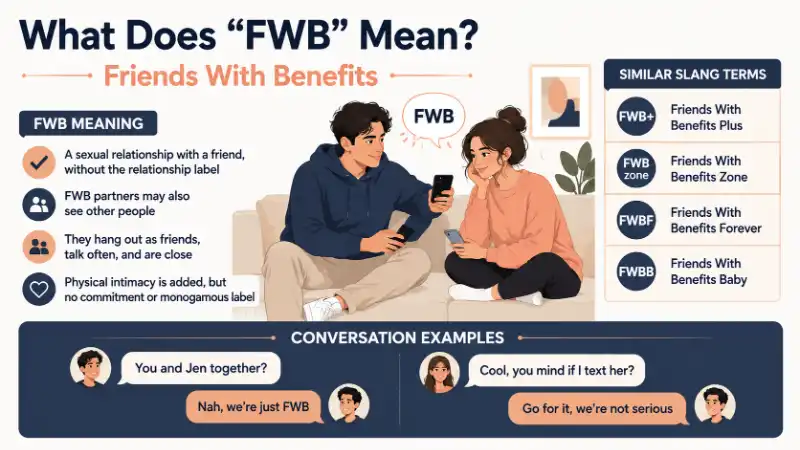
You’re texting someone new, and they casually mention they’re “looking for FWB.” Or maybe a friend just told you they’re in an “FWB situation,” and you nodded along — but secretly, you’re not entirely sure what that means.
Don’t worry, you’re not alone.
FWB is one of the most used — and most misunderstood — terms in modern dating. It shows up everywhere: in text messages, on Tinder bios, in casual conversations, and even in pop culture. But while the acronym is short, the meaning behind it is surprisingly layered.
Does FWB just mean casual sex? Does it mean you’re dating? Can it turn into something more? And what’s the actual difference between FWB and a hookup, a situationship, or just being “friends”?
If you’ve ever found yourself confused by this term, this guide is for you. We’ll break down exactly what FWB means, how it’s used in different contexts, and what you should know if you ever find yourself in one — whether you’re considering it, currently in it, or just trying to understand what someone else is talking about.
Let’s get into it.
What Does FWB Mean?
At its simplest, FWB stands for “Friends with Benefits.” It describes a relationship where two people who share a friendship also engage in sexual activity — but without the romantic commitment, emotional expectations, or traditional relationship milestones that usually come with dating.
In other words: friendship plus physical intimacy, minus the “boyfriend/girlfriend” label.
But here’s where it gets interesting. FWB isn’t a one-size-fits-all arrangement. For some people, it’s mostly physical with a hint of friendship on the side. For others, the friendship is genuine and meaningful, and the physical part is simply an added bonus. The spectrum is wide, and how an FWB arrangement actually works depends entirely on the people involved.
The term itself became mainstream in the early 2000s, largely thanks to pop culture — but the concept has existed for much longer. Today, it’s a standard part of dating vocabulary, used by people of all ages to describe a specific kind of connection that sits somewhere between friendship and romance.
To truly understand FWB, you need to break it down into its two parts: the “friends” and the “benefits.”
What “Friends” Means in FWB
The “friends” part is what separates FWB from a one-night stand or a purely transactional hookup. In an FWB arrangement, the people involved typically have some existing connection. They might:
- Know each other socially before becoming intimate
- Share mutual friends or belong to the same social circles
- Genuinely enjoy each other’s company outside the bedroom
- Have inside jokes, shared interests, and emotional comfort with each other
- Talk about their lives, not just arrange meetups
This doesn’t mean they have to be best friends. Some FWB arrangements start with acquaintances or casual friends who decide to add a physical layer. Others involve people who become friendly through the arrangement itself — they develop a rapport over time, but the emotional bond stays intentionally limited.
The important distinction is this: in FWB, there is some level of personal connection. You’re not strangers. You’re not just using each other’s bodies. There’s a human, friendly element that makes the dynamic feel different from a cold hookup.
What “Benefits” Means
The “benefits” part refers to the sexual and physical aspects of the arrangement. This can include a range of activities, depending on what both partners are comfortable with:
- Kissing, touching, and physical affection
- Oral sex
- Intercourse
- Other sexual acts agreed upon by both parties
One key point: FWB implies regular or ongoing sexual activity, not a one-time thing. The frequency can vary widely — some FWB partners meet weekly, others monthly, and some only connect when both happen to be single and available. But the arrangement is meant to be a recurring dynamic, not a one-off event.
Another important nuance: the “benefits” often come with some level of mutual care. Unlike a purely transactional hookup, FWB partners usually want the other person to enjoy themselves. There’s often more communication about preferences, boundaries, and comfort — because, after all, you’re friends.
Where Did the Term “FWB” Come From?
You might be surprised to learn that the term “Friends with Benefits” wasn’t born on dating apps. It actually gained mainstream recognition thanks to Alanis Morissette.
In 1995, her hit song “Head Over Feet” famously included the line: “You’re my best friend, best friend with benefits.” While the phrase had existed in casual use before that, the song brought it into the cultural spotlight. From there, it spread through movies, TV shows, and eventually became a standard label for this kind of arrangement.
Interestingly, the concept itself is much older. People have been navigating the tricky middle ground between friendship and romance for centuries. But the shorthand “FWB” gave it a name — and that name made it easier to talk about, negotiate, and understand.
How FWB Differs From a Regular Friendship
This is where things get clear. A regular friendship involves emotional connection, shared activities, mutual support, and trust — but stops short of physical intimacy. You care about your friends, you enjoy their company, but you don’t have sex with them.
An FWB arrangement adds that physical layer while attempting to maintain the same emotional boundaries as a regular friendship. That’s the tricky part.
Here are the key differences:
| Aspect | Regular Friendship | FWB Arrangement |
|---|---|---|
| Physical intimacy | None | Regular sexual activity |
| Emotional boundaries | Open and platonic | Intentionally limited to prevent romantic attachment |
| Expectations | No sexual or romantic expectations | Established sexual expectations |
| Future planning | Friendship continues organically | No long-term planning; arrangement is present-focused |
| Romantic gestures | None | Usually avoided to prevent blurring lines |
In theory, the goal of FWB is to keep the friendship intact while adding the physical component. In practice, it often requires more effort to maintain boundaries than a regular friendship does. That’s why many people find FWB more complicated than it initially sounds.
What Does FWB Mean in Text Messages?
If you’ve ever received a text that simply said “FWB?” or “Are we FWB?” you know the confusion that can follow. In text messages and online communication, FWB is shorthand — a quick way to describe a relationship status, express what someone is looking for, or check in about an existing arrangement.
The beauty of the acronym is efficiency. Instead of sending a long message explaining the nuances of your situation, you can simply say “We’re FWB” and the other person immediately understands the general framework.
But because the term covers such a wide range of dynamics, context matters — a lot. Let’s break down exactly how people use FWB in texts.
Common Ways People Use FWB in Texts
Here are the most common contexts where you’ll see “FWB” appear in a text message:
1. Describing an existing arrangement:
“Me and Sarah are FWB now.”
“We’ve been FWB for a few months.”
2. Asking about someone else’s situation:
“Are you guys just FWB or is it serious?”
“Wait, so are you two FWB or actually dating?”
3. Clarifying what someone wants:
“I’m not looking for a relationship right now — just FWB.”
“Honestly, all I want is FWB. Nothing more.”
4. Checking in about the current setup:
“Still good with our FWB arrangement?”
“Just checking — are we still on the same page with FWB?”
5. Gossiping or sharing news with friends:
“Did you know Mark and Jess are FWB?”
“I just found out they’re FWB. Wild, right?”
The tone can range from casual and lighthearted to serious and borderline confrontational, depending on the context and the relationship between the people texting.
What “We’re FWB” Means
When someone types “We’re FWB” in a text, they’re communicating several things at once — often without needing to spell them out:
- We’re not dating. There’s no romantic commitment, no boyfriend/girlfriend label, and no expectation of a traditional relationship.
- We’re having sex. Physical intimacy is part of the dynamic — regularly, not just once.
- We’re still friends. There’s some level of platonic connection beyond just sex.
- It’s casual. Neither party should expect serious relationship milestones like meeting families, moving in together, planning a future, or even celebrating anniversaries.
- It’s intentional. This isn’t an accident or a blurred line — it’s an arrangement both people have (hopefully) talked about and agreed to.
That said, the phrase can also hide complications. Two people might both say “we’re FWB” but mean very different things. One might think it’s purely physical, while the other secretly hopes it evolves into something more. That’s why the term requires ongoing conversation, not just a one-time label.
How Context Can Change the Meaning
The exact meaning of “FWB” shifts depending on where and how it’s used:
- In a text between friends: It’s often explanatory or gossipy. Example: “They’re FWB.” It just means that two people are casually involved.
- In a text between partners: It’s usually a check-in or clarification. Example: “Are we still FWB or is this something else?” It signals a need for communication.
- In a dating app message: It’s often part of a negotiation. Example: “What are you looking for? FWB?” It’s a question about intentions.
- In a text from someone who has feelings: It can be a painful confession. Example: “I know we’re FWB, but I think I’m catching feelings.” It’s a turning point.
The same acronym can mean something entirely different depending on who’s saying it, to whom, and in what situation. That’s why context — and follow-up questions — are your best friends when navigating FWB conversations.
👉 *"If you're exploring casual arrangements, you might also come across other intimate slang — like **DATY meaning** — which refers to a specific sexual act sometimes mentioned in FWB conversations."* 👈
What Does FWB Mean on Dating Apps?
Dating apps like Tinder, Bumble, and Hinge have given “FWB” a new life. People now openly list it in their bios, mention it in their opening messages, or use it as a filter to find others who want the same thing.
If you’ve ever seen “Looking for FWB” on someone’s profile and wondered exactly what they meant, you’re not alone. The term carries specific connotations in the app world that are slightly different from how it’s used in personal conversation.
What “Looking for FWB” Usually Means
When someone writes “Looking for FWB” on their dating profile, they’re typically signaling:
- A consistent hookup partner: They want regular sex with the same person, not a one-night stand.
- Some friendship element: They’re not interested in completely transactional or anonymous hookups. They want to vibe with you outside the bedroom too.
- Zero commitment: They are absolutely not looking for a boyfriend, girlfriend, or anything serious.
- Ongoing availability: They want someone they can see repeatedly — weekly, biweekly, or at least somewhat regularly — without the pressure of dating.
Many people prefer FWB over one-night stands because the consistency often means:
- Better sex (since you learn each other’s preferences)
- Less awkwardness (you know each other)
- More comfort and safety (you’re not meeting strangers every time)
- Less effort (you don’t have to constantly find new partners)
However, it’s worth noting that “Looking for FWB” on a dating app is often a signal that the person wants the benefits first and the friendship second. The arrangement is primarily physical, with the friendship element being a bonus — not the primary draw.
Does FWB Mean They Want a Relationship?
No. And this is one of the most common misunderstandings.
When someone explicitly says they’re looking for FWB, they are telling you they do not want a relationship. They want the physical part, and maybe some friendship, but they don’t want:
- Emotional exclusivity (unless specifically agreed upon)
- Relationship milestones (meeting parents, holidays, anniversaries)
- Labels like boyfriend/girlfriend
- Future planning (marriage, kids, moving in together)
- Heavy emotional involvement
That said, it doesn’t mean they never want a relationship. It means they don’t want one right now — or at least, not with the person they’re matching with on the app.
This is why the label is so important on dating apps. It’s a form of clear communication — a way to say “I’m not leading you on with false hope.”
Why People Use FWB as a Dating Label
People choose to label themselves as “looking for FWB” for many reasons. Some of the most common include:
- After a breakup: They want physical connection without emotional risk.
- Busy lifestyle: They have demanding careers or schedules and don’t have time for a full relationship.
- Casual preference: Some people simply prefer casual intimacy over romantic entanglement.
- Avoiding vulnerability: They want sex without the emotional exposure that comes with dating.
- Exploration: They want to explore their sexuality or preferences without commitment.
- Recent relocation: They moved to a new city and aren’t ready to settle down.
Using the FWB label on a dating app is efficient. It immediately tells potential matches what you’re looking for without requiring a long explanation. It also serves as a filter — people who want something serious will swipe left, and people who want the same thing will swipe right.
But it’s also worth saying: not everyone who says “FWB” on a dating app is being completely honest. Some people use it because they think it sounds more acceptable than “just sex.” Others use it because they don’t want to seem desperate. And some genuinely mean it but don’t have the emotional intelligence to handle it well. That’s why, just like with any dating label, a follow-up conversation is always worth having.
How Is FWB Different From Dating and Other Casual Relationships?
One of the biggest sources of confusion around FWB is how it compares to other relationship types. Is it dating? Is it just a hookup? What about a situationship or NSA?
These are not just academic questions. They matter in real life — because calling something by the wrong name can lead to mismatched expectations, hurt feelings, and messy conversations.
Here’s a clear breakdown of how FWB compares to the most common alternatives.
FWB vs Romantic Dating
Romantic dating involves:
- Emotional investment and growing attachment
- Exclusivity (usually)
- Relationship milestones (meeting families, anniversaries, holidays)
- Future planning
- Public acknowledgment as a couple
- Romantic gestures, dates, and effort
- The intention (or hope) that things progress toward something serious
FWB involves:
- Limited emotional investment
- Casual intimacy with friendship elements
- No relationship milestones
- No future planning
- Often private or selectively shared
- More focus on physical connection and friendship than romance
The fundamental difference is this: dating builds toward something; FWB stays in the present. Dating is a journey with a destination in mind; FWB is a mutual agreement to enjoy each other without mapping a future together.
FWB vs a Hookup
A hookup is:
- Often a one-time or occasional thing
- Minimal to no friendship required
- Little emotional connection
- Sometimes involves strangers
- Quick to end or fade away
- May be impersonal
- Doesn’t require ongoing communication
FWB is:
- Ongoing and regular
- Involves genuine friendship (or at least friendly rapport)
- Emotional connection (though limited)
- Between people who know each other
- Has consistency and some level of pattern
- Involves communication and check-ins
The key difference is regularity and friendship. Hookups are often fleeting and transactional; FWB offers consistency, comfort, and a known partner. In a hookup, you might never see the person again. In FWB, you actively plan to see them again — sometimes multiple times.
FWB vs a Situationship
A situationship is:
- Ambiguous and undefined by nature
- Often involves more emotional intensity than FWB
- May involve romantic feelings, but no labels
- Lacks clear boundaries
- Can be anxiety-inducing and confusing
- Often feels like “almost dating”
- Usually ends badly because of unspoken expectations
FWB is:
- More clearly defined (at least in theory)
- Actively avoids romantic feelings
- Has explicit boundaries (when done well)
- More structured and discussed
- Less emotionally confusing
- Both parties (usually) agree on what it is
The biggest difference: situationships are messy because nobody knows what they are. FWB, when done right, is clear because both people have talked about what they are — and what they’re not.
FWB vs NSA (No Strings Attached)
NSA stands for “No Strings Attached.” It’s similar to FWB but leans even more casual:
- Purely sexual with minimal emotional connection
- No friendship requirement
- Sometimes no conversation beyond arranging meetups
- May be with strangers or acquaintances
- Minimal personal connection
- Often more transactional
FWB is:
- Sexual plus friendship
- Has a personal connection
- Involves genuine social interaction
- More ongoing and consistent
- More human connection
- Conversations beyond just scheduling
NSA is the most detached casual arrangement. FWB adds the friendship element, which makes it a hybrid of intimacy and connection. In practice, NSA partners might not even know each other’s last names. FWB partners usually know a lot more about each other — because they’re friends.
Can People Develop Feelings in an FWB Relationship?
Here’s the honest truth that most people don’t want to admit: yes — and it happens more often than you’d think.
The combination of friendship, regular physical intimacy, shared vulnerability, and ongoing connection creates fertile ground for emotional attachment. What starts as a “casual” arrangement can unexpectedly become something much more complicated — for one person, or sometimes both.
This isn’t a failure or a flaw. It’s actually quite natural. Human beings are wired to bond. When you spend time with someone, share experiences, have sex, and care about their well-being, it’s almost strange not to develop some level of emotional connection.
The key is understanding why feelings develop, what to do when they do, and whether the arrangement can ever transition into something more serious.
Why Feelings Can Change
Several factors contribute to emotions shifting in an FWB dynamic:
- Oxytocin and bonding hormones: Physical intimacy, especially sex, releases oxytocin — sometimes called the “bonding hormone.” It creates feelings of closeness and attachment. While this doesn’t guarantee romantic love, it certainly makes emotional connection more likely.
- Familiarity breeds closeness: The more time you spend with someone, the more comfortable you become. Inside jokes, shared routines, and knowing each other’s quirks naturally deepen your bond. Over time, the lines between “friend I sleep with” and “person I care about deeply” can blur.
- Vulnerability creates attachment: Sex requires emotional and physical exposure. When you’re vulnerable with someone regularly, trust builds. And trust, combined with attraction, often feels indistinguishable from romantic feelings.
- The friendship foundation: Unlike a pure hookup, FWB starts with some level of friendship. That means you already like this person as a human being. Adding physical intimacy to that mix can accelerate emotional connection faster than either person expects.
- Time: The longer an FWB arrangement continues, the more likely feelings are to develop. What feels manageable for three months can feel entirely different after a year.
What Happens When One Person Wants More
This is the moment that defines an FWB arrangement — when one person catches feelings and the other doesn’t. Common outcomes include:
- The confession: The person with feelings finally speaks up. They might say, “I know we said casual, but I’m starting to feel more.”
- The rejection: The other person doesn’t feel the same way. They may want to keep things exactly as they are — or they may want to end things entirely.
- Ending the arrangement: To protect themselves from further hurt, the person with feelings might decide to walk away. Sometimes the other person also ends it out of respect or discomfort.
- Trying a relationship: If both people feel the same way, they might agree to explore something more serious — dropping the FWB label and dating properly.
- Silent suffering: One person stays quiet, continues the arrangement, and quietly gets more hurt over time. This is the most painful and common outcome when communication breaks down.
The hardest part? There’s no “right” way to handle it. The only wrong way is to ignore it and hope it goes away. Feelings rarely go away on their own; they usually grow stronger or more painful.
Can FWB Become a Serious Relationship?
Yes — but it’s not the norm.
Some FWB arrangements do evolve into committed relationships. When this happens, it usually involves:
- Mutual feelings: Both people develop romantic interest, not just one.
- Honest conversation: They acknowledge the shift and talk about it openly.
- Mutual agreement: Both people want the same thing — a real relationship.
- Redefining boundaries: The structure changes. They stop being “casual” and start building something intentional.
However, there’s an important warning: never enter an FWB arrangement hoping it will become a relationship. That’s a recipe for heartbreak. If you secretly want more, the arrangement is already unbalanced. The “benefits” should be the primary draw — not the possibility of something serious down the line.
Treat FWB as what it is: a casual arrangement with no guarantees. If it evolves, that’s a bonus. But if you go in hoping for a relationship, you’re setting yourself up for disappointment.
What Are the Rules and Expectations in an FWB Arrangement?
FWB arrangements don’t work by accident. They work when both people are clear, honest, and willing to communicate — even when it’s uncomfortable.
Without clear expectations, confusion takes over. One person might assume exclusivity while the other assumes openness. One person might want emotional distance while the other wants daily texts. These mismatches can turn a good arrangement into a painful one.
Here’s what needs to be discussed upfront.
Communication and Boundaries
The foundation of any successful FWB arrangement is explicit, ongoing communication. You can’t assume anything. Everything needs to be spoken out loud — at least once, and ideally regularly.
Key questions to discuss early on:
- What’s the frequency? How often will you see each other? Weekly? Monthly? Only when both are single?
- What are the sexual boundaries? Are there any “off-limits” activities? Do you use protection? Are you both tested for STIs?
- How much emotional connection? Do you hang out outside the bedroom? Do you text casually, or only to arrange meetups?
- What’s the privacy level? Is this arrangement private, or are you telling friends? What happens if someone asks about your relationship status?
- What’s the exit plan? How do you end this respectfully if someone catches feelings or wants to date someone else?
Healthy FWB requires emotional maturity. People who can’t communicate clearly about their needs often struggle with this arrangement. The conversation might feel awkward at first, but it’s far less awkward than dealing with misunderstandings later.
Exclusivity and Seeing Other People
One of the most common sources of conflict in FWB is exclusivity — or the lack of it.
Here’s the range of what people typically agree to:
- Exclusive FWB: Both partners agree not to sleep with other people — but they’re still not “dating.” This is often done for health reasons (STI prevention) or personal comfort.
- Non-exclusive FWB: Both are free to see and sleep with other people. This is the most common arrangement, especially if both are actively dating others.
- “Don’t ask, don’t tell”: They don’t discuss other partners. They assume the other is seeing others but prefer not to hear about it.
- Open communication: They agree to tell each other if they start seeing someone seriously, so the arrangement can end or adjust accordingly.
The key is to discuss this directly. Assuming exclusivity when the other person assumes non-exclusivity is a fast track to jealousy, resentment, and hurt feelings.
What Happens When Expectations Change
Expectations in FWB aren’t static. They shift over time. Common changes include:
- One partner starts wanting more emotional connection
- One partner starts seriously dating someone else
- The sexual frequency decreases or increases
- The friendship element changes (becomes closer or more distant)
- Someone develops romantic feelings
- Life circumstances change (moving, new job, personal growth)
When expectations change, the arrangement needs to be renegotiated — or ended. Staying silent when you know something has shifted leads to resentment and frustration. Regular check-ins (every few months, or whenever something feels different) are the best way to keep things healthy.
Having an Exit Strategy
This is something many people forget to discuss — and it’s one of the most important parts of an FWB arrangement.
FWB arrangements usually end. Either someone catches feelings, someone starts dating someone seriously, or the arrangement simply runs its course. Having a plan for how to end things respectfully can save the friendship.
Questions to consider:
- How do you want to be told? A text? A phone call? An in-person conversation?
- What happens to the friendship? Do you want to stay friends, or does the friendship end with the arrangement?
- Is there a way to pause? What if someone wants a break but doesn’t want to end things forever?
An exit strategy isn’t pessimistic — it’s practical. Knowing how to end things respectfully makes the entire arrangement safer and more comfortable for both people.
What Are the Benefits and Risks of FWB?
Like any relationship structure, FWB comes with real advantages and real downsides. Understanding both sides helps you make an informed decision — whether you’re considering it or currently in one.
Remember: this isn’t about judging whether FWB is “good” or “bad.” It’s about understanding what you’re signing up for.
Why Some People Choose FWB
For many people, FWB offers significant benefits:
- Regular sex without relationship effort: Consistent physical intimacy without the demands, expectations, and emotional labor of a full relationship.
- Comfort with a known partner: Better, more satisfying sex with someone you trust and know, compared to navigating new partners.
- Time and energy saved: No dating effort required — no swiping, no awkward first dates, no getting to know someone from scratch.
- Emotional safety: Intimacy without the vulnerability of a relationship. You get some connection without the risk of heartbreak (or so it seems).
- Enjoyable friendship: Sex with someone you genuinely like as a person, which makes the experience feel more human and less transactional.
- Convenience: Consistent availability without the pressure of a relationship.
- Lower pressure: No relationship stress — no worrying about anniversaries, meeting parents, or planning a future together.
- Flexibility: Freedom to end things whenever you want, without the complications of a breakup.
Common Challenges of FWB
But FWB also carries significant risks:
- Developing feelings: The most common and painful risk. When feelings become one-sided, someone gets hurt.
- One-sided attachment: Unequal feelings create tension, resentment, and eventual heartbreak.
- Fading friendship: Sex can change a friendship. Sometimes the friendship ends entirely when the arrangement ends.
- Jealousy: When one partner sees or sleeps with other people, especially if there are unspoken feelings.
- Miscommunication: Assumptions about exclusivity, frequency, or emotional boundaries lead to conflict.
- The “relationship” grey area: Ambiguity creates anxiety. Not knowing where you stand can be exhausting.
- Social judgment: Not everyone understands or accepts FWB arrangements, which can create social awkwardness.
- Future relationship complications: Some potential partners may be uncomfortable with your FWB history, especially if you stayed friends with that person.
How FWB Can Affect a Friendship
The greatest risk of FWB is losing the friendship entirely. When the arrangement ends poorly, the friendship often goes with it.
Here’s how it can go wrong:
- Unreciprocated feelings: One person catches feelings, the other doesn’t. The rejected person pulls away to protect themselves, and the friendship suffers.
- Messy ending: If the arrangement ends with conflict or resentment, the friendship might not survive.
- Jealousy: Seeing your FWB date someone else can be painful, even if you thought you were okay with it.
- Blurred boundaries: Once you’ve been intimate, the friendship dynamic is permanently altered. Some friendships never feel “normal” again.
But it doesn’t always end badly. Some FWB arrangements end with the friendship intact when:
- Both people communicate well.
- Both are emotionally mature.
- The arrangement ends mutually and respectfully.
- Both are willing to put in the effort to rebuild the friendship.
Success isn’t guaranteed. But it’s more likely when both people treat each other — and the arrangement — with respect from the start.
What Are Some Examples of FWB in Conversation?
Sometimes the best way to understand FWB is to see it in action. Here are realistic examples of how people use the term across different contexts — from texts to dating app conversations to explaining their status to a friend.
FWB in a Text Message
Scenario 1: Checking in
Sarah: “Hey, are you free this weekend?”
Mark: “Yeah, Saturday night works. Coming over?”
Sarah: “I can. Still good with our FWB setup?”
Mark: “Absolutely. You still seeing that other guy?”
Sarah: “Nope. It’s just us right now.”
Scenario 2: Gossiping with a friend
Jenna: “Me and Tom are FWB now.”
Rachel: “Wait, really? I thought you guys were just friends.”
Jenna: “We were! But we talked about it and decided to try this.”
Rachel: “Are you sure that’s smart? Don’t catch feelings.”
Scenario 3: Confessing a problem
Alex: “Hey, can we talk?”
Jordan: “Sure. What’s up?”
Alex: “I know we said FWB, but I think I’m starting to feel something more.”
Jordan: “Oh. I don’t know what to say. That’s not where I’m at.”
FWB on a Dating App
Scenario 1: Profile bio
“Here for meaningful conversations and maybe more. Not looking for a relationship — open to FWB if the connection is right. Let’s see where things go. 😊”
Scenario 2: Profile bio (more direct)
“Recently out of a long relationship. Not ready for dating. Seeking FWB with someone who understands boundaries and good communication. Must be respectful and adult about it.”
Scenario 3: Opening message
“I saw you’re looking for FWB. I’ve had a few arrangements before and know how to handle it. What kind of arrangement are you hoping for? Frequency? Exclusivity?”
Someone Explaining Their FWB Status
Scenario 1: Explaining to a concerned friend
“Look, I know you think I’ll catch feelings, but we’ve been FWB for six months and it’s fine. We talk about everything. If either of us wants something more, we’ve agreed to be honest about it. The friendship and the sex work for us right now.”
Scenario 2: Explaining to a new potential partner
“I need to be transparent. I currently have an FWB arrangement with an old friend. We see each other occasionally, but there’s no romantic attachment. It’s just physical. If you and I start getting serious, I’ll end it.”
Scenario 3: Casual explanation to a friend
“I’m not dating anyone right now. I have an FWB situation with someone I’ve known for a few years. We hang out sometimes, we hook up, but it’s not serious. Neither of us wants a relationship right now, so it works.”
Frequently Asked Questions About FWB
These are the most common lingering questions people have about FWB — the ones that haven’t been fully answered in the sections above. They cover real concerns, edge cases, and practical scenarios.
Is FWB Always Exclusive?
No. Exclusivity is the exception, not the rule, in most FWB arrangements. Most FWB relationships are non-exclusive, meaning both people are free to see or sleep with other people. However, some people do agree to exclusivity — usually for health reasons (STI prevention) or personal comfort.
The important thing is to discuss it directly. Don’t assume you’re exclusive just because the sex is good. Ask the question: “Are we exclusive, or are we both free to see other people?” The answer might not be what you want to hear, but knowing is better than guessing.
Does FWB Always Stay Casual?
Not necessarily. While FWB starts with the intention of staying casual, feelings frequently develop. Some FWB relationships remain purely casual indefinitely. Others evolve into friendships without the sexual component. And a smaller number transition into serious romantic relationships.
The outcome depends on the people involved, how they communicate, and what they do when feelings shift. The key is to check in regularly. Don’t assume the arrangement is still casual just because it started that way. Ask each other: “Are we still on the same page?”
Can FWB Work Between Two Close Friends?
Yes, but it takes significant effort. Friends who become FWB face additional challenges because they have more to lose. The friendship is on the line.
Success requires:
- Strong, honest communication: Being willing to say uncomfortable things — even if they might hurt the friendship.
- Emotional maturity: Handling feelings without drama or blame.
- Boundary maintenance: Not letting the arrangement blur into relationship territory.
- Exit strategy: Knowing how to end it without ruining the friendship.
- Mutual respect: Treating each other well, not just using each other.
Many friendships survive FWB, particularly when both people are emotionally intelligent, clear about expectations, and willing to end the arrangement if necessary. But it’s never guaranteed. The closer the friendship, the higher the stakes.
Final Thoughts: Is FWB Right for You?
FWB is not a one-size-fits-all arrangement. For some people, it’s a perfect middle ground — offering physical intimacy, friendship, and freedom without the demands of a relationship. For others, it’s a recipe for confusion, hurt feelings, and lost friendships.
The difference comes down to three things: honesty, communication, and emotional awareness.
If you’re considering FWB, ask yourself these honest questions:
- Am I genuinely okay with casual intimacy, or am I secretly hoping this turns into something more?
- Can I handle seeing this person date or sleep with other people?
- Am I emotionally mature enough to end this respectfully if feelings change?
- Is the friendship worth the risk?
If the answer to these questions is “yes,” FWB can be a healthy, positive arrangement. If you’re unsure — or if you’re already feeling attached — proceed with caution.
And if you’re currently in an FWB arrangement, remember this: check in regularly. Feelings shift. Life changes. What worked six months ago might not work today. The strongest FWB relationships are built on ongoing conversations, not one-time agreements.
The label “FWB” is just a starting point. The real work is in how you treat each other — with respect, honesty, and kindness, whether you’re friends, lovers, or something in between.