100 Homophones with Meaning and Examples

Last updated: June 26, 2026 at 12:51 pm by Meaningexplainer explainer

Homophones meaning is simple: homophones are words that sound the same but have different meanings and, in most cases, different spellings. For example, sea refers to a large body of salt water, while see means to look with your eyes. Although these words have the same pronunciation, their meanings and spellings are different, so choosing the correct one depends on the context of the sentence.

Have you ever written their instead of there, or confused right with write? You’re not alone. Homophones are one of the most common causes of spelling mistakes in English because they sound identical but represent different ideas.

In this complete guide, you’ll learn the homophones meaning, explore 100 common homophones with meanings and examples, understand how they differ from homonyms and homographs, and discover practical tips, memory tricks, and practice exercises to improve your spelling, grammar, and writing skills.

Whether you are a student preparing for exams, an English learner improving vocabulary, a teacher creating lessons, or someone who wants to write more accurately, this guide will help you recognize confusing words and choose the correct spelling with confidence.

By the end of this article, you will understand how homophones work, avoid common mistakes, and use these words correctly in everyday conversations, academic writing, emails, and professional communication.

Quick Answer

Homophones are words that have the same pronunciation but different meanings and usually different spellings. Although they sound alike when spoken, they represent different ideas and are used in different contexts.

For example, the words sea and see are pronounced the same, but sea refers to a large body of salt water, while see means to look with your eyes.

Similarly:

  • Right means correct.
  • Write means to form letters or words.

Because homophones sound identical, listeners usually understand the correct word from the context of a conversation. In writing, however, choosing the wrong homophone can change the meaning of an entire sentence.

Quick Examples

HomophoneMeaningExample Sentence
SeaA large body of salt waterWe spent our vacation by the sea.
SeeTo look with your eyesI can see the mountains from here.
RightCorrect; opposite of leftYou gave the right answer.
WriteTo form letters or wordsPlease write your full name here.
TheirBelonging to themTheir house is near the park.
ThereRefers to a placePut your bag over there.
They’reContraction of they areThey’re studying for tomorrow’s exam.

Key Point: Homophones sound the same, but their meanings—and usually their spellings—are different. The correct word always depends on the context of the sentence.

Why This Matters

If you understand homophones, you’ll be able to:

  • Write with fewer spelling mistakes.
  • Choose the correct word in essays, emails, and exams.
  • Improve your grammar and vocabulary naturally.
  • Communicate more clearly in both spoken and written English.
  • Avoid common errors that even fluent English speakers sometimes make.

Teacher’s Tip: Don’t try to memorize every homophone at once. Focus on understanding the meaning of each word and practice using it in your own sentences. When you learn homophones through context instead of memorization, they become much easier to remember.

100 Homophones at a Glance

If you’re short on time, this overview will help you understand what this guide covers before exploring each section in detail. Think of it as a roadmap that shows exactly what you’ll learn and who this guide is designed for.

FeatureDetails
Topic100 Homophones with Meaning and Examples
DefinitionWords that have the same pronunciation but different meanings and usually different spellings
Difficulty LevelBeginner to Intermediate
Best ForStudents, teachers, English learners, writers, parents, and exam preparation
What You’ll LearnDefinitions, meanings, example sentences, common mistakes, memory tricks, practice questions, and learning tips
Total Homophones Covered100 commonly used English homophones
Reading TimeAbout 12–15 minutes
Estimated Learning TimeAround 30–45 minutes with practice
Skills You’ll ImproveSpelling, grammar, vocabulary, reading comprehension, writing accuracy, and spoken English
Common UsesSchool assignments, competitive exams, IELTS preparation, professional writing, emails, and everyday communication

Why This Guide Is Worth Reading

Many articles simply list homophones without explaining how they are used in real life. As a result, readers often memorize words but still struggle to choose the correct one when writing or speaking.

This guide is different because it teaches homophones the way they are explained in a classroom. Every section is written to help you understand why a word is used, when to use it, and how to remember it. Instead of relying on memorization, you’ll learn through clear explanations, practical examples, and easy learning strategies.

Whether you’re preparing for an English exam, improving your academic writing, teaching students, or simply expanding your vocabulary, this guide is designed to help you build confidence step by step.

Teacher’s Note: Don’t feel pressured to learn all 100 homophones in one sitting. Read each section carefully, practice a few word pairs at a time, and revisit them regularly. Consistent practice is far more effective than memorizing a long list all at once.

What Are Homophones?

Before you can confidently use homophones in your writing, it’s important to understand exactly what they are and why they often cause confusion.

A homophone is a word that has the same pronunciation as another word but a different meaning and, in most cases, a different spelling. In other words, two or more words may sound identical when spoken, yet they represent completely different ideas.

When people speak, listeners usually understand the correct word from the surrounding context. However, in writing, the pronunciation is no longer available to guide the reader. That means choosing the correct spelling becomes essential because even a single letter can completely change the meaning of a sentence.

For example, consider these two sentences:

  • I can see the mountains from my window.
  • The ship sailed across the sea.

The words see and sea are pronounced exactly the same, but they have different meanings. The first refers to the act of using your eyes, while the second refers to a large body of salt water.

Here are a few more common examples:

Homophone PairMeaning of the First WordMeaning of the Second Word
Right / WriteCorrectTo form letters or words
Flour / FlowerPowder used in bakingA blooming plant
Knight / NightA medieval soldierThe time between sunset and sunrise
Mail / MaleLetters and packagesA person or animal of the masculine sex
Pair / PearTwo matching itemsA sweet fruit
Brake / BreakA device used to stop a vehicleTo separate into pieces

Notice that every pair sounds the same when spoken. The only way to know which word is correct is by understanding the meaning of the sentence.

Why Do Homophones Cause So Much Confusion?

Many students assume that if two words sound the same, they can be used interchangeably. Unfortunately, that’s one of the most common mistakes in English.

For example:

Please right your answer on the paper.

Please write your answer on the paper.

The word right means correct or opposite of left, while write means to form letters or words. Even though they sound identical, only one fits the sentence.

The same mistake often happens with words like their, there, and they’re, or your and you’re. These homophones appear frequently in emails, essays, exams, and social media posts, making them some of the most important word pairs to master.

How Can You Identify a Homophone?

A simple way to recognize a homophone is to ask yourself three questions:

  1. Does another English word sound exactly the same?
  2. Do the two words have different meanings?
  3. Do they have different spellings in most cases?

If the answer is yes, you’re probably looking at a pair of homophones.

For example:

  • Son sounds the same as Sun.
  • One sounds the same as Won.
  • Meat sounds the same as Meet.

Although each pair has the same pronunciation, each word serves a completely different purpose.

Teacher’s Classroom Example

Imagine you’re writing this sentence:

“We need flour to bake a cake.”

Now replace flour with flower:

“We need flower to bake a cake.”

The sentence suddenly becomes incorrect because flower is a plant, while flour is the ingredient used for baking.

This simple comparison shows why understanding the meaning—not just the pronunciation—is essential when using homophones correctly.

Key Takeaway: A homophone is a word that sounds the same as another word but has a different meaning and usually a different spelling. The correct homophone is always determined by the context of the sentence, not by its pronunciation alone.


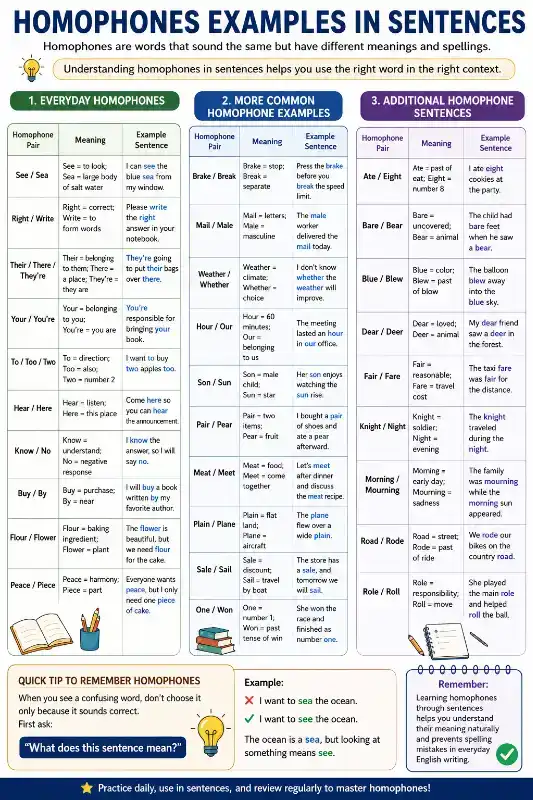
Homophones Examples in Sentences

Understanding homophones becomes much easier when you see how they work in real sentences. Since homophones have the same pronunciation but different meanings, the context of a sentence tells us which word is correct.

Below are some of the most common homophone pairs used in everyday English.

Everyday Homophones

Homophone PairMeaningExample Sentence
See / SeaSee = to look; Sea = large body of salt waterI can see the blue sea from my window.
Right / WriteRight = correct; Write = to form wordsPlease write the right answer in your notebook.
Their / There / They’reTheir = belonging to them; There = a place; They’re = they areThey’re going to put their bags over there.
Your / You’reYour = belonging to you; You’re = you areYou’re responsible for bringing your book.
To / Too / TwoTo = direction; Too = also; Two = number 2I want to buy two apples too.
Hear / HereHear = listen; Here = this placeCome here so you can hear the announcement.
Know / NoKnow = understand; No = negative responseI know the answer, so I will say no.
Buy / ByBuy = purchase; By = nearI will buy a book written by my favorite author.
Flour / FlowerFlour = baking ingredient; Flower = plantThe flower is beautiful, but we need flour for the cake.
Peace / PiecePeace = harmony; Piece = partEveryone wants peace, but I only need one piece of cake.

More Common Homophone Examples

Homophone PairMeaningExample Sentence
Brake / BreakBrake = stop; Break = separatePress the brake before you break the speed limit.
Mail / MaleMail = letters; Male = masculineThe male worker delivered the mail today.
Weather / WhetherWeather = climate; Whether = choiceI don’t know whether the weather will improve.
Hour / OurHour = 60 minutes; Our = belonging to usThe meeting lasted an hour in our office.
Son / SunSon = male child; Sun = starHer son enjoys watching the sun rise.
Pair / PearPair = two items; Pear = fruitI bought a pair of shoes and ate a pear afterward.
Meat / MeetMeat = food; Meet = come togetherLet’s meet after dinner and discuss the meat recipe.
Plain / PlanePlain = flat land; Plane = aircraftThe plane flew over a wide plain.
Sale / SailSale = discount; Sail = travel by boatThe store has a sale, and tomorrow we will sail.
One / WonOne = number 1; Won = past tense of winShe won the race and finished as number one.

Additional Homophone Sentences

Homophone PairMeaningExample Sentence
Ate / EightAte = past of eat; Eight = number 8I ate eight cookies at the party.
Bare / BearBare = uncovered; Bear = animalThe child had bare feet when he saw a bear.
Blue / BlewBlue = color; Blew = past of blowThe balloon blew away into the blue sky.
Dear / DeerDear = loved; Deer = animalMy dear friend saw a deer in the forest.
Fair / FareFair = reasonable; Fare = travel costThe taxi fare was fair for the distance.
Knight / NightKnight = soldier; Night = eveningThe knight traveled during the night.
Morning / MourningMorning = early day; Mourning = sadnessThe family was mourning while the morning sun appeared.
Road / RodeRoad = street; Rode = past of rideWe rode our bikes on the country road.
Role / RollRole = responsibility; Roll = moveShe played the main role and helped roll the ball.

Quick Tip to Remember Homophones

Whenever you’re unsure which homophone to use, ask yourself, “What does this sentence mean?” Context always helps you choose the correct spelling.

Example:

❌ I want to sea the ocean.
✅ I want to see the ocean.

The ocean is a sea, but looking at something means see.

Learning homophones through real sentences makes them easier to remember and helps you avoid common spelling mistakes in everyday English.

Why Does English Have So Many Homophones?

One of the most common questions my students ask is:

“Why does English have so many words that sound exactly the same?”

It’s a great question because the answer explains why homophones are so common—and why even native English speakers sometimes confuse them.

The simple answer is that English has borrowed words from many different languages over hundreds of years. As these words became part of everyday speech, their pronunciations gradually changed. In many cases, different words eventually came to sound the same, even though they kept different spellings and meanings.

For example, English vocabulary comes from several major languages, including:

  • Old English, which forms the foundation of modern English.
  • French, which introduced thousands of words after the Norman Conquest.
  • Latin, the source of many academic, legal, scientific, and religious terms.
  • Greek, which contributed words used in medicine, mathematics, and philosophy.
  • Old Norse, which added many everyday words during the Viking period.

Because these languages evolved differently, words with completely different origins sometimes ended up having the same pronunciation in modern English.

Pronunciation Changed Faster Than Spelling

Another reason English has so many homophones is that pronunciation has changed much more quickly than spelling.

Over the centuries, English speakers gradually began pronouncing many words differently, but their written forms remained almost unchanged. This means two words that once sounded different may now sound exactly alike.

One of the biggest reasons for this change was a historical event known as the Great Vowel Shift, which dramatically changed the pronunciation of many English words between the 15th and 18th centuries.

Although the sounds changed, the spellings often stayed the same. As a result, modern English contains many homophones that can seem confusing at first.

Silent Letters Create More Homophones

Silent letters are another major reason homophones exist.

Many English words still contain letters that were pronounced hundreds of years ago but are now silent.

For example:

WordSilent LetterSounds Like
KnightKNight
WriteWRight
KnowKNo
WholeWHole

Although these words have different spellings, the silent letters make them sound identical when spoken.

Context Is What Makes English Understandable

At this point, you might wonder:

“If so many words sound the same, how do people know which one you mean?”

The answer is context.

When people speak, the surrounding words make the intended meaning clear.

For example:

  • I need to write an essay before tomorrow.
  • You gave the right answer.

Even though write and right sound identical, the rest of the sentence tells us which word is correct.

The same idea applies to:

  • The children played by the sea.
  • I can see the birds flying overhead.

Your brain naturally uses context to understand the speaker’s meaning without even thinking about it.

Should You Memorize Every Homophone?

No—and that’s one of the biggest mistakes learners make.

Instead of trying to memorize hundreds of word pairs, focus on understanding how each word is used in context. When you read, write, and practice regularly, you’ll begin to recognize the correct homophone naturally.

This is the same approach we use in the classroom. Rather than memorizing isolated words, students learn through meaningful examples and real-life sentences, making the correct spelling much easier to remember.

Teacher’s Tip: Whenever you come across a new homophone, don’t just learn its definition. Write one or two original sentences using each word. This simple habit strengthens your vocabulary, improves your writing, and helps you remember the correct spelling much longer than memorization alone.

Key Takeaway

English has many homophones because it developed from multiple languages, its pronunciation changed over time while spellings often remained the same, and many words still contain silent letters. Although this may seem confusing at first, understanding the context of a sentence makes it much easier to choose the correct homophone in both writing and everyday communication.

Why Are Homophones Important?

Now that you understand what homophones are and why English has so many of them, let’s answer another important question:

Why should you spend time learning homophones?

The simple answer is that homophones affect almost every type of English communication. Whether you’re writing an essay, sending an email, taking an exam, posting on social media, or preparing a professional report, choosing the correct homophone helps you express your ideas clearly and accurately.

Because homophones sound the same, it’s easy to choose the wrong spelling if you rely only on pronunciation. In spoken English, listeners usually understand your meaning from the context. In writing, however, the reader sees only the words on the page. If you choose the wrong homophone, your sentence may become confusing, grammatically incorrect, or even change its meaning completely.

For example, compare these sentences:

Their going to the library after class.

They’re going to the library after class.

Both sentences sound exactly the same when spoken, but only the second sentence is correct because they’re means they are, while their shows ownership.

Here’s another example:

Please right your answer below.

Please write your answer below.

Again, the pronunciation is identical, but right means correct, whereas write means to form letters or words.

These examples show why understanding the meaning of each homophone is just as important as knowing how to pronounce it.

How Learning Homophones Improves Your English

Mastering homophones doesn’t just help you avoid spelling mistakes—it strengthens several essential language skills at the same time.

Improve Your Spelling

Many spelling mistakes happen because writers choose a word that sounds correct instead of one that is spelled correctly for the sentence. Learning common homophones helps you recognize these differences and write with greater accuracy.

Build a Stronger Vocabulary

Every homophone pair introduces you to two different words with different meanings. As you learn more homophones, you naturally expand your English vocabulary and become more confident using precise language.

Write More Clearly

Whether you’re writing an academic essay, a business email, or a social media post, the correct homophone makes your message easier to understand. Clear writing helps readers focus on your ideas instead of being distracted by errors.

Perform Better in Exams

Homophones frequently appear in:

  • English grammar tests
  • School and university examinations
  • Competitive exams
  • IELTS and other English-language assessments
  • Spelling quizzes and vocabulary tests

Understanding common homophones can help you avoid unnecessary mistakes and earn better marks.

Improve Reading and Listening Skills

When you know that two words sound the same but have different meanings, it becomes easier to understand conversations, follow written texts, and interpret the correct meaning from context.

Where Will You Use Homophones?

Many students believe homophones are useful only in English class. In reality, you’ll encounter them almost everywhere.

You’ll use homophones when:

  • Writing essays and research papers
  • Completing homework and classroom assignments
  • Sending emails and text messages
  • Posting on social media
  • Preparing résumés and job applications
  • Writing reports at work
  • Reading books, newspapers, and online articles
  • Communicating in everyday conversations

No matter your profession or level of English, using the correct homophone helps you communicate more effectively.

A Teacher’s Advice

When I teach homophones, I remind students that the goal isn’t to memorize hundreds of words overnight. Instead, focus on understanding the meaning of each word and how it’s used in a sentence.

For example, don’t just remember that sea and see sound the same. Learn how each word functions:

  • We spent the afternoon at the sea.
  • I can see the mountains from here.

Once you understand the context, choosing the correct spelling becomes much more natural.

Teacher’s Tip: Every time you learn a new homophone pair, write one original sentence using each word. This simple habit strengthens your spelling, improves your grammar, and helps you remember the correct word much longer than memorizing definitions alone.

Key Takeaway

Learning homophones is important because they improve your spelling, grammar, vocabulary, reading, and writing skills. They also help you avoid common mistakes, communicate more clearly, and perform better in school, exams, and professional writing. The more you practice using homophones in real sentences, the more confident and accurate your English will become.

Homophones vs. Homonyms vs. Homographs

This section has strong search intent because many readers search for these terms together. Instead of simply defining them, we’ll compare them in a way that’s easy to understand—just as a teacher would explain them in a classroom.


Homophones vs. Homonyms vs. Homographs

One of the questions students ask most often is:

“Are homophones, homonyms, and homographs the same thing?”

The answer is no. These three terms are closely related because they all describe relationships between words, but they are not interchangeable. Each one focuses on a different feature of the English language.

Once you understand the difference, you’ll find it much easier to identify confusing words and use them correctly in both speaking and writing.

Let’s look at each term one by one.

What Are Homophones?

Homophones are words that have the same pronunciation but different meanings and usually different spellings.

Because they sound identical, the correct word depends on the meaning of the sentence.

Examples:

  • Sea – A large body of salt water.
  • See – To look with your eyes.
  • Right – Correct.
  • Write – To form letters or words.

Although these words sound the same, they have different meanings and different spellings.


What Are Homonyms?

Homonyms are words that have the same spelling or the same pronunciation but different meanings.

Unlike homophones, homonyms don’t always have different spellings. Sometimes they are spelled exactly the same but represent completely different ideas.

Examples:

  • Bat – A flying mammal.
  • Bat – A piece of sports equipment used in baseball or cricket.

Another example is:

  • Bank – A financial institution.
  • Bank – The land beside a river.

The spelling and pronunciation are the same, but the meanings are completely different.


What Are Homographs?

Homographs are words that have the same spelling but different meanings. In some cases, they are also pronounced differently.

For example:

  • Lead (leed) – To guide someone.
  • Lead (led) – A heavy metal.

Another example:

  • Bow (boh) – To bend at the waist.
  • Bow (bau) – A decorative ribbon or the front of a ship.

Although the spelling is identical, the meaning—and sometimes the pronunciation—changes depending on the context.


Quick Comparison Table

TermSame Sound?Same Spelling?Different Meanings?Example
Homophones✅ YesUsually No✅ YesSea / See
Homonyms✅ Sometimes✅ Sometimes✅ YesBat (animal) / Bat (sports equipment)
Homographs❌ Not Always✅ Yes✅ YesLead (guide) / Lead (metal)

An Easy Way to Remember the Difference

Students often find these terms confusing because their names look similar. Here’s a simple memory trick that can help.

  • Homophone → Think Phone = Sound
    Same pronunciation.
  • Homograph → Think Graph = Writing
    Same spelling.
  • Homonym → Think Name
    Words that share the same spelling, pronunciation, or both, but have different meanings.

If you remember these three clues, you’ll rarely confuse the terms again.


Why Understanding the Difference Matters

Knowing the difference between homophones, homonyms, and homographs helps you become a more accurate English reader and writer.

For example, if someone asks you why sea and see are called homophones, you’ll know it’s because they sound the same but have different spellings.

If you see the word bat used in different ways, you’ll recognize it as a homonym because the spelling and pronunciation are the same while the meanings are different.

And when you encounter a word like lead, you’ll understand that it’s a homograph because the spelling stays the same, but the meaning—and sometimes the pronunciation—changes depending on the sentence.

Understanding these differences also improves your grammar, vocabulary, reading comprehension, and spelling, making it easier to interpret English correctly in academic writing, exams, and everyday communication.

Teacher’s Tip: Don’t try to memorize the definitions alone. Instead, focus on the examples. When you can explain why sea/see are homophones, bat/bat are homonyms, and lead/lead are homographs, you’ve truly understood the concept.

Key Takeaway

Although homophones, homonyms, and homographs are related, they describe different types of word relationships.

  • Homophones have the same pronunciation but different meanings and usually different spellings.
  • Homonyms share the same spelling, pronunciation, or both, but have different meanings.
  • Homographs have the same spelling but different meanings and may also have different pronunciations.

Once you understand these differences, identifying and using these words correctly becomes much easier in both spoken and written English.

How to Learn Homophones Faster

Many students make the same mistake when learning homophones—they try to memorize a long list of words in one sitting. While this may work for a short time, it’s easy to forget the meanings because the words aren’t connected to real situations.

As a teacher, I encourage my students to focus on understanding rather than memorizing. When you know what each word means and how it’s used in a sentence, remembering the correct spelling becomes much easier.

Here are some practical strategies that can help you learn homophones more quickly and remember them for the long term.

1. Learn a Few Homophone Pairs at a Time

Don’t try to study all 100 homophones in one day. Instead, choose five to ten pairs and learn them thoroughly before moving on to the next group.

For example, you might study:

  • Sea / See
  • Right / Write
  • Their / There / They’re
  • Flour / Flower
  • Pair / Pear

Learning small groups helps you stay focused and prevents information overload.


2. Understand the Meaning Before Memorizing the Word

Instead of memorizing spellings first, begin by understanding what each word actually means.

For example:

  • Flour is the powder used for baking.
  • Flower is the colorful part of a plant.

When you understand the meanings, choosing the correct word becomes much more natural.


3. Create Your Own Example Sentences

Reading examples is helpful, but writing your own examples is even more effective.

For instance:

  • I can see the rainbow after the rain.
  • We spent the weekend by the sea.

Creating original sentences forces you to think about the meaning of each word, which strengthens both your vocabulary and your writing skills.


4. Read the Words Aloud

Because homophones have the same pronunciation, reading them aloud helps you recognize them in conversations and listening exercises.

As you read, pay attention to how the meaning changes even though the sound remains the same.

This exercise also improves your listening skills and pronunciation.


5. Practice with Real-Life Writing

One of the best ways to master homophones is to use them in your everyday writing.

Try including newly learned homophones in:

  • School assignments
  • Journal entries
  • Emails
  • Text messages
  • Short stories
  • Classroom exercises

The more often you use a word correctly, the easier it becomes to remember.


6. Read English Every Day

Books, newspapers, magazines, blogs, and websites naturally expose you to homophones in context.

When you see words used in real sentences, you begin to recognize which spelling fits different situations without consciously thinking about it.

Even reading for 15–20 minutes a day can significantly improve your vocabulary over time.


7. Review Regularly Instead of Cramming

Learning is much more effective when you review information regularly.

Instead of studying for several hours in one day, spend 10 to 15 minutes each week reviewing the homophones you’ve already learned.

This method, often called spaced repetition, helps move information into your long-term memory.


8. Test Yourself Frequently

After learning a group of homophones, check your understanding by asking yourself simple questions.

For example:

  • Which word means to looksee or sea?
  • Which word means correctright or write?
  • Which word refers to ownershiptheir, there, or they’re?

Self-testing helps you identify weak areas before they become habits.


Common Mistakes to Avoid While Learning Homophones

Many learners slow their progress by making a few common mistakes.

Try to avoid these habits:

  • Memorizing words without understanding their meanings.
  • Ignoring example sentences.
  • Learning too many homophones in one study session.
  • Depending only on pronunciation instead of context.
  • Skipping regular review and practice.

Remember, understanding how a word is used is far more valuable than simply remembering its spelling.


A Teacher’s Learning Plan

If I were teaching this lesson in a classroom, I would recommend the following routine:

DayTask
MondayLearn 5 new homophone pairs.
TuesdayWrite one sentence for each word.
WednesdayRead a short English article and identify homophones.
ThursdayTake a short quiz without looking at your notes.
FridayReview everything you learned during the week.

Following a simple routine like this helps you make steady progress without feeling overwhelmed.

Teacher’s Tip: The goal isn’t to memorize all 100 homophones immediately. The goal is to understand them so well that choosing the correct word becomes automatic whenever you read or write English.

Key Takeaway

The fastest way to learn homophones is to study them in small groups, understand their meanings, use them in your own sentences, read regularly, and review them consistently. With daily practice, you’ll begin to recognize the correct homophone naturally, making your writing more accurate and your English more confident.

The 20 Most Common Homophones Used in Everyday English

Before exploring the complete list of 100 homophones, it’s helpful to start with the word pairs you’re most likely to encounter in everyday English.

As a teacher, I always encourage students to master the most common homophones first. These words appear regularly in school assignments, exams, emails, books, newspapers, social media posts, and daily conversations. Once you’re comfortable using these frequently used pairs, learning the remaining homophones becomes much easier.

The table below highlights 20 of the most common homophone pairs along with a brief explanation of their meanings.

Homophone PairMeaning
Their / There / They’reTheir shows ownership, There refers to a place, and They’re means they are.
Your / You’reYour shows ownership, while You’re means you are.
To / Too / TwoTo shows direction or purpose, Too means also or excessively, and Two is the number 2.
Sea / SeeSea is a large body of salt water, while See means to look with your eyes.
Right / WriteRight means correct, while Write means to form letters or words.
Here / HearHere refers to a place, while Hear means to listen.
Know / NoKnow means to understand, while No is a negative response.
Buy / ByBuy means to purchase, while By means near, beside, or through the action of.
Flour / FlowerFlour is used in baking, while Flower is the colorful part of a plant.
Peace / PiecePeace means freedom from conflict, while Piece is a part of something.
Brake / BreakBrake helps stop a vehicle, while Break means to separate into pieces.
Mail / MaleMail refers to letters and packages, while Male refers to the masculine gender.
Wear / WhereWear means to have clothing on, while Where asks about a place.
Weather / WhetherWeather describes atmospheric conditions, while Whether introduces a choice or possibility.
Hour / OurHour is a period of 60 minutes, while Our shows ownership.
Son / SunSon is a male child, while Sun is the star at the center of our solar system.
Pair / PearPair means two matching things, while Pear is a fruit.
Meat / MeetMeat is animal flesh used as food, while Meet means to come together.
Plain / PlanePlain means simple or flat, while Plane is an aircraft.
Sale / SailSale means goods offered for purchase, while Sail means to travel by boat.

Why Should You Learn These Homophones First?

These homophone pairs appear more often than most others in written and spoken English. You’ll see them in:

  • School homework and university assignments
  • English grammar and spelling tests
  • IELTS, TOEFL, and other language exams
  • Emails and business communication
  • Books, newspapers, and online articles
  • Text messages and social media posts
  • Everyday conversations

Because they’re used so frequently, mastering these homophones first will help you avoid many of the spelling mistakes that English learners—and even native speakers—commonly make.

A Simple Study Tip

Don’t rush through the list. Instead, choose three to five homophone pairs each day, read their meanings, create your own example sentences, and review them regularly. This approach is much more effective than trying to memorize dozens of words at once.

Teacher’s Tip: If you can confidently use these 20 common homophone pairs in your writing, you’ll already avoid many of the most common English spelling mistakes. Think of them as the foundation before moving on to the complete list of 100 homophones.

Key Takeaway

The 20 homophone pairs above are among the most frequently used in everyday English. Learning them first will strengthen your spelling, improve your grammar, and make it much easier to understand and use the remaining homophones in this guide.

100 Homophones with Meaning and Examples

The tables below organize 100 common English homophones alphabetically. Each word includes a simple meaning and an example sentence to help you understand how it is used in everyday English.


A–C Homophones

WordMeaningExample
AcceptTo receive willinglyShe accepted the invitation.
ExceptExcludingEveryone came except Ali.
AisleA passage between rows of seats or shelvesWe walked down the supermarket aisle.
I’llContraction of “I will”I’ll call you after work.
AtePast tense of eatWe ate dinner together.
EightThe number 8Eight students joined the competition.
BareWithout coveringHe walked on the bare floor.
BearA large wild animalWe saw a bear during our trip.
BeTo existAlways be respectful.
BeeA flying insectA bee landed on the flower.
BlueA colorBlue is her favorite color.
BlewPast tense of blowThe wind blew all night.
BrakeA device used to stop a vehiclePress the brake gently.
BreakTo separate into piecesBe careful not to break the glass.
BuyTo purchaseI want to buy a new notebook.
ByNear or besideSit by the window, please.
CellA small room or unitThe prisoner stayed in a cell.
SellTo exchange something for moneyThey sell fresh vegetables every weekend.
CentOne hundredth of a dollarThis candy costs one cent.
ScentA pleasant smellI love the scent of fresh flowers.
CerealA breakfast foodShe eats cereal every morning.
SerialArranged in sequenceThe magazine published a serial story.
CoarseRough in textureThe fabric feels coarse.
CourseA class or directionI’m taking an English course.

D–H Homophones

WordMeaningExample
DearBeloved or valuedDear friend, thank you for your support.
DeerA wild animalWe spotted a deer near the forest.
DieTo stop livingPlants die without enough water.
DyeTo change the color of somethingShe decided to dye her hair brown.
FairJust or reasonableThe teacher made a fair decision.
FareThe cost of transportationThe train fare increased this year.
FlourPowder used for bakingWe need flour to bake the cake.
FlowerThe colorful part of a plantEvery flower in the garden is blooming.
ForUsed to show purpose or recipientThis gift is for you.
FourThe number 4Four students received awards.
HearTo listen with your earsCan you hear the music?
HereIn this placePlease come here for a moment.
HealTo recover from an injuryThe cut will heal within a week.
HeelThe back part of the footMy shoe has a broken heel.
HoleAn openingThe rabbit disappeared into a hole.
WholeComplete or entireShe ate the whole pizza herself.
HourA period of 60 minutesThe meeting lasted an hour.

I–M Homophones

WordMeaningExample
KnightA medieval soldierThe knight protected the castle.
NightThe time between sunset and sunriseWe walked under the stars at night.
KnowTo understand or be awareI know the correct answer.
NoA negative responseNo, I don’t need any help.
MailLetters and packagesThe mail arrived this morning.
MaleA person or animal of the masculine sexThe male elephant was enormous.
MainMost importantThe main entrance is closed today.
ManeLong hair on a horse or lionThe lion’s mane looked impressive.
MeatAnimal flesh used as foodWe bought fresh meat for dinner.
MeetTo come togetherLet’s meet after school.
MorningThe early part of the dayGood morning, everyone!
MourningFeeling sadness after someone’s deathThe family is mourning their grandfather.

N–R Homophones

WordMeaningExample
OneThe number 1Only one student answered correctly.
WonPast tense of winShe won the spelling competition.
PairTwo matching thingsI bought a pair of running shoes.
PearA sweet fruitHe ate a ripe pear after lunch.
PainPhysical discomfortHe felt pain in his shoulder.
PaneA sheet of glassThe window pane cracked during the storm.
PeaceFreedom from conflictEveryone hopes for lasting peace.
PieceA part of somethingWould you like another piece of cake?
PlainSimple or flatShe wore a plain white shirt.
PlaneAn aircraftThe plane landed safely.
PrayTo speak to GodThey pray every evening.
PreyAn animal hunted for foodThe tiger quietly followed its prey.
PrincipalHead of a schoolThe principal welcomed the new students.
PrincipleA basic rule or beliefHonesty is an important principle.
RainWater falling from cloudsHeavy rain is expected tonight.
ReignThe period a ruler is in powerThe king’s reign lasted forty years.
ReadTo look at written wordsI read a new book every month.
ReedA tall plant growing near waterBirds built nests among the reeds.
RightCorrect or opposite of leftYou gave the right answer.
WriteTo form letters or wordsPlease write your full name here.
RoadA street or highwayThe road was closed for repairs.
RodePast tense of rideWe rode our bicycles to school.
RoleA character or responsibilityShe played the lead role in the play.
RollTo move by turning overRoll the ball toward me.

S–Z Homophones

WordMeaningExample
SailTo travel by boatThey sail every summer.
SaleThe selling of goodsThe store is having a weekend sale.
SceneA setting or part of a movieMy favorite scene was the ending.
SeenPast participle of seeI have seen that movie before.
SeaA large body of salt waterThe sea was calm today.
SeeTo use your eyesI can see the mountains clearly.
SonA male childTheir son just started college.
SunThe star at the center of our solar systemThe sun rises in the east.
StairOne step in a staircaseWatch the broken stair.
StareTo look fixedlyIt’s rude to stare at strangers.
StationaryNot movingThe train remained stationary for ten minutes.
StationeryWriting paper and office suppliesShe bought colorful stationery for school.
SteelA strong metalThe bridge is made of steel.
StealTo take something without permissionIt is wrong to steal from others.
TailThe rear part of an animalThe dog wagged its tail happily.
TaleA storyGrandpa told an old fairy tale.
TheirBelonging to themTheir house is near the park.
ThereRefers to a placePut your bag over there.
They’reShort form of “they are”They’re waiting outside.
ThrewPast tense of throwHe threw the ball across the field.
ThroughFrom one side to the otherWe walked through the tunnel.
ToIndicates direction or purposeWe are going to the museum.
TooAlso or excessivelyI want to come too.
TwoThe number 2Two birds sat on the fence.
WaistThe middle part of the bodyThe belt fits around my waist.
WasteTo use carelesslyDon’t waste food or water.
WaitTo stay until something happensPlease wait outside.
WeightHow heavy something isThe weight of the package is five kilograms.
WeakNot strongI felt weak after the illness.
WeekA period of seven daysI’ll visit you next week.
WearTo have clothing onShe likes to wear blue dresses.
WhereIn what placeWhere do you live?
WeatherThe condition of the atmosphereThe weather is sunny today.
WhetherExpresses a choiceI don’t know whether he’ll come.
WhichAsking about a choiceWhich color do you like best?
WitchA fictional person with magical powersThe witch appeared in the fairy tale.
WoodMaterial from treesThe table is made of wood.
WouldA modal verb expressing possibility or willingnessI would love to help you.
YolkThe yellow part of an eggThe yolk contains many nutrients.
YokeA wooden bar used with animalsThe farmer placed a yoke on the oxen.
YourBelonging to youYour notebook is on the desk.
You’reShort form of “you are”You’re doing an excellent job.

Common Homophone Mistakes

Even advanced English speakers sometimes confuse homophones because they sound exactly the same. In most cases, the mistake isn’t pronunciation—it’s choosing the wrong spelling for the intended meaning.

The easiest way to avoid these errors is to think about what the sentence actually means before you write the word.

Here are some of the most common homophone mistakes people make.

1. Their vs. There vs. They’re

❌ Their going to the park.

✅ They’re going to the park.

Explanation:

  • Their shows ownership.
  • There refers to a place.
  • They’re is the short form of they are.

2. Hear vs. Here

❌ I can here you clearly.

✅ I can hear you clearly.

Explanation:

  • Hear means to listen.
  • Here means in this place.

3. Right vs. Write

❌ Please right your name.

✅ Please write your name.

Explanation:

  • Right means correct.
  • Write means to form letters or words.

4. Sea vs. See

❌ We walked beside the see.

✅ We walked beside the sea.

Explanation:

  • Sea is a large body of salt water.
  • See means to use your eyes.

5. Know vs. No

❌ I no the answer.

✅ I know the answer.

Explanation:

  • Know means to understand.
  • No is a negative response.

6. Your vs. You’re

❌ Your very kind.

✅ You’re very kind.

Explanation:

  • Your shows ownership.
  • You’re means you are.

7. To vs. Too vs. Two

❌ I want too go.

✅ I want to go.

Explanation:

  • To shows direction or purpose.
  • Too means also or excessively.
  • Two is the number 2.

Quick Tip

If you’re unsure which homophone is correct, replace it with its definition.

For example:

You’re happy.

You are happy. ✔️

The sentence still makes sense, so you’re is correct.


Easy Memory Tricks for Homophones

Remembering homophones becomes much easier when you connect each word with a simple mental clue instead of trying to memorize definitions.

Here are some effective memory tricks.

HomophoneMemory Trick
SeaContains the letter A, just like water.
HearContains ear, which helps you remember listening.
WriteBegins with W, reminding you of writing words.
FlourUsed in the kitchen for baking.
FlowerGrows in a garden.
StationeryContains ER, just like papER.
PrincipalEnds with pal—your principal should be your “pal.”
PieceContains pie, reminding you of a piece of pie.
PeaceThink of peaceful countries without war.
WeatherContains EA, just like the Earth and atmosphere.

Small memory associations make confusing homophones much easier to remember over time.


Practice Exercise

Test your understanding by choosing the correct homophone.

1. I can _____ the rainbow.

A. Sea

B. See

Answer: See


2. We walked beside the _____.

A. Sea

B. See

Answer: Sea


3. Please _____ your full name.

A. Right

B. Write

Answer: Write


4. _____ going to the museum tomorrow.

A. Their

B. There

C. They’re

Answer: They’re


5. The lion has a thick _____.

A. Main

B. Mane

Answer: Mane


6. We need _____ to bake bread.

A. Flower

B. Flour

Answer: Flour


7. Everyone hopes for world _____.

A. Peace

B. Piece

Answer: Peace


8. Please wait _____.

A. Hear

B. Here

Answer: Here


9. I _____ the correct answer.

A. Know

B. No

Answer: Know


10. She bought a _____ of shoes.

A. Pair

B. Pear

Answer: Pair


Tips for Students, Teachers, and English Learners

Learning homophones doesn’t have to be difficult. A few simple habits can make a big difference in improving your spelling and writing skills.

For Students

  • Study five to ten homophone pairs each day instead of trying to memorize a long list.
  • Create your own example sentences to understand each word in context.
  • Review previously learned homophones every week.
  • Make reading English books, articles, or stories part of your daily routine.

For Teachers

  • Explain different meanings with pictures and real-life examples.
  • Design matching games, quizzes, and classroom activities to reinforce learning.
  • Ask students to write short paragraphs using common homophones correctly.
  • Add homophone practice to regular spelling and vocabulary lessons.

For English Learners

  • Focus on understanding the meaning of each word rather than pronunciation alone.
  • Listen to native English conversations to hear homophones used naturally.
  • Keep a vocabulary notebook for confusing homophone pairs and review it regularly.
  • Try using newly learned homophones in your daily speaking and writing practice.

Key Takeaways

Before you leave, remember these important points.

  • Homophones are words that sound the same but have different meanings.
  • Most homophones also have different spellings.
  • Context helps you choose the correct word.
  • Learning homophones improves spelling, grammar, vocabulary, and writing.
  • Reading example sentences makes homophones easier to remember.
  • Regular practice is the fastest way to master English homophones.
  • Studying common homophones first builds a strong foundation for learning more advanced vocabulary.

Frequently Asked Questions (FAQs)

What are homophones?

Homophones are words that have the same pronunciation but different meanings and usually different spellings.

Example:

  • Sea — A large body of salt water
  • See — To look with your eyes

Why are homophones important?

Homophones help improve spelling, grammar, vocabulary, reading comprehension, and writing accuracy. Knowing the correct homophone makes your communication clearer and more professional.


What is the easiest example of a homophone?

One of the simplest examples is:

  • Sea — Ocean
  • See — To look

Although both words sound identical, they have different meanings.


How many homophones are there in English?

There is no exact number because English contains hundreds—and possibly thousands—of homophones. New words, names, accents, and regional pronunciations continue to influence the language.


What is the difference between homophones and homonyms?

Homophones are words that sound the same but usually have different spellings.

Example:

  • Right
  • Write

Homonyms are words that share the same spelling or pronunciation but have different meanings.

Example:

  • Bat (animal)
  • Bat (sports equipment)

Are homophones difficult to learn?

No. Most learners find homophones much easier when they study them in small groups, understand their meanings, and practice using them in sentences instead of memorizing long lists.


Are homophones important for English exams?

Yes. Homophones commonly appear in:

  • School examinations
  • English grammar tests
  • Competitive exams
  • IELTS and other English-language tests
  • Writing assignments

Understanding homophones helps you avoid spelling mistakes and choose the correct word based on context.


How can I remember homophones more easily?

The best way is to connect each word with a simple memory trick, write your own example sentences, read regularly, and review common homophone pairs every week.


Final Thoughts

Homophones are an essential part of English because they show that words can share the same pronunciation while expressing completely different meanings. Learning to recognize these differences helps you write more accurately, speak more confidently, and avoid many of the spelling mistakes that English learners commonly make.

In this guide, you’ve learned what homophones are, why they exist, how they differ from homonyms and homographs, explored 100 common homophones with meanings and examples, corrected common mistakes, completed practice exercises, and discovered practical memory techniques to make learning easier.

Don’t try to memorize all 100 homophones in one day. Instead, learn a few pairs at a time, practice them in your own sentences, and review them regularly. Over time, these small study sessions will strengthen your vocabulary, improve your grammar, and make your English writing feel more natural and confident.

Whether you’re preparing for an exam, teaching a class, improving your professional communication, or simply expanding your English vocabulary, mastering homophones is a valuable step toward becoming a stronger and more confident English user.


Leave a Comment