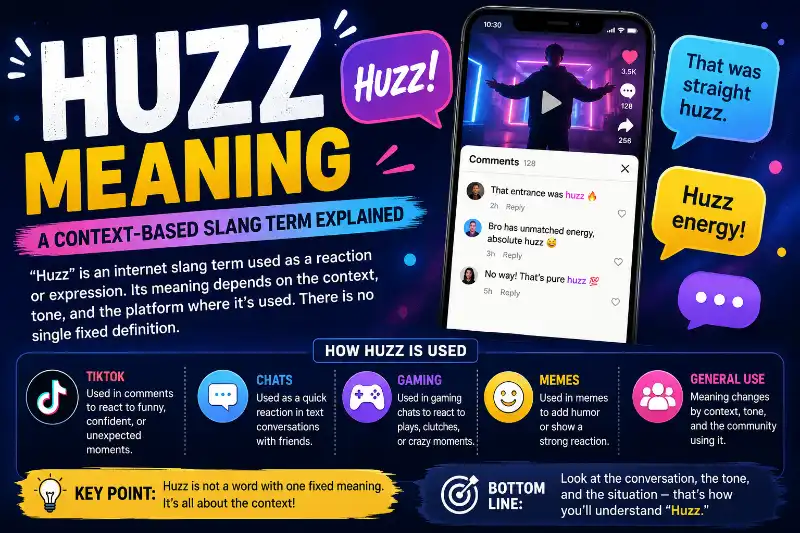
If you have scrolled through TikTok, Instagram Reels, or Discord recently, you have probably stumbled upon the word “Huzz.”
You might have seen comments like:
- “He did it for the huzz.”
- “The huzz are watching.”
- “My huzz.”
And if you are like most people, your first thought was: “What on earth does that mean?”
The Quick Answer: In modern internet slang, “Huzz” is primarily used to refer to girls or women. It is a casual, often playful slang term that gained massive popularity through streamers like Kai Cenat and TikTok culture.
However, unlike simple words like “girls,” the tone of “Huzz” can range from affectionate and joking to slightly disrespectful, depending entirely on the context.
Did you just see “huzz” in a TikTok comment and have no idea who they are talking about? Are you confused by phrases like “the huzz,” “my huzz,” or “for the huzz”? Are you worried it might be offensive or disrespectful? If you are looking for a clear, honest answer—not vague guesses—you have come to the right place. We will explain exactly what Huzz means, who it refers to, how to understand it in any sentence, and whether you should use it.
What Does “Huzz” Mean in Simple Terms?
Let’s cut through the noise.
The Primary Definition (Slang for Girls/Women)
In the vast majority of cases online today, Huzz is internet slang for “girls” or “women.”
It evolved from slang terms like “hoes” (which itself is a derogatory term for women) but has been softened and repurposed by Gen Z into a more playful, meme-friendly expression.
Does It Mean One Girl or a Group?
This is where it gets specific:
- It can refer to a specific group of women (e.g., “The huzz are in the building”).
- It can refer to a romantic interest or crush (e.g., “I’m trying to get the huzz”).
- It is rarely used to refer to just one specific named individual (you wouldn’t say “Sarah is my huzz” unless you are being extremely ironic).
The One Rule to Remember (Context is King)
If a guy posts a video of himself dressing sharply and writes “For the huzz,” he means “I am doing this to impress the girls.”
If someone comments “The huzz are going crazy,” under a female celebrity’s video, they mean “The women in the audience are reacting wildly.”
Key Takeaway: Don’t overthink it. 90% of the time, “Huzz” simply means “girls.”
What Do “The Huzz,” “My Huzz,” and “For the Huzz” Mean?
You will rarely see “Huzz” standing completely alone. It usually comes with a prefix. Here is the exact translation for the most common phrases you will encounter online.
“The huzz” – Referring to a Specific Group of Women
- Meaning: A specific group of women or the general female audience.
- Example: “The huzz are watching the game.”
- Translation: “The girls are watching the game.”
- When to use: When you are referring to a specific set of women in a particular situation (e.g., the female viewers of a stream, the girls at a party).
“My huzz” – Claiming Affiliation or a Crush
- Meaning: My girls, my female friends, or a romantic interest.
- Example: “I’m about to go see my huzz.”
- Translation: “I’m about to go see my girlfriend/female friends.”
- When to use: This is often used to claim ownership or association with a specific group of women. However, some men use this to refer to “their” specific group of women, which can sometimes sound possessive or ego-driven depending on the tone. Be careful with this one.
“For the huzz” – Doing Something to Impress
- Meaning: Doing an action specifically to gain female attention or validation.
- Example: “He put on a suit just for the huzz.”
- Translation: “He dressed up just to impress the girls.”
- When to use: This is the most common usage in memes. It is used to explain someone’s exaggerated or impressive behavior.
How to Figure Out What “Huzz” Means in Any Comment (5 Steps)
Instead of guessing the meaning every time you see “Huzz,” use this simple 5-step framework. This is your problem-solving toolkit.
Step 1: Identify the Target (Who is the comment about?)
Look at the video or the person being discussed.
- If the video features a woman or a group of women, “Huzz” almost certainly refers to them.
- If the video is of a man doing something impressive, “Huzz” refers to the women he is trying to impress.
Step 2: Look for Romantic or Attraction Cues
Is the comment attached to a video of someone flexing, dancing, or showing off?
- If yes, “Huzz” means “the people I am trying to attract.”
- If the video is of a woman, “Huzz” means “the women in this situation.”
Step 3: Check the Tone (Playful, Serious, or Mocking?)
- If the comment uses laughing emojis (😂💀) or exaggerated caps (“HUZZ”), it is usually playful.
- If the comment is angry or aggressive, “Huzz” might be used disrespectfully.
- If the comment is neutral, it is simply a factual reference to women.
Step 4: Read the Surrounding Comments
Don’t just look at the word in isolation. Scroll down a bit.
- If other commenters are saying “The girls are eating this up” or “The ladies love it,” then “Huzz” is definitely a synonym for those words.
- The community often confirms the meaning for you.
Step 5: Apply the “Replacement” Test (Does “girls” fit here?)
Mentally replace “Huzz” with “girls” or “women” in the sentence.
- Original: “The huzz are going crazy.”
- Test: “The girls are going crazy.”
If the sentence makes perfect sense, you have successfully decoded the meaning! Congratulations — you now understand “Huzz.”
Is “Huzz” Offensive, Disrespectful, or Just Playful?
This is the #1 question. Your Google search data confirms that “is huzz a bad word” and “is huzz offensive” are among the top searches. Here is the nuanced, honest answer.
Why Some People Link It to Disrespect (The “Hoes” Connection)
Linguistically, “Huzz” is derived from the same sound family as “Hoes” — a historically derogatory term for women. Because of this origin, some people, particularly older generations, feminists, and those sensitive to sexist language, view it as inherently degrading.
Fact: The word “hoes” has been used for decades to objectify women. “Huzz” is essentially a playful, softened mutation of that sound.
How Gen Z Actually Uses It (Playful Reclamation vs. Objectification)
However, language evolves. In the context of Kai Cenat’s streams, TikTok memes, and everyday Gen Z banter, “Huzz” has largely been softened.
For most young people using it, it does not carry the heavy misogynistic weight of its predecessor. It is treated more like “girls” or “chicks” — casual, in-group slang.
- Playful use: “Bro did that for the huzz 😂” — clearly a joke.
- Objectifying use: “Look at all those huzz walking by.” — this crosses the line into disrespect.
Does the Intent Match the Impact?
Here is the golden rule: Intent matters, but impact matters more.
- If a guy is using it to genuinely hype up his female friends, it’s usually fine.
- If a guy is using it to objectify random women passing by, it is disrespectful.
- If a woman uses it about her own friend group, it’s often a sign of playful reclamation.
The Sliding Scale:
- Most respectful: “Girls,” “Ladies,” “Women.”
- Neutral: “Huzz” (used playfully in memes).
- Disrespectful: “Huzz” used to catcall or degrade.
When Should You Avoid Using It?
Avoid using “Huzz” in:
- Professional workplaces or emails.
- Formal conversations (e.g., meeting a partner’s parents).
- Contexts where you do not know the women you are referring to personally (as it can seem objectifying).
- If you are over 30 and talking to teenagers — it will sound awkward and forced.
Pro Tip: If you have to ask “Is this offensive?”, it is often safer to just say “girls” or “ladies” in real life. Internet slang doesn’t always translate well to the real world.
Where Did the Slang “Huzz” Come From?
Understanding the origin helps you understand its vibe and why it suddenly appeared everywhere.
The Kai Cenat / Twitch Connection
The modern explosion of “Huzz” is heavily credited to popular Twitch streamer and YouTuber Kai Cenat.
Kai frequently used the term in his streams while reacting to videos, interacting with female guests, or joking with his audience. Because Kai has a massive young male following (and is known for his energetic, meme-heavy style), his slang spread like wildfire through the streaming community.
The “-Uzz” Suffix Trend (Bruzz, Gruzz)
“Huzz” is also part of a larger internet trend of replacing parts of words with “-uzz.”
- Bruzz → Brothers / Friends
- Gruzz → Group
- Chuzz → Chad / Man
- Huzz → Hoes / Girls
When creators started saying “Huzz” alongside these other “-uzz” words, it normalized the term within the streaming and meme culture. It became part of a “language family” of playful slang.
How It Exploded on TikTok
TikTok editors and fans started clipping Kai Cenat’s streams and adding subtitles. Soon, “Huzz” escaped the streaming bubble and became a standalone meme.
Users started applying it to any context involving women, which is how you see it all over your For You Page today.
The Viral Moment: When a popular clip goes viral where a streamer says “For the huzz,” thousands of users copy the phrase in comments, making it spread even faster.
Key Takeaway: “Huzz” didn’t come from a dictionary. It came from a streamer, his community, and the internet’s love for copying funny sounds.
Is “Huzz” the Same as “Huzzah”?
This is one of the biggest points of confusion. If you type “Huzz” into a standard dictionary, you might get a result for “Huzzah.”
Let’s clear this up permanently.
What Does “Huzzah” Mean? (The Old English Cheer)
“Huzzah” is an archaic English word used to express joy, approval, or triumph. It is similar to saying “Hurrah!” or “Hooray!”
- Example: “Huzzah! We have won the battle!”
- Origin: It was popular in the 17th and 18th centuries, often used in Shakespearean plays or historical reenactments.
- Tone: Formal, old-fashioned, celebratory.
Why People Confuse Them
The confusion is entirely understandable:
- They look almost identical (Huzz vs. Huzzah).
- They sound similar when spoken quickly.
- If you search “Huzz meaning” on Google, some dictionaries might show “Huzzah” as a related or similar word.
However, they are completely unrelated in meaning and usage.
The Clear Difference
| Feature | Huzz (Modern Slang) | Huzzah (Old English) |
|---|---|---|
| Meaning | Girls / Women (internet slang) | An exclamation of joy or triumph |
| Usage | TikTok, memes, texting, streaming | Historical contexts, literature, theater |
| Tone | Casual, playful, internet-based | Celebratory, old-fashioned, formal |
| Example | “The huzz are going crazy.” | “Huzzah! The king has arrived!” |
Key Takeaway: If a teenager says “Huzz,” they are almost certainly talking about people, not celebrating a victory. Do not confuse the two.
Real-Life Examples of How People Use “Huzz”
Now that you know the definition and the 5-step identification method, let’s see “Huzz” in action across real online scenarios.
Example 1: Commenting on a Video
- Video: A guy performs a difficult skateboard trick.
- Comment: “Bro did that just for the huzz 😂”
- Translation: “He only did that skateboard trick to impress the girls watching.”
- Why it works: The commenter is using “huzz” to refer to the female viewers who might find the trick attractive. The laughing emoji indicates it’s playful, not serious.
Example 2: Texting a Friend
- Text: “Yo, we pulling up to the party tonight? Are the huzz gonna be there?”
- Translation: “Are we going to the party tonight? Will there be girls there?”
- Why it works: The person is asking about the guest list. “Huzz” is simply a casual, slangy way to ask about the female presence at an event.
Example 3: The Meme Context
- Post: A picture of an expensive dessert with a fancy presentation.
- Caption: “The huzz love sweets.”
- Translation: “Women generally enjoy sweet desserts.”
- Why it works: This is a classic internet meme format — making a playful, slightly stereotypical observation. It’s not meant to be taken as a factual statement; it’s just a lighthearted joke.
Example 4: Reacting to a Celebrity
- Video: A female celebrity walks the red carpet in a stunning outfit.
- Comment: “The huzz are eating this up.”
- Translation: “Women are absolutely loving this outfit.”
- Why it works: The commenter is describing the reaction of the female audience. “Eating this up” means they are loving it.
Should You Use the Word “Huzz” Yourself?
So after all this explanation, the biggest question remains: Should I start using it?
This is the most practical, actionable part of this guide. Here is exactly when to use it — and when to avoid it.
When It Might Be Okay (Casual, Same-Age Groups)
Using “Huzz” is acceptable in these situations:
- In a group chat with close friends who already use internet slang.
- When creating or commenting on memes where the playful tone fits.
- If you are Gen Z or a very online millennial who understands the cultural context.
- When referring to your own female friend group (e.g., “Me and my huzz are going out” — if you are female).
- When you are 100% sure the women you’re referring to won’t mind.
Why You Might Want to Avoid It (Professional/Sensitive Settings)
Avoid using “Huzz” in these situations:
- Professional workplaces: Do not use it in emails, meetings, or Slack channels.
- Academic settings: Presentations, essays, or formal assignments.
- Meeting a partner’s parents or elders: It will sound disrespectful and immature.
- Real life, face-to-face: Calling a woman “Huzz” to her face (unless you are joking with a very close friend) usually sounds awkward at best and creepy at worst.
- If you are over 30 and talking to teenagers: It will sound forced and out of touch.
- If you don’t know the women personally: Referring to strangers as “huzz” can come across as objectifying.
The Golden Rule: If you have to ask yourself, “Is this the right moment to say ‘huzz’?” — the answer is almost always no. When in doubt, use standard English.
Safer Alternatives to Use Instead
If you want to refer to a group of women casually without the baggage, just use these universally understood alternatives:
| Instead of “Huzz” | Use This | Why It’s Better |
|---|---|---|
| “The huzz” | “The girls” | Clear, neutral, and widely accepted. |
| “My huzz” | “My friends” or “My girlfriends” | Avoids possessiveness or misinterpretation. |
| “For the huzz” | “To impress the ladies” | More respectful and clearly understood. |
| “Huzz are here” | “The women are here” | Professional and unambiguous. |
Pro Tip: Internet slang is like a costume. It’s fun to wear at a party, but you wouldn’t wear it to a job interview. Choose your words based on your audience.
Frequently Asked Questions About Huzz
Q: Is Huzz used for men too?
A: Rarely. While some people use it ironically for mixed groups, the overwhelming consensus in internet slang is that “Huzz” specifically targets women or girls.
If you want to refer to men, you might hear “Bruzz” (brothers/friends) or simply “Guys.” Using “Huzz” for men would confuse almost everyone.
Q: Is Huzz the same as “Hussy”?
A: No. A “Hussy” is an old-fashioned, derogatory term for a woman considered immoral, disrespectful, or promiscuous. It dates back centuries and carries heavy negative judgment.
“Huzz” is modern internet slang and does not carry that specific historical baggage. They are completely unrelated words that just happen to look slightly similar.
Q: How do you pronounce Huzz?
A: It rhymes with “Buzz” or “Fuzz.”
- Pronunciation: /hʌz/
- Say it like: “huh” + “z” (with a short, sharp sound).
It is a single syllable, similar to “buzz” but with an ‘h’ at the start.
Q: Will Huzz become an official dictionary word?
A: It is already listed by some dictionaries (like Merriam-Webster) as an “internet slang” or “slang” term. However, its longevity depends on whether internet culture continues using it.
The Truth: Slang words become official when they survive for many years and enter mainstream, formal usage. “Huzz” is still relatively new. For now, it is considered “slang,” not “standard English.” It might make it into the dictionary permanently, or it might fade away like many other viral trends. Only time will tell.
Final Teacher’s Advice
Don’t overthink “Huzz.”
Whenever you see it online, take a breath, look at the video and the sentence, and simply translate it to “girls” or “women” in your head.
If you are a parent or teacher hearing it for the first time, know that while it has roots in disrespectful language, the modern usage is often playful and harmless—but it is still a casual word best kept in memes and group chats.
Here is your cheat sheet for life:
| Situation | What to Do |
|---|---|
| Reading a TikTok comment with “huzz” | Mentally replace it with “girls.” |
| Considering using “huzz” in a text | Only if you’re with close friends. |
| Considering using “huzz” at work | Don’t. Just don’t. |
| Unsure about the meaning in a specific context | Use the 5-Step Method (Part 1). |
| Want to stay completely safe | Just say “girls” or “ladies.” |
You now possess the complete, step-by-step guide to the “Huzz meaning.” Go forth and decode those TikTok comments with confidence!


