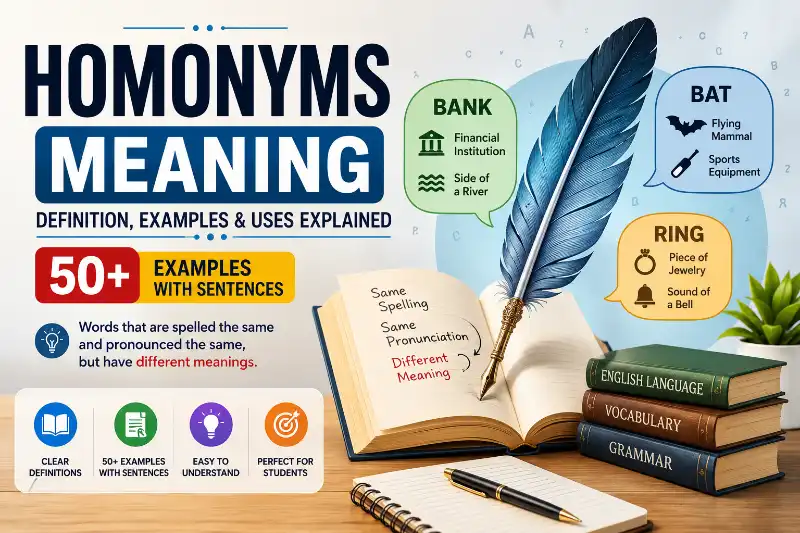
Homonyms meaning is simple: homonyms are words that have the same spelling, the same pronunciation, or both, but completely different meanings. For example, the word bat can refer to a flying mammal or a piece of sports equipment used in games like baseball or cricket. Although the word looks and sounds the same, its meaning changes entirely depending on the context.
Have you ever read a sentence and wondered why the same word seemed to have two different meanings? English is full of words that can be confusing at first, and homonyms are one of the biggest reasons. They appear in books, classrooms, exams, newspapers, business communication, and everyday conversations. Even fluent English speakers occasionally misunderstand them when the context is unclear.
The good news is that learning homonyms doesn’t require memorizing hundreds of difficult words. Once you understand how context works, identifying the correct meaning becomes much easier. Instead of treating homonyms as confusing vocabulary, think of them as words with multiple identities. The surrounding words in a sentence tell you exactly which meaning the writer or speaker intends.
In this complete guide, you’ll learn the meaning of homonyms, discover common examples, understand the different types of homonyms, compare them with homophones and homographs, explore 50 common homonyms with meanings and examples, and practice using them correctly through real-life sentences and exercises.
Whether you’re a student preparing for exams, an English learner expanding your vocabulary, a teacher creating classroom materials, or someone who simply wants to write and speak more confidently, this guide will help you understand homonyms in a practical and easy-to-remember way.
By the end of this article, you won’t just know the definition of homonyms—you’ll understand how they work, why they exist, and how to identify their correct meaning in almost any English sentence.
Quick Answer
If you’re looking for a quick definition, here’s the answer.
Homonyms are words that have the same spelling, the same pronunciation, or both, but different meanings. The intended meaning depends entirely on the context of the sentence.
For example:
Bat
- A flying mammal
- A piece of sports equipment
Example sentences:
- A bat flew out of the cave at sunset.
- He hit the ball with a wooden bat.
Although the word is identical in both sentences, its meaning changes completely because the surrounding words provide different contexts.
Another simple example is bank.
- A financial institution
- The side of a river
Examples:
- She deposited money in the bank.
- The children sat on the bank of the river.
In everyday communication, readers and listeners rarely become confused because context naturally reveals the intended meaning.
Key Point
A homonym is one word with two or more completely different meanings. To understand which meaning is correct, always read or listen to the entire sentence instead of focusing on the word alone.
📚 Related Articles
100 Homophones with Meaning and Examples
Quick Examples of Homonyms
Before exploring the concept in detail, let’s look at a few common homonyms you’ll encounter in everyday English. Seeing real examples first makes the definition much easier to understand.
| Word | Meaning 1 | Meaning 2 | Example Sentence |
|---|---|---|---|
| Bat | A flying mammal | Sports equipment | The bat flew over the stadium while the player picked up his bat. |
| Bank | Financial institution | Side of a river | We visited the bank before walking along the river bank. |
| Bark | Sound made by a dog | Outer covering of a tree | The dog’s bark echoed through the forest, where the tree’s bark was covered in moss. |
| Match | A sports contest | A stick used to start a fire | He watched the football match before lighting a candle with a match. |
| Ring | Circular piece of jewelry | Sound made by a phone or bell | Her gold ring sparkled just as the phone began to ring. |
| Spring | A season | A coiled object or natural water source | Flowers bloom in spring, and fresh water flows from a mountain spring. |
Why These Examples Matter
At first glance, these words may seem confusing because they look exactly the same. However, once you read each sentence, the intended meaning becomes obvious.
This is the most important idea to remember about homonyms:
The meaning never depends on the word alone—it depends on the context in which the word is used.
That’s why experienced readers don’t stop to think every time they see a homonym. Their brains automatically use the surrounding words to determine the correct meaning.
What Are Homonyms?
Now that you’ve seen a few examples, let’s understand the concept more deeply.
A homonym is a word that shares the same spelling, the same pronunciation, or both with another word but has a completely different meaning.
This doesn’t mean the word has a slightly different definition. Instead, each meaning represents a separate idea.
Take the word bat as an example.
When someone says:
“A bat flew across the cave.”
You immediately imagine a flying animal.
Now read this sentence:
“She bought a new cricket bat.”
This time, you imagine sports equipment.
The spelling hasn’t changed.
The pronunciation hasn’t changed.
Only the context has changed.
This is exactly how homonyms work.
Another common example is bark.
Sentence one:
“The dog’s bark woke everyone.”
Sentence two:
“The bark of the tree feels rough.”
Again, the same word represents two completely different things.
Many learners believe homonyms are difficult because they expect one word to have only one meaning. English doesn’t always work that way. Many words developed multiple meanings over hundreds of years, and modern speakers understand them naturally through context.
This is why reading complete sentences is far more important than memorizing definitions. The surrounding words provide clues that tell you which meaning the writer intends.
Teacher’s Classroom Example
Imagine I write only one word on the classroom board:
Bank
Can you tell me its meaning?
Probably not.
Now look at these sentences.
“She opened a savings account at the bank.”
“The fisherman sat quietly on the river bank.”
Without changing the word, we’ve changed its meaning simply by changing the sentence around it.
This is the easiest way to understand homonyms.
Key Takeaway
A homonym is a word that can represent two or more completely different meanings. The correct meaning is always determined by the context of the sentence, not by the word itself.
Why Are They Called Homonyms?
Many students understand what homonyms are but still wonder where the word homonym comes from.
The name itself provides a helpful clue.
The word homonym comes from two Greek words:
- Homo, meaning same
- Onym (or onoma), meaning name
Together, homonym literally means “same name.”
In English, this doesn’t mean two words always represent the same idea. Instead, it means they share the same written form, the same pronunciation, or both while representing different meanings.
For example, consider the word match.
Sentence one:
“The football match starts at 7 p.m.”
Sentence two:
“Use a match to light the candle.”
The word is identical, but the ideas are completely unrelated.
That’s exactly why linguists use the term homonym. The word appears to have the same “name,” yet it represents different concepts depending on the context.
Understanding the origin of the term also helps you remember its definition. Instead of memorizing a complicated explanation, simply think:
Same word, different meanings.
This simple idea captures the essence of homonyms and makes the concept much easier to remember whenever you encounter new vocabulary.
Teacher’s Tip
Whenever you come across a homonym, don’t ask, “Which meaning is correct?” Instead, ask:
“What is this sentence talking about?”
The answer will almost always reveal the correct meaning without any confusion.
Key Takeaway
The word homonym literally means “same name.” Although the spelling or pronunciation may be identical, the meaning changes according to the context of the sentence. Once you focus on the surrounding words instead of the homonym itself, identifying the correct meaning becomes much easier.
Why Are Homonyms Important?
Now that you understand what homonyms are, you might wonder:
“Why should I spend time learning them?”
The answer is simple: homonyms are used everywhere in English. You will find them in books, newspapers, school assignments, business emails, advertisements, conversations, and even everyday text messages. Because one word can have more than one meaning, understanding homonyms helps you interpret English correctly and avoid misunderstandings.
Many English learners believe that vocabulary is only about learning new words. In reality, learning the different meanings of the same word is just as important. A strong vocabulary isn’t measured only by how many words you know, but also by how well you understand the different ways those words are used.
Imagine reading this sentence:
“The children played on the bank.”
If you immediately think about a financial institution, the sentence may seem confusing. However, when you continue reading and discover that they were fishing by a river, you instantly understand that bank refers to the land beside the water.
This example shows why context is one of the most important skills in English. Homonyms teach you to read beyond individual words and focus on the complete meaning of a sentence.
Whether you’re preparing for an English exam, improving your writing, or simply trying to communicate more naturally, learning homonyms will make your English clearer, more accurate, and more confident.
Improve Your Vocabulary
One of the biggest benefits of learning homonyms is that they naturally expand your vocabulary.
Most vocabulary lessons introduce one meaning for each word. However, English doesn’t always work that way. Many common words have two or more completely different meanings.
For example, consider the word ring.
It can mean:
- A piece of jewelry worn on your finger.
- The sound made by a phone or bell.
- A circular shape.
- A group of people working together illegally.
Instead of learning four different words, you’re learning four meanings of the same word.
This makes your vocabulary richer without making it more difficult.
As you read books, articles, or newspapers, you’ll begin noticing familiar words used in completely different situations. Rather than becoming confused, you’ll recognize that the writer is simply using another meaning of the same homonym.
Over time, this ability makes reading much easier because your brain becomes trained to understand meaning through context rather than memorizing isolated definitions.
Teacher’s Tip
Whenever you discover a new homonym, don’t stop after learning one definition. Write down every common meaning and create a sentence for each one. This simple habit helps you remember the word much longer than memorizing definitions alone.
Key Takeaway
Learning homonyms strengthens your vocabulary because each word introduces you to multiple meanings instead of just one. The more meanings you understand, the more confident you’ll become while reading and writing English.
Improve Reading Comprehension
Many reading difficulties happen because learners focus on individual words instead of the complete sentence.
Homonyms are an excellent example.
Look at this sentence:
“The crane stood quietly beside the lake.”
If you think only about construction equipment, the sentence won’t make much sense.
However, once you recognize that crane can also mean a long-legged bird, the meaning becomes clear.
Now consider another sentence:
“The crane lifted the steel beams.”
This time, the same word refers to a large machine.
The only thing that changed was the surrounding context.
Good readers naturally use nearby words to determine which meaning fits the sentence. This is why practicing homonyms also improves reading comprehension.
You’ll spend less time guessing unfamiliar meanings and more time understanding the writer’s message.
This skill becomes especially valuable when reading novels, newspapers, academic textbooks, professional documents, and online articles where homonyms appear frequently.
Teacher’s Classroom Example
Imagine reading the sentence:
“The seal watched the tourists.”
Are we talking about:
- A sea animal?
or
- A stamp used on official documents?
The words watched the tourists immediately tell us that the correct meaning is the animal.
This is exactly how context guides your understanding.
Key Takeaway
Learning homonyms improves reading comprehension because it teaches you to interpret words based on the surrounding sentence rather than assuming every word has only one meaning.
Improve Writing Skills
Good writing depends on choosing words that communicate your ideas clearly.
Although homonyms share the same spelling or pronunciation, selecting the correct meaning within the right context helps readers understand exactly what you intend.
For example, imagine writing this sentence:
“The coach told us to watch the match carefully.”
Most readers immediately understand that match refers to a sporting event because of the surrounding words.
Now consider another sentence:
“He struck a match before entering the dark room.”
Here, the same word refers to a small stick used to start a fire.
As a writer, your responsibility is to provide enough context so readers never have to guess which meaning you intended.
The better you understand homonyms, the easier it becomes to write sentences that are clear, natural, and easy to follow.
This is particularly important in:
- School essays
- Research papers
- Business emails
- Reports
- Blog articles
- Professional communication
Clear writing builds confidence and helps readers focus on your ideas instead of becoming distracted by confusing language.
Teacher’s Tip
After writing a paragraph, reread it from the perspective of someone seeing it for the first time. Ask yourself:
“Could this word have another meaning?”
If the answer is yes, check whether your sentence provides enough context.
Key Takeaway
Understanding homonyms makes your writing clearer because you learn how to use context to guide your readers toward the correct meaning.
Improve Speaking and Listening Skills
Homonyms aren’t only important in writing—they also play a major role in spoken English.
When people speak, they don’t stop to explain which meaning of a homonym they’re using. Instead, listeners understand naturally because the surrounding conversation provides enough context.
For example, imagine someone says:
“I’ll meet you at the bank after work.”
If you know they work in finance, you’ll probably think of a financial institution.
If you’re spending the afternoon fishing together, you’ll likely imagine the side of a river.
The pronunciation stays exactly the same.
Only the situation changes.
Learning homonyms trains your brain to use context while listening, making conversations much easier to understand.
This skill becomes especially valuable when watching English movies, listening to podcasts, attending lectures, or speaking with native English speakers.
Rather than translating every word individually, you’ll begin understanding complete ideas more naturally.
Key Takeaway
Homonyms improve both speaking and listening because they teach you to focus on the overall meaning of a conversation instead of individual words.
Perform Better in Exams
Homonyms appear regularly in English examinations because they test more than vocabulary. They measure your ability to understand meaning through context.
You’ll often find homonym-related questions in:
- School English examinations
- Grammar tests
- Vocabulary quizzes
- Reading comprehension exercises
- IELTS
- TOEFL
- Competitive examinations
- Teacher recruitment tests
For example, an exam might ask you to identify the correct meaning of a word based on a sentence rather than asking for its definition directly.
Students who understand homonyms usually answer these questions much faster because they rely on context instead of guessing.
That’s why teachers introduce homonyms early in English education—they help develop stronger reading, writing, and critical thinking skills at the same time.
Teacher’s Advice
Don’t prepare for exams by memorizing long vocabulary lists.
Instead, practice reading complete sentences and identifying how context changes the meaning of common homonyms.
This approach not only improves your exam performance but also makes your English more natural in everyday life.
Key Takeaway
Homonyms are important because they improve vocabulary, reading comprehension, writing, speaking, listening, and exam performance. More importantly, they teach you one of the most valuable English skills: understanding meaning through context instead of relying on individual words alone.
Types of Homonyms
Not all homonyms are exactly the same.
Many students assume every homonym works in one way, but English is more interesting than that. Some homonyms share the same spelling, some share the same pronunciation, and some share both.
Understanding these different types helps you recognize why certain words are grouped together and prevents confusion when comparing homonyms with homophones and homographs.
In simple terms, homonyms can be divided into three main categories:
- Homographs
- Homophones
- Perfect Homonyms
Let’s look at each type in detail.
Homographs
Homographs are words that have the same spelling but different meanings. In some cases, they are pronounced differently as well.
For example:
Lead
- To guide someone.
- A heavy metal.
Another example is:
Bow
- To bend forward.
- A decorative ribbon.
- The front of a ship.
Although the spelling stays the same, the meaning changes according to the sentence.
Some homographs are also pronounced differently, while others have the same pronunciation.
Examples of Homographs
| Word | Meaning 1 | Meaning 2 |
|---|---|---|
| Lead | To guide | A metal |
| Bow | Bend forward | Ribbon |
| Tear | Drop from the eye | Rip apart |
| Wind | Moving air | To twist something |
Key Takeaway
Homographs always share the same spelling, but their meanings are different. Their pronunciation may stay the same or change depending on the word.
Homophones
Homophones are words that have the same pronunciation but different meanings and usually different spellings.
Examples include:
- Sea / See
- Right / Write
- Flour / Flower
- Pair / Pear
Although these words sound exactly alike, they represent completely different ideas.
This is why choosing the correct spelling is so important in writing.
Teacher’s Tip
If you’re unsure which homophone is correct, ask yourself:
“What does this sentence mean?”
The answer will usually reveal the correct word immediately.
Key Takeaway
Homophones sound the same but have different meanings and are usually spelled differently. Context determines which word is correct.
Perfect Homonyms
Perfect homonyms are words that share the same spelling and the same pronunciation, yet have completely different meanings.
These are the examples most people think of when they hear the word homonym.
Common examples include:
- Bat
- Bank
- Bark
- Match
- Ring
- Spring
For instance:
“The bat flew into the cave.”
“He bought a new cricket bat.”
The spelling never changes.
The pronunciation never changes.
Only the meaning changes.
Perfect homonyms demonstrate why context is so important in English communication. Without surrounding words, it’s often impossible to know which meaning is intended.
Key Takeaway
Perfect homonyms share the same spelling and pronunciation while representing completely different ideas. The surrounding context is the only way to identify the correct meaning.
Homonyms vs. Homophones vs. Homographs
One of the biggest questions English learners ask is:
“Are homonyms, homophones, and homographs the same thing?”
The short answer is no.
Although these three terms are closely related, they describe different relationships between words. Because their names look and sound similar, many students confuse them. Once you understand the difference, however, identifying each type becomes much easier.
Think of these three terms as members of the same family. They are connected because they deal with words that share something in common, but each one focuses on a different characteristic.
Let’s understand them one by one.
What Are Homonyms?
Homonyms are words that have the same spelling, the same pronunciation, or both, but different meanings.
In everyday English, people often use the word homonym to describe words that look and sound exactly alike while representing completely different ideas.
For example:
Bat
- A flying mammal
- A piece of sports equipment
Examples:
- A bat flew out of the cave.
- He bought a new cricket bat.
Another example is bank.
- A financial institution
- The side of a river
Examples:
- She deposited money in the bank.
- The children played on the river bank.
Notice that the spelling and pronunciation stay the same, but the meaning changes according to the sentence.
Key Point
A homonym always has more than one unrelated meaning, and context tells you which meaning is correct.
What Are Homophones?
Homophones are words that sound the same but usually have different spellings and different meanings.
Because their pronunciation is identical, they are one of the most common causes of spelling mistakes.
Examples include:
- Sea / See
- Right / Write
- Pair / Pear
- Flour / Flower
For example:
- I can see the ocean.
- The sea was calm today.
Although the pronunciation is identical, the meanings are completely different.
When speaking, listeners understand the intended meaning from context.
When writing, however, choosing the correct spelling is essential.
Teacher’s Example
Compare these sentences.
❌ Please right your answer.
✅ Please write your answer.
The pronunciation is the same, but only write fits the meaning of the sentence.
Key Point
Homophones have the same sound but different meanings and usually different spellings.
What Are Homographs?
Homographs are words that have the same spelling but different meanings.
Sometimes they are pronounced the same.
Sometimes they are pronounced differently.
For example:
Lead
- Lead (leed) = to guide
- Lead (led) = a heavy metal
Another example:
Bow
- Bow (boh) = bend forward
- Bow (bau) = ribbon
The spelling never changes.
The pronunciation may change.
The meaning always changes.
This is what makes homographs unique.
Teacher’s Tip
Whenever you see the same spelling used in different ways, read the entire sentence before deciding how to pronounce the word.
The surrounding words will almost always give you the answer.
Key Point
Homographs always share the same spelling, but their meanings—and sometimes their pronunciation—are different.
Quick Comparison Table
The easiest way to remember these three terms is to compare them side by side.
| Feature | Homonyms | Homophones | Homographs |
|---|---|---|---|
| Same pronunciation | Sometimes or Yes | ✅ Yes | Sometimes |
| Same spelling | Sometimes or Yes | Usually No | ✅ Yes |
| Different meanings | ✅ Yes | ✅ Yes | ✅ Yes |
| Example | Bat, Bank | Sea / See | Lead / Lead |
Instead of memorizing complicated definitions, simply remember what stays the same.
- Homophones → Same sound
- Homographs → Same spelling
- Homonyms → Same word form with different meanings
This simple comparison helps students remember the differences much more quickly.
An Easy Memory Trick
Many students confuse these terms because they all begin with “homo.”
Fortunately, there’s an easy way to remember them.
Homophone → Think Phone
A phone is something you hear.
So homophones have the same sound.
Example:
- Sea
- See
Homograph → Think Graph
A graph is something you write or draw.
So homographs have the same spelling.
Example:
- Lead
- Lead
Homonym → Think Name
The word comes from Greek.
- Homo = same
- Onym = name
So a homonym is a word that shares the same “name” but has different meanings.
Example:
- Bat
- Bank
Teacher’s Classroom Memory Trick
Imagine you’re teaching three students.
One student says,
“These words sound the same.”
That’s a homophone.
Another student says,
“These words are spelled the same.”
That’s a homograph.
The third student says,
“This word has two completely different meanings.”
That’s a homonym.
When students remember the idea instead of memorizing definitions, they rarely confuse these terms again.
Why Knowing the Difference Matters
Some learners wonder whether they really need to know the difference between these three terms.
The answer is yes, especially if you’re studying English seriously.
Understanding these word relationships helps you:
- Improve reading comprehension.
- Avoid spelling mistakes.
- Understand dictionary entries.
- Build a stronger vocabulary.
- Perform better in grammar tests.
- Write with greater accuracy.
- Understand classroom lessons more easily.
For example, if a teacher asks:
“Why are sea and see called homophones?”
You’ll immediately know it’s because they sound the same.
If someone asks why lead is a homograph, you’ll know it’s because the spelling stays the same while the pronunciation and meaning may change.
Similarly, you’ll recognize bat as a homonym because the word has multiple unrelated meanings.
Understanding these differences also makes learning future vocabulary much easier because you’ll begin noticing patterns instead of memorizing isolated words.
Teacher’s Final Advice
Students often spend too much time memorizing definitions.
Instead, focus on the examples.
If you can explain:
- why sea / see are homophones,
- why lead / lead are homographs,
- and why bat is a homonym,
then you’ve truly understood the topic.
Real understanding comes from recognizing these words in everyday reading and writing—not from memorizing textbook definitions.
Key Takeaways
Before moving on to the next section, remember these essential points:
- Homonyms are words with the same spelling, pronunciation, or both, but different meanings.
- Homophones sound the same but usually have different spellings and meanings.
- Homographs share the same spelling but have different meanings and may also have different pronunciations.
- Context is the most reliable way to identify the correct meaning of any homonym.
- Learning the differences between these terms improves your vocabulary, grammar, spelling, reading comprehension, and writing skills.
- The easiest way to remember them is:
- Phone = Sound = Homophone
- Graph = Writing = Homograph
- Name = Homonym
The 20 Most Common Homonyms Used in Everyday English
Before exploring a larger collection of homonyms, it’s helpful to begin with the words you’re most likely to see and hear every day. These common homonyms appear in school textbooks, newspapers, novels, emails, advertisements, business communication, and everyday conversations. Learning them first gives you a strong foundation for understanding more advanced vocabulary later.
As a teacher, I always encourage students to master the most frequently used homonyms before trying to memorize long lists. Once you recognize these words in context, you’ll notice them almost everywhere, making it much easier to remember their different meanings naturally.
The table below introduces 20 common homonyms along with their different meanings.
| Homonym | Meaning 1 | Meaning 2 |
|---|---|---|
| Bat | A flying mammal | A piece of sports equipment |
| Bank | Financial institution | Side of a river |
| Bark | Sound made by a dog | Outer covering of a tree |
| Ring | Jewelry worn on a finger | Sound made by a bell or phone |
| Match | Sports competition | Stick used to start a fire |
| Spring | Season of the year | Natural water source or metal coil |
| Rock | Stone | Music genre or to move gently |
| Jam | Fruit spread | Traffic congestion |
| Watch | Timepiece | To look carefully |
| Light | Brightness | Not heavy |
| Park | Public recreation area | To leave a vehicle |
| Can | Metal container | To be able to do something |
| Left | Opposite of right | Past tense of leave |
| Wave | Movement of water | Hand gesture |
| File | Collection of documents | Tool for smoothing surfaces |
| Fair | Public event | Just or reasonable |
| Point | Sharp end | Main idea or score |
| Duck | A water bird | To lower your head quickly |
| Kind | Type or category | Caring and generous |
| Well | Healthy | Deep hole that provides water |
Although each word looks exactly the same, its meaning changes according to the sentence. This is what makes homonyms unique and why context is so important in English.
Why Should You Learn These Homonyms First?
These twenty homonyms are among the most frequently used words in modern English. They appear in a wide variety of situations, which means you’ll encounter them regularly whether you’re reading, writing, or speaking.
For example, you’ll find them in:
- School assignments and English textbooks
- Grammar and vocabulary exercises
- IELTS, TOEFL, and competitive examinations
- Business emails and workplace communication
- Books, newspapers, and magazines
- Blogs and online articles
- Movies, television shows, and podcasts
- Everyday conversations
Because they’re used so often, understanding these words first will improve both your reading comprehension and your confidence when communicating in English.
Instead of stopping every time you see a familiar word used in an unfamiliar way, you’ll naturally recognize that the writer is using another meaning of the same homonym.
Homonyms Examples in Sentences
The easiest way to understand homonyms is to see how they work in real sentences. A definition tells you what a word can mean, but a sentence shows you how that meaning changes in context.
Read each example carefully and notice how the surrounding words make the correct meaning obvious.
| Homonym | Example Showing Meaning 1 | Example Showing Meaning 2 |
|---|---|---|
| Bat | A bat flew out of the cave at sunset. | He bought a new cricket bat yesterday. |
| Bank | She deposited money in the bank. | We sat on the bank of the river. |
| Bark | The dog’s bark woke the neighbors. | The tree’s bark feels rough. |
| Ring | She wore a diamond ring. | I heard the phone ring twice. |
| Match | We watched a football match. | He lit the candle with a match. |
| Spring | Flowers bloom during spring. | Fresh water flowed from the mountain spring. |
| Rock | The child picked up a rock. | The baby began to rock gently to sleep. |
| Jam | I spread strawberry jam on my toast. | We were stuck in a traffic jam. |
| Watch | I wear a watch every day. | Please watch the road carefully. |
| Light | The room was filled with light. | This bag is surprisingly light. |
| Park | The children played in the park. | Please park your car here. |
| Can | She opened a can of soup. | I can solve this problem. |
| Left | Turn left at the traffic lights. | She left home early this morning. |
| Wave | A huge wave hit the beach. | She gave me a friendly wave. |
| File | Keep the documents in this file. | Use a file to smooth the metal edge. |
| Fair | We visited the county fair. | The teacher made a fair decision. |
| Point | The pencil has a sharp point. | That’s an excellent point. |
| Duck | A duck swam across the lake. | Duck! The ball is coming toward you. |
| Kind | What kind of music do you enjoy? | She is always kind to others. |
| Well | The farmer dug a well. | I’m feeling well today. |
What Do These Examples Teach Us?
Notice something interesting about every sentence above.
The word itself never changes.
Only the surrounding words change.
For example:
“The phone began to ring.”
Here, ring refers to a sound.
Now compare it with:
“She bought a gold ring.”
This time, ring refers to a piece of jewelry.
The spelling is identical.
The pronunciation is identical.
Only the meaning changes.
This is exactly how homonyms work in everyday English.
The more sentences you read, the more naturally you’ll recognize the correct meaning without stopping to think about it.
Teacher’s Study Tip
Don’t simply read these examples once and move on.
Instead, choose five homonyms each day and write one original sentence for every meaning.
For example:
Light
- The sunlight filled the room with light.
- This backpack is very light, so it’s easy to carry.
Creating your own examples helps your brain connect each meaning with a real situation, making it much easier to remember than memorizing definitions alone.
Another effective strategy is to highlight homonyms whenever you read books, newspapers, or online articles. Ask yourself:
- Which meaning is being used here?
- What clues in the sentence helped me understand it?
This simple habit will quickly improve your vocabulary, reading comprehension, and writing accuracy.
50+ Homonyms with Meaning and Examples (A–F)
Now that you understand what homonyms are and why they matter, it’s time to explore them in alphabetical order. This section introduces common homonyms beginning with the letters A to F. Each word includes its different meanings along with simple example sentences so you can understand how context changes the meaning.
As a teacher, I recommend reading one word at a time instead of memorizing the entire table. Focus on understanding how each meaning is used in a sentence. This approach helps you remember homonyms much more effectively.
A–F Homonyms Table
| Homonym | Meaning 1 | Example Sentence | Meaning 2 | Example Sentence |
|---|---|---|---|---|
| Address | Location of a place | Please write your home address on the form. | To speak to someone | The principal will address the students today. |
| Arm | Part of the human body | She injured her arm while playing football. | A weapon or firearm | The museum displayed ancient arms from history. |
| Ashes | Powder left after burning | The fire left only ashes behind. | A type of tree (ash) in plural | Tall ashes lined the country road. |
| Band | A musical group | The school band performed beautifully. | A strip or ring | He wore a gold band on his finger. |
| Bark | Sound made by a dog | The dog’s bark woke the neighborhood. | Outer covering of a tree | The tree’s bark felt rough. |
| Bat | A flying mammal | A bat flew through the cave. | Sports equipment | He hit the ball with a cricket bat. |
| Bank | Financial institution | She opened an account at the bank. | Side of a river | We had lunch on the river bank. |
| Bear | A wild animal | We saw a bear in the forest. | To carry or tolerate | I can’t bear the loud noise. |
| Board | A flat piece of wood | He cut the board into two pieces. | A group managing an organization | The school board approved the new policy. |
| Book | A printed publication | I’m reading an interesting book. | To reserve | We need to book our hotel early. |
| Bolt | A metal fastener | Tighten the bolt with a wrench. | To run away suddenly | The horse bolted across the field. |
| Bow | To bend respectfully | The actors bowed after the show. | A ribbon or decorative knot | She tied a pink bow in her hair. |
| Box | A container | Put the toys in the box. | To fight in a boxing match | He loves to box every weekend. |
| Brake | Device that stops a vehicle | Press the brake carefully. | (Often confused with “break”—not a homonym, but included for awareness) | Remember that brake and break are homophones, not homonyms. |
| Brush | A tool for cleaning or painting | She cleaned her shoes with a brush. | Light contact | My hand made a brush against the wall. |
| Can | A metal container | Open the can of soup. | To be able | I can speak English fluently. |
| Capital | A country’s main city | Islamabad is the capital of Pakistan. | Money or wealth used in business | The company raised more capital this year. |
| Case | A container | Keep your glasses in the case. | A legal matter | The lawyer presented the case in court. |
| Check | To examine | Please check your answers. | A written payment order (cheque) | She paid by check. |
| Chest | Front part of the body | He felt pain in his chest. | A storage box | The treasure was hidden in a wooden chest. |
| Club | An organization | She joined the science club. | A heavy stick | The guard carried a wooden club. |
| Coach | A sports trainer | The coach encouraged the players. | A passenger bus or railway carriage | We traveled by coach. |
| Crane | A large bird | A crane stood near the lake. | A lifting machine | The crane lifted the steel beams. |
| Cross | To move from one side to another | Please cross the road carefully. | Angry or annoyed | She looked cross after the argument. |
| Current | Present time | The current situation is improving. | Flow of water or electricity | The river current was very strong. |
| Date | A day on the calendar | Write today’s date on your paper. | A social meeting | They went on a dinner date. |
| Deck | Floor of a ship | We stood on the ship’s deck. | A set of playing cards | Shuffle the deck before dealing. |
| Draft | First version of writing | I finished the first draft of my essay. | Air current | I felt a cold draft from the window. |
| Duck | A water bird | A duck swam across the pond. | To lower your head quickly | Duck! The ball is coming. |
| Fair | Just or reasonable | The judge made a fair decision. | Public exhibition or festival | We visited the county fair. |
| Fan | A device that moves air | Turn on the fan. | An enthusiastic supporter | She’s a huge football fan. |
| File | Collection of documents | Keep the papers in the file. | Tool for smoothing metal or wood | Use a file to smooth the edge. |
| Fine | Good or satisfactory | I’m feeling fine today. | A monetary penalty | He paid a parking fine. |
| Firm | A business company | She works for a law firm. | Strong or solid | Hold the rope with a firm grip. |
| Fly | An insect | A fly landed on the table. | To move through the air | Birds fly south in winter. |
| Foot | Part of the body | My foot hurts after the walk. | Bottom of something | We stood at the foot of the mountain. |
G–M Homonyms with Meaning and Examples
Now let’s continue with homonyms beginning with the letters G through M. These words share the same spelling but have different meanings. In some cases, they also have different pronunciations, while in others, the pronunciation remains the same. The correct meaning always depends on the context of the sentence.
As you read through the table, pay close attention to the example sentences. They show how the same word can express two completely different ideas without changing its spelling.
| Homonym | Meaning 1 | Example Sentence | Meaning 2 | Example Sentence |
|---|---|---|---|---|
| Jam | A sweet fruit spread | I spread strawberry jam on my toast every morning. | A situation where movement is blocked | We were stuck in a traffic jam for an hour. |
| Kind | A type or category | What kind of music do you enjoy? | Caring and generous | Our teacher is always kind to every student. |
| Left | Opposite of right | Turn left at the next traffic light. | Past tense of leave | She left home before sunrise. |
| Letter | A written message | I received a letter from my cousin yesterday. | A character of the alphabet | The first letter of the English alphabet is A. |
| Light | Brightness that makes things visible | The room was filled with natural light. | Not heavy | This backpack is surprisingly light to carry. |
| Line | A long narrow mark | Draw a straight line across the page. | A queue of people | We waited in a long line at the ticket counter. |
| Match | A sports competition | Our school won the football match. | A small stick used to start a fire | He lit the candle with a match. |
| Mean | To intend or signify | What does this word mean? | Unkind or unfriendly | The boy was mean to his classmates. |
| Mine | A place where minerals are extracted | The workers entered the coal mine early in the morning. | Belonging to me | That blue notebook is mine. |
| Minute | A unit of time | The meeting will begin in one minute. | Extremely small | We noticed only a minute difference between the two pictures. |
Common Homonym Mistakes
Even experienced English speakers sometimes misunderstand homonyms because the same word can have more than one meaning. The spelling stays the same, but the meaning changes depending on how the word is used in a sentence.
The best way to avoid confusion is to read the entire sentence instead of focusing on the word by itself. Context almost always tells you which meaning is correct.
Here are some common examples:
1. Bat
❌ The bat scored a century.
✅ The player with the bat scored a century.
Explanation:
The word bat can mean a flying mammal or a piece of sports equipment. The surrounding words tell you which meaning is intended.
2. Bank
❌ We had lunch at the bank.
✅ We had lunch on the river bank.
✅ She deposited money in the bank.
Explanation:
Bank may refer to a financial institution or the land beside a river.
3. Light
❌ This suitcase has plenty of light.
✅ This suitcase is light.
✅ Please turn on the light.
Explanation:
Light can describe something that isn’t heavy or refer to brightness.
4. Match
❌ I watched a match burn for ninety minutes.
✅ I watched a football match for ninety minutes.
✅ He lit the candle with a match.
Explanation:
A match may be a sporting contest or a small stick used to start a fire.
5. Mine
❌ The coal is mine.
The sentence could mean:
- The coal belongs to me.
- The coal comes from a mine.
Explanation:
Always use enough context to make your meaning clear.
Easy Memory Tricks for Homonyms
Unlike homophones, homonyms have the same spelling. The easiest way to understand them is to connect each meaning with a real-life situation.
| Homonym | Memory Trick |
|---|---|
| Bank | Think about money or a river. The sentence will tell you which one. |
| Bat | If the sentence mentions cricket or baseball, it means sports equipment. If it mentions caves or flying, it means the animal. |
| Light | Ask yourself whether the sentence is talking about brightness or weight. |
| Match | A football match is a game. A match in a box starts a fire. |
| Mine | If ownership is discussed, it means belongs to me. If digging is mentioned, it refers to a mine underground. |
| Ring | Jewelry goes on a finger. Phones and bells ring. |
| Watch | You wear a watch on your wrist, but you watch a movie with your eyes. |
| Jam | Breakfast usually means fruit jam. Heavy traffic means a traffic jam. |
Teacher’s Tip: Don’t memorize meanings in isolation. Imagine a real-life situation for each meaning. Visual associations help you remember words much longer.
Practice Exercise
Choose the correct meaning of the highlighted homonym.
1. We waited at the bank of the river.
A. Financial institution
B. Side of a river
✅ Answer: B
2. She wore a beautiful ring.
A. Jewelry
B. Telephone sound
✅ Answer: A
3. The phone began to ring.
A. Jewelry
B. Produce a sound
✅ Answer: B
4. The traffic jam lasted two hours.
A. Fruit spread
B. Congested traffic
✅ Answer: B
5. This bag is very light.
A. Brightness
B. Not heavy
✅ Answer: B
6. Please turn off the light before leaving.
A. Brightness
B. Not heavy
✅ Answer: A
7. We watched an exciting football match.
A. Sports competition
B. Fire-lighting stick
✅ Answer: A
8. I bought a new watch yesterday.
A. Wrist timepiece
B. Look carefully
✅ Answer: A
9. That blue bicycle is mine.
A. Belonging to me
B. Place where minerals are extracted
✅ Answer: A
10. The workers entered the coal mine.
A. Belonging to me
B. Underground excavation
✅ Answer: B
Tips for Students, Teachers, and English Learners
Learning homonyms becomes much easier when you practice them regularly instead of trying to memorize long definitions. A few simple habits can improve both your vocabulary and your reading comprehension.
For Students
- Read one or two new homonyms each day.
- Write separate sentences for each meaning.
- Review previously learned words every week.
- Pay attention to context while reading English books.
For Teachers
- Explain homonyms using pictures and real-life examples.
- Create classroom matching games and quizzes.
- Encourage students to identify different meanings in short passages.
- Use homonyms during vocabulary and reading lessons.
For English Learners
- Focus on understanding the sentence instead of translating individual words.
- Listen to English conversations and notice how context changes meaning.
- Keep a notebook of new homonyms you discover.
- Practice writing short paragraphs using words with multiple meanings.
Frequently Asked Questions (FAQs)
What are homonyms?
Homonyms are words that have the same spelling, the same pronunciation, or both, but different meanings. The intended meaning becomes clear from the context.
What is the easiest example of a homonym?
One of the simplest examples is bat.
- Bat = a flying mammal
- Bat = sports equipment used in cricket or baseball
The spelling and pronunciation remain the same, but the meanings are different.
What is the difference between homonyms and homophones?
Homonyms are words that share the same spelling, pronunciation, or both but have different meanings.
Homophones are words that sound the same but usually have different spellings and meanings.
For example:
- Homonym: bat (animal / sports equipment)
- Homophone: sea and see
Are homonyms difficult to learn?
Not usually. Once you understand how context works, identifying the correct meaning becomes much easier. Reading regularly and creating your own example sentences are excellent ways to learn.
Why are homonyms important?
Homonyms help improve reading comprehension, vocabulary, writing accuracy, and communication skills. Understanding them also makes it easier to interpret books, exams, conversations, and professional writing correctly.
How can I remember homonyms more easily?
Learn one word at a time, understand each meaning, write your own example sentences, and review them regularly. Associating each meaning with a real-life situation makes them much easier to remember.
Final Thoughts
Homonyms are an important part of English because they show that one word can represent two or more completely different meanings. Although this may seem confusing at first, context almost always tells you which meaning the writer or speaker intends.
In this guide, you’ve learned what homonyms are, how they differ from homophones and homographs, why they matter, explored common examples, practiced identifying their meanings, and discovered practical strategies for remembering them more easily.
Rather than trying to memorize long lists, focus on understanding how homonyms work in real sentences. As you continue reading, writing, and practicing English, recognizing the correct meaning will become more natural, helping you communicate with greater accuracy and confidence.