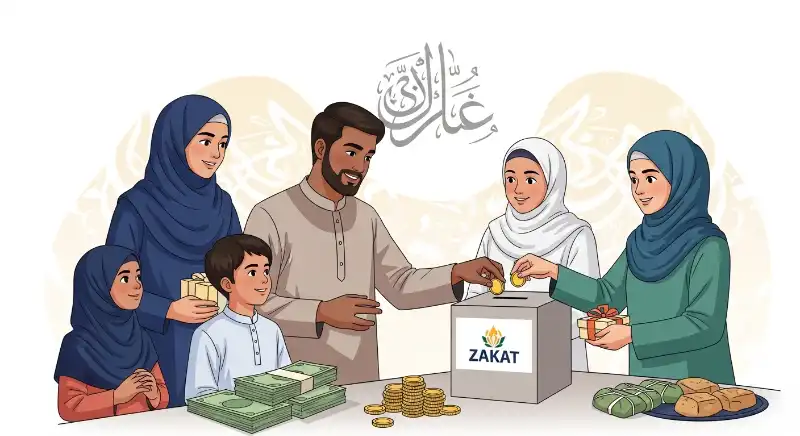
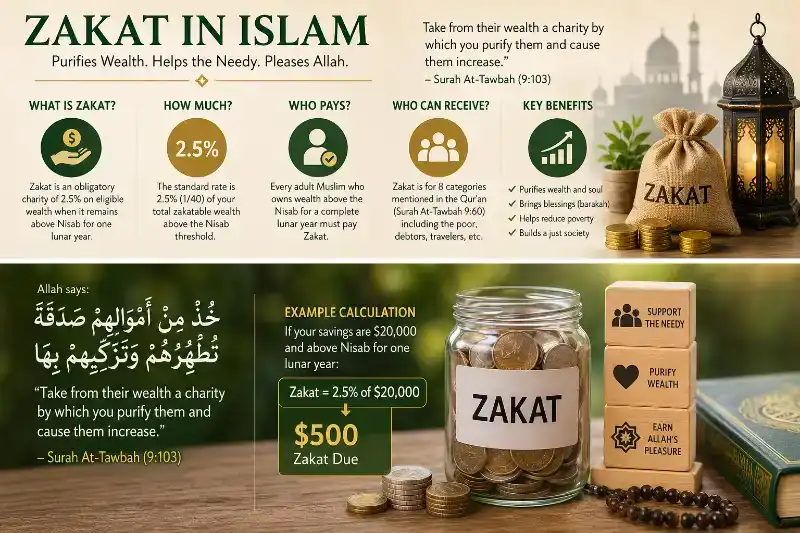
Zakat in Islam is an obligatory annual charity of 2.5% on eligible wealth that has remained above the Nisab threshold for one lunar year. It is the third pillar of Islam and a divine system designed to purify wealth, support people whose income is below the poverty threshold or those with low income, and build fairness in society. In simple words, Zakat is not extra charity. It is a required duty on certain wealth when a Muslim meets the conditions.
For Muslims living in the United States, understanding Zakat correctly means knowing how to calculate it in USD, how it applies to cash savings, gold, silver, stocks, business inventory, crypto, 401(k), IRA, and other assets, and who qualifies to receive it. This guide keeps the answer simple first, then adds the deeper Islamic meaning, so you can use it as both a learning page and a practical reference.
What Is Zakat? (Meaning, Definition & Example)
Linguistic Meaning
The word زكاة (Zakat) means:
- Purification
- Growth
- Blessing
It purifies wealth from greed and spiritually increases barakah.
Islamic Legal Definition
Zakat is a fixed portion of specific wealth categories that a Muslim must give once their savings exceed Nisab for one Hijri year.
It is one of the Five Pillars of Islam.
So when people search “what is Zakat in Islam,” they are usually asking two things at once: what it means, and when it becomes obligatory.
Human Example
If Fatima in California has $12,000 in savings for one full lunar year:
2.5% of $12,000 = $300 Zakat due
That $300 is not optional charity — it is the rightful due for people whose income is below the poverty threshold or low-income households.
That is why Zakat is often described as a right of people with low income, not merely an act of charity from those with greater wealth.
Zakat in the Qur’an (Arabic Verses with English Translation)
Zakat is repeatedly paired with Salah in the Qur’an, showing its importance.
Surah Al-Baqarah 2:43
وَأَقِيمُوا الصَّلَاةَ وَآتُوا الزَّكَاةَ وَارْكَعُوا مَعَ الرَّاكِعِينَ
Translation:
“Establish prayer and give Zakat and bow with those who bow.”
Zakat is mentioned alongside prayer — proving its obligation.
Surah At-Tawbah 9:60 (Eligible Recipients)
إِنَّمَا الصَّدَقَاتُ لِلْفُقَرَاءِ وَالْمَسَاكِينِ وَالْعَامِلِينَ عَلَيْهَا وَالْمُؤَلَّفَةِ قُلُوبُهُمْ وَفِي الرِّقَابِ وَالْغَارِمِينَ وَفِي سَبِيلِ اللَّهِ وَابْنِ السَّبِيلِ
Translation:
“Zakat is designated for people whose income is below the minimum threshold, those in financial need, those employed to administer Zakat, individuals whose hearts are to be reconciled, people in captivity, those burdened by debts, those striving in the path of Allah, and travelers facing hardship.”
These are the 8 categories defined by Allah.
This verse is important because it gives a clear answer to the question, “Who can receive Zakat?”
Surah At-Tawbah 9:103
خُذْ مِنْ أَمْوَالِهِمْ صَدَقَةً تُطَهِّرُهُمْ وَتُزَكِّيهِم بِهَا
Translation:
“Take from their wealth a charity by which you purify them and cause them increase.”
This verse is one of the strongest proofs that Zakat is about purification, growth, and blessing, not only about giving money away.
Zakat in Authentic Hadith
The Prophet ﷺ said:
بُنِيَ الإِسْلاَمُ عَلَى خَمْسٍ… وَإِيتَاءِ الزَّكَاةِ
“Islam is built upon five… including giving Zakat.”
Reported in Sahih al-Bukhari and Sahih Muslim
He also warned:
“Whoever is given wealth by Allah and does not pay its Zakat, it will be turned into a serpent on the Day of Judgment…”
(Reported in Sahih al-Bukhari)
This shows the seriousness of neglecting Zakat.
In other words, Zakat is not a side topic in Islam. It is part of the foundation of the faith.
Nisab in 2026 (How Much Wealth Makes Zakat Obligatory?)
What Is Nisab?
Nisab equals:
- 87.48g of gold
- OR 612.36g of silver
Most scholars recommend using silver value to help more poor people.
Because gold and silver prices change, Nisab is not a fixed dollar number. It changes with the market.
Example (Estimated USA 2026)
If silver ≈ $0.80 per gram:
612 × 0.80 ≈ $490
If your savings exceed $490 for one lunar year → Zakat becomes obligatory.
That means the best practice is to check the current gold or silver value at the time you calculate Zakat.
How Much Is Zakat? (Quick Calculation Table)
Zakat rate = 2.5% (1/40)
| Total Savings | Zakat Due |
|---|---|
| $5,000 | $125 |
| $10,000 | $250 |
| $20,000 | $500 |
| $50,000 | $1,250 |
Example:
If you have $25,000 → $625 Zakat due.
The formula is simple: eligible wealth × 2.5% = Zakat due.
How to Calculate Zakat in the USA (Step-by-Step)
Step 1: Add Zakatable Assets
Include:
- Cash
- Savings
- Gold & silver
- Stocks
- Crypto
- Business inventory
- Rental income savings
- Money owed to you that is likely to be collected
If the asset is part of your real wealth and can be counted on your Zakat date, it may need to be included.
Step 2: Subtract Immediate Debts
Example:
Savings = $15,000
Credit card due now = $2,000
Net = $13,000
Usually, the focus is on debts that are actually due and payable now or very soon.
Step 3: Pay 2.5%
$13,000 × 2.5% = $325
That final number is your Zakat amount if the wealth remained above Nisab for one lunar year.
What Counts as Zakatable Wealth?
This is one of the most important parts, because many people accidentally leave out assets.
Usually, Zakat can apply to:
- Cash in hand
- Bank savings
- Gold jewelry or gold held as wealth
- Silver
- Trade goods
- Business inventory
- Stocks held for investment
- Cryptocurrency
- Money owed to you that you expect to receive
Usually, Zakat does not apply to:
- Your primary home
- Your personal car
- Furniture
- Clothes
- Daily personal items
- Tools used for work and not for resale
A simple way to think about it is this: personal-use items are usually not Zakatable, but wealth kept, traded, or invested often is.
Zakat on Business, Stocks, 401(k), IRA & Crypto (USA Specific)
Business Inventory
If you own a halal store in New York:
Inventory value = $40,000
Zakat due = $1,000
You must calculate:
- Inventory market value
- Cash
- Receivables expected
If your business holds goods for sale, those goods are often part of your Zakatable wealth.
Stocks & Investments
If held for investment:
Pay 2.5% on current market value.
If you own stocks for long-term growth or profit, they are usually treated as wealth rather than personal-use property.
401(k) & IRA in America
There are two scholarly views:
- Pay yearly if accessible
- Pay when withdrawn (after tax deduction)
Consult a qualified scholar for personal financial details.
This is an area where people often need guidance, because retirement accounts are not always simple cash assets.
Cryptocurrency
Crypto is treated like an asset:
If your Bitcoin or Ethereum value stays above Nisab → 2.5% due.
If you hold crypto as an investment, it may be Zakatable just like other forms of wealth.
Zakat vs Sadaqah (Important Difference)
Zakat:
- Obligatory
- Fixed rate (2.5%)
- Specific recipients
Sadaqah:
- Voluntary
- No fixed amount
- Can be given anytime
Example:
Giving $100 randomly is Sadaqah.
Paying 2.5% annually is Zakat.
This difference matters because Zakat has rules, while Sadaqah has more flexibility.
When Is Zakat Due?
Zakat becomes due:
- After one lunar year (Hijri year)
- Once wealth remains above Nisab
Important:
Do not calculate based on Gregorian calendar.
A helpful way to remember it is to set one annual Zakat date and review your wealth on that same date every year.
Who Can Receive Zakat?
Zakat can be given to the eligible categories mentioned in the Qur’an, including people whose income is below the minimum threshold, those in financial need, debtors, travelers facing hardship, and others listed in Surah At-Tawbah 9:60.
In simple terms, Zakat should go to people who truly qualify and genuinely need help.
Who Cannot Receive Zakat?
You cannot give Zakat to:
- Parents
- Grandparents
- Children
- Grandchildren
- Spouse
Because you are financially responsible for them.
This is one of the easiest mistakes to avoid if you remember that Zakat is not meant to replace your direct family responsibility.
Can Family Members Ever Receive Zakat?
Yes, some relatives can receive Zakat if they are not in your direct financial responsibility.
For example, a needy sibling, uncle, aunt, cousin, or distant relative may be eligible if they meet the conditions.
This makes Zakat a powerful way to support both charity and family ties at the same time.
Spiritual Benefits of Zakat
1️⃣ Purifies the Heart
Removes greed.
2️⃣ Protects Wealth
Charity does not decrease wealth.
3️⃣ Builds Social Justice
Reduces poverty and resentment.
Zakat helps the giver, the receiver, and the whole community. That is why it is both an act of worship and a system of care.
What Did Great Islamic Scholars Say About Zakat?
Al-Ghazali
He explained that Zakat cures attachment to worldly wealth.
Abu Hanifa
He emphasized strict financial accuracy in Zakat calculation.
Abdul Qadir Gilani
He advised giving Zakat secretly to preserve sincerity.
These scholars all point toward one message: wealth should be purified, not worshipped.
Zakat and Economic Development
Islamic scholars explain that Zakat creates:
- Wealth circulation
- Poverty reduction
- Social stability
- Economic balance
When wealth does not concentrate among the rich only, society grows collectively.
Allah says:
Arabic:
كَيْ لَا يَكُونَ دُولَةً بَيْنَ الْأَغْنِيَاءِ مِنكُمْ
(سورة الحشر 59:7)
English Translation:
“So that it will not circulate only among the rich among you.”
This is why Zakat is also a system of justice, not only a private act of giving.
Benefits of Zakat
Spiritual Benefits
- Purifies heart from greed
- Strengthens faith
- Brings barakah
Social Benefits
- Reduces poverty
- Supports debtors
- Helps travelers
- Builds unity
Economic Benefits
- Circulates money
- Encourages productivity
- Prevents hoarding
Zakat keeps wealth moving in a healthy way instead of trapping it in one place.
What Happens If Someone Does Not Pay Zakat?
According to authentic Hadith in Sahih al-Bukhari, wealth becomes a punishment on the Day of Judgment.
Zakat is not optional charity — neglecting it is a major sin.
A person should never treat Zakat like a suggestion. It is a sacred duty with serious meaning.
Is Zakat Tax Deductible in the USA?
If given to IRS-registered 501(c)(3) Islamic charities, it is usually tax deductible. Always consult a tax professional.
The safest way to handle this is to treat Zakat first as a religious obligation, then check the U.S. tax rules separately with a qualified professional.
Common Mistakes American Muslims Make
- Using Gregorian year
- Ignoring crypto
- Not calculating business inventory
- Forgetting gold jewelry
- Delaying payment
- Confusing Zakat with Sadaqah
Another common mistake is forgetting receivables or counting the wrong type of debt. That can make the total inaccurate.
People Also Ask
What is Zakat in Islam?
Zakat is the third pillar of Islam, a mandatory act of worship that purifies wealth, supports people whose income is below the minimum threshold, and strengthens social justice.
Who must pay Zakat?
Every adult Muslim who owns wealth above the Nisab threshold for one lunar year is obligated to pay Zakat.
How is Zakat calculated?
Zakat is generally 2.5% of savings, cash, or trade assets above the Nisab threshold. Agricultural produce and livestock have specific rates mentioned in Qur’an and Hadith.
Who can receive Zakat?
Zakat is designated for people whose income is below the minimum threshold, those in financial need, Zakat administrators, people whose hearts are to be reconciled, people in captivity, debtors, travelers facing hardship, and those striving in the path of Allah.
Is Zakat the same as charity?
No — Zakat is an obligatory right for eligible recipients, unlike voluntary charity (Sadaqah), which is optional.
Can Zakat be paid online in the USA?
Yes — many registered Islamic charities in the USA accept Zakat payments online, ensuring it reaches eligible recipients efficiently.
What are the spiritual benefits of Zakat?
Zakat purifies the heart from attachment to wealth, strengthens faith, increases barakah (blessings), and protects against hardship.
Conclusion
Zakat is far more than a financial duty — it is a divine system of spiritual purification, social justice, and economic balance. The Qur’an and Hadith repeatedly emphasize its importance, its rules, and the severe consequences of neglect.
When Muslims pay Zakat correctly, sincerely, and according to the prescribed rates, it transforms both their hearts and the wider society. Wealth becomes a source of growth, faith deepens, and communities flourish.
The best way to understand Zakat is to see it as a complete system: it purifies the soul, supports people with low income, and ensures wealth circulates in a fair and blessed way.
Understanding Zakat in this holistic way shows that it is not simply a payment — it is a lifelong commitment to justice, compassion, and divine obedience. May Allah guide us to fulfill this sacred obligation with knowledge and sincerity. Ameen.