
If you came across YonoChomp Com in Google and were not sure what kind of website you had found, the confusion is understandable. The name does not immediately tell you whether you are looking at a service, an app, a company website, or simply a place to read articles.
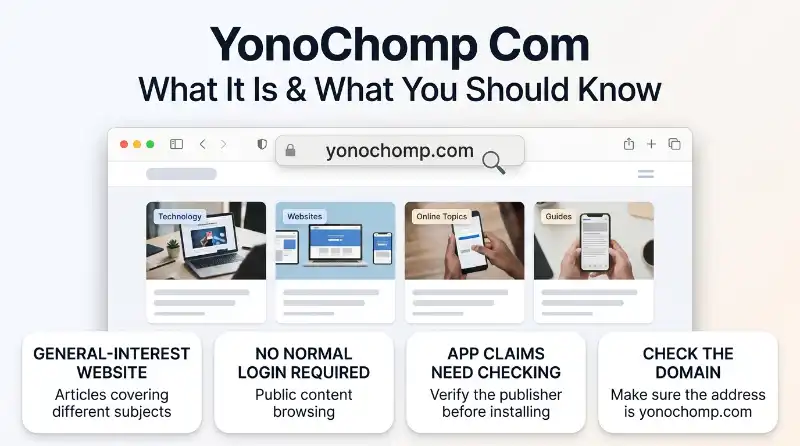
YonoChomp appears to be a general-interest content website. Its purpose is mainly to publish articles on different subjects rather than provide a banking account, shopping service, or dedicated online platform.
The more useful question, though, is not simply whether the website exists. You may also want to know whether there is a login, whether an official app exists, how safe the site is to browse, and whether you should rely on something you read there.
This guide breaks those points down without treating every article on the internet as automatically trustworthy.
YonoChomp Com Is Mainly a Content Website
YonoChomp is best understood as a website built around published content.
You can visit a page, read an article, move to another topic, and continue browsing without treating the site like a service that requires a personal account. The material associated with the site covers different subjects, which gives it more of a general-interest blog feel than a specialist publication.
That explains why the website may seem unusual if you expected one specific service.
A person searching for “YonoChomp” might expect a login page or an app because the name sounds like a digital product. The actual experience is closer to browsing an ordinary article website.
The broad subject mix is also worth remembering. A site can publish something about technology, websites, entertainment, finance, or another subject without becoming an expert authority in all of those areas.
For readers, the individual article matters more than the name of the website.
The Domain Is the First Thing to Check
When you find YonoChomp through Google or another website, look at the complete web address before assuming you are on the official site.
For YonoChomp Com, the domain to look for is yonochomp.com.
This sounds obvious, but search results can contain pages that merely mention a website. Similar names can also create confusion. A page using the word “YonoChomp” in its title is not automatically operated by YonoChomp.
If you encounter another domain using a similar name, treat it separately until you find clear evidence that the two websites are connected.
The same rule is useful when following links. A link inside a YonoChomp article can send you to another website. Once that happens, check the new domain rather than assuming you are still dealing with the same publisher.
There Does Not Appear to Be a Normal YonoChomp Login

If you searched for a YonoChomp login, you may be looking for something the website does not appear to be built around.
The available information describes YonoChomp as a publicly accessible content site rather than an account-based service. Visitors can read its published material without needing the type of personal dashboard commonly found on banking, shopping, gaming, or subscription platforms.
So, if your only goal is to read an article, a username and password should not normally be part of that experience.
This is also useful when judging unexpected pages. If a page suddenly asks for account credentials while you were simply trying to read a public article, stop and check the address before entering anything.
Be Careful With Unverified YonoChomp Apps
Another search that can cause confusion is YonoChomp app.
There is not enough reliable information here to treat a random app using the YonoChomp name as an official product. A name match alone is weak evidence.
Before installing anything, check:
- who published the app
- where the download comes from
- whether YonoChomp itself links to it
- what permissions the app requests
- whether the publisher information matches the claimed service
A third-party download page can use a familiar name without having any official relationship with the website.
If you only wanted to read an article, there is little reason to install an unfamiliar application simply because its name contains “YonoChomp.”
Browsing the Site Is Different From Trusting Every Article
This is probably the most important distinction when dealing with a general-interest website.
A page can be perfectly accessible while the information on that page still needs checking.
Think about the type of claim you are reading. A casual explanation about a common topic does not require the same level of verification as advice involving money, health, legal requirements, account security, or an important purchase.
Start with the article itself.
Look for an author name, publication date, update date, supporting links, and references to original information. These details do not guarantee accuracy, but they give you something concrete to examine.
An article that explains where its information came from is easier to evaluate than one that simply makes a strong claim and leaves you with nothing to check.
Check the Source Behind Important Claims
Suppose a YonoChomp article discusses a company’s policy.
Instead of relying only on the article, visit the company’s own documentation and compare the information.
The same approach works for other subjects:
- Government rules: check the relevant government website.
- Product specifications: check the manufacturer’s information.
- Software features: check the software publisher’s documentation.
- Prices or offers: check the seller or service provider.
- Company policies: check the company’s official website.
A third-party article can still be useful because it may explain something in simpler language. The original source simply gives you a stronger reference when accuracy matters.
You also do not need to verify every sentence. Focus on the claims that could actually affect your decision.
HTTPS Helps With Security, Not Accuracy
You may notice HTTPS and a lock symbol when visiting YonoChomp.
That is a useful technical security feature. HTTPS encrypts the connection between your browser and the website, helping protect information while it travels between the two.
It does not, however, tell you whether the article is accurate.
A secure website can still publish outdated information. It can also contain an unsupported opinion or repeat information from another source without checking it.
So keep the two questions separate:
Is the connection technically protected?
and
Is the information reliable?
They are related to different parts of the website experience.
Watch for Unexpected Downloads and Redirects
Normal browsing should not require you to hand over sensitive information just because you opened an article.
If a page unexpectedly sends you to another domain, starts a download, asks you to install an extension, requests payment, or demands personal credentials, pause before continuing.
Check the new web address.
Ask yourself why the request appeared and whether it makes sense for what you were trying to do.
You do not have to click through a warning or download something simply to find out what happens next. Closing the page and returning to your search is often the simpler option.
Look at Who Is Publishing the Information
Publisher transparency can also help you judge a website.
Check whether the site provides information about its authors, an About page, contact details, or other information explaining who is responsible for the content.
Limited information does not automatically prove that a website is dishonest. It simply leaves you with fewer details for evaluating the publisher.
For a casual article, that may not matter much.
For a page making an important financial, legal, technical, or safety-related claim, it becomes more useful to know where the information came from and who is responsible for it.
Promotional Articles Need a Closer Read
General-interest websites can sometimes contain commercial, sponsored, guest, or promotional material.
That does not make an article automatically false.
The useful question is whether the article clearly separates information from promotion and whether important claims have supporting evidence.
Pay particular attention to statements about:
- guaranteed results
- product performance
- rankings
- savings
- special benefits
- prices
- claims that strongly favor one company
If the statement comes mainly from the company that benefits from it, look for independent confirmation before treating it as established fact.
When YonoChomp Is Useful and When to Verify Elsewhere
There is nothing wrong with using a general-interest article as a starting point.
You might discover a new topic, learn the basic idea behind something, or find links that lead you toward better sources.
The situation changes when you need the information for an important decision.
In that case, use the YonoChomp article as one piece of the research rather than the final authority. Check important claims against an official or specialist source, especially when the information could affect your money, privacy, work, health, or legal responsibilities.
The goal is not to distrust every article.
It is to match the amount of checking with the importance of the information.
Final Takeaway
YonoChomp Com appears to function primarily as a general-interest content website, rather than a traditional account-based service or dedicated mobile platform.
If you found the site through search, first make sure you are on the correct domain. From there, treat each article on its own merits. Look at the author, date, supporting evidence, and original sources instead of judging reliability from design or search position alone.
For ordinary reading, that may be enough.
For anything important, take one extra step and verify the key information with the source that actually controls or created it.
That approach gives you a much clearer way to use YonoChomp without assuming that every page is either completely trustworthy or completely useless.


