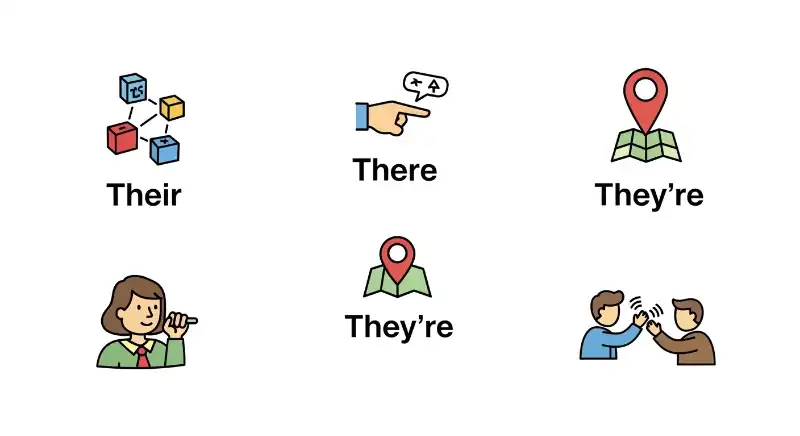
Their, there, and they’re sound exactly the same when spoken, but they do not mean the same thing. Their shows that something belongs to someone, there usually refers to a place or is used in expressions such as “there is” and “there are,” while they’re is the contraction of they are.
If you often stop and wonder whether a sentence should use their, there, or they’re, you are dealing with a very common English spelling confusion. The good news is that you do not need to memorize dozens of complicated grammar rules. Once you understand what each word is doing in a sentence, the difference becomes much easier to recognize.
This guide explains their vs there vs they’re in simple language, with clear examples, common mistakes, memory tricks, tricky cases, and practical exercises.
Their vs There vs They’re: Quick Answer
Here is the easiest way to remember the three words:
| Word | What it means | Quick test | Example |
|---|---|---|---|
| Their | Belonging to them | Ask “Whose?” | Their house is large. |
| There | A place, or used to introduce something | Ask “Where?” or look for “there is/are” | The keys are over there. |
| They’re | They are | Replace it with “they are” | They’re ready to leave. |
The 3-second rule
When you are unsure, ask:
1. Does it show ownership? → THEIR
Their dog is sleeping.
The dog belongs to them.
2. Does it refer to a place or introduce something that exists? → THERE
The dog is over there.
It points to a place.
There is a dog outside.
It introduces something that exists.
3. Can you replace it with “they are”? → THEY’RE
They’re waiting outside.
→ They are waiting outside. ✅
If “they are” does not work, they’re is probably not the correct choice.
Their vs There vs They’re: The Main Difference
The easiest way to understand these words is to focus on their job in the sentence rather than their sound.
Their = Shows Possession
Their tells us that something belongs to, is associated with, or is connected to someone.
Their car is parked outside.
The students finished their homework.
Their parents are visiting.
In each example, their answers the question:
Whose?
Whose car?
Their car.
Whose homework?
Their homework.
Whose parents?
Their parents.
There = Place or Existence
There commonly refers to a location.
Put the box over there.
I left my phone there.
We have been there before.
In these sentences, there has a connection with place or location.
But there is another important use that beginners often miss.
There is also used to introduce the existence or presence of something:
There is a problem.
There are two chairs in the room.
There was a strange noise outside.
So it is not accurate to think of there as meaning only “a place.”
They’re = They Are
They’re is a contraction of:
they + are = they’re
For example:
They’re coming home.
means:
They are coming home.
Another example:
They’re very excited.
means:
They are very excited.
The quickest test for they’re is therefore simple:
Try “they are.”
If the sentence still makes sense, they’re is correct.
They’re late.
→ They are late. ✅
They’re playing football.
→ They are playing football. ✅
They’re happy.
→ They are happy. ✅
Their vs There vs They’re in One Sentence
One of the best ways to understand these words is to see all three together.
They’re taking their bags over there.
Now break the sentence apart:
- They’re = they are
- their = the bags belong to them
- there = a particular place
So:
They’re taking their bags over there.
means:
They are taking the bags that belong to them to that place.
This is an excellent sentence to remember because it demonstrates the difference between all three words at once.
Here are more examples:
They’re leaving their coats over there.
They’re meeting their friends there.
They’re putting their books over there.
They’re taking their children there tomorrow.
Notice how the three words can appear naturally in the same sentence without having the same function.
What Does “Their” Mean?
Their is used to show possession or association.
In simple words:
Their = belonging to them
Examples of Their
Their house is beautiful.
Their team won the game.
Their children are at school.
I like their new car.
The company changed their policy.
The students opened their books.
In every case, their connects something with a person, group, or entity.
Their answers the question “Whose?”
Consider:
The students brought their laptops.
Ask:
Whose laptops?
Answer:
Their laptops.
That is why their is correct.
Their in Everyday Writing
You will see their everywhere in normal English:
In conversation
Where are their parents?
In text messages
I think that’s their house.
In emails
The clients sent their documents this morning.
In school writing
Students should complete their assignments on time.
In workplace writing
Employees should submit their reports before Friday.
On social media
Their new video is really good.
The word does not become different because the context changes. Its basic function remains connected to possession or association.
Can “Their” Refer to One Person?
Yes.
This is an important point that many learners miss.
You may see their used with a singular person when the person’s gender is unknown, irrelevant, or when the writer chooses gender-neutral language.
For example:
Someone left their phone on the table.
Here, someone is singular, but their can refer to that person.
Another example:
Every student should bring their own notebook.
Here, their refers to each student.
This is often called singular they or singular their.
More examples
If anyone calls, tell them I’ll call back.
Every applicant should submit their form online.
Someone forgot their umbrella.
A customer left their wallet at the counter.
This usage is common in contemporary English and is especially useful when the person’s gender is unknown or does not need to be specified.
Their vs Theirs: What’s the Difference?
Another commonly confused pair is their and theirs.
They are related, but they do not work in exactly the same way.
Their comes before a noun
That is their car.
I found their books.
We visited their house.
Theirs normally stands on its own
That car is theirs.
The books are theirs.
The house is theirs.
Compare:
This is their house. ✅
This house is theirs. ✅
But:
This is theirs house. ❌
The key difference is:
their + noun
theirs = possession without a following noun
What Does “There” Mean?
There has more than one important use.
For beginners, remember these two main ideas:
1. There can refer to a place
The school is over there.
Put your shoes there.
I have seen that movie there before.
Here, there refers to a location.
2. There can introduce something that exists
There is a problem.
There are several options.
There was a loud noise.
There were many people at the event.
This second use is extremely important because simply memorizing:
“there = place”
is not enough.
There for a Place
When there points to a location, it often works as the opposite of here.
Compare:
Come here.
Go there.
Put the bag here.
Put the bag there.
More examples
My brother is standing over there.
I left my keys there.
We went there last weekend.
Don’t sit there.
The restaurant is right there.
A useful memory trick is:
There contains “here” with a “t” in front.
That is not a grammatical rule, but it can help you remember that there is associated with a place.
There Is and There Are
This is one of the most important uses of there.
Use:
There is with a singular noun or an uncountable noun.
There is a book on the table.
There is a problem with the computer.
There is some water in the bottle.
Use:
There are with plural nouns.
There are two books on the table.
There are several problems to solve.
There are many students in the classroom.
Common mistakes
❌ Their is a problem.
✅ There is a problem.
❌ Their are three options.
✅ There are three options.
The mistake happens because their and there sound identical.
The meaning of the sentence tells you which spelling you need.
What Does “They’re” Mean?
They’re is simply a shorter form of they are.
It is a contraction.
Examples
They’re happy.
= They are happy.
They’re coming soon.
= They are coming soon.
They’re my friends.
= They are my friends.
They’re working today.
= They are working today.
They’re ready for the meeting.
= They are ready for the meeting.
Whenever you can replace they’re with they are, the contraction is working correctly.
They’re vs Their
This is one of the most common mistakes.
Compare:
They’re going to school.
Here:
They’re = They are
Their school is nearby.
Here:
Their = belonging to them
Look at the difference:
❌ Their going to school.
✅ They’re going to school.
Why?
Because:
They are going to school. ✅
But:
Belonging to them going to school. ❌
Now compare:
They’re car is new. ❌
Their car is new. ✅
Why?
Because the car belongs to them.
Quick test
If you can write:
They are
use they’re.
If the word is describing ownership, use their.
There vs They’re
These two are also easy to confuse because they sound alike.
Compare:
They’re waiting outside.
= They are waiting outside.
They are waiting over there.
= They are waiting in that place.
Here is a sentence containing both:
They’re waiting over there.
The first word means they are.
The second refers to a place.
More examples
They’re sitting there.
They’re going there tomorrow.
They’re already there.
They’re waiting over there.
A useful trick:
They’re = they are
There = place/existence
Their vs There
Now compare the two words directly.
Their
Shows possession:
Their house is large.
There
Refers to a place:
The house is over there.
Another comparison
Their dog is sleeping.
The dog belongs to them.
The dog is sleeping over there.
The word there identifies a location.
The question trick
Ask:
Whose? → their
Whose dog?
Their dog.
Ask:
Where? → there
Where is the dog?
Over there.
This simple test works for many everyday sentences.
Their vs There vs They’re: Common Mistakes
Because these three words sound alike, spelling mistakes are easy to make when typing quickly.
Mistake 1
❌ Their going to the store.
✅ They’re going to the store.
Why?
“They’re” means “they are.”
Mistake 2
❌ There dog is cute.
✅ Their dog is cute.
Why?
The dog belongs to them, so their shows possession.
Mistake 3
❌ Their is a problem.
✅ There is a problem.
Why?
This is the existence pattern there is.
Mistake 4
❌ I left my bag over their.
✅ I left my bag over there.
Why?
The sentence refers to a location.
Mistake 5
❌ They’re house is beautiful.
✅ Their house is beautiful.
Why?
The house belongs to them.
A Simple Way to Check Your Sentence
When you see their, there, or they’re, don’t choose based on sound.
Instead, stop and ask one question:
Does it mean “they are”?
Yes → they’re
They’re tired.
Does it show possession?
Yes → their
Their car is outside.
Does it refer to a place or form “there is/there are”?
Yes → there
The car is over there.
There is a car outside.
This method is much more reliable than trying to remember how the words sound.
Their vs There vs They’re: Easy Memory Tricks
If you still mix them up, use these three associations.
Their → Heir → Ownership
An heir is someone who may receive property or possessions.
So:
their → heir → belonging
Example:
Their house is beautiful.
There → Here → Place
The word there contains here with an extra letter at the beginning.
Think:
here / there = places
Example:
Your shoes are over there.
They’re → They Are
This is the easiest one.
Whenever you see they’re, expand it:
they’re → they are
Example:
They’re late.
→ They are late. ✅
If the expanded sentence sounds wrong, don’t use they’re.
The Fastest Their vs There vs They’re Test
Use this three-step check before you finish your sentence:
Step 1: Can I replace the word with they are?
→ Use they’re.
Step 2: Is the word showing that something belongs to them?
→ Use their.
Step 3: Is the sentence talking about a place or using there is / there are?
→ Use there.
Example
___ going to leave ___ bags over ___.
First blank:
“They are going to leave…” → They’re
Second blank:
The bags belong to them → their
Third blank:
It refers to a place → there
Correct sentence:
They’re going to leave their bags over there.
Once you understand the meaning, the spelling becomes much easier.
Their, There, and They’re in Real Sentences
Seeing the words in natural sentences is one of the best ways to understand how they work.
Example 1
They’re taking their children to school over there.
- They’re = they are
- their = the children belong to them
- there = a location
Example 2
Their friends are waiting over there, and they’re ready to leave.
- Their friends = friends associated with them
- there = that place
- they’re = they are
Example 3
They’re looking for their keys, but the keys are actually over there.
Again, each word has a completely different job.
Example 4
Their teacher said that they’re going to meet there tomorrow.
This sentence contains all three forms naturally.
Example 5
They’re proud of their team because there were so many people supporting them.
Here, there is not pointing to a physical place. It appears in the structure there were, which introduces the existence of something.
20 Their vs There vs They’re Examples
Here are more examples grouped by meaning.
Examples of “Their”
Their house is near the park.
Their dog needs a bath.
I like their new idea.
Their parents arrived early.
The students opened their books.
The players celebrated their victory.
We visited their office yesterday.
Their answer was correct.
The children packed their bags.
Someone left their phone on the desk.
Examples of “There”
Place
The library is over there.
Put the chair there.
I have been there before.
Don’t leave your shoes there.
Look over there!
Existence
There is a problem.
There is enough food for everyone.
There are three books on the desk.
There are several ways to solve this problem.
There was a long line outside.
There were many people at the event.
Examples of “They’re”
They’re coming soon.
They’re very friendly.
They’re waiting outside.
They’re working today.
They’re ready to begin.
They’re going to call later.
They’re excited about the trip.
They’re learning English.
They’re already at home.
They’re planning a party.
Their vs There vs They’re in Emails
Grammar mistakes can be especially noticeable in professional communication.
Compare these examples.
Incorrect
Their are several changes in the report.
Correct
There are several changes in the report.
Incorrect
They’re new office is downtown.
Correct
Their new office is downtown.
Incorrect
Please send the documents over their.
Correct
Please send the documents over there.
Correct professional examples
Their team will review the proposal.
There are several points we need to discuss.
They’re available for a meeting tomorrow.
I believe their department has already responded.
The files are stored over there.
The same rules apply whether you’re writing an email, report, message, or essay.
Their vs There vs They’re in Academic Writing
Students often encounter these words in essays and assignments.
Their
Students should develop their writing skills.
There
There are several reasons for this change.
They’re
They’re not always easy to distinguish in informal writing.
In formal academic writing, contractions such as they’re may sometimes be avoided in favor of they are, depending on the required style.
For example:
They are important examples of common English usage.
This does not mean they’re is grammatically incorrect. It simply means the expanded form may be preferred in some formal contexts.
Their vs There vs They’re in Text Messages and Social Media
Fast typing makes these words particularly easy to confuse because they sound identical.
Someone might write:
I think their coming later.
The intended sentence is:
I think they’re coming later.
Because:
They are coming later. ✅
Another example:
I love there new song.
Correct:
I love their new song.
Because the song is associated with them.
And:
Meet me over their.
should be:
Meet me over there.
because the sentence refers to a location.
The context determines the spelling.
Their vs There vs They’re: Tricky Sentences
Now let’s look at sentences that require a little more thought.
1.
Everyone should bring ___ own notebook.
Correct:
Everyone should bring their own notebook.
Why?
The notebook belongs to each person.
2.
___ is someone waiting outside.
Correct:
There is someone waiting outside.
This is the existence pattern there is.
3.
___ going to bring ___ books over ___.
Correct:
They’re going to bring their books over there.
This sentence uses all three words correctly.
4.
The children said ___ parents were waiting over ___.
Correct:
The children said their parents were waiting over there.
5.
I think ___ already here.
Correct:
I think they’re already here.
Expand it:
I think they are already here. ✅
There, Their, and They’re: A Comparison Table
| Word | Main meaning/function | Example | Quick test |
|---|---|---|---|
| Their | Possession or association | Their house is new. | Whose? |
| There | Place | The house is over there. | Where? |
| There | Existence | There is a house nearby. | There is/are |
| They’re | They are | They’re at home. | They are? |
| Theirs | Belonging to them, used without a noun | The house is theirs. | Belongs to them? |
| There’s | There is / sometimes there has | There’s a problem. | There is? |
The last two forms are worth learning because they often create additional confusion.
What Does “There’s” Mean?
There’s is a contraction.
Most commonly:
There’s = there is
For example:
There’s a problem.
means:
There is a problem.
Another example:
There’s a book on the table.
means:
There is a book on the table.
Compare “There’s” and “Theirs”
These words are pronounced differently, but they are sometimes confused in writing.
There’s a car outside.
= There is a car outside.
The car is theirs.
= The car belongs to them.
More examples
There’s someone at the door.
Their car is outside.
The blue car is theirs.
These three forms have different grammatical jobs.
Their vs Theirs vs There’s
This is a useful three-way comparison.
Their
Comes before a noun:
Their house is large.
Theirs
Usually appears without a following noun:
The house is theirs.
There’s
Means there is:
There’s a house nearby.
Compare:
Their house is beautiful.
The house is theirs.
There’s a beautiful house nearby.
These sentences may sound similar, but the meaning and grammar are different.
Common Their, There, and They’re Mistakes
Mistake 1: “Their” instead of “They’re”
❌ Their going to win.
✅ They’re going to win.
Test:
They are going to win. ✅
Mistake 2: “There” instead of “Their”
❌ There parents are visiting.
✅ Their parents are visiting.
Test:
Whose parents?
Their parents.
Mistake 3: “Their” instead of “There”
❌ The restaurant is over their.
✅ The restaurant is over there.
Test:
Where is the restaurant?
Over there.
Mistake 4: “They’re” instead of “Their”
❌ They’re house is beautiful.
✅ Their house is beautiful.
Test:
The house belongs to them.
Therefore:
their house
Mistake 5: “There” instead of “They’re”
❌ There waiting outside.
✅ They’re waiting outside.
Expand it:
They are waiting outside. ✅
How to Correct Their vs There vs They’re Mistakes
If you are proofreading your own writing, don’t just search for spelling mistakes.
Search specifically for:
their
there
they’re
Then read the complete sentence.
For every occurrence, ask:
Question 1
Does this mean they are?
If yes:
they’re
Question 2
Does it show that something belongs to them?
If yes:
their
Question 3
Does it refer to a place?
If yes:
there
Question 4
Does it form there is / there are / there was / there were?
If yes:
there
This process catches many errors that ordinary spell-checkers may not catch because all three words are correctly spelled words.
Why Spell-Check May Not Catch the Mistake
This is an important point for writers.
Suppose you write:
Their going to the meeting.
The word their is spelled correctly.
A basic spelling checker may therefore not treat it as a spelling error.
But the sentence is grammatically incorrect because the intended meaning is:
They’re going to the meeting.
This is an example of a contextual grammar error.
The problem is not the spelling of the individual word. The problem is choosing the wrong word for the meaning of the sentence.
That is why understanding the difference is more useful than relying entirely on automatic correction.
Their vs There vs They’re: Practice Exercises
Now test yourself without looking at the answers first.
Exercise 1: Fill in the Blank
Choose their, there, or they’re.
- ___ going to the cinema tonight.
- I left my keys over ___.
- The children finished ___ homework.
- ___ is a new restaurant nearby.
- ___ parents are visiting tomorrow.
- I think ___ already here.
- Put the boxes over ___.
- ___ planning to sell ___ old car.
- The students opened ___ books.
- ___ are several reasons for the decision.
Answers
- They’re
- there
- their
- There
- Their
- they’re
- there
- They’re / their
- their
- There
Exercise 2: Choose the Correct Sentence
Question 1
A. Their going to school.
B. They’re going to school.
C. There going to school.
Answer: B
Why?
“They’re” means “they are.”
They are going to school.
Question 2
A. Their house is large.
B. There house is large.
C. They’re house is large.
Answer: A
Why?
The house belongs to them.
Question 3
A. The books are over their.
B. The books are over there.
C. The books are over they’re.
Answer: B
Why?
The sentence refers to a place.
Question 4
A. Their are five students.
B. They’re are five students.
C. There are five students.
Answer: C
Why?
The correct existence structure is:
There are five students.
Question 5
A. They’re already waiting over there.
B. Their already waiting over there.
C. There already waiting over their.
Answer: A
Why?
They’re = they are.
There = location.
Their vs There vs They’re: Mini Mastery Test
Try completing this paragraph:
Sarah and Tom are preparing for a trip. ___ packing ___ clothes, and their parents are waiting over ___. ___ going to leave after lunch because ___ car is already ready.
Correct answer
Sarah and Tom are preparing for a trip. They’re packing their clothes, and their parents are waiting over there. They’re going to leave after lunch because their car is already ready.
Now identify each one:
- They’re = they are
- their = possession
- there = location
The same rule works even when the words appear several times in a paragraph.
Their vs There vs They’re for Kids
A simple explanation can make these words much easier for younger learners.
Their
Think:
It belongs to them.
Example:
Their cat is sleeping.
The cat belongs to them.
There
Think:
That place.
Example:
The cat is over there.
It tells you where the cat is.
They’re
Think:
They are.
Example:
They’re playing with the cat.
They are playing with the cat.
Kid-friendly memory trick
Ask three questions:
Whose? → Their
Where? → There
They are? → They’re
That’s the entire basic system.
Their vs There vs They’re: Quick Mastery Chart
| If you mean… | Use | Example |
| Belonging to them | their | Their dog is friendly. |
| That place | there | Their dog is over there. |
| Something exists | there | There is a dog outside. |
| They are | they’re | They’re playing outside. |
| Belonging to them without a noun | theirs | The dog is theirs. |
| There is | there’s | There’s a dog outside. |
Frequently Asked Questions About Their vs There vs They’re
1. What is the difference between their, there, and they’re?
Their shows possession, there refers to a place or introduces something that exists, and they’re means they are.
2. When should I use “their”?
Use their when something belongs to or is associated with them.
Their house is beautiful.
3. When should I use “there”?
Use there when referring to a place or in structures such as there is and there are.
The car is over there.
There are three cars outside.
4. What does “they’re” mean?
They’re is a contraction of they are.
They’re ready.
= They are ready.
5. How can I remember their and there?
Think:
Their → heir → ownership
There → here → place
These are memory associations rather than grammar rules, but they can make the distinction easier to remember.
6. Is “they’re” the same as “they are”?
Yes.
They’re happy.
and
They are happy.
have the same basic meaning. The difference is that they’re is the contracted form.
7. Can “their” refer to one person?
Yes. Singular their is commonly used with words such as someone, everyone, anybody, and each person, especially when the person’s gender is unknown or not relevant.
Everyone should bring their own pen.
8. What is the difference between “their” and “theirs”?
Their normally comes before a noun:
Their car is outside.
Theirs can stand on its own:
The car is theirs.
9. What is the difference between “there” and “they’re”?
There refers to a place or is used in expressions such as there is and there are.
They’re means they are.
They’re waiting over there.
10. What is the difference between “there’s” and “theirs”?
There’s usually means there is.
There’s a problem.
Theirs shows possession.
The blue car is theirs.
11. Why are their, there, and they’re so easy to confuse?
They are homophones: they have the same or nearly the same pronunciation in standard English but different spellings and meanings.
Because the sound is similar, you must use the sentence’s meaning and grammatical structure to choose the correct spelling.
12. Is “their” only used for plural people?
No. Their can also be used as a singular, gender-neutral possessive form.
Someone left their phone here.
13. Is “they’re” formal English?
They’re is grammatically correct English, but some formal or academic styles may prefer the expanded form they are.
Always follow the style requirements of the context you are writing for.
14. What is an easy sentence using all three words?
They’re taking their books over there.
They’re = they are.
Their = belonging to them.
There = a place.
15. What is the easiest way to choose between their, there, and they’re?
Use this three-question test:
They are? → they’re
Whose? → their
Where / there is / there are? → there
If you apply these tests to the sentence rather than choosing by sound, the correct word becomes much easier to identify.
Final Their vs There vs They’re Cheat Sheet
Before you finish writing, remember:
THEIR
Meaning: belonging to them
Their house is new.
Question: Whose?
THERE
Meaning: a place or an existence structure
The house is over there.
There is a house nearby.
Question: Where? / Is something being introduced?
THEY’RE
Meaning: they are
They’re at home.
Test: Replace it with “they are.”
THEIRS
Meaning: belonging to them, without a noun after it
The house is theirs.
THERE’S
Meaning: there is
There’s a problem.
The One Sentence That Can Help You Remember Everything
If you remember only one example, remember this:
They’re taking their bags over there.
They’re → they are
Their → belonging to them
There → a place
Once these three meanings become automatic, one of the most common English word-choice confusions becomes much easier to avoid.
Final Takeaway
The difference between their, there, and they’re is not difficult once you stop relying on how the words sound.
Use their for possession.
Use there for a place or structures such as there is and there are.
Use they’re when you mean they are.
Then remember the related forms:
their → possession
theirs → possession without a following noun
there → place/existence
there’s → there is
they’re → they are
When you’re unsure, don’t guess. Read the sentence again and ask what the word actually means. That small habit can prevent most their vs there vs they’re mistakes in emails, essays, messages, schoolwork, and everyday writing.