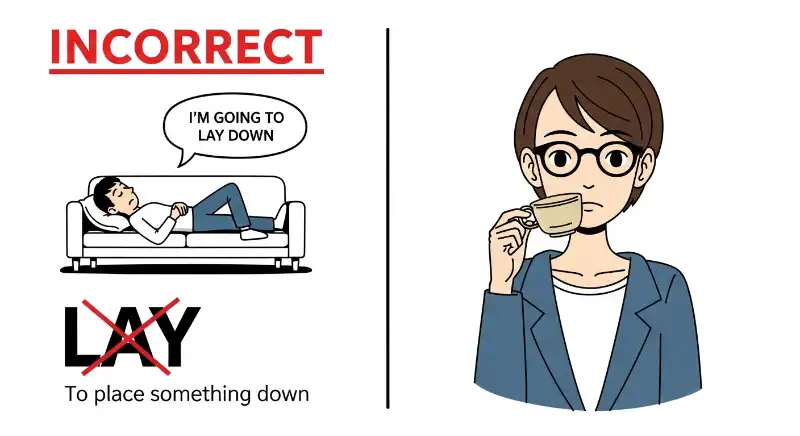
👉 Lie = to rest yourself (no object)
👉 Lay = to put something somewhere (needs an object)
✔️ Use lie when no object is involved
✔️ Use lay when something is being placed
Examples:
- I need to lie down. ✅
- Please lay the book on the table. ✅
Let’s Start Simple: Why Does “Lie vs Lay” Feel So Confusing?
Let’s be honest.
You’ve probably stopped mid-sentence and thought:
👉 “Wait… is it lie down or lay down?”
And suddenly, something that should be simple feels confusing.
Here’s why:
- The words sound similar
- Their past tenses overlap
- People use them incorrectly all the time
- Even native speakers get it wrong
So your brain thinks:
👉 “If everyone is mixing them… what’s actually correct?”
That’s exactly why lie vs lay is one of the most searched grammar topics in English.
But here’s the good news:
👉 There is only ONE core rule you need to remember.
Once you understand it, the confusion disappears forever.
The One Rule That Fixes Everything Instantly
Let’s make it super easy.
🧠 The Core Idea (In Plain English)
👉 Lie = you do it to yourself
👉 Lay = you do it to something else
That’s it.
No complicated grammar needed.
Simple Examples You’ll Never Forget
- You are tired → you lie down
- You put your phone down → you lay the phone down
👉 Same action. Different focus.
The Fastest Decision Trick
Ask yourself:
👉 “Am I placing something?”
- YES → use lay
- NO → use lie
Lie vs Lay Comparison Table (Crystal Clear)
| Verb | Meaning | Needs Object? | Example |
|---|---|---|---|
| Lie | To rest or recline | ❌ No | I will lie down |
| Lay | To put/place something | ✅ Yes | Lay the book here |
👉 This table alone solves 90% of confusion.
Let’s Talk About Grammar (But Keep It Easy)
You might hear these terms:
- Transitive verb
- Intransitive verb
- Direct object
Sounds scary? Don’t worry.
🟢 Lie = Intransitive Verb (No Object)
This means:
👉 Nothing receives the action
Example:
- She lies on the bed
- He is lying on the sofa
No object. Just the person.
🔵 Lay = Transitive Verb (Needs Object)
This means:
👉 Something receives the action
Example:
- Lay the phone on the table
- She laid the baby down
Ask:
👉 “What is being laid?”
If you can answer → use lay
Lie vs Lay Tense Chart (Most Important Part)
This is where most people get confused—but we’ll make it simple.
📊 Full Tense Table
| Verb | Present | Past | Past Participle | -ing Form |
|---|---|---|---|---|
| Lie (rest) | lie | lay | lain | lying |
| Lay (place) | lay | laid | laid | laying |
🧠 Important Insight
👉 “Lay” appears in BOTH verbs
- Past of lie → lay
- Present of lay → lay
That’s why it feels confusing.
Let’s Break It Down With Examples
✅ Lie (Resting)
- I lie down every day
- Yesterday, I lay down
- I have lain here for hours
✅ Lay (Placing Something)
- I lay the book down
- Yesterday, I laid the book down
- I have laid it here before
Lie Also Means “To Tell a Lie” (Important SEO Section)
This is something many articles miss—but it’s very important.
👉 Lie has TWO meanings:
1. To rest (no object)
- I lie down
2. To tell an untruth
- He lied to me
📊 Second Meaning Tense Chart
| Verb | Present | Past | Past Participle |
|---|---|---|---|
| Lie (false) | lie | lied | lied |
⚠️ Important Difference
- Lie (rest) → lay → lain
- Lie (false) → lied → lied
👉 Same word. Different meanings.
Lie Down or Lay Down — Which One Is Correct?
This is the most searched question.
👉 Correct answer: “Lie down”
Because:
- You are resting
- No object is involved
❌ Common Mistake
“I’m going to lay down”
✅ Correct
“I’m going to lie down”
Lying vs Laying (The Confusing Part Made Easy)
✅ Lying = resting
- She is lying in bed
- He is lying on the couch
⚠️ Laying = placing something
- She is laying the table
- He is laying tiles
🧠 Quick Check
Ask:
👉 “What am I laying?”
If nothing → use lying
Real-Life Examples (So It Sticks Forever)
🏠 Morning
You wake up → you lie in bed
💻 Afternoon
You lay your laptop on the desk
😴 Night
You feel tired → you lie down
Common Mistakes People Make (And How to Fix Them)
❌ I was laying on the couch
👉 ✅ I was lying on the couch
❌ I laid down for a nap
👉 ✅ I lay down for a nap
❌ She is laying in bed
👉 ✅ She is lying in bed
Why Even Native Speakers Get This Wrong
Let’s be real—this isn’t just a learner problem.
Even fluent speakers mix it up because:
- Spoken English ignores rules
- “Lay” sounds natural
- Tense forms overlap
- Speed matters more than accuracy
Does It Still Matter in 2026?
Short answer:
👉 Yes—and no
✔️ It matters in:
- Emails
- Job applications
- Academic writing
- Professional content
✔️ It matters less in:
- Text messages
- Social media
- Casual chats
Simple Memory Trick (5-Second Rule)
👉 Lie = Alone
👉 Lay = Load (object)
🧠 Visual Trick
Imagine:
- You walk into your room → you lie down
- You carry a bag → you lay the bag down
Lie vs Lay in Real Conversations (Modern Usage)
💬 Casual Chat
“I’m gonna lay down” (common but incorrect)
💼 Professional Writing
“I need to lie down for a short rest.”
👉 Knowing the rule gives you power:
You can choose when to be correct—and when to be casual.
Mini Quiz (Test Yourself Quickly)
Fill in the blanks:
- I want to ___ down
- Please ___ the keys here
- He is ___ on the sofa
- She ___ the baby down yesterday
✅ Answers
- lie
- lay
- lying
- laid
Advanced Tip (Used by Writers & Editors)
Replace the verb:
👉 If “rest” fits → use lie
👉 If “put” fits → use lay
Example:
“I need to rest” → lie
“I need to put the book here” → lay
FAQ (People Also Ask Optimized)
❓ Is it lay down or lie down?
👉 “Lie down” is correct because no object is involved.
❓ What is the difference between lie and lay?
👉 Lie = rest
👉 Lay = place something
❓ Why is lie vs lay confusing?
Because their past forms overlap and sound similar.
❓ What is the past tense of lie?
👉 Lay (for resting meaning)
❓ Is “I was laying in bed” correct?
❌ No
✅ “I was lying in bed”
❓ Can lay be used without an object?
❌ No. Lay always needs something.
Final Conclusion
Let’s simplify everything:
👉 Lie = rest yourself
👉 Lay = put something down
That’s the rule.
Not complicated. Not confusing.
The reason it feels hard is because:
- English overlaps forms
- People use it incorrectly
- Your brain hears both versions daily
But now?
👉 You understand the logic
👉 You know the pattern
👉 You can decide instantly
And that’s what real learning looks like.
Not memorizing rules…
👉 But understanding meaning.
So next time you pause and think:
“Lie or lay?”
You won’t guess.
👉 You’ll know.
📚 Related Articles Who vs Whom Examples in Real Sentences