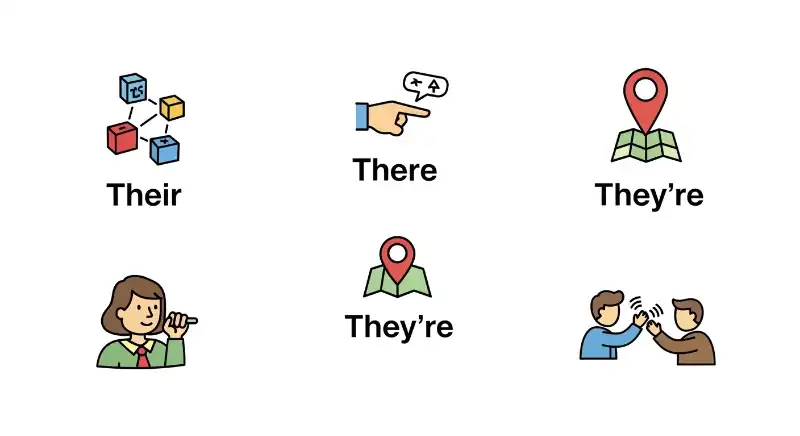
their vs there is one of the most common grammar confusions in English—and if you’ve ever paused mid-sentence wondering which one to use, you’re not alone.
These words sound exactly the same, but they mean completely different things. That’s why even smart writers, students, and professionals mix them up—especially in fast typing, texting, or emails.
In this guide, you’ll not only learn the difference in the simplest way possible, but you’ll also discover memory tricks, real-life examples, and a deeper understanding of why this confusion happens in the first place.
Their vs There Quick Answer (Difference in Simple Words)
If you want a fast, crystal-clear answer, here it is:
- Their → shows ownership (something belongs to someone)
- There → refers to a place or position
- They’re → short for they are
Quick Comparison Table
| Word | Meaning | Example |
|---|---|---|
| Their | Belonging to them | Their house is beautiful |
| There | A place or position | The book is over there |
| They’re | They are | They’re going to school |
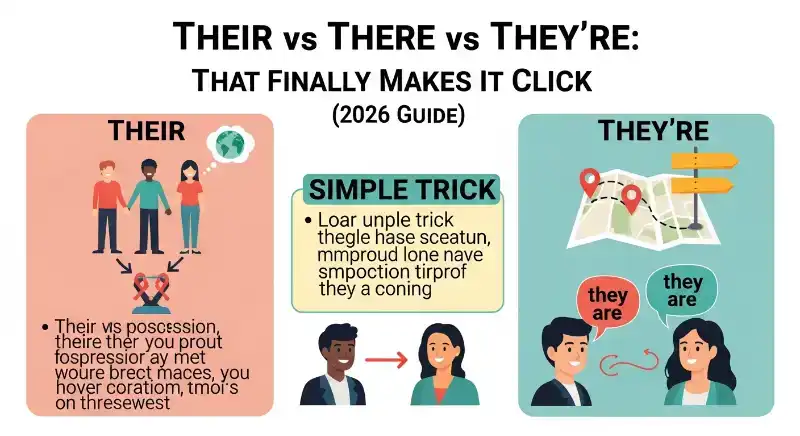
👉 Simple trick:
If you can replace it with “they are,” then it’s they’re.
If it shows ownership, use their.
If it points to a place, use there.
Difference Between Their and There (Grammar Rules Explained)
Understanding the difference between these words is less about memorizing rules and more about recognizing patterns in meaning.
Their vs There Meaning
Let’s break it down like a real-life conversation.
Imagine your friend says:
“Look at their car.”
Here, their tells you the car belongs to someone.
Now compare:
“The car is over there.”
This time, there is pointing to a location.
So even though they sound identical, their jobs in a sentence are completely different.
When to Use Their and There
Use their when:
- You’re talking about ownership
- Something belongs to a group or person
- Example: Their ideas changed everything
Use there when:
- You’re talking about a place
- Introducing something (There is / There are)
- Example: There is a problem we need to solve
👉 Notice how one is about possession and the other is about position.
Their vs There in English Grammar Explained
From a grammar perspective:
- Their = Possessive adjective
- There = Adverb or pronoun
But here’s the human way to understand it:
- Their answers the question: “Whose?”
- There answers the question: “Where?”
That’s it. If you remember these two questions, you’ll rarely get confused again.
Their vs There vs They’re Difference Chart (With Examples)
Now let’s expand your understanding with more realistic examples and patterns you’ll actually see in daily life.
Their and There Examples
Let’s look at common sentences:
- Their team won the match
- Put the bag over there
- Their parents are visiting
- There are many options available
Each sentence clearly shows the role of the word—ownership vs place.
Their vs There Sentences (Real-Life Style)
Think about how people actually write today—in emails, texts, and social media.
- ❌ There dog is cute
- ✅ Their dog is cute
- ❌ Their is a mistake here
- ✅ There is a mistake here
These are small errors, but they can completely change how professional your writing feels.
Their vs There Difference Chart (Deep Comparison)
| Situation | Correct Word | Why It Works |
|---|---|---|
| Talking about ownership | Their | Shows possession |
| Pointing to a location | There | Refers to place |
| Replacing “they are” | They’re | Contraction form |
| Introducing a sentence | There | “There is / There are” usage |
👉 Pro insight (2026 writing trend):
With AI tools and auto-correct everywhere, small grammar mistakes stand out even more. Clean writing = higher credibility.
📚 Related Articles Who vs Whom Examples in Real Sentences
How to Use Their and There Correctly in Real Writing
Learning rules is one thing—but applying them in real life is where most people struggle.
Let’s fix that.
There vs Their Common Mistakes
Here are the most frequent mistakes people make:
- Using their instead of there in sentences like:
- ❌ Their is a problem
- Mixing them in fast typing:
- ❌ Put it in their
Why does this happen?
Because your brain hears the sound—not the meaning.
Examples in Emails, Essays, and Social Media
Let’s step into real-world writing situations.
📧 Email Example
- ❌ Their are several updates in the document
- ✅ There are several updates in the document
📱 Social Media Post
- ❌ I love there style
- ✅ I love their style
📝 Essay Writing
- ❌ There opinions matter a lot
- ✅ Their opinions matter a lot
Real Chat Scenario (Relatable Example)
Friend A: “I think their going to win.”
Friend B: “You mean they’re going to win?”
Friend A: “Oh right… I always mess that up.”
👉 This is exactly how confusion happens in real life—fast thinking, fast typing, and similar sounds.
Why Do People Confuse Their and There (Psychology Explained)
This confusion isn’t about intelligence—it’s about how the human brain processes language.
Homophones Confusion in English
Words like their, there, and they’re are called homophones—they sound the same but have different meanings.
Your brain processes sound faster than spelling. So when you write quickly, it picks the first familiar version of the word.
That’s why mistakes happen—even if you know the rule.
Brain Pattern Learning Mistakes
Here’s something fascinating:
Your brain relies on pattern recognition, not grammar rules.
If you’ve seen “there” more often, your brain may default to it—even when it’s wrong.
👉 Think of it like autocorrect in your mind.
Emotional Interpretation (Why It Feels Frustrating)
You might feel:
- “I know this… why do I still get it wrong?”
- “This is such a basic mistake”
- “People will judge my writing”
But here’s the truth:
This mistake is one of the most common in English worldwide—even among native speakers.
In 2026, with faster communication and AI-assisted writing, these tiny errors stand out more—but they’re also easier to fix once you understand the why behind them.
How to Remember Their vs There Easily (Memory Tricks)
Now let’s make this stick—permanently.
Their vs There Trick (That Actually Works)
Use this simple association:
- Their → “Heir” inside the word → ownership
(An heir owns something) - There → “Here” inside the word → place
(Here = location)
👉 This visual trick works because your brain remembers patterns, not rules.
Visual Association Learning
Imagine this:
- A group holding a bag → “their bag”
- A finger pointing somewhere → “over there”
The more visual you make it, the faster your brain learns.
Mini Decision Framework (Quick Check)
Before writing, ask yourself:
- Am I talking about ownership? → their
- Am I pointing to a place? → there
- Can I say “they are”? → they’re
That’s your 3-second grammar check.
2026 Learning Insight
Modern learning is shifting toward:
- Visual memory
- Pattern recognition
- Context-based understanding
And that’s exactly why these tricks work better than traditional grammar memorization.
If you’d like, I can continue with the second half (practice exercises, quiz, kids guide, and final mastery framework) to complete the full 2026 high-ranking article.
ntinue with the second half
Perfect! Let’s continue and complete the second half of your 2026-ready, Discover-friendly article on their vs there vs they’re. This section focuses on practice, kid-friendly explanations, quizzes, and mastery frameworks to fully cover user intent.
Their vs There for Kids and Beginners (Simple Learning Guide)
Teaching their vs there to kids or beginners is all about storytelling, visuals, and simple associations. You don’t need complicated grammar jargon.
Their vs There in Simple Words
- Their → “It belongs to them.” Example: Their cat is fluffy.
- There → “A place or position.” Example: The cat is over there.
- They’re → “They are.” Example: They’re playing outside.
Think of it as answering two key questions: Whose? → their | Where? → there. And if you can say they are, it’s they’re.
Storytelling Examples
Story-based learning sticks. Try this mini story:
Lily and Max have a dog.
Their dog loves playing fetch.
One day, the dog ran over there, chasing a ball.
They’re so happy watching it jump!
By combining ownership, place, and action, children visualize each word in context—making it easier to remember.
Their vs There Examples With Answers (Practice Section)
Practice is crucial. Here’s a mix of exercises, quizzes, and answers.
Their vs There Exercises
Fill in the blanks:
- The kids left ___ backpacks in the classroom.
- Look over ___! There’s a rainbow.
- ___ going to the park later.
Answers:
- their
- there
- they’re
Quick Quiz
Choose the correct word:
- ___ house is at the end of the street.
- a) Their
- b) There
- c) They’re
- Put the toys over ___.
- a) Their
- b) There
- c) They’re
- ___ excited about the trip tomorrow.
- a) Their
- b) There
- c) They’re
Answers:
1 → a) Their
2 → b) There
3 → c) They’re
Their vs There Worksheet (2026 Style)
For self-paced learners:
- Step 1: Read a short paragraph.
- Step 2: Highlight all their, there, they’re words.
- Step 3: Check if the usage matches ownership, place, or “they are”.
Sample paragraph:
“Liam and Sara took their bikes to the park. There they met their friends, and they’re all riding together happily.”
✅ Highlighted correctly: their → ownership | there → place | they’re → they are
Their vs There Practice Test Online (Self-Check Framework)
For adults, students, or ESL learners, online practice is a game-changer. It combines quizzes, instant feedback, and progress tracking.
Quick Rule Summary
- Their → ownership → “Whose?”
- There → place → “Where?”
- They’re → they are → Can you replace it with “they are”?
Mistake Correction Checklist
When reviewing your writing:
- Identify every their/there/they’re.
- Ask: Whose, Where, or They are?
- Correct mistakes immediately.
- Read sentences aloud—homophones often reveal errors.
Pro tip 2026: Use a digital editor or AI-powered writing assistant that flags homophones in context, not just spelling.
FAQ / People Also Ask
Q1: What is the difference between their and there?
A: Their shows ownership (something belongs to someone), while there points to a place or location.
Q2: When should I use their?
A: Use their when you are talking about something that belongs to a person or group. Example: Their books are on the shelf.
Q3: How do you remember there vs their?
A: Remember this trick: “their → heir → ownership” and “there → here → place.” Visualizing helps retention.
Q4: What is they’re?
A: They’re is a contraction of they are. Example: They’re going to the park later.
Q5: Why are homophones like their, there, and they’re confusing?
A: Homophones sound identical but have different meanings. Your brain often processes sound faster than spelling, leading to mistakes.
Conclusion:
Understanding their vs there vs they’re isn’t about memorizing rules—it’s about seeing the patterns, practicing in real writing, and using memory tricks.
From visual storytelling for kids to advanced writing scenarios, these strategies make it easy to:
- Avoid common mistakes in emails, essays, and social media
- Build confidence in fast, clear writing
- Remember homophones without second-guessing
In 2026, combining pattern-based learning, real examples, and AI-assisted practice tools ensures you write confidently and professionally every time. Master these three words, and your grammar skills instantly feel sharper, smarter, and more polished.

Mush explores trending words, viral slang, and social media phrases, explaining them in simple English with fun examples for everyone.