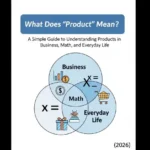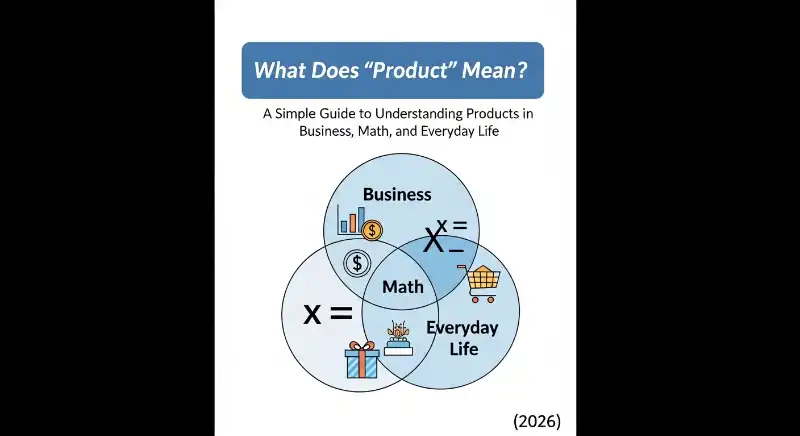
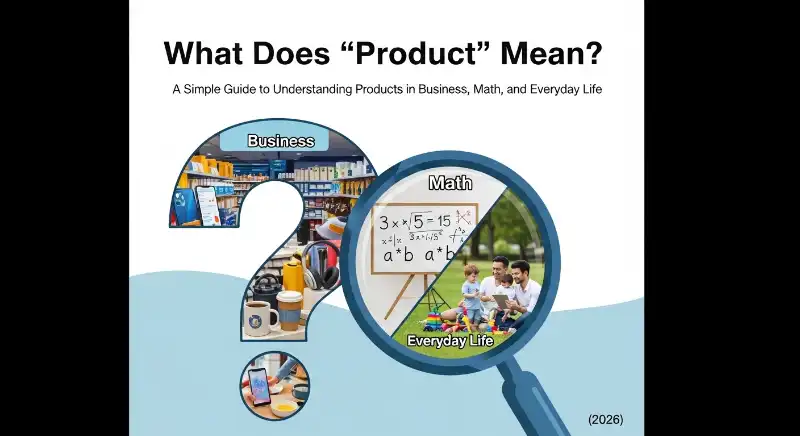
Product meaning is something many people search when they encounter the word in school, business, or everyday conversation. The word sounds simple, but it actually has several meanings depending on the context—such as marketing, economics, or even mathematics.
Think about the last time you bought a phone, downloaded an app, or solved a math equation. In all of those situations, the word product appears in different ways. Understanding what a product really means can help students, entrepreneurs, and curious learners make sense of business ideas, economics, and basic math concepts.
Product Definition:
A product is anything created or produced to satisfy a customer’s need or want. It can be a physical item, digital tool, or service offered by a business.
What Is the Meaning of “Product”? (A Simple Definition)
At its most basic level, product meaning refers to something that is created or produced to satisfy a need or want.
In everyday language, a product is something people can buy or use. It could be a physical item like shoes or a digital tool like a mobile app.
For example:
- A smartphone is a product.
- A laptop is a product.
- A video streaming subscription can also be a product.
In simple terms:
A product is anything made or offered to provide value to people.
This idea applies in many fields such as business, marketing, economics, and mathematics. Each field uses the word slightly differently, which is why people sometimes get confused.
A Quick Real-Life Example
Imagine walking into a store to buy headphones.
The company designed the headphones, manufactured them, packaged them, and placed them in stores. The final item you purchase is the finished product.
This simple example helps explain the finished product meaning: something that has completed the production process and is ready to be sold or used.
Why Do People Get Confused About the Word “Product”?
One reason people search product meaning simple definition is that the word changes depending on the subject being discussed.
For instance, a teacher explaining math might use the word very differently from a business manager discussing sales.
Different Contexts of the Word “Product”
The word “product” appears in many fields, including:
- Business: something a company sells
- Marketing: the item or service offered to customers
- Economics: goods or services produced in an economy
- Mathematics: the result of multiplying numbers
- Science: something created during a chemical process
Because of these different uses, the same word can mean different things.
Everyday Language vs Academic Meaning
In daily conversations, people usually think of physical goods when they hear the word product.
However, in modern economies—especially in 2026—products can also include:
- digital software
- online courses
- mobile apps
- streaming subscriptions
For example, a music streaming platform might sell a monthly subscription. Even though nothing physical is handed to the customer, the service is still considered a product in many business discussions.
What Are Some Real-Life Examples of Products?
To understand product meaning in business, it helps to look at simple real-world examples.
Products appear everywhere in daily life.
Physical Products
These are items you can touch and store.
Examples include:
- smartphones
- shoes
- books
- laptops
- furniture
When a company manufactures and sells these items, they are called physical goods or consumer products.
Digital Products
In the modern digital economy, many products exist only online.
Examples include:
- mobile apps
- eBooks
- software tools
- online courses
- video games
A popular example is a SaaS product meaning (Software as a Service). These products allow users to access software through the internet instead of installing it on their computers.
A Simple Product Example Table
| Type of Product | Example |
| Physical product | Smartphone |
| Digital product | Mobile app |
| Subscription product | Streaming service |
| Educational product | Online course |
These examples show how products can take many different forms.
What Does “Product” Mean in Business?
In business, product meaning refers to anything a company offers to customers in exchange for money or value.
Companies create products to solve problems, meet needs, or make life easier for people.
For example:
- A technology company sells laptops.
- A clothing brand sells jackets.
- A software startup sells a productivity app.
Each of these items is considered a product because it provides value to customers.
Value Creation and Products
Businesses succeed when their products solve real problems.
Imagine a small startup that creates a mobile app helping people manage daily tasks. The app helps users stay organized, which provides value. Because people find it useful, they are willing to pay for it.
That usefulness is what turns an idea into a product.
Special Types of Business Products
In business discussions, you may hear terms like:
- flagship product meaning: the most important or popular product of a brand
- niche product meaning: a product designed for a specific audience
- renewed product meaning: a refurbished item restored to working condition
For example, a company’s most advanced smartphone might be considered its flagship product because it represents the brand’s best technology.
What Is a Product in Marketing? (The Marketing Mix Explained)
Marketing experts use the word product in a slightly different way. In marketing, a product is not just the item being sold—it includes the entire experience surrounding it.
This idea comes from the famous marketing mix, often called the 4Ps of marketing:
- Product
- Price
- Place
- Promotion
The first element, product, focuses on what the company offers to customers.
Elements That Define a Product in Marketing
When marketers design a product, they think about several important factors:
- Quality: How well the product performs
- Design: The look and feel of the product
- Branding: The identity of the company
- Packaging: How the product is presented
These features shape how customers perceive the product.
Minimum Viable Product (MVP)
A modern concept often discussed in startups is the minimum viable product meaning.
A minimum viable product (MVP) is the simplest version of a product that can still solve a customer’s problem.
Startups use MVPs to test ideas quickly before investing large amounts of money.
For example:
A new app might launch with only basic features. If users like it, the company gradually adds more functions.
This approach allows businesses to learn from real users instead of guessing what people want.
Product Meaning in Economics: How Economies Create Value
In economics, product meaning refers to the goods and services produced within an economy. These products represent the output of businesses, industries, and workers working together to create value.
Think of an economy as a giant system of production. Factories manufacture goods, farmers grow crops, software developers build digital tools, and service providers offer expertise. Everything created and sold becomes part of the economy’s overall production.
Economists often measure the total value of products through a concept called Gross Domestic Product (GDP).
GDP represents the total value of all goods and services produced in a country over a specific period of time. If companies produce more products and services, GDP generally increases.
Real-Life Example
Imagine a country producing:
- cars from manufacturing companies
- wheat from agriculture
- mobile apps from tech startups
- online education services
All of these outputs are considered economic products because they contribute to the country’s productivity and economic growth.
Why Products Matter in Economics
Products play several important roles in an economy:
They create jobs.
Factories, offices, and digital companies all employ workers to produce goods and services.
They generate income.
Businesses earn revenue from products, which allows them to pay salaries and invest in growth.
They drive innovation.
New products push companies to improve technology and efficiency.
In modern economies, especially in 2026, digital products such as AI tools, online platforms, and SaaS software are becoming just as important as physical goods.
What Does Product Mean in Math?
In mathematics, the word product has a completely different meaning.
Here, a product refers to the result of multiplying two or more numbers together.
For example:
- 4 × 3 = 12
- 6 × 5 = 30
- 10 × 2 = 20
In each of these equations, the answer is called the product.
Simple Explanation
Think of multiplication as repeated addition.
If you multiply 4 × 3, it means:
4 + 4 + 4 = 12
So 12 is the product.
Everyday Example
Imagine buying three notebooks that cost $4 each.
4 + 4 + 4 = 12
Or using multiplication:
3 × 4 = 12
The product of 3 and 4 is 12.
Other Types of Mathematical Products
In higher mathematics, the term product appears in more advanced concepts such as:
- dot product meaning (used in vector mathematics)
- partial product meaning (used in long multiplication)
- cross product meaning (used in physics and engineering)
Even though these terms sound complex, they all revolve around the same idea: combining numbers through multiplication to produce a result.
Product vs Service: What’s the Difference?
Many people confuse products and services, especially in business discussions.
While they are related, they are not the same.
A product is something created and offered to customers, while a service is an activity performed for someone.
Key Differences
| Feature | Product | Service |
| Nature | Tangible or digital item | Action or assistance |
| Ownership | Customer owns it | Customer experiences it |
| Example | Phone, software, book | Haircut, consulting, repair |
Real-Life Example
Imagine visiting a tech store.
- Buying a laptop is purchasing a product.
- Paying someone to repair the laptop is purchasing a service.
However, modern businesses often combine both.
For example, a software company might sell a digital product and also offer customer support services.
Types of Products in Marketing
Marketing experts often classify products into different categories based on how customers buy them.
Understanding these categories helps businesses design better strategies.
1. Convenience Products
These are items people buy frequently and with little thought.
Examples include:
- snacks
- toothpaste
- bottled water
Customers expect these products to be easily available and affordable.
2. Shopping Products
Shopping products require more research before buying.
Examples include:
- laptops
- smartphones
- furniture
Customers often compare prices, quality, and reviews before making a purchase.
3. Specialty Products
These are unique products with strong brand identity.
Customers are willing to travel or wait to obtain them.
Examples might include luxury watches, designer clothing, or high-end technology.
4. Unsought Products
These are products consumers rarely think about until they need them.
Examples include:
- insurance policies
- emergency repair services
Because people do not actively search for these products, companies must rely heavily on marketing and education.
How Products Are Changing in 2026
The concept of a product has evolved dramatically over the last decade.
In the past, products were mostly physical goods produced in factories. Today, many products exist entirely online.
Several trends are shaping the future of products.
Digital Products Are Dominating
Software, apps, and online tools are now some of the most profitable products in the world.
Instead of selling a physical item once, companies sell subscriptions that generate recurring revenue.
AI-Powered Products
Artificial intelligence has transformed the way companies create tools.
AI-powered writing assistants, image generators, and productivity software are now common digital products.
Many startups build their entire business around AI-driven services.
Creator Economy Products
Another growing trend is the creator economy.
Individuals can now create and sell products like:
- online courses
- digital templates
- eBooks
- membership communities
This means anyone with knowledge or skills can become a product creator.
Common Mistakes People Make About Product Meaning
Despite its simplicity, the word product is often misunderstood.
Here are a few common misconceptions.
Thinking Products Are Only Physical Items
Many people believe products must be tangible.
In reality, digital tools, software, and even online communities can be products.
Confusing Products With Services
Products and services often overlap, but they are not identical.
A product is something created, while a service is something performed.
Assuming Products Are Only Sold by Large Companies
Small businesses, freelancers, and independent creators also build products.
For example, a freelancer who sells an online design template has created a digital product.
FAQ: Product Meaning (People Also Ask)
What is the simple definition of product?
A product is something created or produced to satisfy a need or want. It can be a physical item, digital tool, or service offering value to customers.
What does product mean in business?
In business, a product refers to anything a company sells or offers to customers in exchange for money or value.
What is a product in mathematics?
In mathematics, a product is the result of multiplying two or more numbers together.
What is an example of a product?
Examples of products include:
- smartphones
- books
- mobile apps
- online courses
- software tools
What is the difference between a product and a service?
A product is something created and sold, while a service is an activity performed for someone.
Final Thoughts: Why Understanding “Product” Matters
At first glance, the word product seems simple. But once you explore it across different fields—business, economics, marketing, and mathematics—you realize it carries several meanings.
In everyday life, products are everywhere.
They are the phones we use, the apps we download, the food we buy, and even the digital tools that help us work and learn.
Understanding product meaning helps us see how ideas turn into real solutions that improve people’s lives.
As technology continues evolving in 2026 and beyond, products will likely become even more innovative—combining software, services, and artificial intelligence to create entirely new experiences.
In the end, every successful product begins with a simple question:
What problem does this solve for people?
Answer that well, and a product can change an entire industry.

Mush explores trending words, viral slang, and social media phrases, explaining them in simple English with fun examples for everyone.