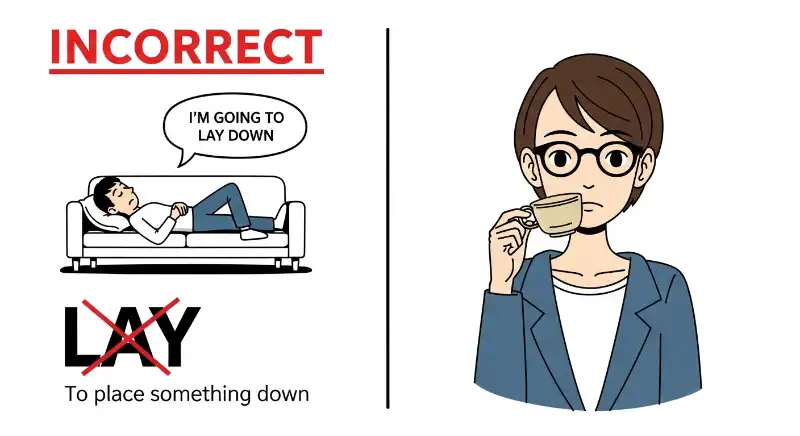
Lie vs lay is one of the most confusing grammar problems in English—and if you’ve ever paused mid-sentence thinking “Wait… is it lay down or lie down?”, you’re definitely not alone.
It feels like a small mistake, but it can quietly affect how clear and confident your writing sounds—whether you’re texting, emailing, or writing professionally.
Here’s the good news: once you understand one simple rule (and a tiny memory trick), this confusion disappears for good.
✅ Quick Answer
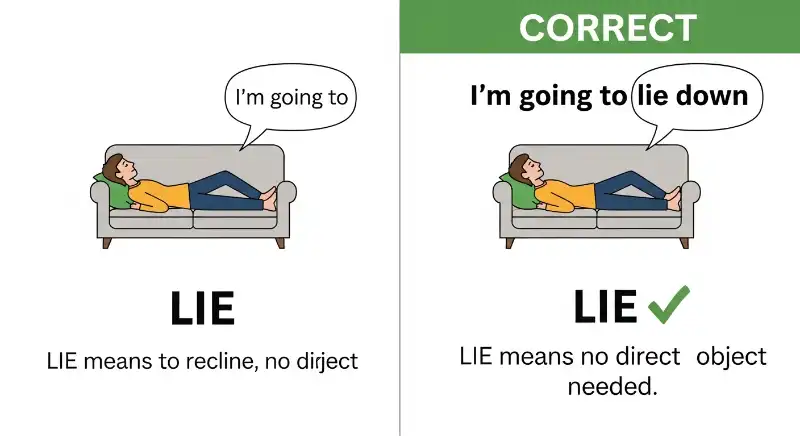
- Lie = to rest yourself (no object)
- Lay = to put something somewhere (needs an object)
👉 If there’s no object, use lie
👉 If there’s something being placed, use lay
Example:
- I need to lie down. (correct)
- Please lay the book on the table. (correct)
Lie vs Lay Explained for Beginners (Quick Answer)
Let’s break this down in the simplest way possible—like explaining it to a friend.
🧠 The Core Idea (In Plain English)
Think of it like this:
- Lie = you do it to yourself
- Lay = you do it to something else
That’s it. That’s the entire foundation.
If you’re tired and want to rest, you lie down.
But if you’re putting your phone on the bed, you lay it down.
💡 Why This Confuses So Many People
The confusion happens because:
- Their past tenses overlap (we’ll get to that later)
- In casual speech, people mix them freely
- “Lay down” sounds natural—even when it’s wrong
For example:
❌ “I’m going to lay down.”
✅ “I’m going to lie down.”
Even native speakers make this mistake daily.
⚡ Micro Comparison (Super Fast)
| Situation | Correct Verb |
|---|---|
| You rest | Lie |
| You place something | Lay |
If you remember just this, you’ll already be ahead of 80% of people.
Difference Between Lie and Lay (Grammar Comparison Guide)
Now let’s go a little deeper so you never second-guess yourself again.
📊 Lie vs Lay Chart With Examples
Here’s a clean comparison that makes everything click:
| Verb | Meaning | Needs Object? | Example |
|---|---|---|---|
| Lie | To rest or recline | ❌ No | I will lie down |
| Lay | To put/place something | ✅ Yes | Lay the keys here |
👉 Notice the pattern:
- “Lie” stands alone
- “Lay” always has something after it
🔍 Transitive vs Intransitive (Simple Explanation)
Don’t worry about the technical terms—here’s what they really mean:
🟢 Lie = Intransitive Verb
It does not need an object.
Example:
- She lies on the couch.
- He is lying in bed.
Nothing is being placed. The person is doing the action themselves.
🔵 Lay = Transitive Verb
It requires an object—something you’re placing.
Example:
- Lay the blanket on the bed.
- She laid the baby down.
Ask yourself:
👉 “What is being laid?”
If you can answer that question, then lay is correct.
🧠 Emotional Clarity Trick
Here’s a human way to feel the difference:
- Lie feels passive (resting, relaxing, existing)
- Lay feels active (placing, doing, moving something)
This emotional cue actually helps your brain choose faster.
When to Use Lie or Lay in Sentences
Now let’s bring this into real life—because grammar only matters when you actually use it.
💬 Lay vs Lie Sentence Examples
Here are simple, everyday sentences:
Using “Lie” (no object)
- I just want to lie down after work
- He lies on the sofa every evening
- The cat is lying in the sun
Using “Lay” (with object)
- Lay your phone on the table
- She laid the clothes on the bed
- He is laying tiles in the kitchen
🧩 Real-Life Examples of Lie and Lay
Let’s imagine a normal day:
Morning:
- You wake up and lie in bed scrolling your phone
Afternoon:
- You lay your laptop on the desk to work
Evening:
- You feel tired and go lie down
See the pattern? It naturally follows your actions.
💬 Real Chat Scenario (Modern Usage)
Here’s how this confusion shows up in real conversations:
Friend A:
“I’m so tired, I’m gonna lay down.”
B:
“Technically, it’s ‘lie down’ 😄”
C:
“Seriously? English is broken.”
👉 This is exactly how it happens in 2026—especially in chats, social media, and texting.
Even though people understand the meaning, correct usage still matters in:
- Professional emails
- Academic writing
- Content creation
Lay Down or Lie Down — Which Is Correct Grammar?
This is the most searched question—and for good reason.
❓ Is It “Lay Down” or “Lie Down”?
👉 Correct answer: Lie down
Because:
- You are not placing anything
- You are resting yourself
🛏️ Lie or Lay in Bed (Correct Usage)
Let’s clear this up once and for all:
- ✅ I will lie in bed
- ❌ I will lay in bed
Why? Because you’re not putting anything down—you are resting.
🔄 Difference Between Lying and Laying
This is where things get tricky.
✅ Lying (correct for resting)
- She is lying on the floor
- He is lying in bed
⚠️ Laying (only correct with object)
- She is laying the table
- He is laying bricks
🧠 Simple Check Trick
Ask yourself:
👉 “What am I laying?”
- If nothing → use lying
- If something → use laying
Lie vs Lay Past Tense Forms (Lie Lay Laid Explained)
Now comes the part that confuses even advanced learners.
🔄 Lie Lay Laid — Why It Feels So Confusing
Because “lay” is both a present tense AND a past tense.
Let’s break it cleanly.
📊 Lie Lay Lain Tense Chart
| Base Verb | Present | Past | Past Participle |
|---|---|---|---|
| Lie | lie | lay | lain |
| Lay | lay | laid | laid |
🧠 Example Breakdown
Lie (resting)
- Present: I lie down
- Past: Yesterday, I lay down
- Perfect: I have lain down
Lay (placing something)
- Present: I lay the book down
- Past: I laid the book down
- Perfect: I have laid the book down
⚠️ Common Mistakes (Lie and Lay)
Here’s what people often say vs what’s correct:
- ❌ I laid down for a nap
- ✅ I lay down for a nap
- ❌ I was laying on the couch
- ✅ I was lying on the couch
😵 Why Even Native Speakers Get It Wrong
Because:
- “Lay” (past of lie) looks identical to “lay” (present of lay)
- Spoken English blurs these distinctions
- Most people rely on habit, not rules
🔮 2026 Usage Insight
In modern communication:
- Casual speech often ignores this rule
- Social media normalizes incorrect forms
- But professional writing still expects correctness
👉 Knowing the difference gives you a subtle but powerful edge.
Simple Trick to Learn Lie vs Lay Instantly
This is where everything finally clicks.
🧠 How to Remember Lie vs Lay (The 5-Second Brain Hack)
Forget long grammar rules. Use this:
👉 Lie = Alone
👉 Lay = Load (something)
If you’re doing the action alone, use lie.
If you’re carrying or placing a load (object), use lay.
⚡ Real-Life Memory Example
Imagine two situations:
- You walk into your room, tired → you lie down
- You walk in holding your bag → you lay the bag down
Same action, different focus.
👉 Your brain naturally understands this when you visualize it.
🧩 Decision Rule Cheat Sheet
Before you speak or write, ask:
- Is there an object?
- Yes → use lay
- No → use lie
- Can I say “what?” after the verb?
- “Lay what?” → correct
- “Lie what?” → doesn’t make sense
💡 Pro Tip (Used by Writers in 2026)
Many writers silently replace the sentence:
- If “put” fits → use lay
- If “rest” fits → use lie
Example:
- “I need to rest” → lie
- “I need to put the keys here” → lay
Lie vs Lay Quiz With Answers (Test Your Grammar)
Let’s make this interactive. Don’t overthink—go with your instinct.
📝 Beginner Quiz
Fill in the blanks:
- I want to ___ down for a while
- Please ___ the book on the table
- He is ___ on the couch
- She ___ the baby in the crib yesterday
✅ Answers
- lie
- lay
- lying
- laid
🔥 Advanced Sentence Correction
Fix these:
- I was laying on the bed all day
- Yesterday, I laid down for two hours
- She is laying in the sun
✅ Correct Versions
- I was lying on the bed all day
- Yesterday, I lay down for two hours
- She is lying in the sun
🧠 Why This Practice Works
Your brain learns faster through correction + repetition.
That’s why even short quizzes like this can permanently fix confusion.
Lying vs Laying Difference in Modern English Usage
Let’s talk about what’s actually happening in real-world English today.
🌍 Casual vs Formal Grammar Usage
In 2026, language is evolving faster than ever:
- Social media → relaxed grammar
- Messaging apps → speed over accuracy
- Content creators → conversational tone
So you’ll often see:
- “I’m laying in bed” (technically incorrect)
- “Gonna lay down” (very common)
⚖️ Does Correct Grammar Still Matter?
Yes—depending on context.
Use correct forms in:
- Emails
- Job applications
- Academic writing
- Professional content
Be flexible in:
- Text messages
- Casual chats
- Social media captions
💬 Grammar in Emails and Social Media
Let’s compare:
Casual Chat:
“Hey, I’m laying down. Talk later.”
Professional Email:
“I will lie down for a short rest and respond shortly.”
🔮 2026 Insight: The Grammar Shift
We’re entering a hybrid era:
- Understanding > Perfection
- But clarity still builds credibility
👉 Knowing the rule gives you control—you can choose when to follow it or bend it.
Lie vs Lay Worksheet and Practice Exercises
Now let’s make this skill permanent.
📄 Printable Practice Sentences
Try these on your own:
- I need to ___ down before dinner
- She ___ the keys on the counter
- They are ___ in the sun
- He ___ the phone on silent mode
✅ Answers
- lie
- laid
- lying
- laid
🧠 Self-Correction Framework
When you’re unsure, pause and ask:
- Is something being placed?
- Can I identify an object?
- Does “rest” or “put” fit better?
This takes 2 seconds, but prevents mistakes instantly.
📈 Practice Strategy (Used by Language Learners)
To master this:
- Write 3 sentences daily using both verbs
- Speak them out loud
- Correct yourself consciously
👉 Within a week, it becomes automatic.
💡 Emotional Tone Interpretation (Why This Confusion Feels Frustrating)
Let’s be honest—this topic feels annoying.
You know English. You communicate daily. Yet this tiny rule trips you up.
That frustration comes from:
- Overlapping verb forms
- Contradicting patterns
- Hearing incorrect usage everywhere
But here’s the shift:
👉 Once you understand the logic, the confusion disappears permanently.
And that creates a quiet confidence—you stop hesitating mid-sentence.
❓ FAQ – Lie vs Lay (People Also Ask)
❓ Is it “lay down” or “lie down”?
👉 The correct phrase is “lie down.”
Use lie because you are resting yourself, not placing something.
- ✅ I need to lie down
- ❌ I need to lay down
❓ What is the difference between lie, lay, and laid?
Here’s the simplest breakdown:
- Lie → to rest (no object)
- Lay → to place something (needs object)
- Laid → past tense of lay
Example:
- I lie down every day
- I lay the book on the table
- Yesterday, I laid the book there
❓ Why is lie vs lay so confusing?
Because:
- “Lay” is both a present verb and a past form of lie
- They sound similar in everyday speech
- People use them incorrectly in casual conversations
👉 Even native speakers mix them up regularly.
❓ Is “laying” ever correct?
Yes—but only when there is an object.
- ✅ She is laying the table
- ❌ She is laying on the bed (incorrect)
👉 If nothing is being placed, use lying instead.
❓ How do I remember lie vs lay easily?
Use this simple trick:
👉 Lie = you do it yourself
👉 Lay = you do it to something
Or:
- Rest → Lie
- Put → Lay
❓ Is “I was laying in bed” correct?
❌ No, it’s incorrect.
✅ Correct version:
👉 “I was lying in bed”
Because you’re resting, not placing anything.
❓ What is the past tense of “lie”?
- Present → lie
- Past → lay
- Past participle → lain
Example:
- Yesterday, I lay down for an hour
❓ Do people still care about this in 2026?
Yes—and no.
- In casual speech, mistakes are common and often ignored
- In professional writing, correct usage still matters
👉 Knowing the rule gives you an advantage.
🌟Conclusion
Let’s be real—lie vs lay isn’t just a grammar rule. It’s one of those small details that quietly shapes how people perceive your communication.
At first, it feels confusing… even frustrating. The rules overlap, people use them incorrectly all the time, and your brain keeps second-guessing itself.
But now, you see the pattern.
You understand that:
- Lie is about rest
- Lay is about action
And more importantly—you know how to decide instantly.
That’s powerful.
Because in a world where most people rely on guesswork, you’re making intentional, confident choices with your words.
And that’s what clear communication is really about.
👉 Not perfection.
👉 Not memorizing rules.
👉 But understanding meaning.
So the next time you pause and think, “Is it lay or lie?”—you won’t hesitate.
You’ll just know.
📚 Related Articles Who vs Whom Examples in Real Sentences

Mush explores trending words, viral slang, and social media phrases, explaining them in simple English with fun examples for everyone.