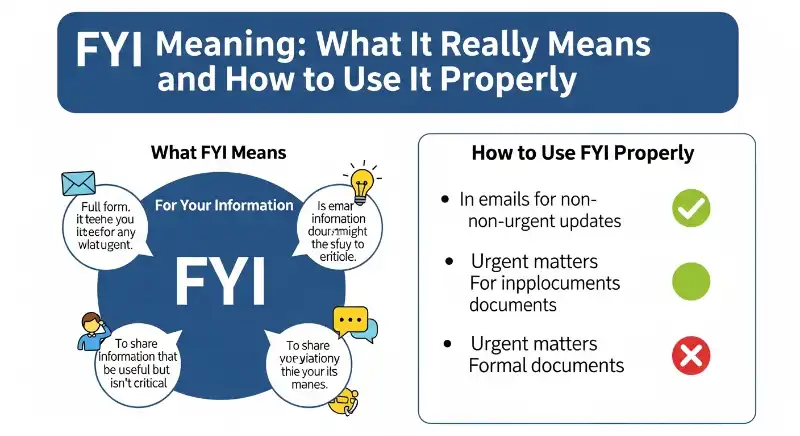
FYI meaning is something many people search after seeing it in a message, email, or workplace chat. FYI is a widely used abbreviation that stands for “For Your Information.” It’s commonly used in text messages, emails, office communication, and online conversations to share information without directly asking for action.
Still, FYI isn’t always interpreted the same way. Depending on tone and context, it can feel helpful, neutral, cold, or even passive-aggressive. That’s why such a small phrase can create confusion—or even anxiety—especially in professional or unclear situations.
Quick Answer:
FYI stands for “For Your Information.” It is used to share information so the other person is aware of it, without expecting action or a response. The tone of FYI depends on context, which is why it can feel neutral, helpful, or sometimes passive-aggressive.
What Does FYI Stand For and Why Is Everyone Using It Suddenly?
FYI is not new, but people notice it more now because modern communication is short, fast, and often lacks emotional cues. When a message is brief, readers tend to read between the lines.
This is why many people search “FYI meaning” right after receiving a message with it.
What Is the Full Form of FYI?
The full form of FYI is “For Your Information.”
Its original purpose is simple: to share information, not to request, command, or criticize.
Neutral example:
- FYI, the office will be closed on Friday.
This sentence only informs. It doesn’t expect a reply.
What Does FYI Literally Mean in Communication?
Literally, FYI means:
“I’m sharing this so you’re aware of it.”
There is no built-in emotion in FYI. Any emotional tone comes from context, wording, and relationship.
Office-style example:
- FYI, the client has approved the proposal.
The intent is awareness, not pressure.
FYI Meaning in Simple Words Most People Actually Understand
Many dictionary explanations make FYI sound more formal than it really is. In real life, FYI is very simple.
What Does FYI Mean in Simple Language?
In everyday words, FYI means:
“Just letting you know.”
That’s it. No hidden message by default.
Beginner-friendly explanation:
- Someone says FYI when they want you informed, not involved.
Why Do People Shorten “For Your Information” to FYI?
People shorten it to FYI because:
- It’s faster to type
- It fits modern email and chat culture
- It avoids sounding overly formal
Before:
- For your information, the report is ready.
After:
- FYI, the report is ready.
Same meaning. Less friction.
What Does FYI Mean in Text Messages and Chats?
In text messages, FYI is usually casual and informational, but because texts are short, tone can feel sharper than intended.
How Is FYI Used in Text Messages?
In chats, FYI often introduces:
- Small updates
- Quick reminders
- Shared awareness
Friend-to-friend example:
- FYI, I’ll be late tonight.
This feels neutral and practical.
Can FYI Sound Cold in Casual Chats?
Yes, sometimes. Short messages lack tone, facial expression, and context.
Slightly sharp example:
- FYI, I already sent that.
This can feel cold even if the sender didn’t mean it that way. Adding context softens it.
FYI Meaning in Emails and Workplace Communication
In professional settings, FYI is extremely common—but also risky if used carelessly.
What Does FYI Mean in Professional Emails?
At work, FYI usually means:
- “This is for awareness”
- “No action required”
- “Sharing for visibility”
Correct workplace example:
- FYI, the deadline has been extended to Monday.
This sets expectations clearly.
When Should FYI Be Avoided at Work?
Avoid FYI when:
- Discussing sensitive feedback
- Communicating authority or discipline
- Addressing emotional topics
Instead of:
- FYI, your performance was discussed.
Better:
- I wanted to update you on a recent discussion.
Tone matters more than speed.
Is FYI Rude, Polite, or Passive-Aggressive?
This is one of the most common concerns around FYI—and the answer depends entirely on context.
Is FYI Considered Rude in Some Situations?
FYI can feel rude when:
- It implies superiority
- It sounds dismissive
- It’s used without explanation
Rude-sounding example:
- FYI, that’s not how it works.
The issue isn’t FYI—it’s the phrasing.
Can FYI Be Passive-Aggressive Without Meaning To Be?
Yes. Especially in Slack or email, FYI can unintentionally sound like:
- “You should already know this”
- “I’m correcting you”
Passive-tone example:
- FYI, this was already decided.
Adding warmth or clarity avoids misinterpretation.
FYI vs ICYMI — Why People Mix Them Up
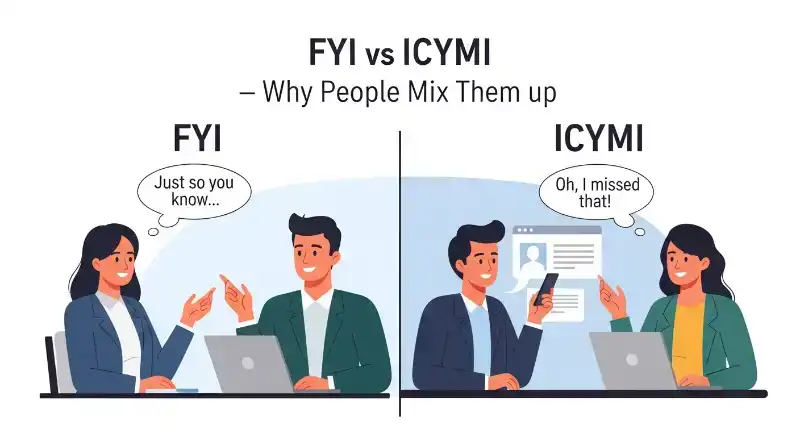
Many people confuse FYI and ICYMI, because both are short acronyms used in communication. However, they serve very different purposes. FYI is forward-looking, while ICYMI is retrospective. Knowing the difference can prevent misunderstandings and improve tone in both professional and casual settings.
What Is the Difference Between FYI and ICYMI?
The main distinction comes down to timing and intent:
- FYI (For Your Information): Sharing new information. Neutral, informative, and often at the beginning of communication.
- ICYMI (In Case You Missed It): Re-sharing previously shared content. Polite reminder, often for posts, emails, or updates.
Example:
- FYI: The report will be delivered by 3 PM.
- ICYMI: ICYMI, the report was delivered yesterday.
The difference is subtle but important: FYI informs; ICYMI reminds.
When Should You Use FYI Instead of ICYMI?
Use FYI when your goal is to provide new information that the recipient may not have seen or considered yet. ICYMI works best for reminders or recaps.
Correct FYI example:
- FYI, the meeting has been rescheduled to 2 PM.
Incorrect FYI example (better with ICYMI):
- FYI, the meeting was yesterday.
(ICYMI is better because the event already occurred.)
How to Use FYI Correctly in a Sentence
Understanding FYI isn’t just about meaning—it’s about placement, tone, and clarity. Using it correctly ensures your message is received as intended, not as blunt or dismissive.
How Do You Use FYI Properly in Writing?
FYI is most often placed at the start of a sentence, followed by a comma, then the key information.
Example:
- FYI, the presentation slides are attached.
It can also appear mid-sentence if you want to softly insert the information:
- The slides, FYI, are attached to this email.
Capitalization is optional in casual chats, but in emails, use FYI uppercase to maintain professionalism.
Should FYI Come at the Start or End of a Message?
Placement affects tone:
- Start: Direct, neutral, and formal.
Example: FYI, the document has been updated. - End: Slightly softer, conversational, or casual.
Example: The document has been updated, FYI.
Choosing placement allows you to control the subtle emotional tone.
Common FYI Mistakes That Make Messages Awkward
Even though FYI is simple, misusing it can make messages feel cold, bossy, or passive-aggressive. Recognizing common mistakes helps you communicate clearly.
What Are the Most Common Mistakes People Make with FYI?
- Using FYI for requests or commands
- Sending FYI about sensitive or personal topics
- Overusing FYI, making it feel repetitive
- Ignoring context and recipient’s relationship
Incorrect example:
- FYI, you should have finished this.
Better version:
- FYI, the deadline is tomorrow.
Notice how context and tone make a huge difference.
Why Does Overusing FYI Sound Annoying?
Repeatedly starting messages with FYI can create fatigue and perceived attitude. People may feel like the sender is correcting them or being dismissive, even when that’s not intended.
Overused FYI example:
- FYI, the meeting is at 3 PM.
- FYI, the slides are updated.
- FYI, the deadline was changed.
Instead, combine or space out FYI to preserve clarity and politeness.
FYI Meaning in 2026 — Still Relevant or Outdated?
Language evolves, but FYI has remained widely accepted across generations and platforms. In 2026, FYI is still seen in emails, Slack messages, text chats, newsletters, and social media posts.
Is FYI Considered Slang Today?
FYI is not slang—it’s a standard abbreviation recognized across generations. Younger people and professionals use it frequently for speed and clarity, especially in digital-first environments.
Example:
- FYI, the AI update is live.
It’s casual but widely accepted, unlike older internet slang that fades quickly.
How Do Younger People Perceive FYI Now?
Gen Z and Millennials use FYI mostly in informational, non-confrontational ways. They prefer it short, polite, and easy to read, often paired with emojis or context to soften tone in informal messages.
Example in a group chat:
- FYI 😊, the deadline got moved to Friday.
The message is polite, casual, and clear—all at once.
Is FYI Rude, Polite, or Passive-Aggressive?
The emotional interpretation of FYI depends on relationship, placement, and context. In neutral situations, it is polite and informative. In tense or sensitive contexts, it can appear cold or passive-aggressive.
Can FYI Be Interpreted as Rude?
Short, abrupt messages without context may feel rude. Especially in email threads where tone is invisible, FYI can be misread as sharp or dismissive.
Example:
- FYI, this was already sent.
Adding context or phrasing adjustment can prevent misinterpretation.
Can FYI Be Passive-Aggressive Without Meaning To Be?
Yes. FYI can inadvertently suggest superiority or dismissal when paired with criticism or sarcasm.
Slack example:
- FYI, the report was already shared yesterday.
Softening with context or emojis usually fixes this.
Final Conclusion: Why FYI Still Matters and How to Use It Confidently
FYI mean may seem like a small abbreviation, but it carries big weight in modern communication. Whether in emails, text messages, Slack, or group chats, FYI signals awareness, sharing, and consideration. When used thoughtfully, it keeps your messages clear, polite, and efficient.
The key to using FYI successfully is context and tone. At work, it shows professionalism without demanding action. In casual chats, it informs without sounding bossy. Misplaced or overused, it can feel cold or passive-aggressive—but with a little attention, FYI becomes a powerful communication tool.
Next time you type FYI, remember: it’s more than an abbreviation. It’s a way to connect, inform, and keep people in the loop—without confusion or unintended tone. Use it mindfully, and you’ll communicate clearly, politely, and confidently every time.
You’ll never have to guess what FYI means again. Now, you can spot the tone, intent, and proper use instantly, no matter the platform.

Mush explores trending words, viral slang, and social media phrases, explaining them in simple English with fun examples for everyone.



3 thoughts on “FYI Meaning: What It Really Means and How to Use It Properly”