If you searched for Extroly.com, you may have seen different explanations of what this website does. Some online articles describe it as a social platform or an AI tool, while others discuss it as a content website. This can make it hard to know which information is correct.
The best way to understand Extroly.com is to check the actual website instead of trusting every description you find online. You should look at what it offers, who runs it, and whether its claims can be verified.
In this article, we will examine these questions step by step. You will learn how to check its features, review its trust signals, and decide what information you should verify before using the site.
Quick Answer:
Extroly.com is a website whose purpose should be confirmed through its current pages and available evidence. Online descriptions have associated the domain with content publishing, social networking, and AI tools, but those descriptions should not be treated as proof that all these features exist. Check the live website, its official information, and its privacy details before relying on any specific claim.
What Is Extroly.com Actually Used For?
If you are unsure what Extroly.com does, start by looking at the website itself. A domain name or a description written by another blog cannot tell you everything about its actual purpose.
A website may publish articles, offer online tools, or provide a service that requires an account. These are different functions, so it is important to identify what visitors can really do on Extroly.com.
What should you look at first?
Open the exact domain and examine its main pages. Start with these areas:
- Homepage: Look at the main message and the services or content it presents.
- Navigation menu: Check whether it links to articles, tools, user accounts, or other features.
- About page: Look for an explanation of the website’s purpose and the people or organization behind it.
- Recent content: See whether the site mainly publishes articles or provides an interactive service.
- Contact page: Check whether visitors have a clear way to reach the operator.
These checks can help you understand the site’s main purpose without making assumptions.
For example, if the homepage mainly displays articles about technology, business, lifestyle, or other subjects, that is evidence of a publishing function. It does not automatically prove that the website also operates a social network or an AI platform.
What if the website’s purpose is still unclear?
Do not force the available information into a definite answer. Look for official documentation, working features, and links to related services.
If you cannot verify the website’s owner or main service, state that limitation clearly. A missing explanation does not prove that the site is fraudulent, but it does mean you should be careful about accepting unsupported claims.
What to do next: Establish what the live website actually displays before deciding whether its other advertised features are genuine.
Why Do Websites Describe Extroly.com Differently?
If you have read several articles about Extroly.com and each one gives a different explanation, you may wonder which one to believe. This often happens when websites repeat information from other blogs without checking the original source.
The solution is to compare each claim with evidence from the actual domain. Do not assume that a statement is correct just because several websites repeat it.
How can you separate facts from online claims?
Use a simple comparison when reviewing information about Extroly.com.
| Online claim | What you should check |
|---|---|
| Extroly.com is a social platform | Look for working user profiles, messaging, or community features. |
| It provides AI tools | Check for an actual tool, official documentation, or a working demonstration. |
| It is a publishing website | Review its article pages, categories, authors, and publication details. |
| It offers a user dashboard | Look for an official login route and evidence of what the dashboard does. |
| It is a trusted website | Review its ownership information, privacy practices, content quality, and available safety signals. |
This comparison helps you avoid a common mistake: treating a description of a service as proof that the service exists.
Also, remember that a website can offer more than one service. Finding articles on the homepage does not automatically rule out other features. You need to check each claim separately.
What makes an online description reliable?
A useful description should provide evidence that readers can check for themselves.
For example, an article that says Extroly.com provides an AI writing tool should identify the tool and explain how to access it. Official documentation or a working demonstration would provide stronger evidence than a general statement with no supporting link.
You should also consider when the information was published. A website may change its purpose, remove features, or update its services over time.
What to do next: Keep a distinction between verified facts, claims that have not been confirmed, and statements that available evidence directly contradicts. This will help you form a more accurate picture of Extroly.com.
Does Extroly.com Have Social Features or AI Tools?
If you found Extroly.com described as a social network or an AI productivity platform, you may want to know whether you can actually use those features. The important question is not what another article calls the website. It is what the domain currently provides.
How can you check its social features?
A genuine social platform may provide features such as:
- User registration and personal profiles.
- Messaging or communication between users.
- Community pages or discussion areas.
- Options to follow other users or share content.
These are examples of features to look for, not confirmed features of Extroly.com.
Check whether the relevant pages work and whether the website explains how people use them. A login button alone does not establish that the site operates a social network.
How can you check claims about AI tools?
If a source describes Extroly.com as an AI tool, look for evidence such as a working interface, official product instructions, or documentation explaining what the tool does.
You should also check whether the tool is actually hosted on Extroly.com or whether the article links to a separate service. Similar names and external links can sometimes cause confusion.
For instance, a blog post discussing AI writing does not prove that the publishing website provides its own AI writing software.
What if you cannot find these features?
If you cannot locate a working social feature or AI tool, do not assume that the claim is correct. Record that you could not verify the feature during your inspection.
That wording is more accurate than declaring that the feature never existed or that the website is a scam.
What to do next: Confirm the website’s actual functions before creating an account, downloading software, or sharing personal information. In Part 2, we will examine the website’s legitimacy, privacy and ownership details, app or login claims, content reliability, and the checks you should complete before using it.
Is Extroly.com Legit and Safe to Visit?
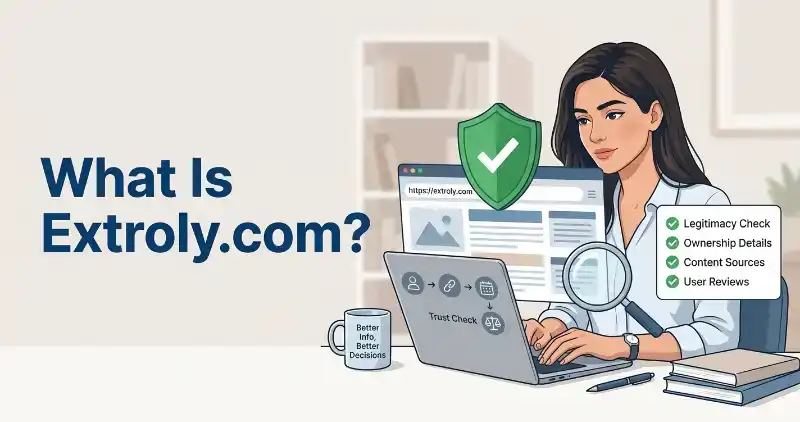
If you are wondering whether Extroly.com is legitimate, do not rely on a simple yes or no answer. A website can be active without clearly showing who operates it, and a professional-looking design does not prove that every claim is trustworthy.
The best approach is to check its identity, privacy information, contact details, and technical safety signals separately.
What should you check before trusting the website?
Start with these checks:
- Website identity: Confirm that the address in your browser is exactly
extroly.com. - Contact information: Look for a working contact page and a clear way to reach the website operator.
- Privacy policy: Check whether the site explains how it collects, uses, and shares personal information.
- Terms of service: If available, read the rules that apply to accounts, services, payments, or user contributions.
- Browser warnings: Pay attention to security warnings rather than ignoring them.
- Independent safety checks: Use a reputable website reputation service to look for known threats.
Each check answers a different question. Contact information helps you understand accountability, while a privacy policy explains data practices. Neither one alone proves that a website is safe.
What do these checks tell you about Extroly.com?
You should base your conclusion on the evidence you can actually confirm. If you find a clear privacy policy, you can report that the policy is available. You should not automatically claim that the website handles data responsibly without examining what the policy says.
The same rule applies to ownership. If you cannot identify a responsible operator through reliable sources, say that ownership could not be independently verified.
Also, HTTPS is not a complete trust test. It helps protect information sent between your browser and the website, but it does not guarantee honest business practices or accurate content.
What to do next: If important details remain unclear, limit your activity to low-risk browsing. Avoid entering sensitive information or making payments until you have enough evidence to feel comfortable proceeding.
What Do Extroly.com’s Ownership and Privacy Details Show?
If you cannot find out who runs Extroly.com, you may find it difficult to judge who is responsible for its content or services. This matters most when a website asks for personal details, account registration, or payment.
How can you check who runs the website?
Look for an About page, a named publisher, an editorial team, or a company name in the website’s legal documents.
You can also check publicly available domain-registration records through an ICANN RDAP lookup. These records may show registration dates, registrar details, or limited information about the registrant. Privacy services can hide some details, so an unavailable owner name does not automatically indicate wrongdoing.
Compare any company or individual named on the site with the information in its contact details and official records. If the details do not match, investigate the difference rather than guessing why it exists.
What should you look for in the privacy policy?
A privacy policy should explain what information the website collects and how it uses that information.
Pay attention to:
- Information collected through forms or account registration.
- Cookies and other tracking technologies.
- Whether information is shared with service providers or other parties.
- How users can contact the operator about their data.
- Any stated options for managing or deleting personal information.
For example, if you plan to create an account, check what information the site requires and why. If the policy is missing or does not explain important data practices, consider whether you really need to register.
What to do next: Make sure you understand the site’s data practices before sharing information. If you cannot establish who is responsible for the service, treat that uncertainty as a reason for caution.
Does Extroly.com Have an Official App or Login?
If you found a page claiming to offer an Extroly.com app or login, verify that it belongs to the exact website before entering any information.
A login page does not prove that a website offers a genuine account service. Similarly, an app download page does not prove that the app is official.
How can you verify an app?
Check these details before downloading anything:
- Does Extroly.com’s official website link to the app?
- Is the app listed in an established app store?
- Does the developer name match the website’s identified operator?
- Do the app description and requested permissions make sense for its stated purpose?
- Can you find reliable information about the app’s publisher?
Do not install an unknown file simply because its name matches the website.
How can you check a login page?
Start by checking the full web address in your browser. Look for misspellings, extra words, unusual domain endings, or unexpected redirects.
If the site asks you to enter a password, payment details, or other sensitive information, stop until you can verify the page’s connection to the official domain.
What to do next: If you cannot confirm that an app or login page is official, do not download the file or submit your details.
Can You Trust Articles Published on Extroly.com?
If you visit Extroly.com to read an article, you may also want to know whether its information is accurate. A website’s identity and the quality of its content are two different things.
Even a genuine publishing website can contain mistakes. The safest approach is to check important claims, especially when they relate to money, health, law, or online security.
What makes an article worth trusting?
Look for a few clear signs:
- Author information: Does the article identify its writer or provide useful information about their experience?
- Reliable sources: Does it link to official documents, original research, or other sources that support its claims?
- Accurate details: Can you confirm important facts through independent sources?
- Updated information: Does the article reflect current facts when the topic changes over time?
- Clear explanations: Does it explain how it reached its conclusions, or simply make broad claims?
For example, if an article says a website offers a particular AI tool, check the official product page or try to locate the tool itself. If the claim concerns a company’s ownership, look for reliable company records or a statement from the company.
What if an article has no sources?
A lack of citations does not automatically mean an article is false. However, it makes important claims harder to verify.
Use unsourced articles as a starting point for research rather than treating them as the final authority. You know, even a confident explanation can contain an error if the writer has not checked the facts.
What to do next: Before relying on an Extroly.com article for an important decision, confirm its main claims through trustworthy sources.
What Should You Check Before Using Extroly.com?
If you are still unsure whether to use Extroly.com, the answer depends on what you plan to do there. Reading a public article carries different risks from downloading a file, creating an account, or paying for a service.
Use the checks below to decide what makes sense for your situation.
| Your intended use | What to check first |
|---|---|
| Read public articles | Check the information against reliable sources. |
| Use an online tool | Confirm that the tool works as described and review its privacy terms. |
| Create an account | Verify the login page, operator, and data collection policy. |
| Download an app or file | Confirm the source and check for security warnings. |
| Share personal information | Understand why the information is needed and how it will be used. |
| Make a payment | Verify the provider, total cost, terms, and refund policy. |
| Consider a guest post | Confirm the publishing route, editorial standards, audience evidence, and commercial terms. |
These checks do not guarantee a risk-free experience. They help you make a more informed choice before taking an action that could expose your information or money.
Is Extroly.com worth using for guest posts or backlinks?
If you are researching Extroly.com as a publishing opportunity, do not assume that it accepts guest posts directly or that a link from the domain will improve your rankings. Confirm whether a current offer exists, who provides it, and what the terms require.
Before agreeing to a placement, examine the site’s actual articles, topical relevance, audience evidence, and written publishing conditions. Ask whether the article will remain available, who can edit it, and how any paid relationship will be disclosed.
Google’s official guidance identifies buying or selling links to manipulate search rankings as link spam. Paid placements should be appropriately qualified, such as with rel="sponsored" or, where appropriate, rel="nofollow".
A paid placement may have advertising or referral value, but it does not guarantee better rankings.
What to do next: Proceed only when the offer and its terms are verifiable, and evaluate the placement for genuine editorial or audience value rather than a promised SEO result.
Final Verdict: What Should You Know About Extroly.com?
Extroly.com should be judged by what its current website and reliable supporting evidence actually demonstrate, not by descriptions repeated across other blogs.
Before treating it as a social platform, AI service, or publishing opportunity, verify the relevant features. Check ownership and privacy information before sharing personal details, and assess the accuracy of individual articles before relying on them.
The same principle applies to its safety and legitimacy. A website’s existence does not prove that every claim about it is accurate, but missing information alone does not prove fraud either.
The practical answer: If the website’s purpose, ownership, or requested actions remain unclear, limit your activity and verify the details before proceeding. That is a more reliable approach than trusting a blanket claim that Extroly.com is either completely safe or a scam.
Frequently Asked Questions
What is Extroly.com?
Extroly.com is a domain whose current purpose should be identified from its live pages and official information. Claims that it operates a social platform, AI service, or other product require supporting evidence.
Is Extroly.com legit?
Its legitimacy cannot be established through its domain name or appearance alone. Check its operator, contact details, privacy policy, available services, and independent safety information before making a decision.
Does Extroly.com have an app?
An official app should be confirmed through a trustworthy app-store listing and a link from the verified website. Do not assume that a third-party download with a matching name is genuine.
Can you create an account on Extroly.com?
Confirm whether the current website offers an official registration or login feature. If you cannot verify the page, avoid entering your password or personal details.
Does Extroly.com accept guest posts?
This requires current confirmation from the website or a verifiable publishing provider. Check the submission process, editorial terms, and costs before agreeing to a placement.
Should you trust information published on Extroly.com?
Judge each article by its sources, accuracy, author information, and relevance to the topic. Confirm important claims independently, particularly when they could affect your finances, health, or security.