
If you searched for Test.com, you may be wondering what this website actually does. Is it a typing test website, an online exam tool, or a company that provides testing software?
The answer depends on which service you mean. Test.com, Inc. is associated with Gauge, an online testing and certification platform designed for organizations that need to create exams, manage candidates, and run professional testing programs. The official Gauge website describes its service as software for online exam delivery and certification management. Official source
This can be confusing because the word “test” appears in many website names. A typing test, an internet speed test, and a professional certification platform serve very different purposes.
In this article, we will look at what Test.com does, how Gauge works, which organizations may benefit from it, and what you should check before choosing the service. We will also look at its features, pricing, technical options, and company information so you can make a more informed decision.
What Is Test.com and How Is It Connected to Gauge?
When two names appear on a company’s website, it is natural to wonder whether they belong to separate businesses. In this case, the important thing is to understand the difference between the company name and the product name.
Test.com, Inc. vs. Gauge: What’s the Difference?
Test.com, Inc. is the company name associated with Gauge. Gauge is the name used for its online testing and certification software.
The company’s official website explains that Gauge provides tools for organizations that need more control over their exams and testing programs. Its platform is intended for professional assessments, training, and certification rather than casual online quizzes alone.
You may see the name Gauge on product pages, pricing information, support articles, and login resources. That does not automatically mean you have landed on a different service. Check the official website and its linked resources to confirm that the page belongs to the same platform.
The company’s terms of service identify Gauge with Test.com, Inc. However, that page was last modified in 2016, so it should not be treated as the only source for every current company detail.
What should you remember? Test.com, Inc. is the company name, while Gauge is the product brand used for its testing platform. If you need current ownership or leadership information, check recent official company information rather than relying on an old document.
What Type of Testing Platform Is Gauge?
Gauge is designed to help organizations create, deliver, and manage online exams. It can support different kinds of assessment programs, including professional certification, training tests, and continuing education assessments.
For example, imagine a professional association that needs to test hundreds of members each year. It may need to create exams, set passing scores, control the number of attempts, manage candidate accounts, and keep records of results. A dedicated testing platform can help organize those tasks in one place.
This is different from a basic typing test website. A typing test usually measures how quickly and accurately someone can enter text. Gauge, on the other hand, is designed to help an organization run its own assessment program.
It is also different from an internet speed test, which measures a connection’s download speed, upload speed, and related performance details.
So, if you arrived at Test.com expecting to check your typing speed or internet connection, make sure you have the correct website. If you are looking for software to manage exams or certifications, Gauge is the relevant service to investigate.
Who Uses Gauge and What Problems Does It Solve?
Choosing testing software can be difficult when you are not sure what kind of organization it is built for. The best starting point is to look at the work you need to complete and compare it with the platform’s documented capabilities.
Organizations That Need Online Exams and Certification
Gauge is aimed at organizations that run formal testing programs. These may include professional associations, certification bodies, training providers, and businesses that need to assess employees or other participants.
Here are a few practical examples:
- Professional certification: An organization needs to assess whether candidates meet its exam requirements.
- Employee training: A company wants to check whether staff members understand a new procedure.
- Continuing education: A training provider needs to deliver assessments linked to educational programs.
- Recurring examinations: A professional body needs to run similar exams throughout the year while keeping candidate records organized.
These are examples of possible use cases, not a guarantee that every organization will need the same features or plan.
The official Gauge testing page describes exam creation, question banks, configurable settings, and tools for managing different types of assessments.
Before choosing the platform, consider how many people will take your exams, how often you will run them, and whether the results need to support certification or other formal decisions.
When Does a Specialized Testing Platform Make Sense?
A simple quiz tool may be enough if you only need to ask a few questions after a short training session. You may not need a dedicated platform for that task.
The situation changes when testing becomes a regular part of your organization’s work. You might need reusable question banks, different exam rules, controlled attempts, candidate records, reports, or connections to other systems.
For example, a company that trains 20 employees once a year may have fairly simple needs. A certification organization that administers thousands of exams each year may need more control over security, reporting, and candidate management.
Gauge is worth evaluating when your current process involves too many separate tools or repeated manual tasks. Still, a larger platform is not automatically the right choice for every small organization.
Before making a decision, write down your main requirements. Include the number of exams you expect to deliver, the types of assessments you use, and any security or reporting needs. You can then compare those requirements with the features and costs offered by Gauge.
What Features Does Gauge by Test.com Offer?
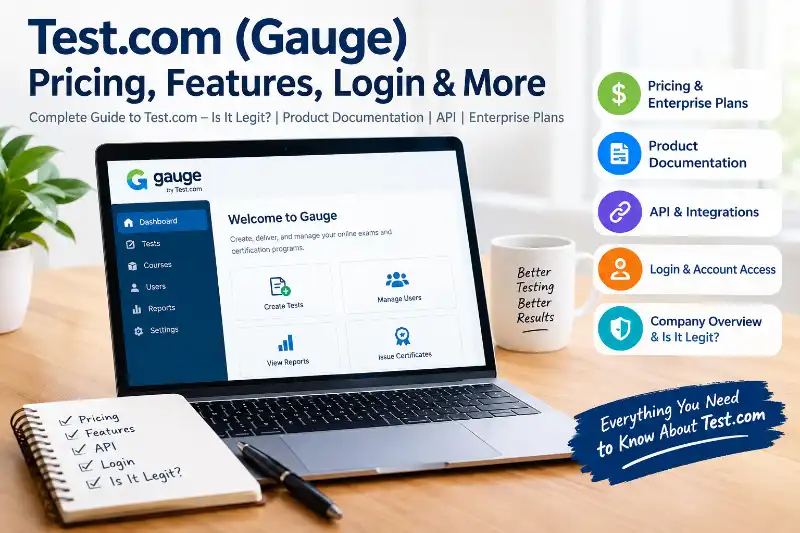
A long list of features does not tell you much unless you know how those features solve a real problem. The useful question is whether the platform gives you the controls needed to run your particular exams.
Exam Creation, Question Banks, and Assessment Settings
Gauge provides tools for creating online exams and adjusting how they work. Its official testing page lists question types such as multiple choice, matching, sorting, true or false, text answers, and Likert-scale questions.
It also describes bulk question uploads and settings for time limits, passing scores, question randomization, and the number of attempts allowed.
These options can save time when an organization runs similar assessments repeatedly. Instead of rebuilding every exam from scratch, administrators may be able to reuse existing questions and adjust the settings for each assessment.
Question banks are especially useful when you need to create different versions of an exam. For instance, an organization might maintain a pool of questions about workplace safety and draw a selection for each candidate. Randomization can make it harder for every candidate to receive the exact same question order.
However, random questions alone do not guarantee a fair or secure exam. The quality of the questions, scoring rules, exam settings, and identity checks can all affect the results.
Before choosing a plan, verify which settings are available for your intended exam type and whether any advanced options require an additional module.
Courses, Certificates, and Candidate Management
Running an exam is only one part of a testing program. Organizations may also need to manage participants, assign learning materials, track progress, and keep records after an assessment is complete.
Gauge’s product tour describes tools for courses and programs, user management, messaging, reporting, and certification-related workflows. The exact setup will depend on the features enabled for an organization.
Think about a training provider that offers several courses. It may need to assign the right assessment to each participant, track completion, and keep the results organized. A connected workflow can reduce the need to move information manually between separate systems.
There is one distinction worth keeping in mind: a certificate issued through software is not automatically the same as an independently recognized professional qualification. Recognition depends on the organization issuing the credential and the relevant industry or professional requirements.
If you need a recognized certification program, ask the organization responsible for the credential how its exams and certificates are accepted. Do not assume that using a particular testing platform guarantees accreditation.
Reporting, Proctoring, and Exam Security
Exam results are more useful when administrators can review them and understand what happened during a testing session. Reporting tools can help an organization monitor results, review candidate progress, and manage its assessment program.
For exams where integrity matters, administrators may also need controls over attempts, question selection, timing, and remote or in-person supervision.
Gauge’s official product tour describes virtual proctoring integrations, including ProctorU and ProctorFree. Its current availability and compatibility should be confirmed directly with the company before you build a testing process around them. Explore the official product tour.
It is also important to separate three different concerns:
- Exam integrity: Controls intended to reduce cheating or unauthorized access to exam content.
- Account security: Measures used to control who can sign in and access information.
- Data privacy: Rules governing how personal information is collected, stored, used, and shared.
A platform may offer useful exam controls without automatically meeting every organization’s privacy or regulatory requirements. If you handle sensitive candidate information or administer high-stakes exams, review the relevant policies, available security controls, and contractual terms before committing.
The practical takeaway is simple: match the platform’s documented controls to the risks of your exam program. Do not rely on a general claim that an online testing platform is “secure” without checking what that means for your particular use case.
How Much Does Test.com Cost? Pricing and Enterprise Plans
If you searched for test.com pricing enterprise plans, you probably want to know whether the platform fits your budget before contacting the company. The official pricing page for Gauge, the platform associated with Test.com, lists starting prices for two main plans.
Professional vs. Enterprise Pricing
Gauge lists the following starting prices on its official pricing page:
| Plan | Published starting price | Best suited for |
|---|---|---|
| Professional | $750 per year | Smaller or growing testing and certification programs |
| Enterprise | $10,000 per year | Larger programs that need more advanced features and integrations |
The Professional plan also lists a $250 hosting fee and a one-time $500 setup fee. Enterprise lists a $1,000 hosting fee and a one-time $2,000 setup fee.
These are starting prices, not a promise that every customer will pay only that amount. The final cost can depend on annual exam volume, selected modules, and the services your organization needs. Some features, such as certification and badging, may carry separate costs.
Gauge says its Enterprise plan is intended for organizations running more than 10,000 tests per year. Its published Enterprise pricing describes volume-based rates starting at $3 per test, with lower rates at higher volumes.
Honestly, don’t compare plans by the yearly price alone. Ask for a written quote that shows the setup fee, hosting fee, expected exam charges, optional features, and renewal costs.
What Should You Check Before Buying?
Before choosing a plan, ask the sales team these questions:
- Does the quoted price cover the number of exams we expect to run?
- Are certification badges and proctoring included, or billed separately?
- Does the plan include API access and webhooks?
- Are there extra charges for data migration, training, or custom development?
- What happens if our exam volume grows during the year?
- Can we export our test questions, candidate records, and results if we leave?
The answers will help you work out the likely total cost instead of relying on the advertised starting price.
You can compare the options directly on the Gauge pricing page.
Does Test.com Offer Product Documentation and API Features?
If you’re researching test.com product documentation features, you may need to know whether the platform can handle your exams and connect with your current systems. Gauge provides an online Knowledge Center with instructions for administrators and users.
Where Can You Find Test.com Company Documentation?
The Gauge Knowledge Center is the main place to start. It includes guidance on creating tests, managing users, setting up courses, changing settings, and reviewing results.
The documentation also covers features such as:
- Creating tests and reusable question banks
- Managing lessons, programs, and courses
- Setting up user groups and access rules
- Managing certificates and reports
- Configuring security and customization options
- Working with API settings and integrations
For example, if your team needs to reuse questions across several exams, the official exam documentation explains the different test types, including tests built with question banks.
This is useful when you’re checking test.com company documentation before making a purchase. You can review the help material and see whether the available tools match your team’s needs.
Keep in mind that some documentation describes settings available to administrators. You may need a trial account or an existing customer account to test those options yourself.
Does Test.com Have an API?
Yes. Gauge’s official Enterprise page describes a full REST API, webhooks, and single sign-on (SSO) support.
These features can help organizations connect their testing platform with other software.
For example, a training company might want exam results to appear in its learning management system. An organization might also need candidate records to sync with a customer relationship management system. API access and webhooks may help support these workflows, depending on the setup.
Before choosing a plan, confirm the details with Gauge’s technical team:
- Which API endpoints are available?
- Is API access included in the proposed plan?
- Are there rate limits or other usage restrictions?
- How does authentication work?
- Can webhooks send the exact events your system needs?
- Is there a developer reference or test environment?
- What support is available during integration?
The phrase test.com API can also refer to unrelated testing tools or websites. If you mean the company behind Gauge, use the official Gauge website and Knowledge Center rather than assuming every search result for that phrase belongs to the same service.
What Can You Learn From the Test.com Product Tour?
The official Gauge product tour gives visitors an overview of the platform’s testing and certification tools.
It covers exam question types, configurable exam settings, course and program features, and options for managing online assessments. The tour also describes integrations and tools for organizations with more advanced testing needs.
Use the tour to make a short checklist of the features your organization requires. Then compare that list with the documentation and ask for a demonstration of anything that remains unclear.
A product tour can show what a platform offers, but it does not prove that every feature is included in every plan. Confirm availability and pricing before signing an agreement.
How Do You Find the Official Test.com Login?
If you searched for test.com login, test com login, or www test com, first make sure you’re looking for the right service.
Gauge is the online testing and certification platform associated with Test.com, Inc. Its official website includes a Log In option. Start at Gauge Online and use the login link provided on that site.
If you’re already a customer, your organization may use a customized account website. In that case, check your welcome email or ask your administrator for the correct sign-in address.
If you can’t log in, try these steps:
- Check that you’re using the correct account website.
- Confirm that your email address is the one registered with the organization.
- Use the password-reset option if one is available on your sign-in page.
- Contact your organization’s administrator if your account is locked or has not been activated.
- If you’re a platform administrator, consult the Gauge Knowledge Center or contact official support.
Don’t enter your password on a website just because its address contains the words “test” or “test.com.” Check the domain and make sure the page belongs to the service you intend to use.
What Is Test.com Company Overview Information Available?
If you’re searching for a test.com company overview, you may want to know whether the business has an identifiable website, what it offers, and how the name Gauge fits in.
Is Test.com the Same Company as Gauge?
Gauge’s official website identifies the platform as Gauge by Test.com and displays a copyright notice for Test.com, Inc. Its About page describes Gauge as an online test delivery and certification management platform.
The practical distinction is simple: Test.com, Inc. is the company name shown on the website, while Gauge is the product and brand presented to customers.
That helps explain why searches for “test.com company overview,” “test brand test.com,” and “test.com product tour” may lead to Gauge’s official pages.
Who Owns Test.com, and Who Is the Current CEO or President?
The available official pages connect Gauge with Test.com, Inc., but that alone does not answer every question about the company’s current ownership, shareholders, or executive leadership.
If you need to confirm who owns Test.com or identify its current CEO or president, look for recent official company announcements or ask the company directly. Check the date and context of any leadership information you find. A name on an old document may no longer reflect the current management team.
For business, procurement, or legal decisions, request the company’s current legal entity name, business address, contract details, and the name of the authorized representative who will sign the agreement.
Is Test.com Legit?
If you’re asking “is test.com legit?”, the sensible approach is to check what the available evidence actually shows rather than relying on a single review or search result.
The official Gauge website identifies Test.com, Inc. and describes a specific business product for online testing and certification. It also publishes product information, pricing, and support documentation. These are useful signs of an identifiable service, but they are not a complete guarantee of security, reliability, or suitability for every buyer.
Here are practical checks you can make before sharing information or paying for a plan.
Check the Website and Company Details
- Start from the official Gauge website.
- Review the About page and pricing page.
- Read the terms and privacy information that applies to your proposed account.
- Confirm the legal entity named in the contract and invoice.
- Ask for written details about data storage, access controls, and account cancellation.
One detail worth checking is the age of any legal document you find. For example, the Terms of Service page has shown an older modification date. Don’t assume an old document answers every question about the company’s current policies. Ask which terms apply to a new account.
Is Test.com a Typing Test or Internet Speed Test Website?
Not in the context discussed in this article. Here, Test.com refers to the company associated with Gauge, an online testing and certification platform for organizations.
Searches such as typing test.com, speed test.com, DMV practice test.com, and DNA test com may point to different services. A shared word or similar search phrase does not mean those websites are operated by Test.com, Inc.
Before following a result, check its full web address and the service it actually offers. This small step can save you from reading information about the wrong website.
What Should You Verify Before Using the Platform?
If your organization plans to run important exams through Gauge, review more than the public website. Ask for a product demonstration, test the features in a trial account, and confirm the security and privacy terms with the company.
For high-stakes exams, also check the available proctoring options, audit records, reporting features, and access controls. The right choice depends on your own requirements.
A website can be a real business and still be the wrong product for your needs. Check the features, costs, contract, and support arrangements before making a decision.
Frequently Asked Questions About Test.com
What is Test.com?
Test.com, Inc. is associated with Gauge, a platform for delivering online exams and managing testing and certification programs. It is designed for organizations that need more than a simple public quiz.
What are the key features of Gauge by Test.com?
Gauge’s documented features include online test creation, question banks, configurable exam settings, lessons, courses, user management, reporting, certification tools, and integration options. The features available to you may depend on your plan.
How much do Test.com enterprise plans cost?
Gauge publishes an Enterprise starting price of $10,000 per year, plus a $1,000 hosting fee and a one-time $2,000 setup fee. The final price can vary by exam volume and selected features, so request a written quote.
Does Test.com have API access?
Gauge’s official Enterprise page describes REST API and webhook support, along with SSO. Confirm the exact access, technical requirements, and costs for your intended integration before signing up.
Where can I find Test.com product documentation?
Start with the Gauge Knowledge Center. It includes guides for exams, question banks, courses, user management, settings, and other platform features.
Who owns Test.com?
Gauge’s official website identifies Test.com, Inc. as the company associated with the platform. For current ownership details or the name of the current CEO or president, use recent official company information or contact the company directly.
Is Test.com legit?
The official Gauge website, product pages, pricing information, and support center provide evidence of an identifiable testing and certification service. Still, review current legal terms, privacy practices, pricing, and security requirements before committing to a plan.
Final Thoughts
If you arrived here looking for test.com pricing enterprise plans, API information, product documentation, or a company overview, the main point is to identify the service first. Test.com, Inc. is associated with Gauge, a platform for online exams and certification programs.
Review the official pricing page, explore the Knowledge Center, and request a demonstration if you’re considering it for your organization. Check the final costs and technical details in writing before you buy.
That way, you’ll be making a decision based on the actual product and your needs—not on search results that happen to use similar words.