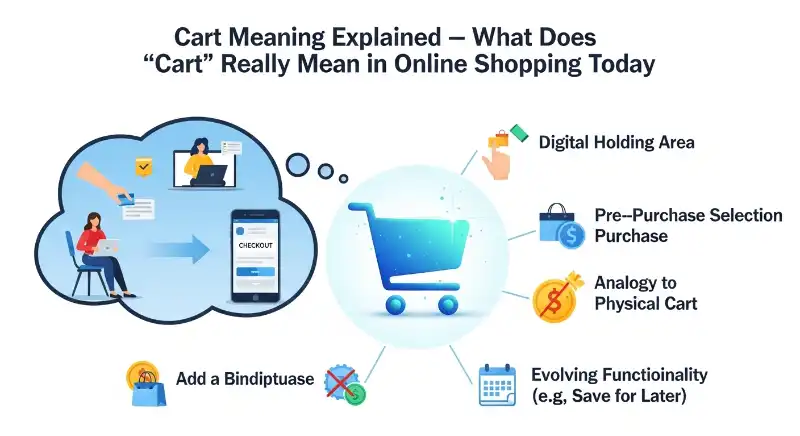
Cart meaning is one of those simple terms that quietly controls your entire online shopping experience.
You’ve seen it hundreds of times — that little icon in the corner of a website. You click “Add to Cart,” maybe plan to buy later… and sometimes never return. But what exactly does it mean, and why does it matter so much?
Here’s the quick truth: a cart is not just a place to store items — it’s where decisions happen. It’s the moment between “I like this” and “I’m buying this.”
⭐ Quick Answer
Cart meaning refers to a temporary digital space where users store selected products before purchasing them online.
👉 Example: You add shoes to your cart but wait before checking out.
Think of it like a real shopping trolley — you collect items first, then decide what to buy.
What Does Cart Mean in Online Shopping
When you shop online, the cart is your decision zone. It sits right between browsing and buying — a small step, but a powerful one.
Cart Meaning in Shopping
In simple words, the cart is where your chosen items go before payment.
Imagine walking into a store. You pick up a shirt, then shoes, then maybe a watch. You don’t pay immediately — you hold everything together until you’re ready.
Online, the cart does exactly that.
It lets you:
- Collect multiple items
- Compare options
- Think before committing
This is why the shopping cart meaning is deeply tied to freedom. It gives users space to decide without pressure.
Add to Cart Meaning
“Add to cart” is a small button — but psychologically, it’s a big step.
It means:
👉 “I’m interested, but I’m not fully committed yet.”
This is important because it signals intent. Businesses track this action closely because it shows a user is considering a purchase.
But here’s the emotional layer:
- Clicking “Buy Now” = certainty
- Clicking “Add to Cart” = curiosity + hesitation
And that hesitation is where most decisions are made.
Example of Add to Cart in Online Store
Let’s make this real:
You’re browsing for headphones.
- You find one you like
- You click “Add to Cart”
- It appears in your cart
- You keep browsing or leave
Now two paths exist:
- You come back and buy
- Or you forget — and the cart sits there
This simple action creates millions of incomplete journeys every day.
📚 Related Articles….Temu Meaning (2026 Update): Is Temu Legit, What It Really Means
Shopping Cart Meaning in eCommerce Websites
Behind the scenes, the cart is not just a feature — it’s a system.
It connects product selection with payment, acting as the bridge between interest and action.
How Shopping Cart Works Online
Here’s the typical flow:
- You select a product
- You add it to cart
- The system stores it temporarily
- You review your items
- You proceed to checkout
But modern carts do much more:
- Calculate total cost instantly
- Add taxes and shipping
- Apply discount codes
- Suggest related products
In 2026, many carts even use AI to:
- Recommend items based on your behavior
- Predict what you might buy next
- Optimize your purchase journey
So when people ask “what is cart in e commerce website”, the real answer is:
👉 It’s both a storage space and a smart decision assistant.
Cart Meaning in Website Experience
From a user experience (UX) perspective, the cart is where clarity matters most.
A good cart:
- Shows prices clearly
- Updates instantly
- Feels simple and fast
A bad cart:
- Confuses users
- Hides costs
- Creates friction
And here’s the truth:
Most users don’t leave because they don’t want the product…
They leave because the cart experience feels uncomfortable.
Cart Abandonment Meaning in Digital Marketing
Now we reach one of the most important ideas: cart abandonment meaning.
This is where business, psychology, and user behavior collide.
Cart Meaning in Digital Marketing
In marketing, the cart is not just a feature — it’s a signal.
It tells businesses:
👉 “This person is close to buying.”
But when users leave without completing the purchase, it creates a gap — and that gap is called cart abandonment.
Why Users Abandon Cart
Let’s be honest. You’ve probably done this too.
You added something… then left.
Why?
Common reasons include:
- Unexpected shipping costs
- Complicated checkout process
- Forced account creation
- Payment trust issues
- Just “not ready yet”
But there’s also an emotional reason:
👉 Doubt creeps in at the cart stage.
The excitement of finding a product turns into questions:
- “Do I really need this?”
- “Is this the best price?”
- “Should I wait?”
📊 Funnel Insight Table
| Stage | User Action | Risk | Fix |
|---|---|---|---|
| Add to Cart | Shows interest | Distraction | Reminders, saved carts |
| Cart Review | Checks total price | Price shock | Transparent pricing |
| Checkout | Enters payment details | Trust hesitation | Secure payment signals |
This table shows something powerful:
👉 The cart is not where buying starts — it’s where buying can fail.
Cart vs Basket Meaning Difference (Comparison Guide)
This is a common confusion, especially for beginners.
Let’s simplify it clearly.
Cart vs Basket Meaning
Both terms mean the same thing — a place to hold items before purchase.
The difference is mostly regional:
- “Cart” → Common in the US
- “Basket” → Common in the UK
So whether a website says “Add to Cart” or “Add to Basket,” the function is identical.
Difference Between Cart and Checkout
This is where confusion really matters.
| Feature | Cart | Checkout |
|---|---|---|
| Purpose | Store selected items | Complete the purchase |
| Action | Review and modify items | Enter payment & shipping info |
| Stage | Before buying | Final step |
Think of it like this:
- Cart = “I’m thinking about buying”
- Checkout = “I’m ready to pay”
Understanding this difference helps users avoid mistakes — and helps businesses design better experiences.
Cart Meaning in Retail and Real-Life Usage
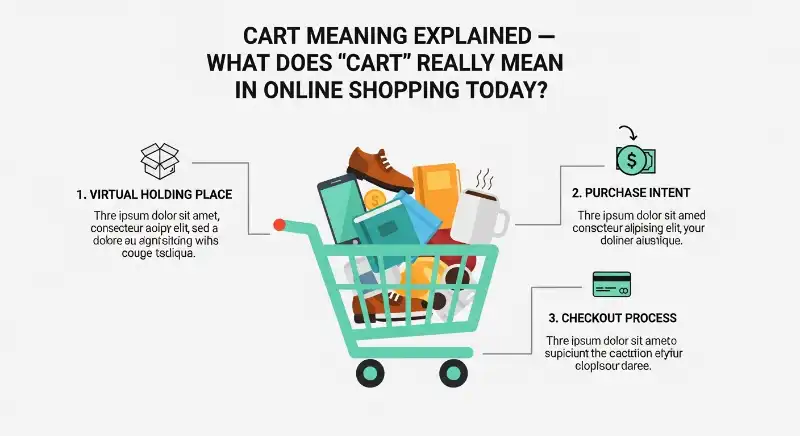
Before the internet, the word “cart” already existed — and its meaning was very physical.
Cart Meaning in Retail
In traditional retail, a cart is:
- A wheeled trolley in a supermarket
- A container to carry items while shopping
It made shopping easier because people could carry more without effort.
That same idea was copied into digital shopping.
👉 This is called a familiar metaphor — using real-life concepts to simplify digital experiences.
Cart Meaning in Real Life
Outside shopping, “cart” can also mean:
- A pushcart used by street vendors
- A vehicle used to transport goods
- A simple container for carrying items
So the core meaning stays the same everywhere:
👉 A cart is something that helps you collect and carry things before using them.
Real Chat Scenario — How People Actually Use “Cart”
Let’s bring this into a real conversation.
1 Person A:
“Did you buy the jacket?”
2 Person B:
“No, I just added it to my cart.”
1 Person A:
“So you’re not buying it?”
2 Person B:
“I might… just thinking about it.”
This small exchange reveals everything:
👉 The cart is not about buying — it’s about deciding.
Emotional Meaning Behind “Cart” (Hidden Psychology)
Most articles stop at definition — but here’s the deeper truth.
The cart represents a pause moment.
It’s where:
- Desire meets doubt
- Logic challenges emotion
- Impulse slows down
That’s why so many purchases never happen.
And that’s also why businesses spend millions improving this one step.
2026 Trend — How Cart Meaning Is Evolving
The concept of a cart is changing fast.
In 2026, we’re seeing:
- AI-powered carts that auto-suggest items
- One-click carts that skip traditional steps
- Voice shopping carts (“Add this to my cart”)
- Cross-device carts that sync across phone and laptop
In the future, the cart may become invisible.
You won’t “go to cart” — the system will quietly prepare your purchase for you.
But the meaning will stay the same:
👉 A space between intention and action.
Why Is It Called a Shopping Cart (Origin of Cart Meaning)
Ever wondered why we use the word “cart” instead of something more digital like “list” or “selection”?
The answer goes back to real-world shopping history.
Why Is It Called Shopping Cart
In the 1930s, supermarkets introduced wheeled carts so customers could carry more items easily. Before that, people used small baskets — which limited how much they could buy.
The cart changed behavior instantly:
- People bought more
- They stayed longer in stores
- Shopping became more comfortable
When online shopping was created decades later, designers reused this idea.
👉 Instead of teaching users something new, they borrowed something familiar.
That’s why today, when you see a cart icon, your brain already understands what to do — even if you’ve never used that website before.
Cart Definition History
Originally, a “cart” meant a simple vehicle used to carry goods.
Over time, the meaning evolved:
- Physical transport → store trolley → digital container
This shift is a perfect example of how language adapts with technology.
And in UX design, this is powerful.
👉 Familiar words reduce confusion and increase action.
Modern Trend — Cart Meaning in AI Commerce and Mobile Shopping (2026)
The cart is no longer just a static feature. In 2026, it’s becoming intelligent.
Cart Meaning in Business Apps
In modern business and eCommerce platforms, carts now act like smart assistants.
They can:
- Predict what users might buy
- Auto-fill items based on browsing behavior
- Suggest bundles (“People also added…”)
- Save items across devices
For businesses, this means:
👉 The cart is no longer passive — it actively drives revenue.
Mobile Cart UX Trends
Most shopping now happens on mobile, and that has changed how carts work.
New trends include:
- Sticky cart icons (always visible)
- Slide-in mini carts (no page reload)
- One-tap checkout options
- Auto-applied discounts
But here’s the deeper shift:
👉 Speed is everything.
If a cart takes too long to load or feels complicated, users leave instantly.
In 2026, the best carts feel almost invisible — smooth, fast, and effortless.
Common Mistakes About Cart Meaning
Even though the concept is simple, many users misunderstand how carts actually work.
Let’s clear that up.
❌ Thinking Cart = Purchase
Adding something to your cart does not mean you bought it.
It only means you’re considering it.
This misunderstanding often leads to confusion like:
- “Why wasn’t my order confirmed?”
- “I thought I already bought it!”
❌ Assuming Items Stay Forever
Many people believe items will stay in the cart forever.
But in reality:
- Some carts expire
- Items can go out of stock
- Prices may change
That’s why carts are temporary — not permanent storage.
❌ Confusing Wishlist vs Cart
This is a big one.
- Cart = items you may buy soon
- Wishlist = items you like but aren’t ready to buy
Mixing these up leads to messy shopping experiences.
❌ Ignoring Price Changes
Sometimes users add items and return later, expecting the same price.
But carts update dynamically.
👉 Always check the total before checkout.
Real Examples of Cart Meaning in Popular Online Stores
Let’s connect everything with real-world situations.
Example 1 — Add to Cart Flow
You visit an online store looking for sneakers.
- You choose your size
- Click “Add to Cart”
- The cart updates instantly
- You continue browsing
This shows how the cart supports multi-item decisions.
Example 2 — Cart Abandonment Recovery
You add a smartwatch but leave without buying.
Later, you receive an email:
👉 “You left something in your cart.”
Sometimes it even includes a discount.
This is a powerful marketing strategy to recover lost sales.
Example 3 — Limited Stock Pressure
You open your cart and see:
👉 “Only 2 items left — checkout now”
This creates urgency.
It pushes you from thinking to acting.
Cart Meaning in Spanish and Hindi
Many users search for meanings in different languages, especially in global markets.
Cart Meaning in Spanish
In Spanish, cart is called:
👉 “Carrito de compras”
It directly translates to “shopping cart” — used in websites and apps across Spanish-speaking regions.
Cart Meaning in Hindi
In Hindi, it’s often referred to as:
👉 “खरीदारी कार्ट”
This means a digital place where selected items are stored before purchase.
Even across languages, the concept stays the same — only the words change.
FAQ — Cart Meaning Questions Users Ask
What is cart in eCommerce website
A cart in an eCommerce website is a temporary space where selected items are stored before checkout. It helps users review products, update quantities, and see the total cost before paying.
Why do online stores use cart
Online stores use carts to make shopping flexible and organized. It allows users to collect multiple items, compare options, and finalize decisions before making a purchase.
Is cart same as checkout
No, they are different stages. The cart is where items are stored and reviewed, while checkout is where payment and shipping details are entered to complete the order.
What happens after add to cart
After adding items, users can continue shopping or move to checkout. The cart calculates totals, applies discounts, and prepares the order for final purchase.
Can items disappear from cart
Yes, items can disappear due to stock changes, session expiry, or manual removal. Some websites also clear carts after a certain time for security reasons.
Final Thoughts The Real Meaning Behind “Cart”
At first glance, the cart seems like a simple feature.
But when you look closer, it’s much more.
It’s a space where:
- Decisions are shaped
- Doubts appear
- Intent turns into action (or disappears)
In both real life and digital shopping, the cart represents one powerful idea:
👉 You’re not just collecting products — you’re deciding your next move.
And as technology evolves, the cart will become smarter, faster, and more invisible.
But its core meaning will always remain the same:
A bridge between wanting something… and actually getting it.
📚 Related Articles
Spotify Explained: Why Millions Use Spotify Every Day in 2026

Mush explores trending words, viral slang, and social media phrases, explaining them in simple English with fun examples for everyone.