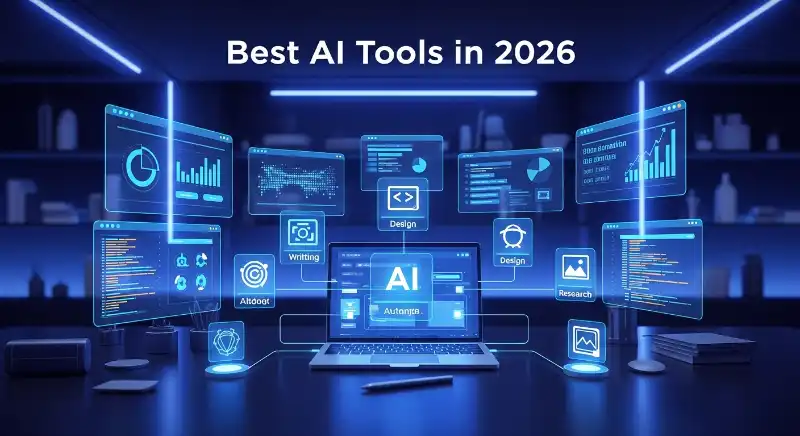
If you’ve ever opened a laptop with ten tabs, five deadlines, and zero mental energy left, you already understand why artificial intelligence has exploded. From students researching assignments to entrepreneurs automating marketing campaigns, AI tools are quietly becoming the invisible engine behind modern productivity.
But there’s a problem: the internet is flooded with hundreds of AI platforms. New tools launch every week, directories list thousands of options, and many guides overwhelm readers with massive lists.
This article takes a different approach. Instead of drowning you in endless recommendations, we’ll provide a categorized, compared, and expertly curated list of the best AI tools in 2026. Think of it as a practical roadmap to the modern AI toolkit.
What Are the Best AI Tools Right Now? (2026 Quick Overview)
The best AI tools in 2026 aren’t just the flashiest—they are the ones that seamlessly integrate into daily workflows, save time, and deliver consistent, high-quality results.
Top 5 Overall Best AI Tools This Year (Curated List)
Based on strict evaluation criteria, these five tools stand out as the absolute best across all categories:
- ChatGPT (OpenAI): Best overall AI assistant for research, brainstorming, and everyday tasks.
- Jasper AI: Best dedicated writing tool for marketers and content creators.
- Midjourney: Best AI image generation for high-quality, artistic visuals.
- GitHub Copilot: Best AI coding assistant for developers looking to speed up programming.
- Zapier AI: Best automation platform to connect apps and eliminate repetitive work.
How We Selected These AI Tools (Strict Evaluation Criteria)
To ensure this list is trustworthy and actionable (EEAT), we evaluated every tool based on four core criteria:
- Ease of Use: Can a complete beginner start using it within 10 minutes?
- Accuracy & Quality: Does it produce reliable, usable output without constant manual corrections?
- Pricing & Value: Is the free version useful? If paid, is the price justified by the time saved?
- Integration & Ecosystem: Does it easily connect with other popular software (e.g., Google Workspace, Slack, VS Code)?
Best AI Tools by Category (Work, Creativity, Coding & More)
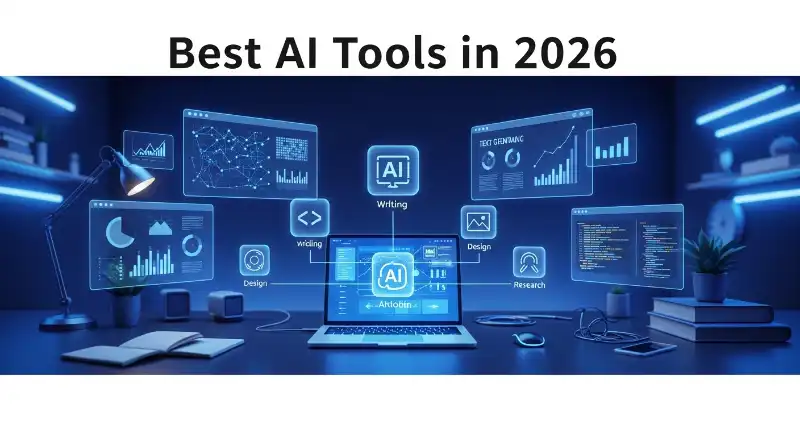
Instead of a random list, the smartest way to explore AI is by category. Here are the top picks tailored to your specific field.
Best AI Assistants and Chatbots (ChatGPT, Claude, Perplexity)
AI assistants are the most versatile type of AI tool. They handle research, writing drafts, summarizing documents, and answering complex questions.
- ChatGPT: The industry leader, ideal for general use, brainstorming, and text generation.
- Claude (Anthropic): Exceptional for long-form content, analyzing large documents, and writing with a natural, conversational tone.
- Perplexity AI: The best for real-time research and citations because it provides sources for every fact it states.
Best AI Writing and Content Generation Tools (Jasper, Copy.ai)
If you need to produce blogs, emails, ad copy, or social media posts, these are your go-to tools.
- Jasper AI: The premium choice for businesses. It offers brand voice customization and built-in SEO tools.
- Copy.ai: An excellent affordable alternative, perfect for generating marketing copy quickly.
- Writesonic: Great for long-form blog generation and integrated with SurferSEO for content optimization.
Best AI Image and Design Tools (Midjourney, DALL-E 3, Canva)
Visual creativity has been revolutionized by generative AI.
- Midjourney: The gold standard for artistic, high-quality, stylized images. Used heavily by designers and artists.
- DALL-E 3: Fully integrated with ChatGPT, making it the easiest tool for generating images directly from conversational prompts.
- Canva AI: Best for non-designers. It offers AI templates, background removal, and magic editing with zero learning curve.
Best AI Coding and Developer Tools (GitHub Copilot, Tabnine)
These tools act as a pair programmer, suggesting code completions, debugging errors, and generating entire functions.
- GitHub Copilot: The undisputed leader, powered by OpenAI Codex. Supports almost every programming language.
- Tabnine: A privacy-focused alternative that works completely offline, ideal for enterprises with strict data security.
- Codeium: A rising, completely free alternative that gives Copilot a run for its money.
Best AI Automation and Productivity Tools (Zapier, Make)
Automation tools allow you to connect different apps and automate repetitive workflows without coding.
- Zapier AI: The most popular automation tool, featuring a new AI engine that can build workflows automatically from natural language prompts.
- Make (formerly Integromat): Offers more complex, visual workflows for tech-savvy users.
Best Free AI Tools That Actually Work in 2026
One of the biggest questions users have is: “Is there a good free version?” (GSC data shows high intent for best free ai tools). Yes, many top-tier tools offer generous free plans that are genuinely useful.
Top Free AI Assistants
- ChatGPT (Free): Offers GPT-3.5/4o-mini access. Great for daily queries and writing drafts.
- Google Gemini (Free): Excellent for quick research and integrating with Google apps.
- Claude (Free): Limited to a certain number of messages per day but provides high-quality, nuanced responses.
Top Free AI Image and Writing Generators
- Canva AI (Free Credits): Provides 50 free uses of its AI image and editing tools per month.
- Copy.ai (Free Plan): Offers a generous 2,000-word monthly limit for free.
- Leonardo.AI: One of the best free alternatives to Midjourney, giving users 150 free credits daily.
Best AI Tools Compared: Side-by-Side Review
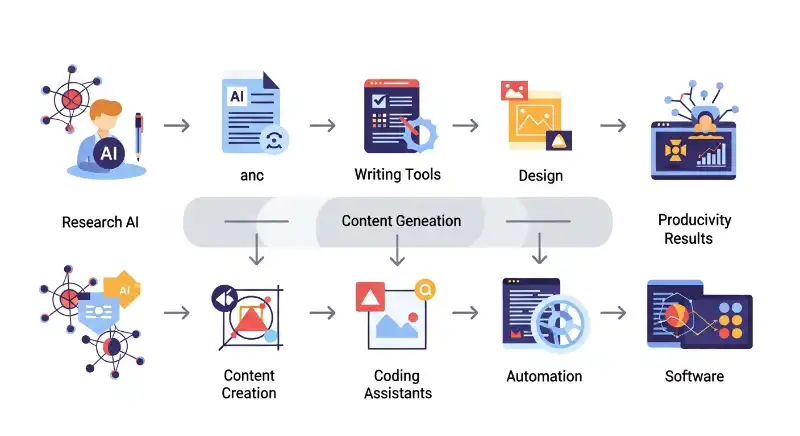
To make your decision easier, here are direct, detailed comparisons of the most hotly debated AI platforms.
ChatGPT vs. Claude vs. Gemini (Which Assistant Wins?)
- ChatGPT: Wins on versatility. It has the largest plug-in ecosystem and supports image generation (DALL-E 3).
- Claude: Wins on Context Window (can process an entire novel) and human-like writing quality. Best for analyzing PDFs.
- Gemini: Wins on Integration with Google Docs, Gmail, and Drive, making it perfect if you live in the Google ecosystem.
Jasper vs. Copy.ai vs. Writesonic (Best for Writers)
- Jasper: Best for Teams and Brands. It features “Campaigns” where you can maintain consistent brand voice across long-form and short-form copy. (Higher price point).
- Copy.ai: Best for Startups and Solopreneurs. The fastest tool for generating ad copy and social media hooks.
- Writesonic: Best for SEO Bloggers. Its integration with SEMrush and SurferSEO allows you to write content that ranks.
Midjourney vs. DALL-E 3 (Which Image Generator is Better?)
- Midjourney: Use this for Marketing Assets and Artwork. It excels at cinematic lighting, abstract art, and stylized renders.
- DALL-E 3: Use this for Practical Illustrations. It is far better at rendering text in images and realistic images of specific objects (like a “red teacup on a wooden table”).
How to Choose the Best AI Tool for Your Specific Needs
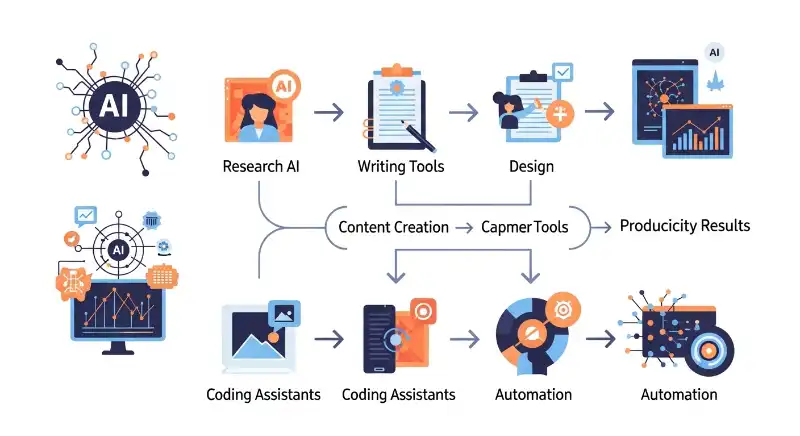
Stop searching for “the best”. Start asking “the best for my job“. Here’s a simple decision matrix.
For Students and Researchers
Recommendation: Start with Perplexity AI (for citations) and ChatGPT Free (for brainstorming).
Why: You need sources and quick answers. Avoid expensive paid tools; the free versions are already powerful enough for academic work.
For Business Owners and Marketers
Recommendation: Build a stack of Jasper AI (content) + Canva AI (design) + Zapier (automation).
Why: You need to produce consistent, on-brand marketing material, manage social media, and automate lead capture. These tools save you the cost of hiring a full-time assistant.
For Developers and Coders
Recommendation: GitHub Copilot or Codeium is non-negotiable.
Why: These tools reduce the time spent on boilerplate code by up to 50%, allowing you to focus on complex architecture.
Latest AI Tool Trends to Watch in 2026 (New Updates)
The AI landscape changes rapidly. Here is what is trending specifically in 2026.
AI Agents vs. Copilots (What’s the Difference?)
- Copilots: Assist you while you work (e.g., writing an email while you type).
- AI Agents: Act independently (e.g., “Book a flight for me and send an agenda to my team”). This is the biggest shift in 2026. Tools like Zapier Central and OpenAI’s o1 models are leading this charge.
Multimodal AI (Text, Image, and Video Combined)
Tools are no longer siloed. The best AI in 2026 can understand text, images, and video simultaneously. Google Gemini and ChatGPT-4o are prime examples. They are increasingly being used for analyzing charts, PDFs, and video transcripts in one single interface.
Frequently Asked Questions About the Best AI Tools
Which AI tool is best for beginners?
ChatGPT is unequivocally the best for beginners. Its conversational interface is intuitive, the free version is robust, and there are thousands of free tutorials online to guide you through any task.
Are AI tools safe and private to use?
This depends on the tool. Most reputable tools (like ChatGPT Enterprise and Microsoft Copilot) have strict privacy policies. Always check the privacy policy before pasting sensitive or proprietary business data into a free public chatbot. For enterprises, services like Azure OpenAI provide data isolation.
Will AI tools replace human jobs?
No. AI tools are designed to augment human capability, not replace it. They automate repetitive, data-heavy, and creative grunt work. The jobs that thrive will belong to those who can leverage AI effectively to increase their output and quality.
Final Verdict: The Best AI Tools You Should Try Today
AI tools aren’t just for tech enthusiasts anymore. They are fundamental to modern productivity.
My Top Picks Summary Table (Quick Decision Matrix)
| Your Goal | Best Tool | Why It’s Best |
|---|---|---|
| Best All-Rounder | ChatGPT | Free, powerful, and supports text + image generation. |
| Best for Writing | Jasper AI | Unmatched marketing workflows and brand consistency. |
| Best for Images | Midjourney | Highest quality artistic generation. |
| Best for Coding | GitHub Copilot | Saves developers hours of debugging. |
| Best Automation | Zapier | Connects 1,000s of apps without coding. |
The Bottom Line
The smartest users don’t use the most tools—they use the right tools efficiently. Instead of chasing every new platform, focus on building a small AI toolkit that supports your specific goals.
Start with ChatGPT to understand AI’s capability, then layer in specialized tools like Canva (for visuals) or Jasper (for writing) as needed. Because the future of work won’t be humans competing with AI—it will be humans working with AI smarter than ever before.
📚 Related Articles
How Perplexity AI Works (Step-by-Step)