If you have come across Yonopress.com, you may be wondering what this website actually does. Is it a news website, a blog, or a place to find information on different topics? You may also want to know whether its articles are reliable before using them for research.
Yonopress.com presents itself as a multi-topic digital publication. It covers different subjects, so the type of information you find may depend on the article you open. Still, knowing what a website publishes does not tell you everything about its accuracy or the people behind it.
In this article, we will look at what Yonopress.com offers, what you can verify about its publisher, and how to check the information it shares. We will also explain what to look for if you are unsure whether a website is trustworthy.
Quick Answer: What Is Yonopress.com?
Yonopress.com is a multi-topic digital publication that shares articles on subjects such as technology, education, business, health, finance, and lifestyle. It can serve as a starting point for general information, but readers should check the author, publication date, and supporting sources before relying on important claims. Its overall credibility should be judged using available evidence.
What Is Yonopress.com?
When you visit an unfamiliar website, the first thing you need to know is its main purpose. A domain name does not always tell you whether a site publishes news, offers a service, or shares general information.
Yonopress.com presents itself as an online publication. Its website contains articles across several subject areas rather than focusing on just one topic.
This means you may find different kinds of information on the same website. One page might explain a technology topic, while another discusses business, education, or health.
The best way to understand the site is to look at its homepage, category pages, and About Us page. These can help you see how the website describes itself and what it publishes.
However, keep one thing in mind: a website’s own description tells you how it presents its purpose. It does not automatically prove that every article is accurate or that every claim has been independently checked.
What Does Yonopress Publish?
If you are trying to decide whether Yonopress.com is useful for your needs, its content is a good place to start. The website covers several subjects, which means you should look at the individual article rather than judge the entire site by one page.
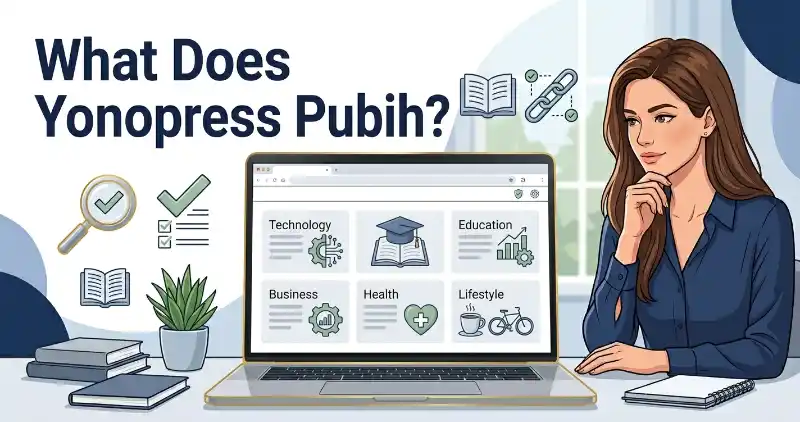
Its visible content includes topics such as:
- Technology: Articles about digital tools, technology trends, and related subjects.
- Education: Information connected to learning and educational topics.
- Business and finance: General information about business, money, and financial subjects.
- Health: Articles discussing health-related topics.
- Lifestyle: Content related to everyday interests and other general subjects.
These categories give readers an idea of the site’s range. They do not prove that every category receives the same level of editorial review.
For example, you might use a general technology article to learn about a topic before doing further research. A health or investment article needs more careful checking because inaccurate information could affect an important decision.
Is Yonopress a News Website, a Blog, or an Information Platform?
These terms can sound similar, but they describe different types of content.
A news website mainly reports current events and developments. A blog may share opinions, personal experiences, or subject-focused articles. An information platform can publish explainers, how-to articles, and general educational content.
Yonopress.com has a broad article-based publishing format. To determine whether a particular page is reporting news or offering general information, check its subject, publication date, sources, and writing style.
Do not assume that an article is verified news simply because it discusses a recent event. Look for evidence that supports its claims.
Who Publishes Yonopress.com, and What Can You Verify About Its Publisher?
You may want to know who is behind Yonopress.com before relying on its articles. That is a reasonable question, especially when a website covers subjects that require accurate information.
Start with the site’s About Us and Contact pages. These may provide details about its purpose, editorial approach, and ways to contact the publisher.
Next, look at the author information attached to individual articles. A named author can help you identify who is credited with a piece, but the name alone does not prove that the person has professional experience in that subject.
You should separate three things:
- What the website says: Information presented on its own pages.
- What you can verify: Details supported by reliable records or independent evidence.
- What remains unknown: Information that you cannot confirm from the available sources.
This distinction matters because a website can describe its goals without providing enough evidence to establish its ownership, qualifications, or editorial practices.
Do Author Names and Contact Details Prove Editorial Credibility?
Not by themselves.
An author name helps identify who is credited with an article. A contact email gives readers a way to reach the website. Both can be useful, but neither guarantees that the published information is correct.
If an article makes a technical, medical, or financial claim, check whether the author provides relevant sources and whether those sources support the explanation.
You can also look for author biographies, editorial policies, and correction procedures. If these details are available, examine what they actually establish rather than treating their presence as automatic proof of quality.
If the publisher’s identity is unclear, report that uncertainty honestly. Missing information alone does not prove that a website is fraudulent.
Is Yonopress.com Trustworthy? What the Evidence Can Tell You
If you are unsure whether Yonopress.com is trustworthy, do not rely on the website’s appearance or a single online review. A clean design does not prove that a site publishes accurate information, and a negative review does not automatically prove that it is unsafe.
A better approach is to check what you can confirm. Look at the website’s public information, examine its articles, and compare important claims with reliable sources.
Yonopress.com presents itself as a multi-topic publication. That tells you something about its purpose, but it does not settle questions about its ownership, editorial quality, or the accuracy of every article.
Here are the main things to consider.
- Publisher transparency: Does the website provide useful information about the people or organization behind it?
- Article quality: Are the author, publication date, and supporting sources clear?
- Independent evidence: Can you confirm important claims through other reliable sources?
- Technical security: Does the website use a secure connection, and are there any specific warnings about the domain?
These checks help you form a fair judgment without making assumptions.
Does HTTPS or an SSL Certificate Mean a Website Is Safe?
You may notice a padlock icon or an HTTPS address when you visit a website. This is useful, but it does not tell you everything you need to know.
HTTPS helps protect information sent between your browser and the website. It does not prove that the publisher is honest or that the articles are accurate.
For example, a website can use HTTPS and still publish incorrect information. The same applies to automated website trust scores. These scores may offer useful clues, but they are not final proof that a website is safe or fraudulent.
If you check a third-party website assessment, look at the date and the reasons behind its rating. Then compare those findings with other evidence.
What to do next: Check the website’s security, but assess its content and publisher separately. Do not use a padlock icon or one trust score as your only reason to trust or reject the site.
How Can You Check Whether a Yonopress Article Is Reliable?
Even if you understand a website’s purpose, you may still wonder whether a particular article is correct. This is especially important when you plan to use the information for schoolwork, research, or an important personal decision.
You do not need to investigate every sentence. Start with the main claim the article asks you to believe, then look for evidence that supports it.
Follow these steps.
1. Check the publication date.
Some information changes quickly. Technology features, government rules, financial information, and health recommendations may become outdated.
Look for the original publication date and any update date. A recent date is helpful, but it does not guarantee accuracy.
2. Look at the author.
Check whether the article names its author and whether a useful biography or professional profile is available. If the article discusses a specialized subject, see whether the author has relevant experience or cites qualified sources.
3. Follow the sources.
If the article includes links, open them. Check whether they lead to original research, official documentation, government websites, or other sources that support the claim.
A list of links is not enough if those links do not support what the article says.
4. Compare important claims with independent sources.
For example, if an article explains a software feature, check the software provider’s current documentation. If it describes a government rule, look for the relevant official government page.
Try to find evidence that directly answers the question rather than relying on several websites repeating the same statement.
5. Recognize what you cannot confirm.
Sometimes a claim has no clear source, or different sources disagree. In that case, avoid treating the claim as an established fact until you have better evidence.
The goal is not to prove that every article is wrong or right. It is to understand how much confidence the available evidence supports.
What Should You Check Before Relying on Health or Financial Content?
Health and financial information deserves extra care because a mistake can have real consequences.
If you read a health article, compare its advice with guidance from an appropriate medical authority. For personal symptoms, treatment decisions, or medication questions, speak with a qualified healthcare professional.
For financial topics, check the relevant official sources and examine whether the article explains its assumptions, risks, and limits. Do not make an investment decision based only on a general-interest article.
The same principle applies to legal and tax information. Rules may depend on your location and personal circumstances, so check the relevant official guidance.
A website disclaimer can remind readers of these limits, but it does not prove that every article is accurate.
The practical rule is simple: Use general articles to learn about a subject, then verify important claims before acting on them.
Is Yonopress.com the Same as Yonopress.io or Yonopres.com?
Similar website names can cause confusion, especially when search results show several domains that look almost identical.
Yonopress.com, Yonopress.io, and yonopres.com have different domain addresses. You should treat them as separate web properties unless reliable evidence establishes a connection between them.
A similar name does not prove that two websites have the same owner, team, or purpose.
This matters if you find a review of one domain and assume it describes another. The information may not apply to the website you are actually visiting.
How Can You Confirm You Are Visiting the Correct Domain?
Before relying on a page, check the full web address in your browser.
- Confirm that the domain is spelled exactly as intended.
- Look for extra letters, missing letters, or a different domain ending.
- Open the website’s own About and Contact pages to understand its stated purpose.
- Do not assume that a similarly named website is an official partner or related company.
- Before entering personal information or making a payment, verify that the page belongs to the service you intended to visit.
For example, a page about Yonopress.io should not be used as proof of the ownership or reliability of Yonopress.com unless the relationship is independently established.
What to do next: If two websites look similar, compare their exact addresses and available publisher information. Do not transfer trust from one domain to another without evidence.
What Is the Best Way to Use Yonopress.com?
If you find an article on Yonopress.com that answers your question, you can use it as a starting point for learning about the topic. The next step depends on what you plan to do with the information.
For general reading, you may only need to understand the article’s main idea and check any claims that seem unclear.
For research or important decisions, use a more careful approach.
| Your purpose | What you should do |
|---|---|
| Learn about a new topic | Read the explanation and note any unfamiliar terms. |
| Research a technology question | Compare important details with current official documentation. |
| Use information for schoolwork | Check the original sources and cite reliable evidence. |
| Understand a health claim | Compare it with authoritative medical guidance. |
| Evaluate financial advice | Verify the claim and consider the risks before acting. |
| Confirm a website’s identity | Check the exact domain and available publisher information. |
Remember that a useful article and a fully verified article are not necessarily the same thing. A page can explain a topic clearly while still leaving questions unanswered.
You should also avoid assuming that every article on a multi-topic website has the same level of accuracy. Judge each article by its own evidence.
What Can We Conclude About Yonopress.com?
Yonopress.com presents itself as a multi-topic digital publication covering subjects such as technology, education, business, finance, health, and lifestyle. Its broad content range may help readers explore different topics in one place.
However, understanding what a website publishes is only one part of evaluating it. Publisher transparency, author information, source quality, and independent evidence also matter.
The available information should not be stretched into a claim that every article is reliable or that the website is a scam. Those conclusions require evidence that goes beyond a website’s name or general description.
If you plan to use Yonopress.com, start by identifying the exact domain, read the article carefully, and verify important claims through reliable sources. For health, financial, legal, or other consequential topics, seek authoritative guidance before making decisions.
That way, you can decide how useful a particular article is without relying on assumptions or an unsupported yes-or-no verdict.
Frequently Asked Questions
Is Yonopress.com free to read?
Check the current website and the particular article you want to access. If the page opens without payment or registration, you can read that page under its displayed access conditions. Do not assume that every feature or future service will always be free.
Does a hidden WHOIS record mean Yonopress.com is a scam?
No. Some domain owners use privacy services to keep their personal registration details private. This alone does not establish fraud. Consider other available evidence, including publisher transparency, article quality, and any specific security concerns.
Can Yonopress.com be used for research?
It may serve as a starting point for learning about a subject. Before using its information in schoolwork, professional work, or an important decision, check the article’s sources and confirm its main claims through reliable evidence.
How do I verify information published on Yonopress.com?
Identify the main claim, check the publication date and author, follow the cited sources, and compare the claim with authoritative or original documentation. If you cannot confirm an important statement, treat it as unverified rather than assuming it is correct.