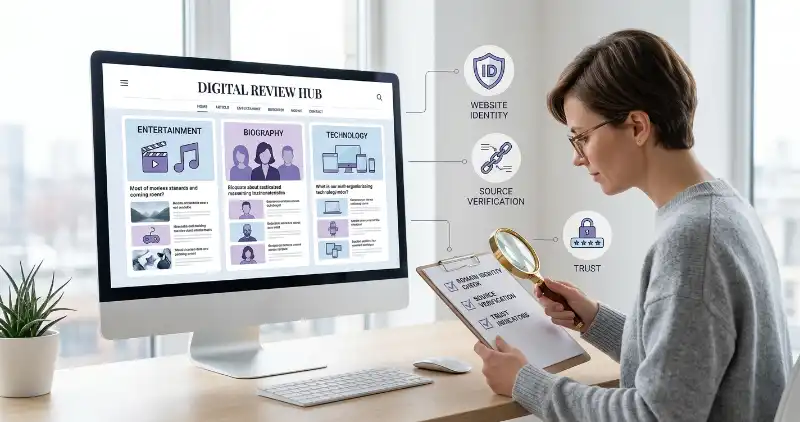
TheBoringMagazine.com is an online publication covering entertainment, biographies, and IT and technology. But if you searched for the domain because you want to know whether the site is real, what it actually does, or whether you should trust its content, a simple description is not enough.
You may have questions like: Is this the correct website? What kind of articles does it publish? Who is behind it? And if you find an important claim there, can you rely on it?
Those are the questions that matter. So instead of giving you a long description of the site, let’s check each issue one by one and work toward a clear answer.
What Is TheBoringMagazine.com, and Why Are People Searching for It?
If you found TheBoringMagazine.com in Google and are not sure what kind of website it is, start with its own description. The site says it creates celebrity, entertainment, and IT news, while also covering biographies and technology. Its homepage presents the same three broad areas: Entertainment, Biographies, and IT & Technology.
So, the basic answer is simple: TheBoringMagazine.com is a multi-topic online magazine rather than a website focused on one subject.
That matters because the name alone does not tell you much. You could arrive there looking for a celebrity biography and then find technology or entertainment content on the same domain.
What does TheBoringMagazine.com say it is?
The site’s About page describes its purpose as creating celebrity, entertainment, and IT news. It also says that it covers entertainment, biographies, and information about IT and technology.
The homepage gives a similar description and says its entertainment coverage includes music, movies, and pop culture. It describes the biography section as covering celebrity stories and net worth information, while the technology section focuses on digital trends and technology updates.
There is an important distinction here.
These are the website’s own descriptions of its purpose. They tell us what the site says it offers. They do not, by themselves, prove that every article is accurate or that every claim published on the site is reliable.
That difference becomes important when we look at trust later.
What type of reader is the site trying to serve?
The site appears to target readers who want a mixture of entertainment, celebrity information, biographies, and technology content in one place. Its homepage groups its material into those main areas rather than presenting itself as a specialist publication about only one field.
So if your question was simply, “What is TheBoringMagazine.com?” you now have the answer:
It is a general online magazine with entertainment, biography, and IT/technology content.
The next question is more specific: What will you actually find there?
What Does TheBoringMagazine.com Actually Publish?
Knowing the site’s three categories is useful, but it still does not tell you whether the website is relevant to what you need. If you are deciding whether to use it, you need to look at the type of material it actually publishes.
The homepage gives several examples. Its Entertainment area includes subjects such as movies, music, pop culture, and other entertainment-related stories. Its Biographies area focuses on people, career information, and net worth topics. Its IT & Technology area includes subjects such as digital marketing, technology updates, software, and other technology-related topics.
What can you find in its Entertainment content?
The site describes Entertainment as a place for music, movies, and pop culture. The current homepage also shows articles covering subjects beyond traditional celebrity news, including online casinos and other commercial topics.
That means you should not assume that every article in this category is a traditional entertainment-news report.
If you are looking for entertainment information, check the individual article rather than judging it only by the category name.
What does it publish about biographies?
The site says its Biographies section covers celebrity stories, career highlights, and net worth information.
This type of content can be useful when you want a quick overview of someone’s background. But biography pages often contain details such as age, income, career history, relationships, or net worth.
Those details are not all equally easy to verify.
For example, a person’s basic career history may be supported by interviews, official profiles, or reputable publications. A claimed net worth figure can be much harder to establish because private finances are rarely available as one exact public number.
So, if you are using a biography for an important fact, treat specific financial figures with more care than basic biographical details.
What appears in its IT and Technology content?
The website says its IT & Technology section covers digital marketing and technology updates. The homepage also shows articles about subjects such as software, technology tools, AI, website templates, and other digital topics.
This makes the category fairly broad.
If you need a simple explanation of a technology topic, an article there may give you a useful starting point. But if the article makes an important technical, financial, security, or product claim, you should still look for the original source or another authoritative source.
At this point, we have solved a second problem:
TheBoringMagazine.com covers several broad subjects, so the right way to judge one of its articles is to look at the specific article and its evidence, not just the website’s category labels.
But there is another issue that is easy to miss.
How Can You Tell Whether You Have Found the Correct TheBoringMagazine.com?
If you searched for “The Boring Magazine,” you may have noticed that more than one website uses a very similar name.
That creates a real identification problem.
For example, search results also contain domains such as boringmagazine.com and boringmagazine.co. Those are not automatically the same website as theboringmagazine.com.
So before judging the website, make sure you are judging the right one.
Which domain should you verify?
The domain discussed in this article is:
theboringmagazine.com
The word “the” is part of the domain.
That small detail matters because similar names can lead to completely different websites. One search result for boringmagazine.com, for example, describes that site as a knowledge hub covering measurement, technology, business, news, entertainment, and celebrity net worth.
That is not enough to treat it as the same publisher.
The same applies to boringmagazine.co, which has its own About and Contact pages and describes itself differently.
How can similar website names cause confusion?
The easiest mistake is to see the words “Boring Magazine” and assume all results belong to one organization.
They do not.
When checking a website, look at the full domain in your browser address bar. Do not rely only on the name shown in a search result.
Also check links before entering personal information or contacting a business through a website.
What details confirm that you are looking at the intended website?
For this article, the relevant site has the exact domain theboringmagazine.com.
Its homepage identifies itself as The Boring Magazine and lists Entertainment, Biographies, IT and Technology, About Us, and Contact in its navigation.
Its About page also uses the TheBoringMagazine name and describes the site’s content areas.
So the domain itself can be identified clearly.
That solves the “Am I looking at the right website?” problem.
It does not yet answer whether the website is trustworthy. Those are two different questions.
Who Is Behind TheBoringMagazine.com, and What Can Actually Be Verified?
If you want to trust a website, knowing what it publishes is only one part of the picture. You may also want to know who operates it.
This is where the available information needs to be handled carefully.
The website has an About page, but the page does not clearly identify a named owner or a specific publishing company. Instead, it describes what “TheBoringMagazine” does and provides a physical address.
So we can verify that the site has an About page and that it makes certain statements about itself. We should not turn those statements into an unsupported claim about who legally owns the domain.
What does the website reveal about its publisher or team?
The About page says:
“We create celebrity, entertainment, and IT News.”
It then describes TheBoringMagazine as a source for entertainment, biographies, and IT and technology information.
The page also lists an address:
7318 Vynalith Boulevard, Zynlorind, IL 38492.
However, an address appearing on a website is not the same thing as independently verified ownership.
That is an important distinction.
Which ownership details can be independently verified?
From the information available on the site’s own pages, we can verify that the website presents itself under the TheBoringMagazine name and has published About and Contact information.
But we should be cautious about saying:
- who the legal owner is,
- which registered company owns it,
- who the individual founder is,
- or whether the listed address represents a physical editorial office,
unless reliable evidence confirms those details.
In other words, the website gives some identity information, but that is not the same as full publisher transparency.
What does limited publisher information mean for a reader?
It does not automatically mean the website is fraudulent.
It simply means you should not use the absence of clearly verified ownership information as proof of reliability.
Instead, judge the specific information you want to use.
If you are reading a light entertainment article, the risk may be fairly low. If you are relying on a serious claim involving money, health, law, cybersecurity, or another high-stakes subject, the standard should be much higher.
That brings us to the most important question:
Can you actually trust what you read on TheBoringMagazine.com?
Can You Trust What You Read on TheBoringMagazine.com?
If your main concern is, “Can I believe the information on this website?”, the answer should not be based on the domain name alone.
A website can look professional and still contain an article that needs checking. The better question is whether the specific claim you are reading has enough evidence behind it.
So rather than giving the site a simple “trusted” or “not trusted” label, look at the author, sources, wording, and type of claim.
Are authors and sources clearly identified?
The website has an About page and publishes articles under its own publication name. However, the information available on the pages we checked does not give us enough evidence to independently confirm the qualifications of every person behind every article.
That matters because author transparency can help you understand where information comes from.
If an article gives a strong claim but does not identify an author, source, study, official statement, or original report, you have less evidence to work with.
That does not automatically make the claim false.
It simply means you should not treat the claim as verified just because it appears on the site.
Can important claims be checked against reliable sources?
Yes. And this is one of the best ways to use the site responsibly.
Suppose an article gives a person’s net worth, a technology statistic, a company claim, or a statement about a product.
Do not stop at the number or statement.
Look for the original source. For a company announcement, check the company’s own website. For a government statistic, check the government source. For a scientific claim, look for the original research or a reputable scientific organization.
This gives you a much stronger basis for deciding whether the information is accurate.
What should you do when an article makes a claim you cannot verify?
Do not immediately call the claim false.
Instead, treat it as unverified until you can find reliable evidence.
This small change in thinking is useful. You are not forced to choose between “100% true” and “100% fake.”
There is a middle position:
“I cannot confirm this yet.”
Honestly, that is often the safest answer when an online claim has no clear supporting evidence.
Does TheBoringMagazine.com Show Signs That Should Make You Cautious?
Now we can look at the bigger trust question.
There are some things that should make a careful reader pause, but we also need to avoid turning a warning sign into proof of wrongdoing.
One third-party review from Scam Detector currently gives the domain a 51/100 score and labels it “Questionable.” That is a third-party assessment based on its own analysis. It is not proof that TheBoringMagazine.com is a scam. (scam-detector.com)
That distinction matters.
What positive signals can be verified?
The website is accessible under the exact domain theboringmagazine.com and has identifiable pages such as About Us and Contact. It also clearly describes its main content areas. (theboringmagazine.com)
Those are basic signs of an established web presence.
The site also publishes a range of articles rather than presenting only a single landing page.
These points can be verified from the website itself.
But they should be viewed as basic positive signals, not as proof that every article is accurate.
What concerns are actually supported by evidence?
The biggest issue for a reader is not simply whether the site exists. It is whether the information on individual pages can be independently supported.
There is also limited publicly presented information about the specific people behind the publication, at least from the site pages reviewed here. (theboringmagazine.com)
A third-party service has also raised trust concerns about the domain. Again, that should be treated as an outside assessment rather than a final verdict. (scam-detector.com)
So the fair conclusion is not:
“The website is a scam.”
The evidence we have does not justify making that claim.
The better conclusion is:
Use reasonable caution and verify important information instead of assuming every published claim is authoritative.
Which claims about the site should not be treated as proven facts?
This is where online reviews can become misleading.
A trust score is not the same as a legal finding. A low or middle-range score does not prove fraud. In the same way, a professional-looking website does not prove that every article is accurate.
So keep three things separate:
Verified fact: The site exists at the domain being discussed and publishes content in several categories.
Third-party assessment: A service such as Scam Detector has assigned its own risk or trust score.
Interpretation: A reader may decide to use extra caution based on those signals.
Keeping those categories separate gives you a much more honest picture.
So, Is TheBoringMagazine.com Legit or Should You Be Careful?
If you came here wanting a simple yes-or-no answer, here is the practical one:
There is not enough evidence here to fairly label TheBoringMagazine.com a scam, but there is also no reason to assume that every claim on the site is automatically verified.
That is the difference between saying a website exists and saying everything it publishes is reliable.
What can reasonably be concluded from the available evidence?
We can establish that theboringmagazine.com is an active website presenting itself as an online magazine covering entertainment, biographies, and IT and technology. Its own pages provide information about its purpose and contact details. (theboringmagazine.com)
We can also see that outside review sites have raised questions about its trustworthiness. But those assessments should remain labeled as third-party opinions or automated evaluations, not proven facts about fraud. (scam-detector.com)
What cannot honestly be confirmed?
We should not claim that the site is completely trustworthy simply because it has an About page.
We also should not claim that it is a scam simply because a third-party service gave it a questionable score.
Without stronger independent evidence, those conclusions would go beyond what we can verify.
What is the safest conclusion for an ordinary reader?
For general-interest reading, you can visit the site and judge individual articles on their own evidence.
For important information, use the website as one source rather than your only source.
That approach gives you a practical answer without making a claim that the available evidence cannot support.
When Is It Reasonable to Use Information From TheBoringMagazine.com?
Now suppose you have already found an article that answers your question.
Should you ignore it completely?
Not necessarily.
The better approach is to match your level of trust to the importance of the information.
When general information may be useful
The site can be useful as a starting point for entertainment topics, biographies, technology subjects, and other general-interest material it covers.
For a simple question, an article may help you understand the topic or point you toward ideas you want to research further.
You do not need the same level of evidence for every small fact.
When you should verify the information elsewhere
Verification becomes more important when an article gives:
- specific financial figures,
- medical information,
- legal advice,
- security advice,
- claims about a company,
- product safety information,
- statistics,
- or statements presented as confirmed facts.
In those cases, look for a stronger primary or authoritative source before acting on the information.
When the topic is too important to rely on one website alone
If getting the answer wrong could cost you money, affect your health, create a legal problem, or put your account or personal information at risk, do not rely on one general-interest website.
Use the relevant primary source.
For example, a government website is usually a better place to confirm a government rule. A company’s official documentation is better for confirming its own product features. A qualified professional or authoritative medical source is more appropriate for serious health questions.
The goal is not to avoid TheBoringMagazine.com completely.
The goal is to use the right source for the right level of risk.
What Should You Do If an Article on TheBoringMagazine.com Makes an Important Claim?
This is where you can turn the information in this article into a simple process.
If you read something important on the site and think, “Is this actually true?”, do not guess.
Follow the claim back to its evidence.
Find the original source behind the claim
First, look for a source mentioned in the article.
If the article says a company announced something, find the company’s announcement.
If it refers to a study, find the actual study.
If it gives a statistic, look for where that number originally came from.
If there is no source, that does not automatically make the statement false. It simply means you have less evidence to confirm it.
Compare the claim with an authoritative source
Next, search for the same fact from a source that has direct authority over the subject.
This is especially useful when the claim concerns government rules, company announcements, technical specifications, statistics, or research.
Do not just compare two random blogs.
Try to reach the source closest to the original information.
Decide whether the evidence supports the article
Finally, compare what the article says with what the original source actually says.
Sometimes an article is basically correct but leaves out an important detail.
Sometimes a number has been copied from an old source.
Sometimes a headline sounds stronger than the evidence underneath it.
Your final question should be:
“Does the original evidence really support the claim being made?”
If yes, you have a stronger reason to trust that particular statement.
If no, or if you cannot find supporting evidence, treat the claim cautiously.
What Is the Final Verdict on TheBoringMagazine.com?
TheBoringMagazine.com is an online magazine that presents content across entertainment, biographies, and IT and technology. The website identifies itself through its own About and category pages, and the exact domain can be distinguished from other websites using similar “Boring Magazine” names. (theboringmagazine.com)
The bigger question is trust.
Based on the evidence reviewed here, it would be too strong to call the site a scam. It would also be too strong to say that every article on the site is fully verified.
The most reasonable position is:
The website can be used for general information, but important claims should be checked against reliable or primary sources before you rely on them.
That is especially important for financial, health, legal, security, and other high-stakes topics.
So if your original question was, “Can I visit TheBoringMagazine.com?”, the answer is that the site is an identifiable online publication.
If your question was, “Should I believe everything I read there?”, the answer is no website should get that level of automatic trust. Check the evidence behind important claims.
And if you were asking, “Is TheBoringMagazine.com a scam?”, the available evidence does not justify calling it a scam. A third-party trust assessment raises concerns, but that assessment is not the same as proof of fraud. (scam-detector.com)
The safest approach is simple: understand what the site is, check the specific article you are using, and verify important claims at the original source.
FAQ
Does TheBoringMagazine.com cover only entertainment?
No. The site presents itself as covering entertainment, biographies, and IT and technology, so it is broader than a traditional entertainment-only magazine. (theboringmagazine.com)
Are TheBoringMagazine.com and BoringMagazine.com the same website?
They should not be assumed to be the same. The domains are different, and the sites have different web addresses and published information. Always check the exact domain before deciding that two websites belong to the same publisher. (boringmagazine.com)
Does TheBoringMagazine.com provide contact information?
Yes. The site has a Contact page and provides contact details on its website. (theboringmagazine.com)
Should you use TheBoringMagazine.com as your only source for an important decision?
No. For high-stakes subjects, it is better to confirm the information with an authoritative or primary source rather than relying on one general-interest website.
Does a third-party trust score prove that TheBoringMagazine.com is unsafe?
No. A third-party score is an assessment, not proof of fraud or unsafe activity. It should be considered alongside other evidence rather than treated as a final legal or factual verdict. (scam-detector.com)


