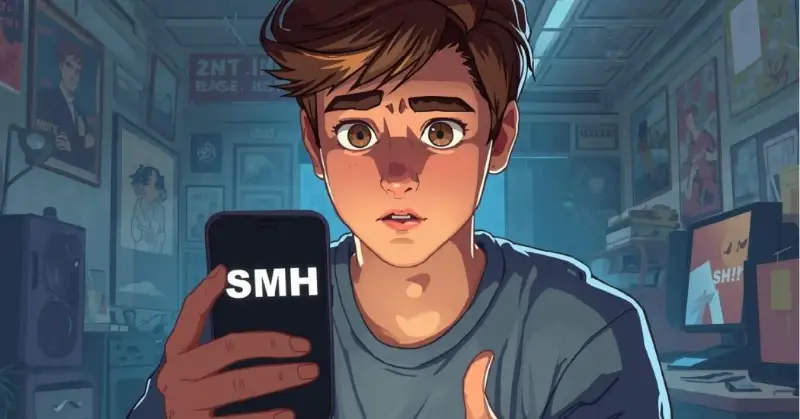
If you have ever received a text that simply said “smh” and found yourself staring at your phone wondering if the other person is angry, disappointed, or just joking — you are not alone. SMH is one of the most common abbreviations in digital communication, but its short length often leaves people confused about the real intent behind it.
Here is the straightforward answer: SMH stands for “shaking my head.” It is the text-based equivalent of that slow, side-to-side head shake you do in real life when you see something ridiculous, disappointing, or hard to believe. People use it in texts, group chats, social media comments, and even gaming lobbies to react quickly without typing out a full sentence.
For example, if a friend tells you “I forgot my wallet at home again,” replying “smh” instantly conveys mild disbelief or playful annoyance. But here is the catch — the exact same abbreviation can feel completely different depending on who sends it, where it is sent, and what was said right before it. This guide will break down everything you need to know: the exact definition, how to use it across different platforms like Snapchat and Roblox, whether it is rude, how to respond when you receive it, and how it compares to similar slang like SMDH and Facepalm.
What Does SMH Mean? Simple Definition and Full Form
Before we dive into the nuances, let us lock in the absolute basics. This section gives you the core definition, the full form, the emotions it carries, and clears up a common confusion with a similar-sounding phrase. Think of this as your foundation — once you understand these building blocks, everything else about SMH will make perfect sense.
What Does SMH Stand For?
This is the most direct question people type into search engines, so let us answer it immediately and clearly.
SMH stands for “shaking my head.” This is the original, dictionary-approved full form recognized by Merriam-Webster, Cambridge Dictionary, and Dictionary.com. There is no other mainstream or widely accepted meaning for this acronym in modern digital communication. Whenever you see SMH in a text, chat, or comment, you can safely assume the sender is referring to the physical act of shaking their head in reaction to something.
What Does SMH Mean in Simple Words?
Not everyone understands dictionary jargon. In plain, everyday language, SMH translates to one of these short phrases:
- “I can’t believe this.”
- “That is so disappointing.”
- “Wow, that was foolish.”
- “Really? Come on.”
- “This is ridiculous.”
It is the digital version of standing there, shaking your head side to side, when you witness something that does not make sense, falls short of expectations, or just makes you sigh. You are not necessarily angry — you are just reacting.
What Feelings Does SMH Express?
SMH is not just a word — it is a reaction marker. It does not describe an action; it performs a reaction. In real-world usage, SMH most frequently expresses one of these five core emotions:
- Disbelief — “You actually quit your job without a backup plan? smh.”
- Disappointment — “The restaurant closed early on our anniversary, smh.”
- Frustration — “My internet crashed right in the middle of the meeting, smh.”
- Disapproval — “He lied to get a discount he didn’t deserve, smh.”
- Mild Exasperation — “I put my phone on charge but forgot to switch the plug on, smh.”
Notice that pure rage or extreme anger is missing from this list. SMH rarely means blind fury. It usually hovers somewhere between “mild annoyance” and “moderate disappointment.” If someone wants to express true anger, they usually use stronger language or the intensified variant SMDH (which we will cover later).
“Shaking My Head” vs. “Scratching My Head”
A tiny minority of sources on the internet occasionally suggest that SMH means “scratching my head” — which would imply confusion or curiosity. Let us kill that confusion permanently.
The universally accepted, mainstream, and dictionary-approved meaning is always “shaking my head.” Scratching your head means you are puzzled and trying to figure something out. Shaking your head means you are reacting with disbelief, disappointment, or judgment. The two gestures are completely different in real life, and the same applies to their digital abbreviations. Stick with “shaking my head” — that is what 99.9% of users intend when they type SMH.
How Is SMH Used in Texting, Chats, and Social Media?
Now that we have the definition locked in, let us talk about action. SMH does not live in a dictionary — it lives in text messages, Snapchat streaks, Instagram comment sections, and Roblox game lobbies. The platform you are on, and the people you are talking to, can change how SMH feels. This section breaks down exactly how SMH behaves in different digital spaces, plus a practical tip on where to place it in a sentence to get the tone right.
SMH in Text Messages and Group Chats
Private texting and WhatsApp or iMessage group chats are the original home of SMH. In these spaces, SMH acts as a quick emotional tag that keeps conversations flowing without interrupting the rhythm.
Here is how it usually shows up:
- Self-directed (funny): “I studied the wrong chapter for the test, smh.” — The sender is laughing at their own mistake.
- Reacting to news about someone else: “She said she would come but she is still sleeping, smh.” — Mild disbelief about a third person.
- Reacting to a shared situation: “This train is delayed again, smh.” — Shared frustration among group members.
In private chats, SMH rarely causes offense because the context is usually clear and the relationship is familiar.
SMH on Snapchat, Instagram, TikTok, and X
Social media is public — or semi-public — which means the stakes feel slightly higher. On platforms like Instagram, TikTok, and X (formerly Twitter), SMH often appears in comments, captions, or replies to viral content.
- In comments: “People actually fall for this scam? smh.” — This can feel slightly more critical because the sender is addressing a wider audience, not just a friend.
- On Snapchat: Because snaps are casual, temporary, and often visual, SMH here is almost always light-hearted. “My Bitmoji looks weird in this outfit, smh 😂” — clearly playful.
- On TikTok captions: “I tried that hack and it failed miserably, smh.” — Self-deprecating and relatable.
The core meaning does not change, but the social effect can. A public SMH carries more weight because others can see it and join in, so it can sometimes amplify the judgmental tone.
SMH in Gaming and Roblox Chats
Search data shows a significant number of people ask “what does smh mean in Roblox” and “smh meaning in games.” This is a specific niche that deserves its own attention.
In online gaming chats — whether Roblox, Valorant, Minecraft, or Call of Duty — SMH is used for fast-paced communication. Gamers do not have time to type out long sentences when they are in the middle of a match. SMH becomes a quick venting tool.
- “Our teammate just ran into the enemy base alone, smh.” — Calling out a silly strategic mistake.
- “I lagged out right before the final kill, smh.” — Frustration at bad luck or server issues.
- “Someone grabbed the loot I was about to pick up, smh.” — Mild annoyance at another player’s timing.
For the younger Roblox crowd, SMH retains the exact same meaning — “shaking my head” — but it is frequently used to react to unfair gameplay, team errors, or unexpected defeats. It is usually light-hearted banter rather than serious criticism, though the intensity can rise in competitive matches.
Where to Place SMH in a Sentence: Beginning, End, or Alone
Most guides miss this practical detail, but the placement of SMH in a sentence subtly changes its tone and emphasis. Here is a quick breakdown to help you sound more natural:
- At the end (most common and softest): “You missed the bus again, smh.” — This feels like a casual afterthought. The main message comes first, and the SMH is just a tag at the end. This is the safest, least aggressive placement.
- At the beginning (stronger): “SMH, I cannot believe you said that.” — Putting the reaction first makes it feel more immediate and urgent. It signals that your emotional reaction is the most important part of the message.
- Standalone (heaviest): If someone shares a shocking or disappointing story and you simply reply “smh” — it means you are processing the information with disbelief and you do not have the words to add. This can feel the most judgmental because it is abrupt and leaves the other person guessing.
Pro tip: If you are unsure about tone, place SMH at the end. It is the most neutral and widely accepted position.
Is SMH Rude? Understanding the Tone and Context
This is the biggest question people have, and rightfully so. Because text messages lack vocal tone, facial expressions, and body language, a simple “smh” can feel like a friendly nudge or a cold slap depending on the situation. The truth is: SMH is not automatically rude. It is just a reaction. It becomes rude when it is weaponized with sarcasm, directed personally at someone’s character, or used in a dismissive way. Let us break down exactly when SMH is playful, when it is frustrated, and when it crosses the line into rudeness.
When SMH Sounds Playful or Funny
If the sender is pointing the finger at themselves, a random object, or a silly situation that nobody takes seriously, SMH is completely harmless and often endearing.
- “I grabbed the hot pan without a glove, smh 🤦” — Playful self-criticism.
- “My cat just knocked over my water bottle for the third time, smh.” — Funny annoyance at a pet.
- “I put salt in my coffee instead of sugar, smh.” — A laughable morning mistake.
How to spot playful SMH: Look for laughing emojis (😂, 🤣, 💀), self-deprecating content, or topics that are clearly low-stakes. If they are laughing at themselves or at a harmless situation, you are safe.
When SMH Shows Disappointment or Frustration
When SMH is directed at situations — not people — it carries mild to medium frustration but rarely offends anyone personally.
- “Train delays again today, smh.” — You are annoyed at the public transport system, not a specific person.
- “My phone battery died at 15% again, smh.” — Universal tech frustration.
- “This weather changes every five minutes, smh.” — Annoyed at nature.
This tone usually invites sympathy or agreement from the other person. It says “I am frustrated by this thing,” not “I am frustrated with you.”
When SMH Sounds Judgmental or Rude
Here is the red flag zone. SMH becomes rude specifically when it is directed at a person’s choices, character, or mistakes in a dismissive or condescending way, without any softening language.
- “You spent $200 on that ugly shirt? smh.” — This implies the receiver has poor taste and feels insulting.
- “You really forgot my birthday, smh.” — This weaponizes the abbreviation to express hurt through passive-aggressive disappointment.
- “You did that again, smh.” — Short, sharp, and aimed directly at the other person’s behavior.
In these cases, the sender is not just reacting to a situation — they are passing judgment on you. That is when SMH crosses from a harmless reaction into rudeness.
Why Context Matters More Than the Word Itself
If there is one thing to take away from this entire guide, it is this: never interpret SMH in a vacuum. The abbreviation is static, but the situation around it is dynamic.
When you receive an SMH, always check three things:
- Your relationship with the sender — A close friend sending “smh” after a funny story is worlds apart from a boss or stranger sending the same abbreviation after a work mistake.
- The previous messages — Was the conversation light-hearted and full of jokes, or serious and tense?
- The presence of emojis — A laughing emoji (😂) or crying emoji (😭) almost always signals playful intent. No emojis, especially in a serious chat, usually means genuine frustration or disappointment.
Let the situation guide your interpretation, not just the abbreviation itself. Context is the key that unlocks the true meaning behind every SMH.
SMH vs. Related Slang: Facepalm, SMDH, and More
SMH does not live in isolation. It has cousins — other reaction-based slangs that often confuse users. You might have seen people use Facepalm (🤦) or SMDH and wondered if they mean the same thing. They do not. This section focuses only on the genuinely useful related terms: the physical gesture of “Facepalm” and the aggressive intensifier “SMDH.” We will also briefly acknowledge other minor variants so you are not caught off guard if you see them in the wild.
SMH vs. Facepalm: What’s the Difference?
Both are reaction gestures, but the emotional energy behind each is completely different. Understanding this distinction will help you choose the right abbreviation for the right moment.
- SMH (Shaking My Head): Leans toward disbelief, disappointment, or disapproval. It is a slower, more judgmental reaction. It is the gesture you make when you are processing something that does not meet your expectations.
- Facepalm (🤦): Leans toward embarrassment, cringe, or frustration. It is the gesture of slapping your palm against your forehead because something is so foolish, awkward, or clumsy that it physically hurts to witness.
Quick comparison with examples:
| Scenario | SMH | Facepalm |
| Someone wears mismatched shoes to a formal event | “He wore flip-flops to the interview, smh.” (Disbelief at the poor choice) | “He wore flip-flops to the interview. Facepalm.” (Embarrassment on his behalf) |
| You send a text to the wrong person | “I sent that to my boss instead of my friend, smh.” (Mild disappointment in yourself) | “I sent that to my boss instead of my friend. Facepalm.” (Strong cringe and embarrassment) |
| A politician makes an obviously false claim | “People actually believe that? smh.” (Disapproval) | N/A — Facepalm does not fit here as well |
The rule of thumb: Use SMH when you are judging a situation. Use Facepalm when you are embarrassed by a situation (especially your own actions).
What Does SMDH Mean? The Stronger Variant
This acronym frequently appears in search queries (GSC data shows it at position 17), so we need to cover it clearly and concisely.
SMDH stands for “shaking my damn head.”
It is the stronger, more intense, more frustrated version of SMH. Merriam-Webster explicitly notes SMDH as a variant used when the sender is highly annoyed, aggressively disappointed, or genuinely angry — not just mildly frustrated.
SMH vs. SMDH side-by-side:
- SMH: “You lost your keys again?” — Mild annoyance, a gentle sigh.
- SMDH: “You lost your keys again in the middle of a thunderstorm when we are already late? SMDH.” — This adds a curse word (“damn”) and a much heavier emotional weight. It signals that the sender is genuinely upset, not just lightly disappointed.
Warning: Use SMDH sparingly. Because it includes a mild curse word, it can easily offend in professional settings, family chats, or sensitive conversations. Reserve SMDH for situations where you are genuinely frustrated and you are communicating with someone who understands your tone.
SMH vs. Similar Reaction Expressions
Beyond SMDH and Facepalm, you might occasionally encounter other variations in the wild. Here is a quick cheat sheet so you are never confused:
| Variant | Full Form | Meaning & Usage |
| SMFH | Shaking my fucking head | Extremely aggressive and frustrated. Includes a strong curse word. Use only in very informal, heated chats — and even then, proceed with caution. |
| SMH | Shaking my head | Your default, safe, standard option. |
| STH | Shaking my head | Just a typo or autocorrect error. Some users type “sth” by mistake, but it means exactly the same as SMH. |
| SMH my head | (Redundant) | Sometimes people jokingly type “SMH my head” for emphasis, like “ATM machine” or “PIN number.” It is playful and not to be taken seriously. |
You do not need to memorize all of these. For 95% of digital conversations, knowing SMH, SMDH, and Facepalm is more than enough to understand and participate in any chat.
How to Respond When Someone Texts You “SMH”
Receiving an “smh” can trigger a moment of anxiety. Did you do something wrong? Are they angry at you? Or are they just joking around? This section is a practical survival guide. Instead of guessing and making things awkward, use these response strategies based on the tone of the conversation.
Playful or Casual Responses
If the chat is light-hearted, filled with emojis, or clearly references a silly situation, match their energy. Do not overthink it — just acknowledge the silliness and move on.
- “I know, I know, I am a disaster today 😂”
- “Do not judge me — you know you would do the same!”
- “Lol, fair enough.”
- “Guilty as charged, smh right back at you.”
These responses keep the conversation breezy and show that you are not defensive. You are playing along with the joke, which is exactly what the sender likely intended.
Serious or Apologetic Responses
If the conversation feels heavy, the topic is serious, and the SMH seems directed at a genuine mistake you made, it is time to take accountability. This is how you de-escalate tension and show emotional maturity.
- “I hear you. That was a mistake on my part, and I will fix it.”
- “You are right — I should have thought that through more carefully.”
- “I understand why you are disappointed. Let me make it right.”
🚨 Critical Mistake to Avoid: Never say “Sorry you felt hurt, smh.” Using SMH in your own apology makes you sound dismissive, sarcastic, and insincere. It completely undermines your apology and will likely make the other person more frustrated. If you are apologizing, leave SMH out of it entirely.
What to Say When You Are Not Sure What They Mean
Ambiguity is the enemy of clear communication. If you genuinely cannot tell whether the sender is joking or genuinely frustrated, the best move is to just ask directly. It shows emotional intelligence and prevents unnecessary misunderstandings.
- “Hard to tell — are you actually mad or just messing around?”
- “I cannot read the tone on that ‘smh’ — are we good?”
- “That smh felt heavy — everything okay?”
Asking for clarification is not a sign of weakness. It is a sign that you care about the other person’s feelings and about getting the communication right. Most people will appreciate the honesty.
Where Did SMH Come From? Origin and History
Search intent analysis shows that “origin” is not the primary driver for this keyword — users mostly want meaning and usage. However, a brief, punchy history section adds credibility and satisfies curiosity. We keep this section short, relevant, and strictly focused on how SMH evolved from niche internet forums to mainstream dictionary recognition.
Early Internet and Forum Usage
SMH did not start with smartphones. It was heavily popularized in the early 2000s on internet forums like Something Awful and early social networks like MySpace. Back then, texting and instant messaging were booming, but character limits and slow typing speeds meant users needed shortcuts. Instead of typing out “I am shaking my head right now,” users abbreviated it to SMH to keep conversations moving quickly.
It was born out of pure necessity — a way to express physical body language in a purely text-based environment. At the time, it was used alongside other early internet slang like LOL (laughing out loud), BRB (be right back), and TTYL (talk to you later).
How SMH Became Mainstream in Digital Communication
How did a niche forum abbreviation become an officially recognized dictionary word? Two major factors drove SMH into the mainstream:
- Character limits: As SMS (texting) character limits became a thing, and Twitter rolled out its original 140-character limit, abbreviations like SMH became linguistic necessities rather than just slang. Every character counted, and SMH saved valuable space.
- Platform adoption: As social media platforms like Facebook, Instagram, and Snapchat exploded in the 2010s, SMH travelled from niche forums to mainstream audiences. It became a staple in comments, captions, and direct messages.
By the time emojis were invented, SMH was already deeply ingrained in the global digital vocabulary. Its formal entry into Merriam-Webster and Cambridge Dictionary solidified its evolution from niche internet slang to recognized, legitimate English. Today, it is used by teenagers, professionals, grandparents, and everyone in between — proof that a good abbreviation never goes out of style.
Frequently Asked Questions About SMH Meaning
To capture long-tail search queries and satisfy quick-lookers, we have consolidated the most burning questions into a concise FAQ section. This structure is excellent for featured snippets and helps users find exactly what they need without reading the entire article. Each answer is direct, clear, and based on real-world usage.
What does SMH mean in texting?
In texting, SMH means “shaking my head.” It is used to express disbelief, disappointment, disapproval, or mild frustration in reaction to a previous message. It is a quick reaction tag, not a standalone insult.
What does SMH mean on social media?
On social media platforms like Instagram, X (Twitter), TikTok, and Snapchat, SMH still means “shaking my head.” It often acts as a public reaction to videos, news, or statements that the user finds unbelievable, silly, or disappointing. Because comments are public, it can feel slightly more critical than in private texts.
Is SMH rude?
Not by itself. SMH is just a reaction word. It becomes rude only when it is directed personally at someone’s behavior in a condescending way, without any softening emojis or friendly context. If the conversation is light and the SMH is aimed at a situation or the sender themselves, it is completely harmless.
What does SMH mean from a girl or guy?
SMH has no specific gender-based meaning. Whether sent by a girl or a guy, it always means “shaking my head.” However, in dating or friendship contexts, if a partner or friend sends it, it usually expresses disappointment in an action or situation. Check for emojis — laughing emojis mean playful, no emojis in a serious chat may mean genuine frustration.
What does SMH mean in gaming or Roblox?
In gaming and Roblox chats, SMH is used for quick team communication. It reacts to a teammate’s silly mistake, bad luck (like lag), or an unbelievable play by the opponent. It is usually light-hearted banter but can become tilted (frustrated) if the game is intense and competitive.
Is SMH a bad word?
No. SMH is not a swear word, derogatory term, or offensive abbreviation. However, because it often implies disapproval, it can be perceived as negative depending on the tone of the conversation. It is a neutral reaction marker that can lean positive or negative based on context.
What does SMDH mean?
SMDH stands for “shaking my damn head.” It is the stronger, more annoyed version of SMH, used when the sender is highly frustrated, aggressively disappointed, or genuinely angry. Use it sparingly because it includes a mild curse word and can easily offend.
Final Thoughts
We have covered a lot of ground, but the core message is simple.
SMH means “shaking my head.” It is a quick, versatile, and highly contextual piece of modern internet slang. While its dictionary definition is straightforward — a reaction of disbelief, disappointment, or disapproval — its real-world usage is an art form dictated by tone, platform, and relationship. The same three letters can sound playful, frustrated, or judgmental depending entirely on the situation.
Whether you are using SMH to laugh at your own coffee mishap, reacting to a frustrating video game death in Roblox, or responding to a friend’s questionable life choice on Snapchat, SMH allows you to convey complex physical body language in just three letters. It is efficient, expressive, and here to stay.
The golden rule to remember:
- Use it to laugh with someone or about a situation — you are completely safe.
- Use it to judge at someone without offering help or kindness — you risk sounding harsh and dismissive.
Context is king, and now — after reading this guide — you are the master of it. The next time you see or send an SMH, you will know exactly what it means, how it will be received, and exactly how to respond. Happy texting!



1 thought on “H1: SMH Meaning: What Does “SMH” Mean in Texting and Social Media?”