
If you searched for pixelspinx.com, you may be trying to figure out one simple thing: what kind of website is this actually? The answer can be confusing because different pages online describe Pixelspinx in different ways.
Some descriptions present it as a creator-focused platform, while other information points to a general content website covering several topics. So before you decide whether the site is useful or trustworthy, it helps to separate what can be seen from what is simply being claimed.
If you are wondering what Pixelspinx.com really does, why its descriptions do not always match, or whether you can use it as a creator platform, this guide will clear those questions up step by step.
What Is Pixelspinx.com Actually?
If you are looking at Pixelspinx for the first time, the first problem is knowing what you are actually dealing with. Is it a social platform, a publishing service, a creator network, or just a website that publishes articles?
Based on the information currently available about the site, Pixelspinx.com appears to function as a multi-topic content website. Its content covers different subject areas rather than focusing on one narrow field.
That matters because a general content website works differently from a platform built specifically for users who want to create profiles, publish their own work, or earn money from their content.
What kind of content does Pixelspinx publish?
The website has been described as covering several broad categories, including areas such as technology, business, finance, health, travel, automotive, gaming, and general topics.
That tells you something useful about the site’s basic purpose. A visitor can come across articles from different parts of everyday life rather than entering a platform built around one specific community.
So, if you found Pixelspinx while searching for an article or topic, you may simply be dealing with a general publishing site.
Is Pixelspinx the same as a social media platform?
Not based on the publicly described structure of the site.
A social platform normally gives users tools such as public profiles, connections, posts, comments, messaging, or other community features. A publishing website can have articles and authors without offering those same functions.
This difference is important because the word “platform” can sometimes make a website sound more interactive than it really is.
For Pixelspinx, the safer way to describe what is visible is to focus on its published content and available website features rather than assume that it works like a social network.
What does this mean if you only want to read its articles?
If your goal is simply to read an article, the question is fairly straightforward.
You can judge the site based on the particular content you found, who appears to have published it, and whether the information can be supported elsewhere.
You do not need to assume that every article on a multi-topic website has the same level of expertise.
For example, an article about a simple technology term and an article discussing financial advice are very different situations. The second one deserves more careful checking because the information could affect an important decision.
The simple answer
So, what is Pixelspinx.com?
It appears to be a general, multi-topic content website rather than a clearly established social network or creator community.
That answers the first question, but it creates another one.
If Pixelspinx looks like a general content site, why do some pages online describe it as a creator platform?
That is where the real confusion begins.
Why Does Pixelspinx.com Have Conflicting Descriptions Online?
If you searched Pixelspinx and found completely different explanations, you are not imagining the problem. The descriptions available online are not always consistent.
Some pages describe Pixelspinx as a place where creators can publish content, build an audience, or potentially monetize their work. Other reviews focus on the site’s visible article-based structure.
The important point is not to immediately choose one description and treat it as proven. Instead, we need to separate what is claimed from what can actually be verified.
Where does the creator-platform description come from?
Some third-party pages describe Pixelspinx as a creator-oriented website. They may mention features such as content publishing, creator participation, or monetization.
Those descriptions are useful because they tell us what some people believe the website is designed to do.
But a third-party description is still a claim.
If a page says that a website allows anyone to create an account and earn from published content, the next question should be simple:
Can that feature actually be confirmed on the website?
That is a much stronger way to investigate the claim than repeating it from one article to another.
Why does the visible website matter?
Think about it this way.
Imagine someone tells you that a website is a job marketplace. You visit it and find a collection of ordinary articles, but you cannot find job listings, employer accounts, applications, or a worker dashboard.
You would naturally pause and ask whether the description matches the actual website.
The same idea applies here.
A website can be described in many ways by other pages, but its visible features provide a more useful starting point.
Does that prove every creator-platform claim is false?
No.
This is an important distinction.
If a public creator dashboard cannot be found, that does not automatically prove that no private contributor arrangement exists. A website owner could have features that are not publicly visible or could change the site later.
So the careful conclusion is:
The publicly visible evidence should be treated as the starting point, while features that cannot be independently confirmed should remain unverified.
That approach avoids both extremes.
You do not need to believe every promotional description, but you also do not need to call something false just because you cannot verify it immediately.
How should you understand the conflicting information?
The easiest way is to place the information into three groups.
Verified information is something that can be directly supported by the website or reliable evidence.
A claim is something another website, company, or person says about Pixelspinx but has not been independently established.
Needs verification means there is not enough public evidence to confidently state the feature as fact.
This simple separation makes the search much less confusing.
For example, saying:
“Pixelspinx publishes articles across several topics”
is different from saying:
“Anyone can join Pixelspinx and make money by publishing articles.”
The first describes the site’s visible publishing activity. The second describes a specific user feature that needs stronger evidence.
What should you take away from this confusion?
If you found different descriptions of Pixelspinx online, do not judge the website based on the label alone.
First identify what the website actually shows. Then compare that with the features being claimed about it.
That gives you a much clearer picture:
Pixelspinx appears to operate as a multi-topic content website, while some third-party descriptions present it as a creator-oriented platform. Those creator features should be treated as claims unless they can be independently confirmed.
Now that the basic identity and the conflicting descriptions are clear, the next question becomes much more practical:
Can you actually create an account, publish your own content, or use Pixelspinx as a creator platform?
Does Pixelspinx.com Actually Let People Create and Publish Content?
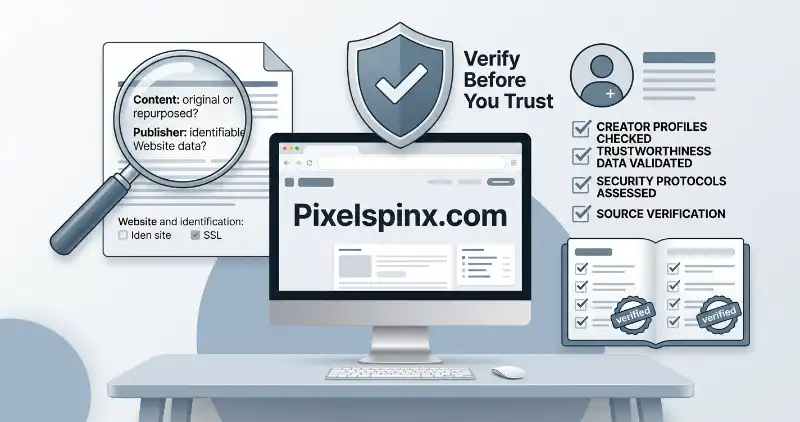
If you are considering Pixelspinx as a creator platform, this is probably the question you want answered next: Can you actually sign up, publish your own content, and use the site as a creator?
This is where it is important to slow down and look at the actual features instead of relying only on descriptions from other websites.
Is there a public creator account system?
A real creator platform normally gives users a clear way to register, create an account, manage a profile, and access tools for publishing.
For Pixelspinx, the publicly available information does not provide strong evidence of a clearly visible, open creator dashboard comparable to a dedicated user-publishing platform.
That does not prove that no private contributor arrangement exists. It simply means you should not assume that the site works like a public self-publishing network unless you can see or confirm those features.
Can you publish your own articles?
This is another point where claims and evidence need to stay separate.
Some third-party pages describe Pixelspinx as a place for creators or contributors. But if your goal is to publish something there, do not treat a general description as proof that anyone can register and upload an article.
Look for an actual submission process, contributor instructions, registration option, or clear contact route for writers.
If those details are not publicly available, the honest answer is that open self-publishing cannot be confidently confirmed from the available information.
What about creator payments?
This needs even more care.
A website being described as a creator platform does not automatically mean that it pays contributors.
To establish a payment system, you would want clear information about things such as:
- who qualifies for payment
- how earnings are calculated
- payment methods
- minimum payout requirements
- terms for creators
- who is responsible for the program
Without clear evidence for these details, do not assume that Pixelspinx offers a regular creator-income system.
So, can you use Pixelspinx as a creator?
The practical answer is simple:
Do not assume that Pixelspinx is an open creator-publishing platform just because some online descriptions call it one.
If you want to contribute content, first look for a real submission process or direct instructions from the website.
If you cannot find those features, treat the creator-platform claim as unverified rather than building a decision around it.
That resolves the creator question without making a claim that the available evidence cannot support.
What Kind of Content Will You Find on Pixelspinx.com?
Now suppose your main reason for visiting Pixelspinx is not publishing. You simply want to know what you will find there.
The easiest answer is that Pixelspinx has been described as a multi-topic publishing website. Its subject areas cover several unrelated parts of everyday interest.
What topics does the site cover?
Available descriptions of Pixelspinx mention categories such as:
- Technology
- Business
- Finance
- Health
- Travel
- Automotive
- Gaming
- General topics
The exact categories and content can change as a website grows, so it is better to use these as a picture of its broad direction rather than a permanent list.
The main point is that Pixelspinx is not limited to one specialist subject.
Why does the wide range of topics matter?
A broad website can be useful when you are looking for general information.
But it also means you should pay attention to the subject of the individual article.
For example, reading a general technology explanation is one thing. Reading financial, health, or legal advice is another.
A website can publish information about a topic without being the primary authority on that topic.
So the category of the article should help you decide how carefully to check it.
What should you expect when browsing?
You should approach Pixelspinx mainly as a content website.
If you find an article that answers your question, check the article itself rather than assuming that everything published across the site has the same source or level of expertise.
Look at the author information, supporting sources, dates, and the actual claims being made.
That gives you a better answer than simply asking whether the entire domain is “good” or “bad.”
The practical answer
If your goal is to find general-interest articles, Pixelspinx may be relevant depending on the topic you are searching for.
If you need information for an important decision, use the article as one source and verify important claims elsewhere.
That distinction becomes even more important when we ask whether the site’s information should be trusted.
Can You Trust Information Published on Pixelspinx.com?
This question is slightly different from asking whether the website is safe.
A website can be technically safe to visit while an individual article still contains incomplete, outdated, or unsupported information.
So if you are wondering whether you should rely on a Pixelspinx article, judge the specific information rather than the domain name alone.
Start with the source of the claim
Suppose an article says a company launched a product, a law changed, or a financial service works in a certain way.
Do not stop at the statement itself.
Ask where that information came from.
For important topics, a company announcement, government website, official documentation, research paper, or other primary source can give you stronger evidence than a general blog article.
Check whether the article gives supporting evidence
A useful article should make it reasonably clear where important facts come from.
That does not mean every short sentence needs a citation.
But major claims deserve more attention, especially when they involve money, health, legal rights, security, or personal data.
If an article makes a strong claim without explaining its source, treat that claim carefully.
Does a multi-topic site automatically make its information unreliable?
No.
The number of topics covered by a website does not by itself prove whether an article is accurate.
The better question is:
How well is this particular claim supported?
For example, a simple explanation of a common technology term may be easy to verify from several reliable sources.
A medical recommendation or financial claim needs a much higher level of checking.
How should you use Pixelspinx articles?
For ordinary background information, you can read the article and compare important points with other reliable sources.
For high-stakes decisions, do not rely on one general-interest article alone.
That gives you a practical rule:
Use the article for information, but verify important claims before acting on them.
This is more useful than giving the entire website a blanket label based on limited evidence.
Is Pixelspinx.com Safe and Legitimate to Use?
If you are asking this question, you probably want a simple yes-or-no answer.
But “safe” and “legitimate” can mean several different things. A site may use HTTPS and still publish information that needs checking. Likewise, limited ownership information does not automatically prove that a website is fraudulent.
So the useful approach is to separate the different concerns.
What does website safety mean here?
At the basic browsing level, look for normal security signals such as HTTPS and a functioning website connection.
You should also pay attention to what the site asks you to do.
A normal article page does not need your banking password, unnecessary identity documents, or sensitive personal information simply because you want to read an article.
If a page suddenly asks for unusual information, stop and examine why it is needed.
Does HTTPS prove that a website is legitimate?
No.
HTTPS protects the connection between your browser and the website. It does not guarantee that every claim made by the website is true, nor does it prove who operates the domain.
This is an easy mistake to make.
A padlock or secure connection is a technical security feature, not a complete trust certificate.
What about the word “legitimate”?
Legitimacy is broader.
You would want to know what the site does, whether it clearly identifies itself, whether its public information is consistent, and whether its claimed services actually exist.
For Pixelspinx, available third-party information leaves some details about the site’s operator and certain claimed features less clear than a reader might expect from an established public platform.
That means the sensible position is to verify important details rather than make an extreme claim in either direction.
What is the practical safety decision?
If you are simply reading a public article, that is a different situation from giving a website sensitive information or making a payment.
The more personal or financial risk involved, the more evidence you should require before continuing.
So instead of asking only:
“Is Pixelspinx safe?”
ask:
“What am I being asked to do, and what evidence do I have before I do it?”
That question gives you a much more useful answer.
Who Is Behind Pixelspinx.com?
Once you have looked at the website and its features, another reasonable question is who actually operates it.
This matters because ownership and contact information can help you understand who stands behind a website.
What can public information tell you?
Website pages may show author names, contact details, About information, or other identifiers.
These details can help connect the content to a person, organization, or publishing operation.
However, an author name should not automatically be treated as proof of legal ownership.
The same applies to domain registration information.
What does private WHOIS information mean?
Domain registration records can sometimes show useful details such as a registration date or registrar.
But privacy services can hide the registrant’s personal details.
That means a private WHOIS record does not, by itself, tell you that a website is suspicious.
It simply limits what the public can learn from that particular source.
For Pixelspinx, domain information can help establish details about the domain itself, but it should not be used alone to make a definitive claim about the individual or company behind the website.
What if the operator is not clearly identified?
Then say exactly that.
There is nothing wrong with an article stating that certain ownership details could not be independently confirmed.
In fact, that is more useful than filling the gap with a guess.
The important distinction is:
Unknown does not automatically mean unsafe.
It simply means you have less information available when evaluating the site.
What Should You Do Before Sharing Information or Relying on the Site?
At this point, you should have a clearer picture of Pixelspinx.com. But you may still be asking the most practical question:
“What should I actually do if I want to use this website?”
The answer depends on what you plan to do.
If you only want to read an article
You can treat the site like any other general content source.
Read the article, check the author and supporting information where available, and compare important facts with reliable sources.
There is no need to treat every general-interest article as a high-risk interaction.
If you want to publish or contribute
Do not assume that a creator program exists simply because another website describes Pixelspinx that way.
Look for an actual submission process or direct instructions from the site.
If you contact the site about publishing, confirm:
- who you are communicating with
- what will be published
- whether there is a fee
- where your content will appear
- what links are allowed
- what rights you retain over your content
This prevents confusion before you agree to anything.
If a page asks for personal or payment information
Stop and consider whether the request makes sense for what you are trying to do.
Reading an article normally does not require sensitive information.
If payment is involved, confirm the service, the recipient, the terms, and the reason for the payment before proceeding.
Do not send passwords, banking credentials, or unnecessary identity information simply because a page asks for them.
If the article contains an important claim
Verify it before acting.
For health information, check reputable medical or public-health sources.
For financial information, check official financial institutions or regulators.
For legal information, check the relevant government or legal source.
For technology instructions, compare the information with the product’s official documentation when possible.
That small extra step can prevent a lot of trouble.
Frequently Asked Questions About Pixelspinx.com
Is Pixelspinx.com free to read?
The website can be accessed as a public content website, but individual features or services should be checked directly if a page asks for registration or payment.
Does Pixelspinx.com require an account to browse its content?
A public article can generally be viewed without treating Pixelspinx as a social network. If a particular feature asks you to register, check what that feature is before providing information.
Does Pixelspinx.com have an app?
There is not enough reliable evidence here to treat a separate official Pixelspinx mobile app as an established feature. Be careful with apps using a similar name unless they can be connected to the official website.
Can writers publish on Pixelspinx.com?
Some third-party descriptions present Pixelspinx as a creator or publishing platform, but an open public self-publishing system should not be assumed without a verifiable submission process.
What Should You Understand About Pixelspinx.com Now?
Pixelspinx.com can be confusing because descriptions of the website do not always line up. The available information points toward a multi-topic content website, while some third-party pages describe it as a creator-focused platform.
The safest way to understand that difference is to separate what can be seen and verified from what is simply claimed.
If you only want to read its content, judge the individual article and verify important claims when necessary. If you want to publish, earn money, make a payment, or share sensitive information, look for clear evidence of the exact feature before taking action.
Honestly, that approach is useful for almost any unfamiliar website: identify what it really offers, verify the claims that matter to you, and then decide what level of trust is appropriate for your specific use.


