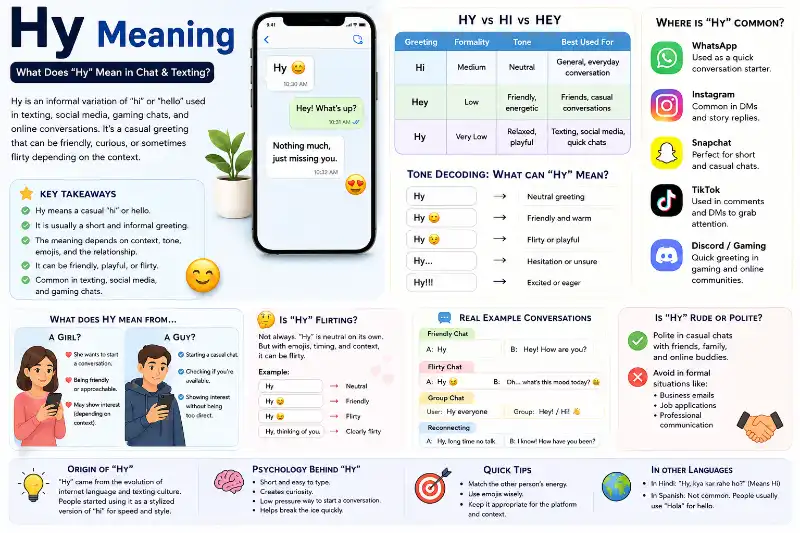
HY meaning in text is usually a casual way of saying “hi” or “hey,” but that is not the only possible meaning. In some conversations, HY can also mean “hell yeah” or “hell yes,” especially when someone uses it to strongly agree with something.
That can make a short message like “HY” confusing. If someone sends it to you, you may wonder whether they are simply greeting you, agreeing with you, trying to get your attention, or showing a little extra interest.
The good news is that you do not have to guess. The meaning of HY depends mainly on where it appears, what was said before it, and the overall tone of the conversation.
Did someone text you “HY” and leave you wondering what it means? You may be trying to figure out whether it means “hi,” “hey,” or “hell yeah”—especially if it came from a friend, someone you like, or someone you’re getting to know.
You may also wonder whether HY sounds friendly, flirty, rude, or simply casual, and whether its meaning changes across apps like WhatsApp, Instagram, Snapchat, TikTok, or Discord.
This guide will show you how to identify what HY means from the conversation, understand the sender’s tone, and choose the right response step by step.
What Does HY Mean in Text, and What Are Its Common Meanings?
The first thing to know is that HY does not always have one fixed meaning. In casual texting, its meaning changes according to context.
The two meanings you are most likely to encounter are:
- HY = Hi / Hey — when someone is starting a conversation
- HY = Hell Yeah / Hell Yes — when someone is strongly agreeing with something
There can also be less common interpretations, but you should not automatically assume one of them without looking at the surrounding message.
HY Means “Hi” or “Hey” When It Starts a Conversation
When someone sends “HY” as the first message, it usually works as a casual greeting.
For example:
Person A: HY
Person B: Hey! What’s up?
Here, HY simply means something like “Hi” or “Hey.”
People may use this spelling because it feels quick, informal, and natural in online conversations. It is similar to other casual variations such as “hey,” “heyy,” or shortened texting expressions.
You may see this use of HY when someone wants to:
- Start a conversation
- Get your attention
- Check whether you are online
- Reconnect with you
- Open a casual chat
So if HY appears at the beginning of a conversation, the safest interpretation is usually “Hi” or “Hey.”
HY Can Mean “Hell Yeah” or “Hell Yes” as an Agreement
The situation changes when HY appears as a response to something someone has already said.
For example:
Person A: Do you want to come with us tonight?
Person B: HY!
Here, HY may mean “Hell yeah!” or “Hell yes!”
It expresses strong agreement, excitement, or enthusiasm.
Another example:
Person A: Would you try that again?
Person B: HY 😂
In this situation, interpreting HY as a greeting would not make sense. The previous message gives you the clue that the sender is expressing agreement.
This is why you should never interpret HY in isolation when the conversation contains other messages.
HY Can Have Other Informal Meanings in Certain Contexts
In some conversations, people may give HY other informal interpretations, such as “hey you.” However, these uses are less important than the two main possibilities.
If someone writes:
HY, are you there?
they may simply be using HY as a casual way to get your attention.
The important rule is:
Do not force a rare meaning onto HY when the conversation clearly supports a common one.
Start with the most natural interpretation, then use context to confirm it.
Is HY an Abbreviation, a Typo, or Just an Informal Spelling?
If you’re wondering whether HY has an official full form, the answer depends on how it is being used.
When HY means “hi” or “hey,” it is generally better understood as an informal texting spelling, not a formal English abbreviation.
For example:
- Hi → HY can be a casual spelling variation.
- Hey → HY can also be understood informally.
- Hell Yeah → HY can function as an abbreviation in a different context.
So there is no single full form that works in every message.
If someone sends only:
HY
you need the surrounding conversation to determine what they intended.
How Can You Tell Which Meaning of HY Someone Intended?
This is the most useful part if you have actually received “HY” in a message and don’t know what it means.
Instead of guessing, follow these steps.
Step 1: Read the Message Before HY
First, look at what the other person said immediately before “HY.”
If there is no previous message and HY begins the conversation, it is probably a greeting.
Example:
HY, how are you?
Here, HY clearly works as “Hi” or “Hey.”
But if someone responds:
Do you want pizza?
HY!
the meaning is probably “Hell yeah!”
The previous message often gives you the strongest clue.
Step 2: Check Whether HY Starts or Replies to the Conversation
Ask yourself one simple question:
Is HY opening the conversation or answering something?
If it starts the conversation:
HY 👋
it probably means Hi/Hey.
If it answers a question or suggestion:
Want to go out tonight?
HY!
it can mean Hell Yeah/Hell Yes.
This simple test can eliminate much of the confusion.
Step 3: Look at Emojis, Punctuation, and Extra Letters
Emojis and punctuation can help you understand the intended tone.
For example:
HY 😊
This is likely a warm, friendly greeting.
HY!
The exclamation mark can make the message sound more energetic.
HY 😂
The laughing emoji may indicate a playful or humorous tone.
Likewise, variations such as HYY or HYYY may make a greeting feel more expressive or excited, although the exact tone still depends on the conversation.
Don’t treat an emoji as absolute proof. Use it as one clue alongside the actual words.
Step 4: Consider Your Relationship With the Sender
Think about who sent the message.
If it came from a close friend, HY is probably just a relaxed greeting or casual response.
If it came from someone you recently met, it may simply be an easy way to start talking.
If it came from someone you like, you may naturally wonder whether the message is flirty. But HY by itself is not enough evidence to prove romantic interest.
Your relationship helps explain the tone, but it should not override the actual conversation.
Step 5: Use the Rest of the Conversation to Confirm the Meaning
Finally, look at what happens after HY.
For example:
HY, what are you doing?
The next message confirms that the sender was opening a conversation.
Compare that with:
Are you coming with us?
HY!
The second conversation strongly suggests agreement.
If the meaning still isn’t obvious, read two or three messages before and after HY. Usually, the surrounding conversation makes the intended meaning much clearer.
Quick Examples: When HY Means “Hi” vs. “Hell Yeah”
| Conversation | Most likely meaning |
|---|---|
| HY, how are you? | Hi / Hey |
| HY! Long time no talk. | Hi / Hey |
| HY, are you online? | Hi / Hey |
| Do you want to come? — HY! | Hell Yeah / Hell Yes |
| Would you do it again? — HY 😂 | Hell Yeah / Hell Yes |
| Are you ready? — HY! | Strong agreement |
The easiest rule to remember is:
HY at the beginning of a conversation usually means “Hi” or “Hey.”
HY as an enthusiastic reply can mean “Hell Yeah” or “Hell Yes.”
When you’re unsure, read the message before it first. That one step often solves the confusion.
What Does HY Mean From a Girl, Guy, Friend, or Someone You Like?
If you’re asking because a particular person sent you “HY,” it is understandable to look for a deeper meaning. However, the sender’s gender does not automatically change what HY means.
The conversation and relationship matter much more.
Does HY Mean Something Different From a Girl or Guy?
Usually, no.
If a girl sends:
HY 😊
she may simply be saying “Hi” and starting a conversation.
If a guy sends:
HY, what’s up?
he may also simply be saying “Hey.”
The same applies to friends, classmates, online acquaintances, and other people you communicate with.
So don’t use “girl” or “guy” alone as the deciding factor.
Instead, ask:
- What did they say before HY?
- Why did they message you?
- What did they say afterward?
- Do they normally text you this way?
Those clues are more useful than gender.
Does HY Mean They Are Flirting or Interested?
Not necessarily.
A simple:
HY
does not automatically mean someone has a romantic interest in you.
It may simply mean:
“Hi, I want to talk.”
However, HY can become more personal when it appears alongside other signs of interest.
For example:
HY 😊 How have you been?
or:
HY 👀 What are you doing tonight?
These messages may feel more personal, but even then, you should consider the whole conversation rather than treating HY itself as proof of flirting.
How to Tell Friendly HY From Flirty HY
Look beyond the two letters.
A friendly HY might be followed by:
HY! How’s your day going?
A potentially flirty conversation might include:
HY 😉 What are you up to tonight?
The difference comes from the overall tone, wording, emojis, and relationship, not from HY alone.
So if you’re trying to determine whether someone is flirting, don’t ask only:
“What does HY mean?”
Ask:
“What does the entire conversation suggest?”
That gives you a much more reliable answer.
When You Should Not Assume HY Is Romantic
Avoid assuming that HY means romantic interest simply because:
- Someone messages you first
- They use an emoji
- They say HY instead of Hi
- They message you at night
- They continue the conversation
Any of these things can happen in an ordinary friendship or casual conversation.
HY is usually too short and ambiguous to reveal someone’s intentions by itself.
The safest approach is to look for a consistent pattern across the conversation instead of assigning a romantic meaning to one tiny greeting.
What Does HY Mean on WhatsApp, Instagram, Snapchat, TikTok, Discord & Gaming Chats?
Seeing HY on a particular app can make you wonder whether the platform gives it a different meaning. In most cases, it does not. The basic meaning still depends on the conversation.
What can change is the style and tone of communication. Some platforms encourage very short, fast messages, while others make people more expressive with emojis, reactions, or extra letters.
HY on WhatsApp, Messenger, and Instagram
On WhatsApp, Messenger, and Instagram, HY is commonly used as a casual conversation opener.
For example:
HY, what are you doing?
Here, HY most likely means “Hi” or “Hey.”
You may also see it in a direct message from someone you already know:
HY 😊 Long time no talk!
The greeting itself is still casual. The rest of the message tells you whether the person is simply saying hello, reconnecting, or trying to start a longer conversation.
If HY appears as a response instead:
Want to meet later?
HY!
then the surrounding conversation may indicate “Hell Yeah” or “Hell Yes.”
So on these apps, do not use the platform alone to determine the meaning. Read the message around HY.
HY on Snapchat and TikTok
Snapchat and TikTok often involve quick, informal communication, so short expressions such as HY can fit naturally into chats, comments, or live interactions.
For example:
HY 😄
can function as a simple greeting.
A message such as:
HY, loved your video!
is also clearly being used to start interaction.
However, if someone writes:
You wanna join us?
HY!
the context can point toward “Hell Yeah!”
The important point is that Snapchat or TikTok does not automatically give HY a special definition. The conversation still determines what the sender intended.
HY in Discord and Gaming Chats
In Discord and gaming communities, people often prefer short messages because conversations can move quickly.
A player might write:
HY team!
This is most naturally understood as “Hi team” or “Hey team.”
You might also see:
HY, ready to play?
Again, HY is functioning as a greeting.
Gaming conversations can also contain the agreement meaning:
Want to run another match?
HY!
Here, HY may mean “Hell Yeah!”
Because gaming chats move quickly, the best way to understand HY is to check whether the sender is greeting people or responding enthusiastically to something.
Does the Platform Change What HY Means?
Usually, no.
WhatsApp, Instagram, Snapchat, TikTok, Discord, and gaming chats may have different communication styles, but the basic interpretation of HY still comes from context.
A useful rule is:
The app can influence the tone, but the conversation determines the meaning.
So if you receive HY on a platform you rarely use, don’t assume it has a completely different definition. First check what the person was responding to and what they say afterward.
How Should You Reply to HY Based on What the Sender Means?
Once you understand what HY means, the next problem is simple:
What should you say back?
Your reply should match the meaning and tone of the original message. You do not need to overthink a simple greeting.
If HY Is a Casual “Hi” or “Hey”
If someone uses HY to greet you, a short friendly response is usually enough.
You can reply with:
Hey!
Hi 😊
Hey, what’s up?
Hi! How are you?
If you want to continue the conversation, add a simple question.
For example:
Them: HY
You: Hey! How are you?
Or:
Them: HY 😊
You: Hi! What’s going on?
There is no need to create a complicated response to a simple greeting.
If HY Means “Hell Yeah” or “Hell Yes”
If HY is being used as an enthusiastic agreement, respond to the idea or question that came before it.
For example:
You: Want to watch the game tonight?
Them: HY!
You: Awesome! What time?
Here, replying with another “Hi” would be confusing because HY was not being used as a greeting.
The key is to continue the conversation naturally rather than treating every HY as “hello.”
If You Are Not Sure What the Sender Means
Sometimes the context really is unclear.
Instead of guessing, look at the previous message first.
For example:
You: Are you free later?
Them: HY
If you cannot confidently tell whether they mean “Hell yeah” or something else, you can ask naturally:
“You mean yes? 😄”
Or simply continue with a clarifying question:
“Haha, is that a yes?”
This is often better than making an incorrect assumption.
If HY starts a conversation with no previous message, however, “Hi” or “Hey” is usually the most natural interpretation.
What Should You Reply When You Want to Keep the Conversation Going?
If someone sends only:
HY
and you want to keep talking, don’t feel limited to replying with another greeting.
Try:
Hey! How’s your day going?
Hi! What are you up to?
Hey, it’s been a while! How have you been?
Hi 😊 What’s new?
These replies give the sender something to respond to and help move the conversation forward.
If the person sends HY repeatedly without adding anything else, you can also let them explain why they contacted you:
Hey! What’s up?
That keeps the conversation natural without guessing their intention.
When Should You Use HY—and When Should You Avoid It?
HY is useful when you want to sound casual and relaxed, but it is not suitable for every situation.
The easiest way to decide is to consider who you’re talking to and how formal the conversation is.
Is HY Rude, Polite, or Just Casual?
HY is generally casual rather than rude.
Among friends or people who regularly text informally, a message like:
HY!
is unlikely to cause a problem.
However, the same spelling can look careless or overly informal when the recipient expects professional communication.
So the issue is usually not that HY is rude. The issue is whether the level of informality fits the situation.
Where Is HY Appropriate to Use?
HY can work naturally in situations such as:
- Texting friends
- Casual group chats
- Social media DMs
- Gaming conversations
- Informal online communities
- Conversations with people who already use casual texting language
For example:
HY bro, you online?
would feel normal in a casual gaming or friend conversation.
When Can HY Sound Too Informal?
HY may feel too casual when you are contacting someone for the first time in a formal setting or when the conversation has an important professional purpose.
For example, opening a message to an employer with:
Hy, I wanted to ask about the position.
can look less professional than a standard greeting.
The same applies when contacting:
- Employers
- Clients
- Teachers or academic staff
- Business contacts
- Senior professionals
- Official organizations
In these situations, the goal is not to sound unfriendly. It is to choose wording that matches the expected level of formality.
What Should You Use Instead in Professional or Formal Messages?
For professional communication, use a standard greeting such as:
Hello,
Hi [Name],
Good morning,
Good afternoon,
For example:
Casual:
Hy, can you send me the file?
More professional:
Hi Sarah, could you please send me the file?
The second version makes the message feel clearer and more appropriate for a formal setting.
A simple rule works well:
Use HY when the relationship is casual. Use “Hi” or “Hello” when professionalism matters.
FAQ About HY Meaning
Does Capitalization Change the Meaning of HY?
Usually, no.
“HY,” “hy,” and “Hy” generally communicate the same basic idea when they are being used as texting slang.
Capitalization may affect the appearance or tone, but it normally does not create a completely different meaning.
The surrounding words remain more important.
Does HYY or HYYY Change the Tone?
Extra letters can make a greeting feel more expressive, playful, excited, or drawn out.
For example:
HY
feels short and neutral.
HYY!
can feel more energetic.
HYYY 😂
may sound especially playful or enthusiastic.
However, extra letters do not guarantee flirting or romantic interest. They mainly add expression to the message.
Can Someone Use HY as a Nickname or Username?
Yes, HY can appear as part of a username, nickname, handle, or other online name, but that does not automatically mean the person is using HY as texting slang.
If you see HY inside someone’s username, profile name, game tag, or account name, look at the surrounding context before interpreting it as “hi,” “hey,” or “hell yeah.”
In other words, HY inside a name is a different situation from HY inside a conversation.
Is HY Understood the Same Way in Every Country?
Not necessarily.
Internet slang can spread across countries, but people do not all use abbreviations and informal spellings in exactly the same way.
Someone who regularly communicates in English online may immediately understand HY as a casual greeting. Another person may be unfamiliar with the spelling or interpret it differently.
If the recipient appears confused, using the standard “Hi” or “Hey” is clearer.
The safest approach is always to consider the language, communication habits, and context of the people involved.
Conclusion
HY usually works as a short, informal way to say “Hi” or “Hey” when it starts a conversation. In another context, particularly as an enthusiastic response, it can mean “Hell Yeah” or “Hell Yes.”
That difference is why looking at the message before HY is so useful. If HY opens the conversation, think greeting. If it responds enthusiastically to a question or suggestion, think agreement.
The sender’s relationship with you, emojis, extra letters, and the platform can help you understand the tone, but HY by itself does not prove that someone is flirting or showing romantic interest.
And if you’re deciding whether to use HY yourself, remember the simplest rule: it fits casual conversations, while “Hi” or “Hello” is safer for professional or formal communication.
Once you stop looking at HY as a word with only one fixed definition and start reading it in context, the confusion becomes much easier to solve.