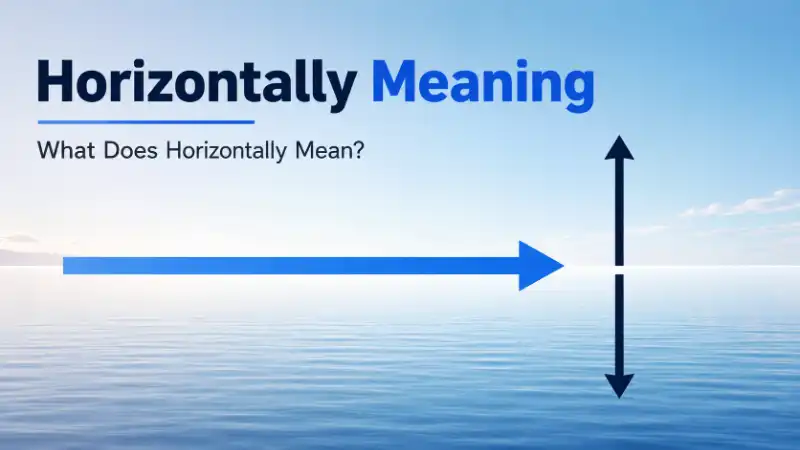
Horizontally meaning is moving, extending, or being positioned from side to side rather than up and down. In simple words, horizontally means across, usually from left to right or right to left, in a direction parallel to the horizon.
Think of a straight line stretching across the screen, a road running from one side to another, or the line where the sky appears to meet the ground. These are simple examples of the basic idea behind horizontal and horizontally.
You may see horizontally used in everyday English, math, geometry, technology, design, photography, and science. Whether someone says “move horizontally,” “scroll horizontally,” or “position the object horizontally,” the meaning stays simple: across from side to side, not vertically up or down.
What Does Horizontally Mean?
Horizontally in Simple Words
Horizontally means in a side-to-side direction or in a position that extends across rather than up and down.
For example, imagine drawing a straight line across a piece of paper:
Left ←────────→ Right
That line is horizontal. If something moves along that line, it moves horizontally.
Now compare it with a vertical direction:
Up ↑
Down ↓
A vertical movement goes up or down, while a horizontal movement goes from one side to the other.
This gives you the easiest memory rule:
- Horizontal = side to side
- Horizontally = in a side-to-side way
- Vertical = up and down
- Vertically = in an up-and-down way
What Does It Mean to Move Horizontally?
When someone says “move horizontally,” they mean move across a surface or space rather than moving upward or downward.
For example:
“Move the box horizontally across the table.”
The box is being moved from one side of the table toward the other.
You might also hear:
“Drag the image horizontally.”
“The object moved horizontally across the screen.”
“Scroll horizontally to see the next column.”
In each case, the movement follows a sideways path.
The direction does not have to be specifically left to right. It can also be right to left. What matters is that the movement stays along a horizontal path.
Is Horizontally Side to Side?
Yes. In simple everyday language, horizontally means side to side.
However, the more precise definition is that something is horizontal when its direction or position is parallel to the horizon or ground in the relevant context.
That distinction matters in technical subjects. For example, on a graph, a horizontal line runs across the page. In physics or engineering, a horizontal direction is considered relative to the reference frame and gravity.
So if you are simply trying to remember the word, think:
Horizontally = across, sideways, not vertically.
What Does Horizontal Mean?
Horizontal Meaning in English
Horizontal is the adjective form related to the idea of the horizon. It describes something that extends from side to side or is positioned parallel to the horizon or ground in a given context.
For example:
- “Draw a horizontal line.”
- “The shelf is horizontal.”
- “The image has a horizontal layout.”
- “The road has a horizontal section.”
Here, horizontal describes a person, object, line, position, direction, or arrangement.
The word horizontally, by contrast, tells us how something happens:
- “The shelf was placed horizontally.”
- “The image moved horizontally.”
- “The object traveled horizontally.”
That small difference is useful when learning English.
What Does It Mean to Be Horizontal?
To be horizontal means to be arranged or positioned across rather than upright.
A person lying flat on a bed is a familiar example of a horizontal position. A person standing upright is generally described as being in a vertical position.
You can also see the same contrast in objects:
- A book lying flat on a desk can be horizontal.
- A standing book can be vertical.
- A shelf extending across a wall can be horizontal.
- A tall pole standing upright is vertical.
The important idea is orientation, not simply whether something is physically “flat.”
Does Horizontal Mean Flat?
Not necessarily.
Horizontal does not always mean completely flat. It generally describes direction or orientation relative to the horizon, ground, or another reference frame.
For example, an object can move horizontally while still having height or depth. Likewise, a horizontal direction on a screen does not mean the object itself is physically flat.
This is why “horizontal = flat” is a useful beginner shortcut in some situations, but it is not a complete definition.
A more accurate rule is:
Horizontal describes an across-the-horizon direction or orientation.
Horizontal vs Horizontally
This is one of the most common grammar questions.
| Word | Grammar | What it does | Example |
|---|---|---|---|
| Horizontal | Adjective | Describes a noun | “The line is horizontal.” |
| Horizontally | Adverb | Describes how something happens | “The line extends horizontally.” |
Think of it this way:
Horizontal = what something is.
Horizontally = how something moves, extends, or is placed.
For example:
“The picture is horizontal.”
Here, horizontal describes the picture.
“The picture was displayed horizontally.”
Here, horizontally describes how the picture was displayed.
This distinction is especially useful in writing because the two words are closely related but do different grammatical jobs.
Horizontal Direction in Math and Everyday Life
The idea of horizontal direction becomes especially clear when you see it in a graph, on a page, or in familiar objects around you. In simple terms, a horizontal direction goes across rather than vertically up or down.
Horizontal Lines and the X-Axis
In math and geometry, a horizontal line extends from left to right without moving upward or downward.
On a standard coordinate graph, the x-axis is horizontal, while the y-axis is vertical. This makes the x-axis a useful visual reference for understanding horizontal direction.
For example, consider these two lines:
Horizontal: ─────────────────
Vertical:
│
│
│
│
The horizontal line stays at the same vertical level as it moves across the page.
This idea also appears when students are asked to draw a horizontal line, measure horizontal distance, or identify the horizontal axis of a graph.
What Is Horizontal Direction?
Horizontal direction means movement or position along a line that runs across a space rather than up or down.
If you walk from the left side of a room to the right side while staying on the same level, your movement is horizontal.
If you climb stairs, rise in an elevator, or move upward along a vertical path, the direction is different.
A useful way to remember it is:
- Horizontal direction: across
- Vertical direction: up or down
- Diagonal direction: slanted
The exact left-to-right orientation can change depending on where you are facing. The important feature is that the movement remains along the horizontal plane or line being used as the reference.
Horizontal Examples in Everyday Life
You encounter horizontal objects and positions all the time.
Examples include:
- A shelf extending across a wall
- A person lying on a bed
- A line drawn across a notebook
- A wide television screen
- A table surface
- A banner displayed across a webpage
- A horizon stretching across a landscape
These examples show why horizontal is more than a math term. It is part of ordinary descriptions of position, shape, direction, and movement.
Imagine placing a pencil on a desk. If the pencil points from left to right across the desk, it has a horizontal orientation. Turn it so that it points from the bottom of the desk toward the top, and its orientation becomes vertical.
What Does “Move Horizontally” Mean?
When instructions say “move horizontally,” they are telling you to move across rather than up or down.
You might hear this instruction in different situations:
“Move the object horizontally until it reaches the edge.”
“Move horizontally across the graph.”
“Drag the window horizontally.”
“The character moves horizontally across the screen.”
The same basic meaning applies in each example: the movement follows a side-to-side path.
In digital interfaces, horizontal movement can also mean moving through content from one side to another. For example, a row of products may require horizontal scrolling instead of the usual vertical scrolling.
Horizontal in Science and Engineering
The word also has a more precise meaning in technical fields.
In science and engineering, horizontal generally describes a direction or surface that is perpendicular to the vertical direction and parallel to the local horizon or level reference.
Builders, engineers, architects, and surveyors may need to distinguish horizontal measurements from vertical measurements.
For example:
- Horizontal distance measures across.
- Vertical distance measures upward or downward.
- Horizontal level refers to a level alignment.
- Horizontal movement describes movement across a reference plane.
This is why the word can appear in construction plans, engineering drawings, physics problems, architecture, and measurement instructions.
Horizontally vs Vertically: What Is the Difference?
The easiest way to understand horizontally vs vertically is to picture a line.
A horizontal line goes across:
←────────→
A vertical line goes up and down:
↑
│
│
↓
Horizontal Means Side to Side
Something horizontal extends across or is positioned along a horizontal direction.
For example:
“The shelf is horizontal.”
“Draw a horizontal line.”
“The image has a horizontal layout.”
Vertical Means Up and Down
Something vertical extends upward and downward or stands upright.
For example:
“The pole is vertical.”
“Draw a vertical line.”
“The menu is arranged vertically.”
This gives you a quick comparison:
| Horizontal | Vertical |
|---|---|
| Side to side | Up and down |
| Across | Upright |
| Left to right or right to left | Bottom to top or top to bottom |
| Horizon-like | Tower-like |
| Often wider than tall | Often taller than wide |
What Is the Opposite of Horizontally?
The usual opposite of horizontally is vertically.
If something moves horizontally, it moves across.
If it moves vertically, it moves up or down.
For example:
“Scroll horizontally to see the other columns.”
means move sideways.
“Scroll vertically to see the content below.”
means move up or down.
This distinction is particularly useful when using websites, mobile apps, graphs, maps, and other digital interfaces.
Which Way Is Horizontally?
Horizontally can mean left to right or right to left, depending on the direction of movement.
It does not always mean only “left to right.”
For example, if a person walks across a room from right to left, the movement is still horizontal. The direction is horizontal because the person is moving across rather than climbing upward or moving downward.
So when someone says:
“Move horizontally.”
Think across, not necessarily one specific side.
Why “Horizontal” Is Connected to the Horizon
The word horizontal is related to horizon, which helps explain why the meaning feels so natural.
When you look across a broad landscape, the horizon appears as a line extending from one side of your view to the other. This gives us a useful mental picture for remembering horizontal direction.
You do not need to memorize a complicated definition.
Just connect these ideas:
Horizon → across → horizontal → horizontally
Once that connection is clear, the difference between horizontal and vertical becomes much easier to remember.
Horizontal Position, Phones, Screens, and Design
The meaning of horizontally becomes even easier when you see how the word is used with position, phones, screens, images, and digital layouts. In each case, the basic idea remains the same: something is arranged, viewed, or moved across rather than vertically.
What Does Horizontal Position Mean?
A horizontal position means that something is arranged or oriented from side to side rather than standing upright.
A person lying flat on a bed is a simple example of a horizontal position. Their body extends across the mattress instead of rising vertically.
Objects can also have a horizontal position:
- A book lying flat on a table
- A shelf extending across a wall
- A picture placed across a wide surface
- A person lying down
- A line drawn across a page
However, horizontal position does not always mean that something is completely flat. The key idea is its orientation relative to the horizontal direction.
Lying Horizontally
When someone says that a person is lying horizontally, they generally mean the person is lying down rather than standing upright.
For example:
“The child was lying horizontally across the bed.”
The person’s body is positioned across the bed.
Compare that with:
“The person was standing vertically.”
The second example describes an upright position.
This is one of the easiest real-life ways to remember the difference between horizontal and vertical.
Horizontal Phone and Landscape Mode
You may hear someone say:
“Hold your phone horizontally.”
This means turning the phone sideways so that its longer dimension runs from left to right.
On most smartphones, this orientation is called landscape mode.
The opposite orientation is usually called portrait mode, where the phone is taller than it is wide.
For example:
Portrait:
📱
Landscape / horizontal:
📱 —
Horizontal orientation is especially useful when watching videos, viewing spreadsheets, playing certain games, or looking at wide images.
What Does Scroll Horizontally Mean?
Scroll horizontally means moving content from side to side instead of moving it up and down.
Most webpages use vertical scrolling. You move downward to see more content.
A horizontal scrolling interface works differently. Content may appear in a row, and you move left or right to see additional items.
For example:
“Scroll horizontally to see the remaining products.”
This means move across the row to reveal more products.
You may see horizontal scrolling in:
- Product carousels
- Image galleries
- Tables
- Dashboards
- Timelines
- Mobile apps
- Wide charts
The word horizontally tells you exactly which direction to move.
Horizontal Images and Videos
A horizontal image is wider than it is tall and is commonly associated with landscape orientation.
This format is popular for:
- Movies
- Television
- YouTube videos
- Landscape photography
- Website banners
- Presentations
- Desktop displays
A horizontal image gives the viewer more space from left to right.
That is one reason landscape photography often uses a horizontal frame: it can capture a wide scene such as a mountain range, coastline, road, or city skyline.
Horizontal Layouts in Design
In graphic design and web design, a horizontal layout arranges elements across a page or screen.
For example, a website might place a logo, navigation links, and buttons in one horizontal row.
A designer might also use a horizontal arrangement for:
- Navigation menus
- Banners
- Cards
- Timelines
- Infographics
- Product displays
- Headers
Horizontal layouts can make information feel broad and easy to scan from one side to another.
The exact design effect depends on the layout, spacing, typography, and content. So “horizontal” describes the arrangement, not a guaranteed visual feeling.
Horizontal vs Landscape: Are They the Same?
Not exactly.
Horizontal describes a direction or orientation.
Landscape is a term commonly used for an image, page, screen, or device orientation that is wider than it is tall.
For example:
“Turn the phone horizontally.”
This describes the action.
“Use landscape mode.”
This describes the resulting orientation.
In everyday technology conversations, the two terms are often used almost interchangeably, but their meanings are not identical in every context.
Horizontal in Architecture and Construction
Horizontal orientation is also important outside digital screens.
Architects and builders work with horizontal surfaces, lines, distances, and structures. A floor, shelf, beam, or level reference may need to maintain a particular horizontal alignment.
For example:
“Check whether the shelf is horizontal.”
This means checking whether it is level rather than tilted upward or downward.
This technical use shows why horizontal is more precise than simply saying “flat.” A surface may appear flat while still being tilted relative to the required horizontal reference.
Horizontal Objects You See Every Day
You do not need a textbook to find examples.
Look around you and you may see:
- A desk
- A tabletop
- A shelf
- A television
- A window ledge
- A road section
- A notebook line
- A picture frame
- A keyboard
- A wide sign
These everyday examples make the meaning easier to remember.
When you see something extending across your field of view, ask:
Is it going across rather than standing up?
If yes, it may be horizontal.
Horizontally in a Sentence, Spelling, and Common Mistakes
Knowing the definition is useful, but seeing horizontally in natural sentences makes the word much easier to use correctly.
Horizontally in a Sentence
Here are some natural examples:
- “The image is displayed horizontally.”
- “Move the box horizontally across the table.”
- “The line extends horizontally across the page.”
- “Scroll horizontally to view the next section.”
- “She held the phone horizontally while recording.”
- “The object moved horizontally across the screen.”
- “The picture was positioned horizontally.”
- “The two shelves were arranged horizontally.”
Notice that horizontally usually describes an action, movement, arrangement, or direction.
How Do You Spell Horizontally?
The correct spelling is:
horizontally
It comes from horizontal + -ly.
Some people type or spell it incorrectly because the middle of the word can be easy to mix up.
Common incorrect forms include:
- horizontaly
- horizontly
- horizantally
- horisontally
- horizentally
These are not standard English spellings.
A useful way to remember the correct form is to start with the base word:
horizontal → horizontally
The spelling of the base word stays recognizable when -ly is added.
Common Mistakes With Horizontal and Horizontally
Mistake 1: Using “horizontal” when an adverb is needed
Incorrect:
“The object moved horizontal.”
Better:
“The object moved horizontally.”
Here, horizontally explains how the object moved.
Mistake 2: Assuming horizontal always means perfectly flat
Horizontal describes orientation or direction relative to a reference. It does not simply mean “flat” in every situation.
Mistake 3: Thinking horizontally only means left to right
Horizontally can describe movement in either direction across a horizontal path.
A movement from right to left can still be horizontal.
Mistake 4: Confusing horizontal with diagonal
A diagonal line is slanted.
A horizontal line runs across without rising or falling.
Mistake 5: Confusing horizontal with landscape
Landscape is often used for wider-than-tall screens or images. Horizontal is the broader directional term.
What Is the Opposite of Horizontally?
The usual opposite of horizontally is vertically.
If something moves horizontally, it moves across.
If something moves vertically, it moves up or down.
For example:
“The menu opens horizontally.”
means it expands across.
“The menu opens vertically.”
means it expands upward or downward.
This simple distinction is useful in everyday speech, math, design, technology, and instructions.
A Quick Memory Trick
If you forget the meaning, remember the two words as a pair:
Horizontal → across
Vertical → upright
Then turn them into adverbs:
Horizontally → across in a horizontal direction
Vertically → up or down in a vertical direction
That mental picture is often enough to understand the word immediately.
Frequently Asked Questions
What does horizontally mean in simple words?
Horizontally means from side to side, rather than up and down. It usually describes something that moves, extends, or is positioned across a horizontal direction.
For example, if you move a picture from the left side of a screen to the right side, you are moving it horizontally.
What does horizontal mean?
Horizontal means extending across or positioned parallel to the horizon or a level reference.
A line drawn from left to right across a page is a horizontal line. A shelf that extends across a wall can also have a horizontal position.
What is the difference between horizontal and horizontally?
Horizontal is usually an adjective, while horizontally is an adverb.
- “The line is horizontal.”
- “The line extends horizontally.”
The first describes the line. The second describes how the line extends.
Is horizontal sideways or up and down?
Horizontal is generally understood as side to side, not up and down.
A horizontal direction can be left to right or right to left. The opposite direction is vertical, which refers to movement or position up and down.
What is the opposite of horizontally?
The usual opposite of horizontally is vertically.
Horizontal movement goes across, while vertical movement goes upward or downward.
What does horizontal position mean?
A horizontal position means that something is arranged or oriented across rather than upright.
A person lying down on a bed is a familiar example. A shelf extending across a wall can also have a horizontal position.
What does it mean to move horizontally?
To move horizontally means to move across a space along a horizontal path.
For example:
“Move the image horizontally across the screen.”
This means move the image from one side toward the other instead of moving it upward or downward.
What does scroll horizontally mean?
Scroll horizontally means moving through content from side to side.
For example, a row of products may extend beyond the visible screen. You can scroll horizontally to the left or right to see the remaining products.
How do you spell horizontally?
The correct spelling is horizontally.
It is formed from the word horizontal with the ending -ly.
Common misspellings such as “horizontaly” or “horizontly” are not standard English spellings.
Can you give an example of horizontally?
Sure. Consider a line across a notebook:
←────────────→
The line extends horizontally.
Another example is a phone turned sideways for landscape viewing. The phone is being held horizontally.
Does horizontal mean flat?
Not always. Horizontal refers primarily to direction or orientation relative to a horizon, ground, or other reference.
“Flat” can describe a surface without necessarily explaining its orientation. Something can be flat but tilted, while a horizontal surface is aligned with the relevant horizontal reference.
What is a horizontal line?
A horizontal line runs across a surface without rising or falling.
On a standard graph, the x-axis is horizontal and the y-axis is vertical.
What does horizontally mean in math?
In math and geometry, horizontally generally describes movement or extension along the horizontal direction.
For example, a horizontal line on a coordinate plane runs parallel to the x-axis.
What does horizontally mean on a phone?
On a phone, holding it horizontally usually means turning it sideways into landscape orientation.
This wider orientation is often useful for videos, games, photographs, spreadsheets, and other content designed for a broad screen.
Why is it called horizontal?
The word horizontal is connected to horizon, the apparent line where the sky and earth seem to meet.
The horizon gives us the familiar visual idea of a line stretching across rather than rising vertically.
That connection makes the word easier to remember:
horizon → horizontal → horizontally
Final Takeaway
The simplest horizontally meaning is side to side or across, rather than up and down.
Use horizontal when describing something, such as a horizontal line or horizontal position. Use horizontally when describing how something moves, extends, or is arranged, such as “move horizontally” or “the image is displayed horizontally.”
Whether you encounter the word in English, math, geometry, technology, design, photography, or everyday conversation, the central idea stays the same: horizontal is across; vertical is up and down.