You may have come across Hoodyvan.com while searching for information online. But what exactly is this website? Is it a blog, a business, or a place where people can publish articles?
The answer isn’t as clear as you might expect.
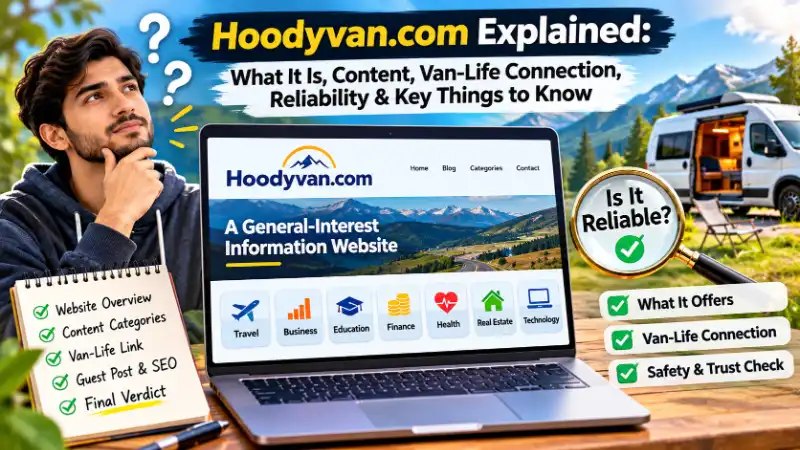
Hoodyvan.com appears to be associated with a general-interest information website covering topics such as travel, business, education, finance, health, real estate, and technology. The domain also appears on a third-party guest-post marketplace. However, its current content, ownership, and services have not been fully verified.
Some online articles even describe Hoodyvan.com as a van-life brand. That makes things more confusing.
This article explains what the available information tells us about Hoodyvan.com, why different descriptions exist, and what you should know before using the website or relying on its content.
What Is Hoodyvan.com?
Hoodyvan.com is a website domain associated with the name Hoody Van. Based on available third-party descriptions, it appears to be connected to general information and online article publishing.
A general-interest website covers several subjects instead of focusing on one topic. For example, a reader might visit such a website for travel information and later read an article about business or technology.
That seems to be the type of website described in some Hoodyvan.com search results.
However, there is an important difference between what other websites say about Hoodyvan.com and what its official pages directly confirm.
During research on November 1, 2026, attempts to access the official website were unsuccessful. The www version returned a 403 Forbidden response. This prevented a full review of its homepage, navigation, published articles, and current services.
As a result, several details remain unknown, including:
- Who currently owns or operates the website.
- How many articles are available.
- Whether its reported content categories are active.
- Whether visitors can create accounts or submit articles.
- Whether the website offers paid services.
These missing details do not mean the website is fraudulent or no longer operating. They simply limit what can be confirmed.
For now, the most accurate description is that Hoodyvan.com is a domain linked by third-party sources to online information publishing, but its current operation has not been independently established.
That distinction matters because readers should receive a clear explanation without being given facts that have not been checked.
What Kind of Content Is Associated With Hoodyvan.com?
If Hoodyvan.com is an information website, the next question is simple: What can people read there?
A third-party article published by Baddiehub Magazine on October 28, 2026, identifies seven broad subject areas associated with the domain.
These are travel, business, education, finance, health, real estate, and technology.
Let’s look at what those categories mean without assuming that every category has an active collection of articles.
Travel and education are subjects that can help readers learn about places, experiences, and everyday questions. A travel section might contain destination information, while an education section might explain learning-related topics. These are examples of what such categories normally contain, not confirmed Hoodyvan.com articles.
Business and technology are broader subjects that may interest people looking for information about companies, digital tools, online services, or changes in how businesses work.
Finance, health, and real estate involve decisions that can have a greater effect on someone’s life. Information in these areas may concern personal money, well-being, or property. Readers should be especially careful about accuracy when using advice from an unfamiliar publisher.
There is another detail worth understanding.
A website can display a category without having much content in it. It may also have older articles that are no longer updated.
For example, seeing a category called “Technology” does not prove that the website has current software reviews, device comparisons, or technology news.
To confirm real coverage, we would need to see accessible article pages, titles, publication dates, and the information inside them.
That evidence was not available during the latest direct website check.
So, the seven subjects should be treated as reported content categories, not a verified list of active Hoodyvan.com publications.
If you can access the website yourself, its article archive and navigation menu would provide a better picture of what it currently offers.
Why Do Some Websites Connect Hoodyvan.com With Van-Life Products?
Here is where the search results become a little unusual.
While one description presents Hoodyvan.com as a general information website, another article connects the name to van camping and vehicle accessories.
A TechnoChops article published on May 9, 2026 describes Hoodyvan.com in connection with stealth camping, magnetic window covers, and vehicle insulation.
These products are commonly associated with people who travel or live in camper vans.
For example, an insulated window cover may be used to block light and improve privacy while a vehicle is parked. That is a real type of accessory, but the existence of such products does not establish that Hoodyvan.com sells or manufactures them.
The important question is not whether van-window accessories exist. It is whether those products have a verified connection to Hoodyvan.com.
The available evidence does not establish that connection through an official product catalog or a confirmed statement from the domain operator.
This leaves two different descriptions of the same name:
One describes a website covering general information topics. The other connects the name to van-life equipment and camping comfort.
Both descriptions come from outside sources. Neither should be treated as a complete official company profile.
You know, it is easy to assume that a detailed article must be accurate. But an article can contain specific product descriptions and still fail to prove which business owns the products.
A stronger connection would require evidence such as an official product page, a clearly identified business, or documentation linking the brand to the exact domain.
Until that evidence is available, Hoodyvan.com should not automatically be described as a camper-van equipment store or manufacturer.
This also helps explain why searching the same domain may produce very different answers.
What If Hoodyvan.com Doesn’t Open?
Suppose you type Hoodyvan.com into your browser and the page fails to load.
Does that mean the website is closed?
Not necessarily.
During the latest research, the official domain could not be fully accessed. A request to the www address returned an HTTP 403 Forbidden error.
A 403 error means that the server received a request but refused to allow access to the requested resource.
There are several possible reasons for this.
A website may restrict automated research tools, limit traffic from certain networks, or use security settings that block particular requests. Access can also be affected by server configuration.
That does not mean we know which explanation applies to Hoodyvan.com.
A 403 response is an access restriction, not proof that a website is a scam, permanently offline, or infected with malware.
If you have trouble opening the domain, start with the simplest explanation.
First, make sure the address is spelled correctly. The domain discussed here is hoodyvan.com, not a similarly named clothing website or another online business.
Next, try opening the main address again in a normal browser. A temporary error may disappear, although repeated attempts are not guaranteed to work.
If a specific page fails but the homepage opens, the problem may affect only that page.
You can also read the actual browser message. A 403 error, a missing-page error, and a connection timeout mean different things.
Do not try to bypass access controls or install unknown software simply because a website is blocked.
And if the website remains unavailable, remember that outside search results may describe older versions of its content.
The fair conclusion is this: Hoodyvan.com’s current accessibility could not be confirmed for ordinary visitors through the research tool. That limitation does not establish its overall safety or operating status.
Is Hoodyvan.com Reliable Enough to Use?
This is probably the most important question if you plan to rely on information from the website.
There is not enough independently verified evidence to give Hoodyvan.com a definite trustworthy or untrustworthy rating.
The domain appears in outside articles and a publishing marketplace. But appearing in search results does not confirm that a website has accurate articles, a responsible publisher, or clear privacy practices.
That does not mean you should assume the worst. It means your level of confidence should match the evidence available.
There are three different things to consider: who runs the website, how reliable its information is, and what happens if you share personal details.
Who Is Responsible for the Website?
A website address does not always tell you who operates the site.
A publisher may be an individual, a small editorial team, or a registered business. To understand who is responsible, it helps to find a clear connection between the website and the people behind it.
An About page can explain the site’s purpose. A Contact page may provide a way to reach the operator. Author profiles can show who writes the articles.
But these pages must actually be accessible and contain meaningful information.
During the research, the official Hoodyvan.com pages could not be fully inspected. Its current operator therefore remains unverified.
Another source of information is ICANN Lookup, which provides access to publicly available domain-registration data.
Such records may help identify a domain registrar and certain registration details. However, private registration services can hide information about the registrant.
Also, the company that registers a domain is not necessarily the company that operates the website.
For example, a domain may use a well-known registrar while being managed by a completely different business.
That is why registration information should be considered supporting evidence rather than automatic proof of ownership.
The available research does not establish who currently runs Hoodyvan.com. A reliable ownership claim would need to be supported by an official disclosure or other independently confirmed records.
Can Readers Depend on Its Articles?
Even when a website has a known publisher, its individual articles still need to be accurate.
Imagine reading two articles about the same financial question.
One explains its claims using official sources and provides enough detail for readers to confirm the information.
The other makes strong promises but gives no sources, author details, or explanation of where its numbers came from.
The first article gives you more evidence to judge. The second leaves you guessing.
The same idea applies to any content found on Hoodyvan.com.
When reading an article, pay attention to who wrote it, when it was published, and whether important claims are supported by reliable sources.
Not every article needs a long reference list. But claims about money, medical treatment, property rules, and other serious matters need stronger support than everyday opinions.
For instance, if an article discusses health advice, compare important recommendations with established medical sources. If it explains a financial rule, an official financial or government source may provide more reliable confirmation.
Publication dates matter, too. Information about software, regulations, services, and prices can become outdated.
Because Hoodyvan.com’s current article catalog could not be reviewed, there is no sound basis for giving its editorial quality a positive or negative score.
The sensible approach is to judge each accessible article by the evidence it provides, rather than trust every claim because it appears on one domain.
What About Personal Information and Payments?
Reading a public webpage and entering personal information are two very different activities.
For example, opening an informational article normally involves a different level of risk from submitting a credit card number or creating an account with a password.
The available research does not confirm whether Hoodyvan.com requires registration, offers subscriptions, or processes payments.
If you encounter a form requesting personal information, understand what the information is needed for before submitting it.
A privacy policy should explain how information is collected, used, and shared. Terms of service may explain the rules for using a platform.
Also, look at the actual website address before entering a password or payment information. A similarly spelled domain could lead somewhere entirely different.
You may notice HTTPS in a website address. This helps protect information traveling between your browser and the website.
However, HTTPS does not prove that the business behind a website is honest or that its content is reliable.
The Federal Trade Commission’s online shopping guidance makes this distinction clear and recommends checking unfamiliar sellers and their policies before making purchases.
For Hoodyvan.com, there is no verified evidence here of a required account, subscription fee, or payment process. Those features should not be assumed.
If an unexpected page asks for sensitive details or an unfamiliar download, do not provide them merely to access information.
The overall lesson is simple: an unfamiliar domain does not deserve an automatic negative judgment, but important decisions should depend on more than the domain’s appearance in search results.
Why Is Hoodyvan.com Listed on a Guest-Post Marketplace?
There is another reason someone might search for this website.
Hoodyvan.com appears in the Adoovy publisher catalog, a marketplace that advertises opportunities to publish content on different websites.
A guest post is an article written for publication on someone else’s website. Businesses, writers, and marketing professionals sometimes use guest posts to reach new readers or share their expertise.
The Adoovy catalog lists Hoodyvan.com in the Finance, Health, and Technology categories.
During the November 1, 2026 review, the listing displayed a $90 publication price, along with third-party SEO measurements.
This tells us something specific: a marketplace is advertising a publishing placement associated with the exact domain.
But it does not answer every important question.
For example, the listing alone does not prove that the domain owner directly manages the offer. It also does not establish the site’s actual readership, editorial quality, or current ability to publish a submitted article.
The price is a marketplace advertisement, not a verified official Hoodyvan.com service fee.
If you are thinking about paying for a guest post, the first issue is whether the seller has permission to arrange publication.
Next comes the quality of the website itself.
A domain rating or traffic estimate may look impressive, but these numbers are not the same as real readers who care about the published content.
A website with a smaller but relevant audience may be more useful for genuine communication than a site with higher estimated metrics and little connection to your subject.
You should also understand what the payment includes. Does the agreement specify publication, review standards, how long the article remains online, and what happens if the placement cannot be completed?
These details matter more than a marketplace badge.
There is also an important Google Search rule.
Google allows websites to publish sponsored material, but links in paid placements should be properly qualified. Its outbound-link guidance recommends rel="sponsored" for advertising and paid placements, while rel="nofollow" is also acceptable.
Google’s spam policies identify paid links intended mainly to manipulate search rankings as a form of link spam when they are not appropriately qualified.
This means buying a guest post is not a guaranteed way to improve Google rankings. A paid placement should make sense for its content, audience, and clearly disclosed commercial purpose.
For Hoodyvan.com, the Adoovy listing establishes an advertised publishing opportunity, not a confirmed SEO benefit or a verified publishing relationship with the website’s operator.
Anyone considering that offer should establish those facts before paying.
For an ordinary visitor who simply wants to read information, this marketplace listing is background context. It does not determine whether a particular Hoodyvan.com article is useful or accurate.
What Is the Bottom Line on Hoodyvan.com?
Hoodyvan.com is associated in third-party sources with a website covering several general-interest subjects. It also appears in a marketplace advertising guest-post publishing.
However, its official pages could not be fully inspected during the November 1, 2026 research. That leaves important questions about its current content, ownership, services, and privacy practices unanswered.
The conflicting van-life description adds another reason not to rely on outside claims without checking their source.
The fairest assessment is that Hoodyvan.com has a visible presence in third-party sources, but the available evidence is not enough to confirm its complete purpose, operating details, or overall trustworthiness.
If you visit the website to read an article, judge the information by its sources and accuracy. If you are considering sharing private details or paying for a publishing service, establish who is responsible and what the agreement involves.
That way, you can make a sensible decision based on evidence instead of assumptions.