Gerund meaning is one of the most searched grammar topics by English learners around the world. If you’ve ever seen words like swimming, reading, or writing and wondered whether they are verbs or nouns, you’re not alone.
In simple terms, gerund meaning refers to a verb form that ends in –ing but functions like a noun in a sentence. Once you understand this idea, recognizing gerunds in everyday English becomes much easier and even interesting.
Gerund Meaning in English Grammar Explained
In English grammar, a gerund is a special verb form that ends in –ing but behaves like a noun.
Normally, verbs show actions:
- run
- read
- cook
- swim
But when we add –ing and use the word as a noun in a sentence, it becomes a gerund.
Simple Gerund Definition
A gerund is:
A verb ending in –ing that functions as a noun in a sentence.
Example:
Swimming is fun.
In this sentence, swimming is not describing an action someone is doing right now. Instead, it represents the idea of an activity, which makes it a gerund.
Easy Examples of Gerunds
Here are some clear examples:
- Reading improves knowledge.
- Cooking relaxes me.
- Running keeps you healthy.
In these sentences, the words:
- reading
- cooking
- running
all act like nouns, which is why they are called gerunds.
This is why many learners search for what is gerund meaning or gerund meaning in English grammar when studying English.
Why Students Get Confused About Gerund Meaning
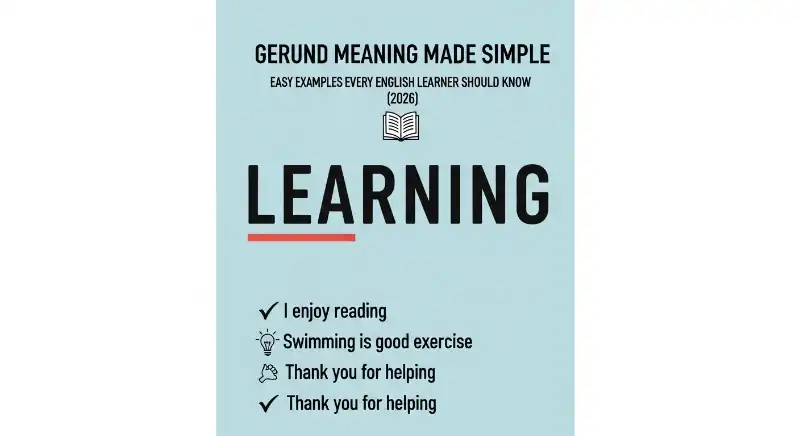
Many students find gerunds confusing because –ing words can serve different roles in English grammar.
Sometimes they are gerunds, but other times they may be:
- present participles
- part of continuous verb tenses
- descriptive verb forms
Example of the Confusion
Look at this sentence:
She is running.
Here, running is not a gerund. It is part of the present continuous tense.
Now compare it with this sentence:
Running improves health.
In this example, running is the subject of the sentence, so it behaves like a noun. That makes it a gerund.
A Simple Trick to Identify Gerunds
Ask yourself one question:
Is the –ing word acting like a noun?
If the answer is yes, then it is likely a gerund.
Example comparison:
| Sentence | Role |
| She is running fast | Verb form |
| Running is healthy | Gerund (noun) |
This small trick helps learners quickly understand the gerund meaning in English grammar.
What Is a Gerund Phrase?
Once you understand gerunds, the next step is learning about gerund phrases.
Gerund Phrase Definition
A gerund phrase includes:
- a gerund
- plus other words that complete its meaning
Example:
Swimming in the ocean is exciting.
Gerund phrase:
Swimming in the ocean
Another example:
Reading books before bed improves sleep.
Gerund phrase:
Reading books before bed
Why Gerund Phrases Are Useful
Gerund phrases make sentences more descriptive and natural.
Example comparison:
Simple sentence:
Swimming is fun.
Expanded sentence:
Swimming in the ocean is exciting.
The second sentence provides more detail and sounds more expressive in everyday English.
What Are Some Easy Examples of Gerunds in Sentences?
The best way to understand gerund meaning and examples is by looking at real sentences.
Here are some common examples used in everyday English.
Simple Gerund Sentences
- Swimming is my favorite hobby.
- Reading helps you learn new ideas.
- Cooking makes people happy.
- Traveling teaches you about cultures.
- Learning English opens new opportunities.
- Writing improves communication skills.
- Running every morning keeps you healthy.
- Listening carefully improves understanding.
- Watching movies can improve language skills.
- Practicing daily leads to success.
In each sentence, the –ing word works like a noun, which makes it a gerund.
Gerund Meaning in Everyday English Conversation
Gerunds are not only found in grammar textbooks. They are very common in daily conversations and natural English speech.
You may hear sentences like these in everyday life:
- Learning new things is exciting.
- Watching movies helps improve English.
- Traveling changes your perspective.
- Listening carefully shows respect.
- Helping others feels rewarding.
Notice how each –ing word represents an activity or idea.
This is why gerunds are such an important part of natural English communication.
Common Verbs That Are Followed by Gerunds
In English, some verbs are usually followed by gerunds instead of infinitives.
Learning these verbs helps students build grammatically correct sentences.
Common Verbs That Use Gerunds
Examples include:
- enjoy reading
- avoid making mistakes
- consider studying abroad
- finish writing the report
- keep practicing daily
- suggest trying a new method
- imagine living in another country
- mind helping me
- quit smoking
- delay making a decision
Example Sentences
- I enjoy reading books.
- She avoided answering the question.
- They finished cleaning the room.
💡 Tip:
After these verbs, the –ing form is usually required, not the infinitive.
Understanding these patterns helps learners use gerund forms correctly in sentences.
Verbs That Can Be Followed by Both Gerunds and Infinitives
Some English verbs are flexible. They can be followed by either a gerund or an infinitive. However, the meaning of the sentence can sometimes change depending on which form you use.
Understanding these verbs helps learners avoid confusion when studying gerund meaning in English grammar.
Common Verbs That Allow Both Forms
Examples include:
- remember
- stop
- try
- begin
- start
- continue
- love
- hate
Example Sentences
Remember
- I remember meeting her at the conference.
- I remembered to meet her at the station.
Stop
- He stopped smoking last year.
- He stopped to smoke outside.
Try
- Try studying in the morning.
- Try to study harder for the exam.
Notice how the meaning of the sentence can change slightly depending on the form used.
Learning these patterns makes it easier to understand infinitive and gerund meaning in real English usage.
Gerund vs Infinitive: What Is the Difference?
One of the most common grammar questions is the difference between gerunds and infinitives.
A gerund uses the –ing form of a verb and functions as a noun.
An infinitive uses to + base verb.
Simple Comparison
| Gerund | Infinitive |
| Reading helps you learn. | I want to read. |
| Swimming is healthy. | She hopes to swim tomorrow. |
| Writing improves skills. | He plans to write a book. |
Key Difference
- Gerund: verb + ing
- Infinitive: to + verb
Both forms can sometimes act like nouns, but they are used in different grammatical situations.
Understanding this difference helps students write more natural sentences.
Gerund vs Present Participle: Why Are They Often Confused?
Another reason learners search for gerund meaning grammar is because gerunds look identical to present participles.
Both forms end with –ing, but they serve different purposes in a sentence.
Key Difference
| Gerund | Present Participle |
| Acts as a noun | Acts as verb or adjective |
| Swimming is fun | She is swimming |
| Reading improves knowledge | The reading student is quiet |
Example Explanation
Sentence 1:
Swimming is relaxing.
Here, swimming is the subject of the sentence. It behaves like a noun, so it is a gerund.
Sentence 2:
She is swimming in the pool.
Here, swimming is part of the verb phrase, so it is a present participle.
Quick Identification Tip
Ask yourself:
Is the –ing word acting like a thing or an action?
- If it represents an idea or activity, it is a gerund.
- If it shows an ongoing action, it is a participle.
Practice Exercises to Understand Gerunds
Practice helps students fully understand the gerund meaning and usage in sentences.
Try filling in the blanks with the correct –ing form.
Fill in the Blanks
1️⃣ I enjoy ___ (read) books.
2️⃣ She avoided ___ (answer) the question.
3️⃣ They finished ___ (clean) the room.
4️⃣ He suggested ___ (try) a new method.
5️⃣ We discussed ___ (travel) next year.
Correct Answers
1 reading
2 answering
3 cleaning
4 trying
5 traveling
These simple exercises help learners practice recognizing gerunds in real sentences.
Gerund Quiz: Test Your Knowledge
Now try this quick quiz to check your understanding.
Question
Identify the gerund in the following sentences:
1️⃣ Reading improves vocabulary.
2️⃣ She is reading a book.
Answer
Sentence 1 → Reading is a gerund because it acts as the subject.
Sentence 2 → reading is a present participle, not a gerund.
This small difference shows why understanding gerund meaning in English grammar is important.
Quick Gerund Rules Cheat Sheet
Here is a quick summary of the most important gerund rules.
Key Rules
✔ Gerunds always end in –ing
✔ Gerunds act as nouns in sentences
✔ They can be subjects, objects, or objects of prepositions
✔ Some verbs require gerunds instead of infinitives
✔ Gerunds often appear after prepositions
Example
- Reading improves knowledge.
- She enjoys painting.
- They talked about traveling.
This simple cheat sheet helps learners quickly remember the basic gerund meaning and rules.
Why Gerunds Are Important in English Communication
Gerunds are extremely common in modern English. They appear in conversations, writing, education, and even professional communication.
Think about these everyday sentences:
- Learning never stops.
- Traveling changes your perspective.
- Helping others feels rewarding.
In each case, the gerund represents an activity or concept.
Benefits of Understanding Gerunds
Learning gerunds improves:
Speaking fluency
You can express activities naturally.
Writing clarity
Your sentences become smoother and more professional.
Academic English
Gerunds are frequently used in essays and reports.
Related Grammar Topics You Should Learn
If you want to master English grammar, these topics are closely related to gerunds.
Learning them will help you understand verb forms more clearly.
Important grammar topics include:
- infinitive meaning
- participle meaning
- parts of speech
- verb forms in English
- present continuous tense
Studying these concepts together builds stronger grammar knowledge.
Final Thoughts: Mastering Gerunds Makes English Much Easier
Understanding gerund meaning is a small step that can make a big difference in learning English.
At first, gerunds may seem confusing because they look like verbs. But once you realize they function as nouns, the idea becomes much easier to understand.
Examples like:
- Reading improves knowledge.
- Swimming keeps you healthy.
- Learning English opens new opportunities.
show how common gerunds are in everyday language.
The more examples you read and practice, the easier it becomes to recognize and use gerunds correctly.
Mastering gerunds also makes other grammar topics—like infinitives, participles, and sentence structure—much easier to understand.
FAQ: Gerund Meaning Explained
What is a gerund in simple words?
A gerund is a verb form that ends in –ing but acts like a noun in a sentence. For example, in the sentence “Reading improves knowledge,” the word reading is a gerund because it behaves like a noun.
What is the gerund meaning in English grammar?
In English grammar, gerund meaning refers to a verb ending in –ing that functions as a noun. Gerunds can act as the subject, object, or object of a preposition in a sentence.
Example:
Swimming is good exercise.
How do you identify a gerund in a sentence?
You can identify a gerund by checking if the –ing word is acting like a noun.
Example:
Running every day improves health.
Here, running is the subject of the sentence, so it is a gerund.
What is the difference between a gerund and an infinitive?
A gerund uses the –ing form of a verb, while an infinitive uses to + base verb.
Examples:
Gerund: Reading helps you learn.
Infinitive: I want to read a book.
Both forms can function as nouns but are used in different grammatical situations.
What is the difference between a gerund and a participle?
A gerund acts like a noun, while a participle acts like a verb or adjective.
Example:
Gerund: Swimming is fun.
Participle: She is swimming in the pool.
Although both end in –ing, their roles in the sentence are different.
Can a gerund be the subject of a sentence?
Yes, gerunds often act as the subject of a sentence.
Examples:
Reading improves vocabulary.
Traveling teaches you about different cultures.
In both sentences, the gerund represents an activity.
📚 Related Articles
What Does a Preposition Do in English Grammar?

Mush explores trending words, viral slang, and social media phrases, explaining them in simple English with fun examples for everyone.



1 thought on “Gerund Meaning Made Simple: Easy Examples Every English Learner Should Know (2026)”