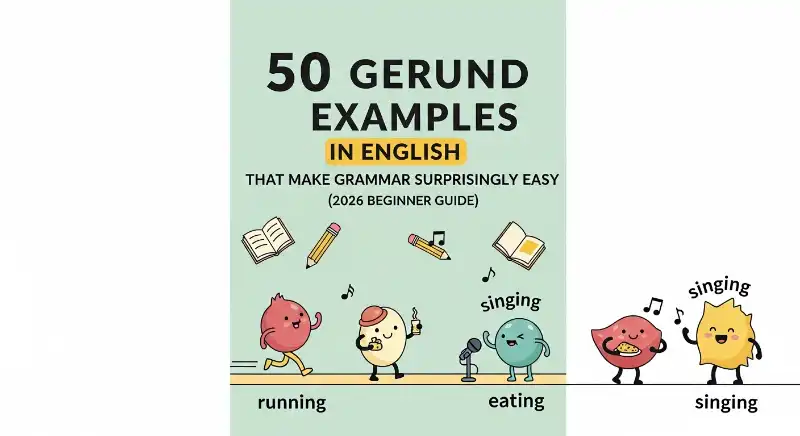
Gerund examples are one of the easiest ways to understand how English grammar really works in everyday life. If you’ve ever wondered why sentences like “Swimming is fun” or “I enjoy reading” sound natural, the secret is the gerund—a verb ending in -ing that behaves like a noun.
A gerund is a verb ending in -ing that acts like a noun in a sentence. Example: “Reading is fun.”
For many English learners, this small grammar idea unlocks a big improvement in speaking and writing. Once you see gerund examples in sentences, the pattern becomes clear. In this beginner-friendly guide, we’ll explore simple explanations, real-life examples, and easy tricks so you can recognize and use gerunds naturally in daily English.
What Is a Gerund in English Grammar? (Simple Explanation)
A Gerund Is a Verb That Acts Like a Noun
In English grammar, a gerund is a verb that ends with -ing but functions as a noun in a sentence.
Think of it like this:
- A verb shows action
- A noun names a thing
- A gerund does both
👉 In simple words: a gerund turns an action into a thing.
Example:
Swimming is fun.
Reading improves knowledge.
Cooking relaxes me.
In these gerund examples in English, the words swimming, reading, and cooking are actions. But they act as subjects, just like nouns.
Simple Gerund Examples for Beginners
Here are a few easy gerund examples sentences beginners often see:
- Swimming is good exercise.
- Learning English takes practice.
- Writing every day improves skills.
- Traveling teaches new ideas.
- Reading builds vocabulary.
👉 Notice something important: In all these sentences, the gerund is the main idea (subject).
These are classic gerund examples in English grammar, where the action word becomes the main topic of the sentence.
Why Do English Learners Often Confuse Gerunds?
Gerund vs Present Participle Confusion
One reason learners struggle is that gerunds and present participles look identical. Both use the -ing form.
Example:
- She is running → Present participle (verb tense)
- Running is healthy → Gerund (noun)
Gerund vs Verb Confusion
Another challenge is recognizing when the -ing word acts like a noun.
Example:
- I am reading → verb action
- Reading helps memory → gerund noun
👉 Quick Trick:
If the word can be replaced with “a thing,” it’s a gerund.
50 Gerund Examples in English Sentences (Easy to Understand)
Gerunds as Subjects
- Swimming is great exercise.
- Reading improves knowledge.
- Learning English takes time.
- Writing daily sharpens skills.
- Traveling broadens the mind.
Gerunds as Objects
- I enjoy reading books.
- She loves dancing.
- They dislike waiting in traffic.
- He avoids eating junk food.
- We finished writing the report.
Gerunds After Prepositions
- She left without saying goodbye.
- He improved by practicing daily.
- They talked about traveling abroad.
- She apologized for arriving late.
- I am interested in learning coding.
👉 Important Rule (Snippet Ready):
After a preposition, always use a gerund (verb + ing).
What Are Gerund Phrases? (Examples That Make Grammar Easy)
A gerund phrase includes a gerund plus extra words.
Example:
- Eating too much sugar is unhealthy.
- Running every morning improves health.
- Reading books before bed relaxes the mind.
👉 Tip: The whole phrase acts like a noun, not just the gerund.
Which Verbs Are Followed by Gerunds?
Certain verbs naturally require gerunds.
- enjoy → I enjoy reading
- avoid → She avoids driving
- consider → They considered moving
- keep → He keeps practicing
- suggest → She suggested watching
👉 Pattern Insight (NEW):
Verbs that show emotion, avoidance, or continuation usually take gerunds.
Gerund vs Infinitive: What Is the Difference?
Sometimes learners see:
- I enjoy reading
- I want to read
A gerund uses: verb + ing
An infinitive uses: to + verb
👉 Easy Rule (Snippet Ready):
Use gerunds after verbs like enjoy, avoid, suggest.
Use infinitives after verbs like want, plan, hope.
Important Gerund Rules in English Grammar
Here are some important gerund rules:
- Gerunds always end with -ing
- Gerunds act like nouns
- Gerunds can be subjects or objects
- After prepositions, always use gerunds
- Many verbs require gerunds
Examples:
- Swimming is excellent exercise.
- She enjoys reading novels.
- They talked about traveling abroad.
🆕 How to Identify a Gerund in Seconds (NEW SECTION)
👉 Step-by-step method:
- Look for a word ending in -ing
- Ask: Is it acting like a thing?
- Check its role (subject, object, etc.)
Example:
Reading improves knowledge.
→ “Reading” is the subject → gerund
Gerund vs Infinitive: Quick Comparison Chart
Gerund → Reading helps memory
Infinitive → I want to read
👉 Key difference:
Gerund = noun
Infinitive = purpose or intention
Quick Gerund Quiz: Test Your Grammar Skills
I enjoy ___ books.
✔ reading
She avoided ___ late.
✔ arriving
They suggested ___ a restaurant.
✔ trying
What Is the Difference Between a Gerund and a Participle?
Gerund = noun
Participle = verb or adjective
Example:
- Swimming is fun → Gerund
- She is swimming → Verb
- The swimming boy → Adjective
👉 Quick Trick:
If it names an activity → gerund
If it describes → participle
Advanced Gerund Forms That Appear in English Grammar
Passive Gerunds
- She dislikes being ignored
- He hates being criticized
Perfect Gerunds
- She regrets having said that
- He admitted having broken the rule
👉 These forms are common in advanced English and exams.
🆕 Common Mistakes Students Make With Gerunds (Expanded)
❌ I enjoy to swim
✔ I enjoy swimming
❌ She suggested to go
✔ She suggested going
❌ without say goodbye
✔ without saying goodbye
👉 Key Rule:
After prepositions → ALWAYS gerund
🆕 Real-Life Use of Gerunds (NEW SEO BOOST SECTION)
Gerunds are everywhere:
- I enjoy watching movies
- She loves traveling
- We discussed starting a business
👉 In exams like IELTS and TOEFL, gerunds improve writing scores and fluency.
Practice Exercise: Can You Spot the Gerund?
Reading helps memory
She loves dancing
They talked about traveling
Answers: reading, dancing, traveling
Why Gerunds Are Important in Daily English Communication
Gerunds help you:
- Speak naturally
- Write clearly
- Avoid grammar mistakes
👉 They make your English sound fluent and natural.
Quick Summary: Gerunds Made Simple
A gerund is:
- a verb ending in -ing
- acting like a noun
Example:
- Swimming is fun
- I enjoy reading
Frequently Asked Questions
What is a gerund with examples?
A gerund is a verb ending in -ing that acts like a noun.
Example:
- Swimming is good exercise
- I enjoy reading
What are 10 simple gerund examples?
- Reading improves vocabulary
- Swimming keeps the body healthy
- Running feels refreshing
- Watching movies is fun
- Traveling teaches life
How do you identify a gerund?
- Look for -ing
- Check if it acts like a noun
What verbs are followed by gerunds?
- enjoy
- avoid
- consider
- practice
- suggest
Final Thoughts: Why Gerunds Make English Easier Than You Think
At first glance, English grammar can feel confusing. Words change forms, rules seem endless, and tiny details like -ing endings might appear insignificant.
But once you understand gerunds, something interesting happens.
You start noticing them everywhere.
In conversations, books, podcasts, and even social media posts, people naturally use gerunds when talking about activities, hobbies, and experiences:
- Reading helps me relax.
- Traveling changed my life.
- Learning never stops.
That’s the beauty of gerunds. They allow actions to become ideas, which makes communication smoother and more expressive.
The best way to master them is simple:
- Pay attention to real sentences
- Practice writing your own gerund examples
- Notice patterns in everyday English
Gerunds turn actions into ideas, making communication smoother and more natural.
The best way to master them is simple:
- Notice patterns
- Practice daily
- Use real-life sentences
With time, gerund examples in sentences will feel completely natural—and your English will become more fluent, confident, and clear.
📚 Related Articles
What Does a Preposition Do in English Grammar?
Why Students Get Confused About Gerund Meaning



1 thought on “Gerund Examples: Simple Guide with Rules, Sentences, and Easy Tips”