
If you have searched for FintechZoom.io, you may want to know what the website does and whether you can trust the information it provides. You might also be confused about the difference between FintechZoom.io and FintechZoom.com. These are important questions, especially if you plan to check stock prices, read crypto news, or buy a financial course.
FintechZoom.io presents itself as a financial information and education website. However, a website’s own description does not prove that every feature works as expected or that every claim is accurate.
Are you trying to find out whether FintechZoom.io is legitimate? Do you want to check who runs it, see whether its market information is reliable, or decide if a course is worth your money? You are in the right place. This article will help you check these issues step by step, understand what the available evidence tells you, and decide what to do before sharing personal information or making a payment.
1. What Is FintechZoom.io, and What Can You Actually Use It For?
If you have opened FintechZoom.io and are unsure what you can do there, start by checking the services it actually lists. A website may cover several financial topics, but that does not mean it provides every tool or service you might expect.
FintechZoom.io presents itself as a website for financial information and education. Its homepage discusses market topics, while its courses page promotes financial learning and investing-related education. You can check these pages directly to see what the website currently offers.
What Financial Topics and Services Does the Website Advertise?
The website lists several financial topics that may help you decide whether its content matches your needs.
- Stocks and Nasdaq: Information about stock markets, companies, and market movements.
- Dow Jones: Content related to a major US stock market index.
- Cryptocurrency: Topics involving Bitcoin, Ethereum, and other digital assets.
- Gold and silver: Precious metals and related market information.
- Real estate: Property-related financial topics.
- Financial courses: Educational content about financial literacy, stock trading, and investing.
You can review the FintechZoom.io homepage and its courses page to see how these services are described.
But here is the important point: a topic listed on a homepage is not proof that the website offers a complete or live data service for that topic.
For example, if you want to learn what affects Bitcoin’s price, a general article may help. If you need the current Bitcoin price before making a trade, you need a source that provides clearly identified and suitably current market data.
How Can You Tell Which Features Are Actually Available?
If you are looking for a particular tool or service, use these steps instead of relying on the homepage description alone.
- Open the page related to the feature you need.
- Check whether the page contains working information or only describes a service.
- Look for examples, explanations, or details about how the feature works.
- If it displays market figures, check the timestamp and data source.
- If it advertises a paid service, read the offer carefully before making a payment.
Suppose the website mentions stock price analysis, but you cannot find a clear price timestamp or data source. You should not assume the figure is live or suitable for a financial decision.
The same rule applies to courses. A course page shows that a course is being advertised. It does not, on its own, prove the quality of the lessons or the results a student can expect.
Is the Website for Financial Education, Market Research, or Investment Advice?
These three purposes are different, and confusing them can lead to poor decisions.
| Purpose | What it means for you |
|---|---|
| Financial education | You learn about financial terms, markets, and investing concepts. |
| Market research | You study market information, company results, prices, and trends. |
| Personal investment advice | Someone gives recommendations based on your financial situation and goals. |
FintechZoom.io advertises financial information and educational courses. That alone does not establish whether a particular service qualifies as regulated investment advice.
If you need a recommendation about your own money, check who provides the advice, what qualifications or authorisation they have where required, and whether they understand your financial circumstances.
What should you do next? Decide what you need from the website. For general learning, start with the relevant educational content. For market prices, verify the figures independently. For personal investment decisions, do not treat a general article as a substitute for suitable professional advice.
2. Is FintechZoom.io the Same as FintechZoom.com?
If you searched for FintechZoom and found a website ending in .io, you may wonder whether you have reached the official website you intended to visit. This matters because two websites can use similar names without being operated by the same organisation.
FintechZoom.com has published a notice stating that FintechZoom.io is not affiliated with it. That is a statement made by the .com website about its relationship with the .io domain. It should be reported as the website’s own claim, not as an independent legal ruling.
What Does FintechZoom.com Say About Its Relationship With FintechZoom.io?
The clearest starting point is the published notice on FintechZoom.com’s website.
Read the FintechZoom.com domain notice and check the wording for yourself. The notice identifies the domain that the .com website considers official and says that FintechZoom.io is not affiliated with it.
This distinction is important for three reasons.
First, you should not assume that the two websites have the same owner.
Second, you should not assume that a course or service advertised on FintechZoom.io is an official product of FintechZoom.com.
Third, you should not assume that information published on one website has been reviewed or approved by the other.
The notice helps explain the websites’ stated relationship, but it does not prove that every claim on FintechZoom.io is false or that every service it advertises is unsafe.
How Can You Check the Exact Domain Before Clicking, Signing In, or Paying?
If you are unsure which website you have opened, follow these steps.
- Look at the address bar at the top of your browser.
- Read the full domain name rather than checking only the word “FintechZoom.”
- Confirm whether the address ends in
.ioor.com. - If you intended to visit FintechZoom.com, type
fintechzoom.cominto your browser yourself. - Before signing in or paying, check the domain again on the page where you enter your details.
Be careful with links in emails, social media posts, and messages from unfamiliar people. A familiar name or logo does not prove that a page belongs to the organisation you expect.
Also, remember that the domain ending is only one part of the address. Check the spelling of the complete domain, especially when a link contains extra words or unusual combinations.
What Should You Do If You Arrived at the Wrong Website?
You do not need to panic if you opened the wrong domain. The next step depends on what you have done there.
- You only opened the homepage: Check the address and navigate to the website you intended to visit.
- You read an article: Verify important financial claims with another suitable source before relying on them.
- You entered a password: If you reused that password or entered it on a page you did not intend to use, change it on the affected account and any other account using the same password.
- You entered payment details: Contact your bank or payment provider through its official contact channel if you are concerned about the transaction.
- You bought a course: Keep the receipt, order confirmation, and refund terms so you can contact the seller or payment provider if a problem arises.
The key is to respond to what actually happened rather than assuming that opening a website automatically means your information has been compromised.
What should you do next? Treat FintechZoom.io and FintechZoom.com as separate websites unless reliable evidence establishes a different relationship. Check the full address before signing in, buying anything, or relying on claims about official affiliation.
3. Can You Trust FintechZoom.io for Stock, Nasdaq, Crypto, and Gold Information?
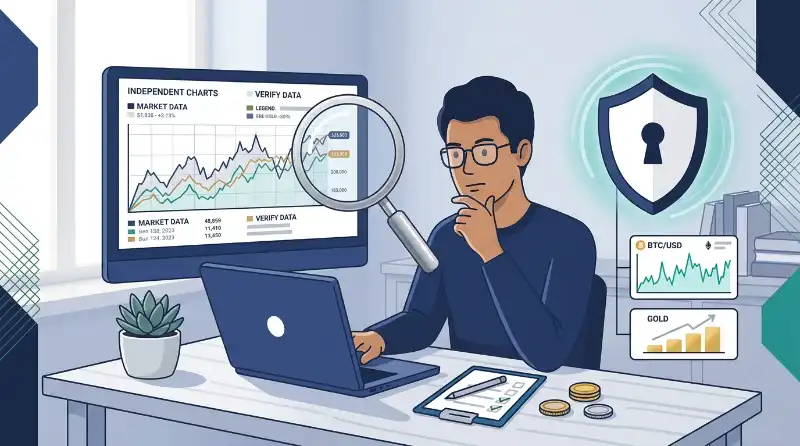
If you visit FintechZoom.io to check a stock price or understand a market movement, the main question is whether the specific information you need is accurate and current.
Do not judge a financial figure only by how professional a webpage looks. A price may be delayed, an article may describe an earlier event, or a figure may refer to a different asset than the one you intended to research.
The best approach is to check the particular information you plan to use.
How Can You Check Whether a Market Price Is Current or Delayed?
If you find a stock or cryptocurrency price on the website, work through these checks.
- Find the timestamp. Look for the date and time when the information was published or updated.
- Identify the asset. Confirm the company’s name, ticker, or cryptocurrency symbol.
- Check the market. Make sure you are looking at the correct exchange or trading market.
- Find the data source. See whether the page explains where its market figures come from.
- Compare the figure. Check the same asset with a suitable market-data provider or exchange.
For example, imagine an article shows a stock price of $100. Without a timestamp, you cannot tell whether that figure reflects the current market or a price from an earlier day.
Even when a timestamp is present, check whether the source provides live or delayed data. A delayed figure may still be useful for reading a past market report, but it may not be suitable for a decision that depends on the latest price.
Also, make sure you are comparing like with like. A stock’s price, an index value, and a company’s market capitalisation measure different things.
What Should You Do If a Stock, Ticker, or Crypto Price Is Missing?
If you cannot find the exact figure you need, do not fill the gap with a guess or rely on an unrelated article.
Instead, choose the source based on the question you are trying to answer.
- For a company’s earnings: Start with its official investor-relations website or its published financial reports.
- For US company filings: Search the SEC’s official EDGAR database.
- For Nasdaq information: Use Nasdaq’s official website and confirm whether the page refers to a specific stock, the Nasdaq Composite, or the Nasdaq-100.
- For cryptocurrency prices: Check a reputable crypto data provider or the exchange where the asset is traded.
- For gold and silver prices: Use a recognised market-data source and check the unit, currency, and type of price being reported.
For cryptocurrency, pay attention to the exact asset name and ticker. Different tokens can have similar names, and the same asset may trade at slightly different prices across exchanges.
If a source does not provide enough information to identify the figure, choose another source that explains what the number represents.
How Can You Verify Financial Claims Before Acting on Them?
A market price is only one type of financial claim. You may also see statements about company performance, investment opportunities, price forecasts, or expected returns.
Before relying on such a statement, ask three questions:
- What evidence supports the claim?
- Can I confirm it through a primary source or another reliable provider?
- Does the information explain the risks and limits, or does it make the outcome sound certain?
For example, if an article says that a company reported strong earnings, look for the company’s own earnings release. If an article predicts that a cryptocurrency will rise, remember that a forecast is not a guarantee.
Be especially careful with claims that promise easy profits or suggest that a particular investment cannot lose money. Markets carry risks, and even well-supported research cannot guarantee future results.
You should also separate facts from opinions. A published earnings figure may be verifiable, while an author’s view about what the stock will do next is an interpretation.
What should you do next? Use FintechZoom.io as a possible starting point for research, but verify important figures and claims with sources suited to the information you need. If you cannot establish the date, source, or meaning of a financial figure, do not rely on it for an important decision.
4. How Can You Check Who Runs FintechZoom.io and Whether Its Claims Are Credible?
If you are unsure who operates FintechZoom.io, do not try to answer that question from the website’s design or name alone. Start with the information the website publishes, then look for evidence that supports its important claims.
This does not mean you must prove every detail about a website before reading a public article. It means you should use stronger checks before sharing sensitive information, paying for a course, or relying on an important financial claim.
What Do the Contact Page, Privacy Policy, and Terms Actually Tell You?
FintechZoom.io has a Contact Us page that lists contact details, including an email address using the authorityventures.com domain and office addresses in New York and London.
These details give you something to investigate, but they do not independently establish legal ownership or prove that every service offered by the website is trustworthy.
To assess the available information, follow these steps.
- Read the contact page. Check whether it identifies a responsible organisation and gives a way to make enquiries.
- Review the privacy policy. Look for an explanation of what information the site collects, why it collects it, and how it says it uses that information.
- Read the terms and conditions. Check the rules that apply when you use a service or buy a course.
- Check the seller details. If you plan to pay, see whether the payment page clearly identifies the seller and the amount.
- Look for supporting evidence. If the website makes a claim about its operator or business relationships, see whether you can confirm it independently.
A policy page is useful because it tells you what the website says about its practices. It is not, by itself, proof that those practices always match the policy.
If you cannot find clear answers to important questions, pause before sharing information or spending money.
How Can You Verify Ownership and Claims of Affiliation?
Website ownership can be harder to establish than it first appears. A contact email, an office address, or a company name may provide useful clues, but each detail needs to be understood in context.
Start by checking whether the website names the company or person responsible for its services. Then compare that information with the details in its policies and payment terms.
If the website claims a connection with another brand, check the other organisation’s own website for a statement confirming that relationship. In the case of FintechZoom.io, FintechZoom.com has published a notice denying affiliation, so you should not assume that the two sites share ownership or approval.
If you cannot find reliable evidence confirming a claim, describe it as unverified rather than treating it as a fact.
You do not need to reach a final judgment about every part of a website. You need enough evidence to make a sensible decision about the particular service you want to use.
Do HTTPS and Third-Party Trust Scores Prove That a Website Is Safe?
You may see a padlock symbol in your browser or a third-party website that assigns a trust score to FintechZoom.io. These signals can be useful, but neither gives you a complete answer.
HTTPS helps protect the connection between your browser and the website. It does not prove that the website operator is honest, that its financial information is correct, or that a course is worth buying.
Third-party trust scores also have limits. Different services may use different methods, and a score may not answer the specific question you have about ownership, payment safety, or course quality.
Use these signals alongside other checks. Read the policies, examine the exact offer, verify important claims independently, and confirm the identity of the payment recipient before paying.
Which Warning Signs Should Make You Pause Before Using the Site?
A warning sign does not automatically prove that a website is fraudulent. It does mean you should stop and investigate before taking the next step.
Pay attention if:
- The website does not clearly explain who provides a paid service.
- A course promises guaranteed profits or unusually easy financial success.
- The payment recipient is different from what you expected, with no clear explanation.
- Important prices, refund conditions, or recurring charges are difficult to find.
- Someone pressures you to pay immediately or share sensitive information.
- A claim of official affiliation conflicts with a statement from the organisation being named.
- Financial figures appear without enough detail to establish what they mean or where they came from.
If you encounter one of these problems, do not rush to make a payment. Ask for clarification, check independent sources, or choose another provider whose details you can verify.
What should you do next? Judge the evidence you can actually confirm. The contact page, privacy policy, HTTPS connection, and third-party scores each tell you something different. None should be treated as complete proof of trustworthiness on its own.
5. Is the FintechZoom.io Course Worth Buying, and What Should You Check First?
If you are thinking about buying a course from FintechZoom.io, do not decide based only on the course title or promises on the sales page. First, check what you will learn, who teaches it, how much it costs, and what happens if the course does not meet your expectations.
A course can be useful, but you should be able to understand what you are paying for before you make a purchase.
What Courses Does the Website List, and What Do They Claim to Teach?
Start with the course page: https://fintechzoom.io/courses/
Read the full description of the course you are considering. Look for specific lessons, learning goals, sample material, and the level of knowledge you need before starting.
For example, a course about stock market basics should explain what students will learn about stocks, market orders, risk, and financial research. A course about cryptocurrency should make its topics clear instead of relying on broad promises about making money.
Be careful if a sales page focuses mainly on income claims, luxury lifestyles, or promises of quick results. Learning about finance does not guarantee profits, and no course can remove the risks of investing.
Also, distinguish between learning about financial markets and receiving personal investment advice. A general course may teach concepts, but that does not mean the instructor understands your financial situation or can tell you what you should buy.
How Can You Verify the Instructor, Course Content, and Qualifications?
Before paying, look for the instructor’s full name and relevant background. Check whether the person’s experience can be confirmed through independent sources.
You can also look for a course outline, sample lesson, clear learning objectives, and realistic information about the time needed to complete the course.
Ask yourself these questions:
- Is the instructor clearly identified?
- Can you verify the experience or qualifications being advertised?
- Does the course explain what lessons are included?
- Are the learning claims specific and realistic?
- Are reviews available from sources other than the seller’s own website?
A missing detail does not automatically prove that a course is fraudulent. However, if important information is unavailable, you have less evidence to support a buying decision.
How Can You Check the Full Price, Refund Terms, and Payment Recipient?
Do not rely on a headline price alone. Before entering your payment details, check the final amount, currency, possible recurring charges, and any extra fees.
Read the refund and cancellation terms carefully. Find out how long you have to request a refund, what conditions apply, and how you must contact the seller. Save a copy of the terms shown when you buy.
Pay attention to the name of the business receiving your payment. If the checkout page uses a different company name, check whether the relationship is explained and can be verified.
Avoid paying through an unexpected personal account, cryptocurrency wallet, or unusual payment method if you cannot confirm who will receive the money. Never share your banking password, card PIN, or one-time verification code with a course seller.
What Should You Do If Important Course Details Are Missing?
If the instructor, price, refund policy, or course content is unclear, pause before purchasing. Contact the seller and ask for the missing information in writing.
Keep copies of the course description, payment page, emails, and any promises made to you. These records may help if you need to dispute a charge later.
If the seller does not answer reasonable questions, pressures you to pay immediately, or promises guaranteed investment returns, consider walking away. You do not need to buy a course just because a sales page makes an offer seem urgent.
6. How Can You Protect Your Personal and Financial Information When Using FintechZoom.io?
The level of risk depends on what you do on a website. Reading a public article is different from creating an account, submitting personal details, or making a payment.
You can reduce avoidable risk by sharing as little information as possible and checking why a website needs it.
What Should You Check Before Creating an Account or Sharing Personal Details?
First, decide whether you actually need an account for the feature you want to use. If an article is publicly available, you may not need to register just to read it.
If registration is required, check the privacy policy and look for details about the information collected, how it is used, and whether it may be shared with other companies.
Use a unique password that you do not use on other websites. A password manager can help you create and store strong passwords. If the service offers two-factor authentication, consider enabling it.
Do not upload identity documents, bank statements, or other sensitive files unless there is a clear reason and you have verified who is requesting them.
Most importantly, do not assume that a site is safe simply because it has a professional design or uses HTTPS. Those details do not independently prove that the business is trustworthy.
What Should You Do If You Have Already Shared a Password or Verification Code?
Your next step depends on what you shared.
If you entered a password that you also use elsewhere, change it immediately on every affected account. Start with your email account because it may be used to reset other passwords.
If you shared a one-time verification code, open the relevant account through its official app or website. Review recent sign-ins, active sessions, security settings, and account recovery details. Sign out unfamiliar sessions and contact the service’s official support team if anything looks wrong.
If you installed software or gave someone remote access to your device, disconnect the session and check your device’s security before using it for banking or other sensitive tasks.
Do not follow security links sent by a stranger who claims they can recover your account. Go directly to the official service instead.
What Steps Should You Take If You Shared Card Details or Suspect Payment Fraud?
Contact your bank or card provider using the phone number on your card or its official app. Explain what happened and ask whether the card should be blocked or replaced.
Check recent transactions for charges you do not recognize. If you see a suspicious payment, ask your bank about its dispute process and report the transaction as soon as possible.
Save receipts, emails, screenshots, and the website address. These details can help your bank or the relevant consumer protection authority understand the situation.
If you bought a course and later became concerned, contact the seller through a verified channel, but do not delay contacting your bank if you suspect unauthorized activity.
Do not share your PIN, full banking password, or one-time code with anyone claiming to be customer support. A genuine support representative should not need those details to investigate a payment problem.
7. Where Can You Verify FintechZoom.io’s Financial Information Independently?
You do not have to depend on one website for financial facts. The best source depends on the information you want to check.
Use the source that is closest to the original data, and make sure you are comparing the same company, asset, currency, and time period.
Where Can You Check Stock Prices, Company Results, and Nasdaq Data?
For company filings and official financial disclosures in the United States, use the SEC’s EDGAR database:
You can search for a company’s reports, annual filings, quarterly results, and other public disclosures. These records help you check whether a claim about a company’s finances matches its published documents.
For Nasdaq-related market information, start with Nasdaq’s official website:
You can also check the exchange or financial-data provider relevant to the stock you are researching. Remember that a displayed price may be delayed, so check the timestamp and data terms before treating it as a live quote.
If a website makes a strong claim about a company’s earnings, debt, or business performance, look for the original filing or company announcement rather than relying only on a short summary.
How Can You Cross-Check Bitcoin and Other Cryptocurrency Prices?
Cryptocurrency prices can differ slightly between exchanges because each platform has its own trading activity and liquidity.
To check a quoted price, compare the same cryptocurrency and trading pair on more than one established exchange or market-data service. For example, a Bitcoin price quoted in US dollars is not directly comparable to a Bitcoin price quoted in Pakistani rupees without considering the exchange rate and fees.
Also check whether the figure represents the last traded price, a market average, or another measurement. These figures may not be identical.
If a site gives a dramatic price prediction, treat it as an opinion or forecast unless it provides reliable evidence. A prediction is not the same as a confirmed market price, and it should not be treated as a promise of future returns.
How Can You Verify Gold and Silver Prices, Units, and Timestamps?
Gold and silver prices may be shown per troy ounce, gram, or kilogram. Before comparing two figures, make sure the units and currencies match.
Check the timestamp, the price source, and whether the number refers to a spot price, a futures contract, or a retail buying price. A local dealer’s selling price may include premiums, taxes, or other costs that do not appear in a general market quote.
For a meaningful comparison, convert the figures to the same unit and currency. If the numbers still differ, check whether the sources are reporting different types of prices rather than assuming one is incorrect.
What Should You Do When Two Financial Sources Show Different Figures?
Do not immediately assume that one source is lying. Different timestamps, market sessions, exchanges, currencies, and pricing methods can explain some differences.
Use this simple process:
- Confirm that both sources refer to the same stock or asset.
- Match the currency and unit.
- Compare the timestamps and market sessions.
- Check whether either source labels its data as delayed.
- Look for an original filing, exchange notice, or other primary source when the claim concerns official company information.
If the difference remains unexplained, do not base an important financial decision on the disputed number. Seek a clearer source or consult a qualified financial professional if the decision could significantly affect your money.
8. What Should You Do Next If You Are Still Unsure About FintechZoom.io?
You do not need to reach one final judgment about every part of a website. You can decide what is reasonable based on the action you want to take.
If You Only Want to Read Articles, What Checks Are Enough?
If you only want to read public financial articles, check the exact domain, review the information critically, and compare important claims with reliable sources.
Be especially careful with specific prices, market predictions, claims about company performance, and statements that encourage you to act quickly. An article can be useful for learning about a topic without being reliable enough to support a financial decision on its own.
Avoid downloading unfamiliar files or installing browser extensions just to read an article.
If You Want to Buy a Course, What Must You Verify First?
Before paying, make sure you understand the course content, instructor, full price, refund terms, and payment recipient.
Keep written records of the claims made by the seller. If any of these details are missing or inconsistent, ask for clarification before entering payment information.
A clear sales page is helpful, but it is not proof that a course will produce a particular financial result. Judge the course by its verifiable content and realistic learning goals, not by promises of easy money.
If You Need Investment Advice, Where Should You Turn Instead?
A general finance website cannot automatically know your income, savings, debts, goals, or ability to handle losses.
If you need advice about a major financial decision, consider a qualified professional whose identity, credentials, fees, and relevant regulatory status you can independently verify. Ask how the person is paid and whether they have conflicts of interest.
Use financial websites to learn terms, explore questions, and find information. For decisions involving significant money, check the evidence and consider advice suited to your own circumstances.
Frequently Asked Questions About FintechZoom.io
Is FintechZoom.io a financial adviser?
Do not assume that it provides personalized financial advice just because it publishes market-related content or offers financial courses. Check the specific service and the qualifications of anyone offering advice. General educational information is not the same as advice based on your personal financial situation.
Can you use FintechZoom.io without buying a course?
Check which pages and features are publicly accessible on the site. Do not assume that every feature is free or that a course purchase is required for all content. Review any sign-up or payment terms before proceeding.
Is FintechZoom.io connected to Crypto30x.com?
A connection should not be treated as confirmed without reliable evidence. Similar topics, shared links, or mentions on another website do not prove common ownership. Look for a clear statement from the businesses and independent evidence before accepting such a claim.
What should you do if a website promises guaranteed investment profits?
Treat the promise as a serious warning sign. Investment returns are uncertain, and a website’s claims do not remove the risk of losing money. Do not pay or share sensitive information until you have independently verified the business and the offer. If the promise involves pressure, secrecy, or an urgent payment request, step away.
Final Verdict: Should You Use FintechZoom.io?
FintechZoom.io should be judged by what you want to do on it and what you can verify. Reading financial content, checking a market figure, registering for a service, and paying for a course all involve different levels of risk.
Before relying on its information, confirm important figures with suitable independent sources. Before buying a course, check the instructor, course outline, full cost, refund rules, and payment recipient. Before sharing personal or financial details, make sure the request is necessary and that you understand how your information may be used.
The difference between a useful financial resource and a risky decision often comes down to verification. Do not rely on a website’s name, appearance, or promises alone. Check the evidence, protect your information, and avoid making financial decisions under pressure.


