Fewer vs less is one of those tiny grammar rules that quietly shapes how clear — and professional — your English sounds.
You’ve probably seen signs like “10 items or less” and wondered… is that actually correct? Or maybe you’ve paused mid-sentence thinking, “Should I say fewer people or less people?”
Here’s the truth: the rule is simple — but real-life usage gets surprisingly messy.
Quick Answer
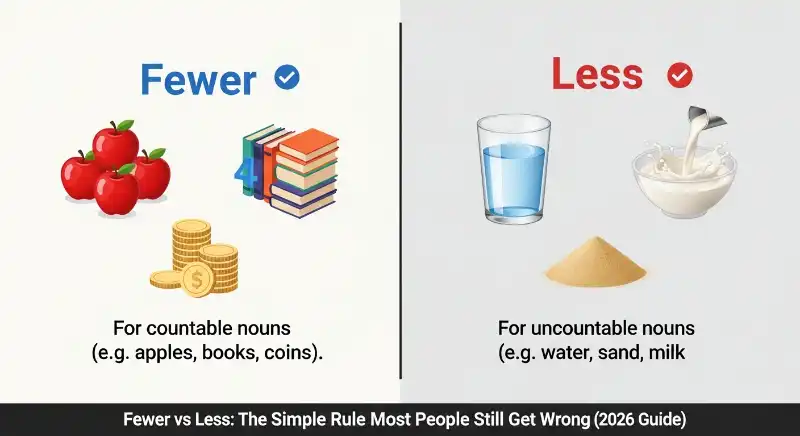
- Use fewer for things you can count (books, people, apples)
- Use less for things you cannot count (water, time, money)
👉 Example:
- Correct: Fewer cars on the road
- Correct: Less traffic today
Fewer vs Less Quick Explanation (Beginner-Friendly Answer)
If you remember just one thing from this entire guide, make it this:
👉 Fewer = countable things
👉 Less = uncountable things
Think of it like this:
If you can count it one by one, use fewer.
If you measure it as a whole, use less.
A Simple Everyday Analogy
Imagine you’re at a grocery store.
- Apples? You count them → fewer apples
- Milk? You measure it → less milk
That’s it. That’s the core rule behind the difference between fewer and less.
Mini Comparison Table
| Situation | Correct Usage |
|---|---|
| People in a room | Fewer |
| Time available | Less |
| Books on a shelf | Fewer |
| Water in a bottle | Less |
Even though this rule is basic, it connects directly to deeper grammar concepts like countable vs uncountable nouns, which we’ll explore next.
Difference Between Fewer and Less (Grammar Rule Explained)
Understanding the fewer or less grammar rule becomes much easier when you zoom out and see the logic behind it.
Fewer vs Less: Countable or Uncountable?
This is where most confusion begins.
Countable Nouns → Use Fewer
These are things you can count individually.
Examples:
- 1 book, 2 books → fewer books
- 5 people → fewer people
- 10 emails → fewer emails
👉 You can ask: How many?
Uncountable Nouns → Use Less
These are things you measure, not count.
Examples:
- Water → less water
- Time → less time
- Money → less money
👉 You ask: How much?
This distinction explains the less vs fewer meaning in a way that feels natural rather than memorized.
How to Use Fewer and Less Correctly
Let’s bring this into real-life language.
Correct Usage
- “There are fewer cars on the road today.”
- “I have less time than yesterday.”
Common Mistake
- ❌ “Less people attended the event.”
- ✅ “Fewer people attended the event.”
This exact confusion leads to one of the most searched questions:
👉 Can you say less people or fewer people?
Answer: Always fewer people (because people are countable).
A Quick Mental Check
Before speaking or writing, pause and ask:
- Can I count it? → Use fewer
- Can I measure it? → Use less
That tiny pause can instantly improve your grammar — especially in formal writing.
When to Use Fewer vs Less in Sentences (Real Examples)
Now let’s make this rule stick with practical usage. Seeing real sentences helps your brain recognize patterns faster.
Less vs Fewer in a Sentence
Here’s how both words behave in everyday communication:
With Fewer
- “We need fewer workers on this project.”
- “There are fewer mistakes in your writing now.”
- “She bought fewer clothes this month.”
With Less
- “I need less stress in my life.”
- “He spends less time on social media.”
- “We have less energy after work.”
Notice how natural it feels when the rule is applied correctly.
Fewer vs Less Examples for Students
If you’re learning English or teaching it, these examples are gold:
- “There are fewer students in class today.”
- “We have less homework this week.”
- “She made fewer errors in her test.”
- “He showed less interest in the topic.”
Real Chat Scenario (Everyday Conversation)
Let’s bring this to life:
Friend A: “Why are there less people at the event?”
Friend B: “You mean fewer people — because you can count them.”
Friend A: “Oh right… fewer people. Got it!”
This is exactly how people learn in real life — through small corrections and repeated exposure.
Is It 10 Items or Less or Fewer (Grammar Debate Explained)
This is one of the most famous grammar debates in English.
You’ve seen it in supermarkets:
👉 “10 items or less”
But according to strict grammar rules… it should be:
👉 “10 items or fewer”
Why Is It “Fewer,” Not “Less”?
Because items are countable.
- 1 item, 2 items, 10 items → clearly countable
- So the correct phrase is fewer than 10 items
This is why people often search:
👉 “less or fewer than 10 items”
Common Mistakes with Fewer and Less
Here are some mistakes even native speakers make:
- ❌ Less cars → ✅ Fewer cars
- ❌ Less people → ✅ Fewer people
- ❌ Less books → ✅ Fewer books
But here’s the twist…
Why Do Stores Still Use “Less”?
Because language isn’t just about rules — it’s about habits and simplicity.
“10 items or less”:
- Sounds shorter
- Feels more natural in speech
- Is widely accepted in casual contexts
👉 In 2026, both forms are understood — but “fewer” is still the grammatically correct choice, especially in writing.
Trick to Remember Fewer vs Less Instantly
Let’s make sure you never forget this again.
The 5-Second Memory Trick
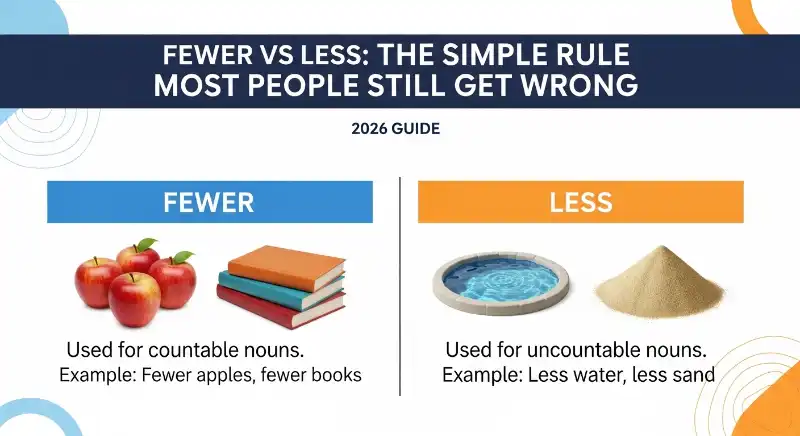
👉 Fewer = Number (you can count it)
👉 Less = Amount (you measure it)
Or even simpler:
👉 If it has an “S” (plural), think “fewer”
- Books → fewer
- Cars → fewer
- People → fewer
Psychology-Based Learning Hack
Your brain remembers patterns better than rules.
So instead of memorizing grammar, train your instinct:
- Visualize counting → choose fewer
- Visualize measuring → choose less
Example:
- Counting apples → fewer
- Pouring water → less
This mental image method is powerful because it connects grammar to real-world experience.
Fewer vs Less Quick Explanation Recap
Before we wrap this half, here’s a rapid-fire recap:
- Countable things → fewer
- Uncountable things → less
- “Fewer people” ✔️
- “Less time” ✔️
- “10 items or fewer” ✔️ (formal)
Can You Say Less People or Fewer People (Common Errors Guide)
This is one of the most searched — and misunderstood — questions in English grammar.
👉 Can you say “less people”?
Short answer: No (in formal English).
Correct form: fewer people
Why? Because people is a countable noun. You can count 1 person, 2 people, 50 people — so the correct choice is fewer.
Less vs Fewer Meaning Confusion
The confusion happens because in spoken English, people often prioritize speed over correctness.
You’ll hear sentences like:
- “There were less people at the concert.”
- “We need less workers.”
These sound natural in casual conversation, but they’re technically incorrect.
👉 The brain simplifies language under pressure — especially in fast speech, social media, or texting.
But in writing (emails, exams, professional work), this difference matters more than you think.
Mistake Correction Examples
Let’s fix common real-life errors:
- ❌ Less people showed up → ✅ Fewer people showed up
- ❌ Less students passed → ✅ Fewer students passed
- ❌ Less cars on the road → ✅ Fewer cars on the road
👉 Quick reminder:
If it has a plural form (people, students, cars), it almost always needs fewer.
Less vs Fewer Rules With Money, Time, and Distance
Now things get interesting — because English isn’t always strict.
There are special cases where less is used with things that seem countable.
Less or Fewer Than 10 Items
We already saw this debate:
- Technically correct: fewer than 10 items
- Common usage: 10 items or less
👉 In formal writing → use fewer
👉 In everyday speech → both are accepted
Exception Usage in Modern English
Here’s where the rule bends.
Even though money, time, and distance can be counted, we treat them as amounts, not individual units.
Use Less With:
- Money → “I spent less than $50.”
- Time → “It took less than 2 hours.”
- Distance → “The store is less than 5 miles away.”
👉 Why?
Because we think of them as a single quantity, not separate pieces.
This is one of the most important insights for mastering how to use fewer and less correctly in real life.
Fewer vs Less in Formal Writing and Academic English
If you’re writing essays, emails, or professional content, this rule becomes more important.
Small grammar mistakes can subtly affect how your writing is perceived.
Fewer vs Less British vs American English
Here’s something interesting:
- 🇺🇸 American English → more flexible in casual usage
- 🇬🇧 British English → slightly stricter in formal contexts
However, both follow the same core rule:
👉 Countable = fewer
👉 Uncountable = less
The difference is mostly in tolerance, not grammar.
Professional Writing Tips
If you want your writing to feel polished in 2026:
- Always use fewer with countable nouns in formal text
- Avoid casual shortcuts like “less people”
- Double-check sentences in emails, reports, and essays
👉 Example:
- Casual: “We had less complaints this month.”
- Professional: “We had fewer complaints this month.”
That one correction instantly improves clarity and credibility.
Fewer vs Less Quiz and Worksheet Practice
Let’s test your understanding.
Fewer vs Less Quiz
Choose the correct option:
- There are ___ mistakes in your essay.
- I need ___ time to finish this.
- We have ___ chairs than before.
- She drinks ___ coffee now.
👉 Answers:
- Fewer
- Less
- Fewer
- Less
Fewer vs Less Worksheet (Practice Sentences)
Try correcting these:
- “There are less options available.”
- “He made less errors this time.”
- “We need less employees.”
👉 Correct versions:
- Fewer options
- Fewer errors
- Fewer employees
Practice like this trains your brain faster than memorizing rules.
Why Native Speakers Still Confuse Fewer vs Less in 2026
You might wonder:
If the rule is so simple, why do so many people still get it wrong?
Social Media and Language Shifts
Platforms like TikTok, Instagram, and X have changed how we use language.
- Speed matters more than accuracy
- Short sentences dominate
- Grammar rules are often ignored
👉 Example:
“Less people here today lol” — quick, casual, understood
This constant exposure reshapes what feels correct.
Spoken vs Written English Difference
There’s a growing gap between how English is:
- Spoken → flexible, fast, forgiving
- Written → structured, precise, professional
In conversation, breaking grammar rules is normal.
In writing, it can affect clarity and credibility.
The Real Reason Behind the Confusion
It’s not that people don’t know the rule.
It’s that:
- The brain prefers simpler patterns
- “Less” is used more frequently overall
- Context often makes meaning obvious anyway
👉 So communication still works — even when grammar isn’t perfect.
Emotional Tone Interpretation (Why This Rule Feels Confusing)
Let’s be honest — grammar rules like this can feel frustrating.
You know the difference… but in the moment, your brain hesitates.
That hesitation comes from:
- Overthinking simple rules
- Fear of sounding incorrect
- Exposure to mixed usage everywhere
But here’s the reassuring truth:
👉 You don’t need perfection — just awareness.
Once you understand the logic (count vs amount), your confidence improves naturally.
Frequently Asked Questions
What is the difference between fewer and less?
The difference between fewer and less is based on countability.
- Use fewer for things you can count (books, people, cars)
- Use less for things you measure (water, time, money)
👉 Example:
- “Fewer students attended the class.”
- “There is less time left.”
Think of it as: number vs amount.
When should you use fewer instead of less?
Use fewer whenever the noun is countable and plural.
Ask yourself: Can I count it one by one?
If yes → use fewer
👉 Examples:
- Fewer apples
- Fewer mistakes
- Fewer emails
This is the core of the fewer or less grammar rule.
Is it fewer people or less people?
Correct: ✅ Fewer people
Incorrect (formal English): ❌ Less people
Because people is countable, it must use fewer.
This is one of the most common mistakes learners make.
Why do stores say “10 items or less”?
Grammatically, it should be: “10 items or fewer.”
However, “10 items or less” is widely used because:
- It sounds simpler
- It’s shorter
- It feels natural in casual language
👉 In 2026, both are understood, but “fewer” is still correct in formal writing.
Can less be used with countable nouns?
Usually, no — but there are exceptions.
Use less with:
- Time → “less than 2 hours”
- Money → “less than $20”
- Distance → “less than 5 km”
Even though these can be counted, they’re treated as amounts, not individual items.
What is a quick trick to remember fewer vs less?
Here’s the easiest memory hack:
👉 Fewer = number (count it)
👉 Less = amount (measure it)
Or even simpler:
👉 If it’s plural → use fewer
This trick works almost every time.
Conclusion:
At first glance, the fewer vs less rule feels like a tiny detail — something easy to ignore. But in reality, it’s one of those subtle skills that quietly upgrades your communication.
Think about it.
When you say “fewer people” instead of “less people,” you’re not just being correct — you’re being clear. You’re showing control over language in a way that feels natural, not forced.
And that’s the real goal in 2026.
We’re living in a world of fast messages, short videos, and quick replies. Grammar is often rushed, skipped, or simplified. But the people who stand out — in writing, speaking, or even AI-driven communication — are the ones who understand the basics deeply.
Here’s what you should carry forward:
- Use fewer for things you can count
- Use less for things you measure
- Don’t stress over perfection — focus on awareness
Because once your brain understands the logic, the hesitation disappears.
And suddenly, grammar isn’t confusing anymore — it becomes intuitive.
👉 That’s when your writing starts to feel effortless, confident, and truly powerful.
📚 Related Articles
Lie vs Lay: The Grammar Mistake Everyone Makes (And How to Fix It Instantly)

Mush explores trending words, viral slang, and social media phrases, explaining them in simple English with fun examples for everyone.