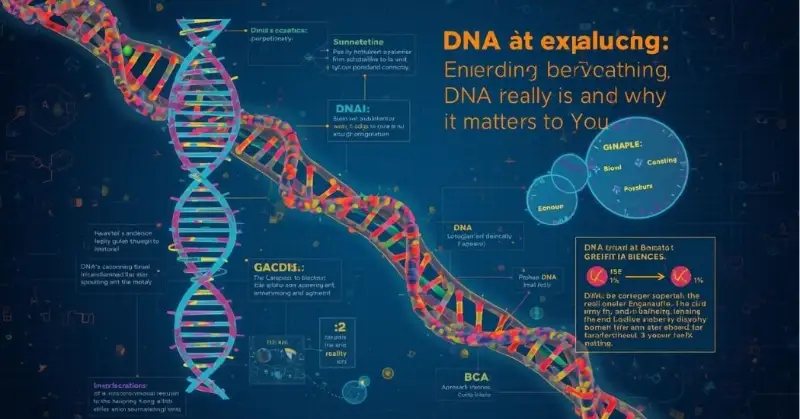
DNA stands for deoxyribonucleic acid. It is the molecule that carries genetic or hereditary information in humans and almost all other organisms. In simple words, DNA stores the biological instructions that help living things grow, function, reproduce, and pass traits from parents to children.
Many people have heard the word DNA in school, crime shows, health discussions, and ancestry testing. The term feels familiar, but the meaning often stays fuzzy. The good news is that the basic idea is not as complicated as it sounds.
Once you understand DNA as the body’s information system, the rest becomes much easier to follow.
This updated guide explains DNA meaning in simple English, shows what DNA stands for, where it is found, what it does, how it relates to genes and chromosomes, and why it matters in everyday life, medicine, inheritance, and forensic science.
DNA Meaning at a Glance
| Term | Simple meaning |
|---|---|
| DNA | The molecule that carries genetic information |
| DNA full form | Deoxyribonucleic Acid |
| Main job | Store and pass biological instructions |
| Found in | Mostly in the cell nucleus, with a small amount in mitochondria |
| Related to genes | Genes are sections of DNA |
| Related to chromosomes | Chromosomes are structures made of DNA and proteins |
This is the core framework used by major health and genetics references.
What Does DNA Mean in Simple Words?
In simple words, DNA is the body’s instruction code. It tells cells how to make proteins, how to do their jobs, and how traits can be passed from one generation to the next. That is why DNA is often described as the hereditary material of life.
A simple way to picture it is this: DNA is like a very large instruction manual, and your body reads those instructions to build and maintain itself.
That comparison is only an analogy, but it helps explain why DNA is so important. DNA does not act alone, yet it carries the core biological information cells need to function.
What Does DNA Stand For?
DNA stands for Deoxyribonucleic Acid. Scientists use this name for the molecule that carries genetic information responsible for development and function in living things.
You do not need to memorize the full name to understand the concept. For most readers, the key point is more important than the chemistry:
DNA is the molecule that stores biological instructions and helps pass them from parents to children.
Where Is DNA Found in the Body?
Most DNA is located in the nucleus of the cell, which is why it is often called nuclear DNA. A small amount is also found in the mitochondria, where it is called mitochondrial DNA. Nearly every cell in a person’s body has the same DNA.
That means DNA is not just in one part of the body. It is present throughout the body in the cells that make up tissues and organs. This is one reason DNA matters so much in growth, repair, inherited traits, and disease research.
What Is DNA Made Of?
DNA is made of two linked strands that wind around each other in a shape called a double helix, often described as a twisted ladder.
Each strand has a sugar-phosphate backbone, and the “steps” of the ladder are made from four bases: adenine (A), thymine (T), cytosine (C), and guanine (G). A pairs with T, and C pairs with G.
You do not need advanced biology to remember the main point: DNA has a stable structure that protects information and allows it to be copied. That copying ability is essential for cell division and inheritance.
What Does DNA Do?
DNA stores the information cells use to make proteins and carry out biological functions. In practical terms, DNA helps guide growth, development, repair, and reproduction. It also plays a major role in how inherited traits are passed from parents to children.
This is why DNA is connected to traits such as eye color, blood type, and some inherited health risks.
At the same time, DNA is not the only influence on a person’s life. Environment, nutrition, culture, experience, and personal choices matter too.
DNA, Genes, and Chromosomes: What Is the Difference?
This is one of the biggest points of confusion, so it helps to separate the terms clearly.
DNA
DNA is the full molecule that carries genetic information.
Genes
Genes are pieces or sections of DNA. Most genes contain the information needed to make a specific protein.
Chromosomes
Chromosomes are structures inside the nucleus made of DNA and proteins. They organize DNA into a form cells can manage more easily.
A simple way to remember it is:
- DNA = the full information molecule
- genes = specific instruction sections within DNA
- chromosomes = packaged structures that contain DNA
That distinction helps clear up many beginner questions about genetics, health reports, and ancestry testing.
How DNA Passes Traits from Parents to Children
DNA carries hereditary information, which means it helps pass traits from one generation to the next. During reproduction, offspring receive
DNA from their parents, and that inherited information contributes to traits and biological characteristics.
This is why families can share physical similarities and certain inherited conditions. However, inheritance is not always simple or predictable in everyday life, because traits can involve many genes and can also be influenced by environmental factors.
Why DNA Is Important in Everyday Life
DNA is not just a classroom term. It affects real-world topics people encounter all the time, including medical testing, family history, ancestry research, and criminal investigations. That is why understanding basic DNA meaning has become more useful outside science lessons.
DNA helps researchers and doctors study inherited conditions and disease risk in medicine. In family history research, DNA testing can reveal ancestry-related patterns. It also plays a major role in forensic science, where distinctive DNA profiles help identify individuals.
What Does DNA Testing Mean?
DNA testing means analyzing parts of a person’s DNA to learn useful information. Depending on the type of test, that information may relate to ancestry, family relationships, inherited traits, or certain health risks.
It is important to understand what DNA testing can and cannot do. It can provide helpful clues and patterns, but it does not reveal everything about a person and it does not predict the future with perfect certainty. DNA testing is a tool for insight, not complete destiny.
How DNA Is Used in Crime and Investigations
DNA plays a major role in modern forensic science. Because DNA found in biological material can be compared with known samples, it can help identify individuals, include or exclude suspects, and support investigations. DNA evidence must still be collected, handled, and interpreted carefully, but it has become one of the most important tools in forensic work.
This is one reason DNA became so widely known in everyday language. Many people first hear about it through crime stories, but its scientific role is much broader than policing alone.
Can DNA Change Over Time?
DNA is generally stable, but it is not completely frozen. Changes can happen through mutations or damage, and some of those changes may matter for health and disease. That is one reason genetics research is so important in medicine and biology.
Still, the everyday takeaway is simple: your DNA usually remains the same basic hereditary material across the cells of your body, even though small changes can occur over time.
Does DNA Fully Determine Who You Are?
No. DNA strongly influences biological traits, but it does not completely define a person’s identity, choices, personality, or life outcome. DNA provides a biological starting point, not a full script for everything you will become.
This matters because people often overstate DNA by saying everything is “in your DNA.” In ordinary conversation, that phrase can work as a metaphor, but scientifically it is too absolute. DNA is powerful, but human life is shaped by more than genes alone.
Why People Say “It’s in My DNA”
In everyday speech, people use DNA as a metaphor for something that feels deeply natural, deeply rooted, or strongly connected to identity. That phrase comes from the real idea that DNA is tied to inherited biological information.
The metaphor works in casual language, but it should not be taken too literally. Scientifically, DNA influences many things, but it does not perfectly explain talents, behavior, values, or personal destiny by itself.
Common Myths About DNA
Myth 1: DNA and genes are the same thing
They are related, but not identical. Genes are sections of DNA.
Myth 2: DNA is only found in the nucleus
Most DNA is in the nucleus, but a small amount is also in mitochondria.
Myth 3: DNA decides everything about you
DNA influences many biological traits, but it does not fully determine a person’s life or identity.
Myth 4: DNA tests reveal everything
DNA tests can be useful, but they only analyze selected parts and have limits.
Frequently Asked Questions
What does DNA mean?
DNA means deoxyribonucleic acid, the molecule that carries genetic or hereditary information in humans and almost all other organisms.
What does DNA stand for in simple words?
The full form is deoxyribonucleic acid, but in simple words DNA is the body’s genetic instruction molecule.
What is DNA used for?
DNA helps store and pass biological information. It is also used in medicine, ancestry research, and forensic science.
Is DNA the same as genes?
No. DNA is the full molecule, while genes are sections of DNA that carry specific instructions.
Where is DNA found?
Most DNA is in the cell nucleus, and a small amount is found in mitochondria.
Can DNA change?
DNA is mostly stable, but changes can happen through mutation or damage.
Final Takeaway
DNA meaning is simpler than it first appears: DNA is the molecule that carries genetic information and helps living things grow, function, and pass inherited traits forward. Most people do not need advanced biology to understand the main idea.
DNA is the body’s core information system, and that is why it matters in health, family traits, ancestry, and science.
The most useful way to remember it is this: DNA holds the biological instructions of life, but it does not explain everything about a person on its own. That one idea keeps the science accurate while still making the topic easy to understand.



1 thought on “DNA Meaning: What DNA Is, What It Stands For, and Why It Matters”