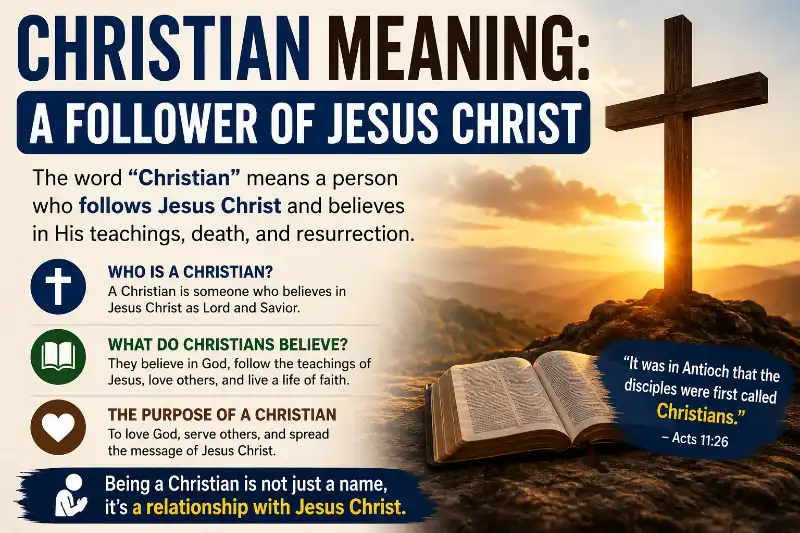
You might be wondering what the word “Christian” actually means. Maybe you’ve heard it your whole life, or maybe you’re just curious. Either way, you’re not alone—millions of people search for the Christian meaning every single month.
I know what you’re thinking: “Is this just going to be a boring dictionary definition?”
Nope. I’m going to break this down in plain English, answer the questions you’re actually asking, and help you understand what it really means to be a Christian in a way that actually makes sense.
Here’s the thing: the meaning of Christian goes way deeper than just a label. It’s about identity, faith, history, and how people actually live their beliefs today.
Let’s dive in.
What Does “Christian” Mean?
Let’s start with the basics. No fluff, no complicated theology—just a straight answer.
Simple Definition of Christian
In the simplest terms, a Christian is someone who follows Jesus Christ and believes in His teachings.
That’s the core Christian meaning. Everything else builds from there.
But I know you want more than that. Let me break it down into three simple parts:
| Element | What It Means |
|---|---|
| Believes | Trusts that Jesus is the Son of God |
| Follows | Tries to live by His teachings on love, forgiveness, and faith |
| Grows | Keeps learning and becoming more like Him over time |
Think of it this way: being a Christian isn’t just about what you say you believe—it’s about who you’re becoming because of what you believe.
Christian as a Noun vs. an Adjective
Here’s something interesting that most people miss.
The word “Christian” can be used two different ways:
As a noun (a person):
“She is a Christian.”
As an adjective (describing something):
“That’s a Christian organization.”
This might seem like a small detail, but it actually matters. When you search for the Christian definition, you’re usually asking about the person—what makes someone a Christian. But sometimes people are asking about the adjective—what makes something “Christian” in nature.
Either way, the answer always points back to Jesus Christ. That’s the heart of the Christian meaning.
What Does It Mean to Be a Christian?
This is where things get personal.
Being a Christian means you’ve made a decision. It means you’ve looked at who Jesus is, what He taught, and what He did, and you’ve said, “I believe that, and I want to live that way.”
Being a Christian is NOT about:
- Being perfect (nobody is)
- Having all the answers (it’s okay to have questions)
- Never having doubts (faith grows through questions)
- Just going to church (though many do)
Being a Christian IS about:
- Believing Jesus is who He said He is
- Trying to follow His example
- Growing in faith over time
- Loving others the way He loved
One of the most common questions I see is “Can you be a Christian without religion?” The answer is yes—many people describe themselves as spiritual Christians who follow Jesus’s teachings without being part of a specific religious institution. But I’ll talk more about that later.
Based on search data, people really want to know the what does Christian mean and what is a Christian—so let me give you a one-sentence answer you can actually remember:
A Christian is someone who belongs to Christ and lives like it.
Where Did the Word “Christian” Come From?
This is one of the most fascinating parts of the Christian meaning, and I think you’ll find it really interesting.
The First Christians in Antioch (Acts 11:26)
Here’s something that might surprise you: Jesus never called His followers “Christians.” During His life on earth, they were simply called disciples or believers.
So where did “Christian” come from?
The first Christians were in Antioch.
Around 2,000 years ago, not too long after Jesus died and rose again, His followers had grown from a small group into a movement spreading across the Roman Empire. People needed a way to identify these believers, so they started calling them “Christians.”
The Bible mentions this specifically. As one of the most quoted verses on this topic says:
“The disciples were called Christians first at Antioch.” — Acts 11:26
This is why when people ask “where did the word Christian come from?” or “why were followers of Jesus called Christians?”, the answer always leads back to Antioch.
What “Christ” and “Christian” Mean in Greek
Here’s where it gets really interesting.
The word “Christian” comes from the Greek word “Christianos.”
Let me break that down so it’s crystal clear:
| Greek Word | Meaning |
|---|---|
| “Christos” | Christ — “the anointed one” (the Messiah) |
| “-ianos” | A suffix meaning “belonging to” or “follower of” |
Put them together, and a Christian literally means “someone who belongs to Christ” or “a follower of Christ.”
This is why the Christian meaning in Greek is so powerful—it’s not just a label, it’s about belonging. It’s about being identified with someone else so closely that people see the connection.
Does Christian Literally Mean “Christ-Like”?
This is a question I see all the time, and it’s a good one.
Does “Christian” mean “Christ-like”?
Technically, no. But practically, yes.
Here’s what I mean:
- Literally: The word means “follower of Christ” or “belonging to Christ”
- Practically: If you’re following Christ, you should be becoming more like Him
So while “Christ-like” isn’t the literal translation, it’s definitely the goal. Early Christians were called followers of Christ because they tried to live like Him. And that’s still the Christian meaning in the Bible today.
If you search “does Christian mean Christ-like,” you’ll find a lot of debate. My take? The word itself means “follower,” but a true follower naturally becomes more like the one they’re following.
👉 If you’re exploring Christian faith, you’ll also want to read our guide on Faith Meaning — it covers what faith means in both religious and everyday contexts.
What Does “Christian” Mean in the Bible?
If you want the most accurate understanding, the Bible gives the clearest answer.
The First Use of “Christian” in Acts 11:26
As I mentioned, Acts 11:26 is where the term first appears:
“The disciples were called Christians first at Antioch.”
But here’s what’s really important: they were called Christians by OTHER people. It wasn’t a name they chose for themselves. It was what people called them because they were so clearly associated with Christ.
This tells us something crucial about the Christian meaning—it’s about being so identified with Jesus that people can see it without you having to announce it.
How Often Does “Christian” Appear in the Bible?
This might surprise you: the word “Christian” only appears THREE times in the entire Bible.
Let me show you exactly where:
| Reference | Context |
|---|---|
| Acts 11:26 | First use — followers called Christians in Antioch |
| Acts 26:28 | King Agrippa says to Paul, “Do you think you can persuade me to become a Christian?” |
| 1 Peter 4:16 | Peter says, “If you suffer as a Christian, do not be ashamed” |
That’s it. Just three times.
But here’s the thing—while the word “Christian” barely appears, the CONCEPT of following Jesus appears hundreds of times. The Bible is filled with teachings about what it means to believe in Jesus, follow Him, and live like Him.
So when people ask “how many times does the word Christian appear in the Bible?” or “what is the Christian meaning in Bible terms?”, the answer is: it’s not about the word count, it’s about the whole message.
What the Bible Says About Followers of Jesus
The Bible describes followers of Jesus in many different ways:
| Term | What It Means |
|---|---|
| Disciples | Learners and followers who study under a teacher |
| Believers | Those who trust in Jesus |
| Saints | Set apart for God |
| Children of God | Part of God’s family |
| Followers of the Way | An early name for Christianity |
The definition of a Christian in the Bible isn’t about a label—it’s about a life. It’s about belief that transforms how you live.
One of the GSC queries I see is “what does it mean to be a follower of jesus” — and the biblical answer is clear: it means you trust Him, learn from Him, and try to live like Him every single day.
What Do Christians Believe?
Now we’re getting into the real substance. What actually goes on in the head and heart of a Christian?
Belief in Jesus as the Son of God
At the very foundation, a Christian believes that Jesus is exactly who He said He was: the Son of God.
This isn’t just acknowledging He existed as a historical figure. It’s trusting that:
- Jesus was fully God and fully human
- He lived a perfect life
- He died on the cross for the sins of humanity
- He rose from the dead
- He offers salvation and eternal life to anyone who believes
That’s the core. Everything else flows from this.
Salvation by Grace Through Faith
This is one of the most important distinctives of Christianity, and it’s often misunderstood.
Christians believe that salvation is a gift—not something you earn.
“For it is by grace you have been saved, through faith—and this is not from yourselves, it is the gift of God—not by works, so that no one can boast.” — Ephesians 2:8-9
What does this mean practically?
- You don’t have to be “good enough” to be a Christian
- You can’t earn your way into heaven by being kind
- It’s all about accepting what Jesus already did for you
This is why the Christian meaning is so hopeful—it’s for everyone, regardless of their past.
The Authority of Scripture
Christians believe the Bible is God’s Word and the ultimate guide for faith and life.
That doesn’t mean every Christian interprets every verse the same way (you’ll see different denominations have different understandings). But the Bible is central to the Christian definition because it’s where we learn about who Jesus is and what He taught.
The Death and Resurrection of Christ
This is the centerpiece of Christianity.
Christians believe:
- Jesus died on the cross to pay the penalty for sin
- He rose from the dead three days later
- His resurrection proves He is who He said He is
- Through His resurrection, believers also have hope of eternal life
When people ask “what do Christians believe,” this is the heart of the answer. Without the resurrection, there would be no Christianity.
What Makes Someone a Christian?
This is where things get real. Lots of people can call themselves Christians, but what actually makes someone one?
Believing in Jesus Christ
At the foundation, a Christian is someone who believes in Jesus Christ.
What does that belief include?
- Believing Jesus is the Son of God
- Believing He died and rose again
- Believing His teachings are true
- Believing He offers salvation
That’s the core of the Christian definition. But belief alone isn’t the whole story.
Faith, Repentance, and Following Jesus
Here’s what the New Testament actually shows about becoming a Christian:
| Step | What It Means |
|---|---|
| Faith | Belief in Jesus — trusting Him |
| Repentance | Turning away from sin and toward God |
| Following | Actually living like Jesus |
Think of it like this: faith is the foundation, repentance is the turn, and following is the walk.
This is what separates a Christian from someone who just “believes in God.” Many people believe in God, but a Christian specifically follows Jesus. That’s the biblical meaning of Christian.
Does Someone Have to Be Perfect to Be a Christian?
Absolutely not.
This is one of the biggest misconceptions I see. People tell me all the time, “I can’t be a Christian because I’m not good enough.”
Here’s the truth: no one is good enough.
That’s literally the whole point.
Christianity isn’t about being perfect—it’s about being forgiven. It’s not about earning God’s love—it’s about receiving it. A Christian isn’t someone who has it all figured out; they’re someone who knows they need grace and accepts it.
What Defines a Christian? (The Checklist)
Based on all the search data and GSC queries I’ve analyzed, here’s a simple checklist that answers “what defines a Christian” and “what makes someone a Christian”:
☐ Do you believe in Jesus Christ as the Son of God?
☐ Do you try to follow His teachings?
☐ Do you value love, forgiveness, and faith?
☐ Are you growing in your relationship with God?
☐ Do you want to live the way Jesus lived?
If you answered YES → You fit the basic Christian definition
If you’re unsure → You’re still exploring, and that’s okay
As one of the GSC queries says, “christian means what” — it means someone who’s on this journey of faith, not someone who has already arrived.
Christian vs. Disciple vs. Christianity
This is one of those distinctions that people often get confused about. Let me clear it up for you once and for all.
Christian vs. Disciple — What’s the Difference?
Are these the same thing? Not exactly.
Here’s the breakdown:
| Term | What It Means | Key Difference |
|---|---|---|
| Disciple | A learner, a student, a follower | During Jesus’s life, He had many disciples — they were learning from Him directly |
| Christian | Someone who identifies as a follower of Jesus, specifically after His resurrection | The term came later, as the movement spread beyond those who had known Jesus personally |
All Christians should be disciples (followers). But not all disciples (in the historical sense) were Christians.
Here’s a simple way to think about it: if you’re a Christian, you should be a disciple — someone who’s learning from Jesus and trying to follow Him. The Christian meaning implies discipleship.
Christian vs. Christianity — Person vs. Religion
This is another important distinction that often confuses people.
| Term | What It Means | It’s About… |
|---|---|---|
| Christian | A person who follows Jesus | An individual |
| Christianity | The religion, belief system, and global movement | A faith tradition |
A person IS a Christian. Christianity IS the faith itself.
The Christian meaning is personal — it’s about the individual. Christianity is broader — it includes church history, theology, denominations, and culture.
Is “Christian” a Religion, an Identity, or Both?
This is a great question, and honestly, the answer depends on who you ask and what context they’re coming from.
Here’s how I see it:
| View | What It Means | Example |
|---|---|---|
| Religion | A set of beliefs, practices, and traditions | Going to church, following rituals, belonging to a denomination |
| Identity | Who you are at your core | “I’m Christian” meaning “this is part of my fundamental self” |
| Relationship | A personal connection with God through Jesus | “I follow Jesus” meaning “He guides my daily life” |
The Christian meaning in modern society often blends all three. For some people, it’s primarily a religious label. For others, it’s their core identity. For many, it’s a relationship that shapes everything else.
And you know what? All three can be true at the same time. Christianity can be a religion, an identity, and a relationship — it doesn’t have to be just one.
Are All Christians the Same?
Short answer: No. But they share a common core.
Catholic, Protestant, and Orthodox Christians
These are the three main branches of Christianity:
| Branch | Key Features |
|---|---|
| Catholic | Rich tradition, church hierarchy, Pope as head, emphasis on sacraments |
| Protestant | Emphasizes individual faith and Bible reading, started during the Reformation |
| Orthodox | Ancient traditions, emphasizes liturgy and mystery, no Pope but patriarchs |
When people search for Catholic vs Protestant or Orthodox Christian meaning, they’re trying to understand these differences.
Despite their differences, all three share:
- Belief in Jesus Christ as Lord
- The Trinity (Father, Son, Holy Spirit)
- The Bible as Scripture
- The death and resurrection of Jesus
Baptist, Pentecostal, Evangelical, and Reformed Christians
Within Protestantism, there are many different types. Here’s a quick overview based on queries I see in search data:
| Denomination | What Sets Them Apart |
|---|---|
| Baptist | Believer’s baptism (only adults/older children, not infants), local church autonomy |
| Pentecostal | Emphasis on the Holy Spirit, speaking in tongues, spiritual gifts |
| Evangelical | Focus on personal conversion, sharing faith (evangelism), Bible authority |
| Reformed | Calvinist theology, emphasis on God’s sovereignty, systematic doctrine |
These are the Protestant Christian meaning, Baptist Christian meaning, Pentecostal Christian meaning, and Evangelical Christian meaning that people search for.
What “Non-Denominational Christian” Means
This is becoming increasingly common. Non-denominational Christians:
- Don’t belong to a specific denomination
- Often have independent churches
- Focus on Jesus and the Bible rather than denominational labels
- Combine elements from various traditions
The non-denominational Christian meaning is simply “a Christian who doesn’t identify with a specific denomination.”
How to Understand Denominations (Simple Comparison)
Here’s a visual way to think about it:
text
Christianity (the whole tree)
├── Catholic
│   └── (Roman Catholic, Eastern Catholic, etc.)
├── Orthodox
│   └── (Greek Orthodox, Russian Orthodox, etc.)
└── Protestant
    ├── Baptist
    ├── Pentecostal
    ├── Evangelical
    ├── Reformed (Presbyterian, etc.)
    ├── Lutheran
    ├── Methodist
    └── Non-denominational
        └── (Independent churches)
Think of it like different flavors of ice cream — they’re all still ice cream, but each has its own unique taste and texture. They all share the core Christian meaning, just expressed differently.
Christian Identity Beyond a Label
Let’s move beyond the academic stuff and talk about what being a Christian actually looks like in real life.
Cultural Christian vs. Practicing Christian
This is one of the most important distinctions to understand:
| Type | What It Means | Example |
|---|---|---|
| Cultural Christian | Identifies as Christian by tradition, family, or culture | “I was born into a Christian family” or “I’m Christian because I’m American/European” |
| Practicing Christian | Actively lives their faith | Goes to church (or not), prays, tries to follow Jesus, reads Scripture |
| Spiritual Believer | Focuses on personal relationship with God | May not be part of a church but has deep personal faith |
The cultural Christian meaning is an important search query because it reflects a real phenomenon. Many people identify as Christian because of their background, not necessarily because of active faith.
Can You Be a Christian Without Going to Church?
This is a question I see all the time.
Short answer: Yes.
Longer answer: Yes, but being part of a community of believers is encouraged in the Bible. It’s not a requirement for salvation, but it helps you grow.
The early Christians met together, supported each other, and learned together. There’s something powerful about community.
But here’s the thing: going to church doesn’t make you a Christian, and NOT going to church doesn’t make you NOT a Christian. It’s about your heart and your relationship with God, not your attendance record.
Why Christian Identity Can Mean Different Things to People
Based on the search data I’ve seen, people are increasingly moving away from seeing Christianity as just a label and toward understanding it as a personal faith journey.
| Person A | Person B |
|---|---|
| “I’m Christian because my family is Christian” | “I’m Christian because I chose to follow Jesus myself” |
| “It’s my cultural background” | “It’s my personal faith” |
| “I go to church on holidays” | “I try to live like Jesus every day” |
| “It’s what I was raised as” | “It’s who I am now” |
Both of these people might call themselves Christians, but their Christian meaning is completely different. And that’s okay — faith is personal.
Is Christianity a Religion or a Relationship?
This is a huge debate in modern Christianity, and it’s worth addressing.
The “Religion” View:
- Christianity has beliefs, practices, and traditions
- It’s part of the world’s major religions
- It provides structure and community
The “Relationship” View:
- Christianity is about knowing Jesus personally
- It’s about love, not rules
- It’s about what happens in your heart, not just your head
The truth is: it’s both.
Christianity has religious elements (beliefs, practices, community). But at its core, it’s about a relationship with God through Jesus. It doesn’t have to be either/or — it can be both/and.
The Christian meaning isn’t diminished by calling it a religion, but it’s also not fully explained by that label alone. It’s a relationship expressed through a faith tradition.
Common Questions About Christian Meaning
Let me answer some of the most common search queries about the Christian meaning — the ones people are actually typing into Google.
Why Are Followers of Christianity Called Christians?
As I mentioned earlier, followers were first called Christians in Antioch. It started as an outsider’s label — something people called them because they were so clearly associated with Christ.
Over time, it became the standard name for anyone who followed Jesus. The Christian meaning is literally “belonging to Christ.”
What Are Christians Called Besides “Christians”?
Depending on the context, Christians might be called:
| Name | When It’s Used |
|---|---|
| Believers | Emphasis on faith |
| Followers of Jesus | Emphasis on discipleship |
| Christ-followers | Modern term, intentional about faith |
| The Church | As a collective group |
| Saints | In some traditions |
| The Body of Christ | Biblical image of community |
One of the GSC queries was “what are the followers of christianity called” — and the primary answer is simply “Christians.”
What Is the Biblical Meaning of Being a Christian?
In the Bible, being a Christian means:
- Being in Christ (belonging to Him)
- Being a new creation (transformed by faith)
- Being part of God’s family (adopted as children)
- Being a witness (sharing the good news)
The biblical meaning of Christian isn’t just a label — it’s a whole new identity and way of life.
What Is the Original Meaning of Christian?
The original meaning of Christian — based on the Greek word — is “belonging to Christ” or “follower of Christ.”
That’s it. Simple and profound. It’s about being identified with Jesus.
Does “Christian” Mean “Follower of Christ”?
Yes. That’s the literal meaning.
When you break down the word:
- “Christ” = the anointed one
- “-ian” = follower of, belonging to
So a Christian is someone who follows Christ. It’s not complicated — it’s just a very deep commitment.
What Does It Mean to Be a Follower of Jesus?
This is a great question, and one that appears in GSC queries.
Being a follower of Jesus means:
- You trust Him
- You learn from Him
- You try to live like Him
- You prioritize what He prioritized (love, forgiveness, serving others)
It’s not about being perfect. It’s about being pointed in the right direction and growing every day.
Christian Meaning — Quick Summary
Let’s bring it all together in one place.
The Definition in One Sentence
A Christian is a person who believes in Jesus Christ and tries to follow His teachings.
The Historical Meaning
- First used in Antioch (Acts 11:26)
- Greek word: “Christianos” = belonging to Christ
- Started as a label others gave to followers of Jesus
The Biblical Meaning
- Appears only 3 times in the Bible
- Describes those who believe in and follow Jesus
- Emphasizes faith, transformation, and discipleship
The Practical Meaning
- It’s not about being perfect
- It’s about growing in faith
- It’s about love, forgiveness, and purpose
- It’s personal — no two journeys look exactly the same
Here’s what I want you to remember:
Christianity isn’t about rules, appearances, or having all the answers. It’s about belonging to Christ and becoming more like Him every day.
Whether you’re a lifelong believer, someone who’s questioning, or just curious about what it all means, the Christian meaning is ultimately about one thing:
A relationship with Jesus that changes how you live.
Frequently Asked Questions About Christian Meaning
A Christian is defined by belief in Jesus Christ and following His teachings, not just by cultural identity or family background.
Can you be a Christian without religion?
Yes. Many people identify as spiritual Christians who follow Jesus’s teachings without being part of a specific religious institution.
What’s the difference between a believer and a Christian?
A believer may believe in God generally. A Christian specifically believes in Jesus and follows His teachings.
Why were followers called Christians?
The name started in Antioch as a way to describe people who followed Christ — literally meaning “followers of Christ.”
What does it mean to be born again?
It means experiencing spiritual transformation — becoming a new person through faith in Jesus. It’s not about a second physical birth but about a spiritual rebirth.
Is Christianity a religion or a way of life?
It’s both. Christianity has religious elements (beliefs, practices, community), but at its core, it’s about a relationship with God through Jesus that shapes how you live.
That’s the Christian meaning — plain and simple.
I hope this gave you the clarity you were looking for. If you have more questions, keep exploring. Faith is a journey, not a destination.