Best AI tools are no longer futuristic experiments—they’re everyday digital partners helping people write faster, study smarter, build businesses, and automate work in ways that seemed impossible just a few years ago.
If you’ve ever opened a laptop with ten tabs, five deadlines, and zero mental energy left, you already understand why artificial intelligence has exploded. From students researching assignments to entrepreneurs automating marketing campaigns, AI tools are quietly becoming the invisible engine behind modern productivity.
But there’s a problem: the internet is flooded with hundreds of AI platforms. New tools launch every week, directories list thousands of options, and many guides overwhelm readers with massive lists.
This article takes a different approach.
Instead of drowning you in endless recommendations, we’ll explore the most useful categories of AI tools, how people actually use them, and which ones truly matter in 2026. Think of it as a practical roadmap to the modern AI toolkit.
What Are the Best AI Tools Right Now? (Quick Answer)
The best AI tools in 2026 include AI assistants, writing tools, design generators, coding assistants, and automation platforms. These tools help users create content, analyze data, automate tasks, and improve productivity in business, education, and software development.
Today’s most useful AI tools typically fall into five major categories:
- AI assistants – help with research, brainstorming, and everyday questions
- Writing tools – generate articles, emails, and marketing copy
- Creative tools – create images, designs, and visual content
- Coding assistants – help developers write and debug software faster
- Automation tools – connect apps and automate repetitive work
The current best AI tools available today combine three key qualities:
- Easy for beginners
- Powerful enough for professionals
- Integrated into daily workflows
For example:
- A student might use AI for research, note-taking, and studying
- A business owner might rely on automation and marketing AI
- A developer might use AI coding assistants to build software faster
Instead of searching for all best AI tools, the smarter strategy is to choose a small toolkit tailored to your goals. That’s exactly what we’ll explore next.
What Are AI Tools and Why Are They Suddenly Everywhere?
Artificial intelligence tools have existed for decades in research labs and enterprise software. What changed recently is accessibility.
Modern AI platforms can now understand language, generate images, write code, analyze data, and even simulate conversations. More importantly, these tools are simple enough for anyone to use.
What AI Tools Actually Do
At their core, AI tools are software systems trained on massive datasets that allow them to recognize patterns and generate responses.
Think of them as smart digital collaborators.
Instead of spending hours researching, designing, or writing from scratch, you can ask an AI system to help you start the process.
For example:
- A writer might use best AI tools for writing to generate article outlines.
- A designer might explore best AI tools for image generation to create graphics.
- A developer might rely on best AI tools for coding to speed up programming tasks.
These tools don’t replace human creativity. Instead, they remove friction from repetitive or time-consuming tasks.
That’s why industries ranging from education to software engineering are rapidly adopting AI workflows.
How AI Tools Are Used in Everyday Work
To understand the real impact of AI, imagine three everyday scenarios.
Student example
A university student preparing for exams might use:
- AI research assistants for finding sources
- summarization tools for simplifying notes
- productivity apps for organizing study sessions
This explains why many searches today focus on best AI tools for students and best AI tools for studying.
Business example
Entrepreneurs often combine multiple tools to run operations:
- AI marketing assistants
- email generation tools
- data analysis platforms
As a result, many founders actively search for best AI tools for business or best AI tools for small business automation.
Developer example
Software developers increasingly rely on AI coding assistants that:
- suggest code completions
- debug errors
- generate entire functions
This explains rising interest in coding best AI tools and developer best AI tools.
In short, AI tools are spreading because they save time, reduce effort, and unlock creativity.
The 5 Categories of Best AI Tools Everyone Should Know
Instead of memorizing a giant directory of software, it’s easier to understand AI through five key categories.
These categories represent the modern AI ecosystem.
| Category | Purpose | Example Use |
|---|---|---|
| AI Assistants | Research, conversation, idea generation | brainstorming, research |
| Writing AI | Content creation and editing | articles, marketing copy |
| Creative AI | Images, graphics, design | logos, social media visuals |
| Coding AI | Software development support | debugging, code generation |
| Automation AI | Workflow automation | connecting apps and tasks |
Let’s break them down.
AI Assistants and Research Tools
AI assistants are the most widely used type of AI software today.
They help users:
- answer complex questions
- summarize information
- brainstorm ideas
- analyze documents
These tools are especially popular for research tasks, which is why people often search for best AI tools for research or what are the best AI tools for research.
Students, journalists, and analysts rely on these assistants to quickly gather insights from large amounts of information.
Instead of spending hours reading articles, an AI assistant can summarize key points in seconds.
This shift has transformed research workflows across industries.
AI Writing and Content Creation Tools
Content creation is another area where AI tools shine.
Writers, marketers, bloggers, and businesses use AI systems to generate:
- blog posts
- product descriptions
- social media captions
- email campaigns
Because of this, many people actively look for content writing best AI tools or best AI tools for content creation.
A marketer launching a campaign might generate ad copy, landing page text, and promotional emails within minutes.
These tools don’t replace writers—but they dramatically accelerate the first draft process.
AI Image and Design Tools
Visual creativity has been revolutionized by generative AI.
Modern design tools can produce:
- illustrations
- marketing graphics
- logos
- product mockups
That’s why designers and creators frequently search for best AI tools for logo design, best AI tools for image editing, or best AI tools for photo editing.
A startup founder with zero design experience can now generate branding concepts in minutes.
Even professional designers often use AI to explore creative directions quickly before refining the final work manually.
AI Coding Tools for Developers
Software development is another field undergoing massive AI transformation.
AI coding assistants can now:
- suggest entire functions
- detect bugs
- generate documentation
- convert natural language into code
This explains growing interest in queries like:
- what are the best AI tools for coding
- best AI tools for software developers
- coding ke liye best AI tools
Developers often describe these systems as pair programmers that sit beside them while they code.
The result? Faster development cycles and fewer repetitive tasks.
AI Automation and Productivity Tools
Automation tools connect different apps and allow workflows to run automatically.
For example, a business might create an automated pipeline where:
- AI generates content
- software schedules social media posts
- analytics tools track performance
This is why professionals often search for best AI tools for productivity or best AI tools for work.
These platforms reduce manual effort and free up time for strategic thinking.
Best AI Tools by Category (Curated Picks)
Instead of overwhelming readers with hundreds of platforms, the smartest strategy is to focus on a curated shortlist of tools that consistently deliver results.
Below is a simplified overview of some of the current best AI tools across major categories.
Best AI Assistants
AI assistants are the backbone of the modern AI ecosystem.
People use them for research, brainstorming, problem solving, and learning.
Typical use cases include:
- writing outlines
- summarizing documents
- generating ideas
- answering complex questions
Many users also look for best AI tools besides ChatGPT or best AI tools apart from ChatGPT, simply to explore alternative AI assistants that offer different strengths.
Some assistants focus on accuracy and research, while others prioritize creative brainstorming or productivity workflows.
The most useful assistants are those that integrate smoothly with your daily work.
Best AI Writing Tools
Writing assistants are among the most widely used AI tools available today.
They are particularly useful for:
- bloggers
- marketers
- educators
- entrepreneurs
- students
These platforms can help generate:
- blog articles
- advertising copy
- social media posts
- academic summaries
Because content creation is such a major use case, many people actively search for content creation best AI tools or best AI tools for digital marketing.
When used correctly, writing tools can dramatically reduce the time required to produce high-quality content.
Best AI Image and Design Tools
AI design tools have become incredibly powerful.
Even beginners can now generate:
- marketing visuals
- social media graphics
- website illustrations
- brand logos
This explains why many creators search for best AI design tools or best AI tools for image generation.
For businesses, these tools provide a fast and cost-effective alternative to traditional design workflows.
Instead of hiring a designer for early-stage concepts, teams can experiment with multiple design ideas instantly.
Best AI Coding Tools
For developers, AI coding assistants are becoming essential.
These tools help programmers:
- generate code snippets
- debug software
- write documentation
- explore new programming frameworks
This growing demand is reflected in search queries like best AI tools developers use and best AI tools for coding.
Many engineers report productivity gains of 30–50% when integrating AI coding tools into their workflow.
That’s a massive shift in how software development happens.
Best AI Automation Tools
Automation tools connect AI with everyday business workflows.
Typical examples include:
- automating marketing campaigns
- managing email responses
- generating reports
- syncing data across apps
Professionals often explore best AI tools for business or best AI tools for productivity when searching for these solutions.
When combined correctly, automation platforms can create self-running workflows that handle repetitive tasks automatically.
If You’re New to AI, Start With These 5 AI Tools
For beginners, the biggest mistake is trying too many tools at once.
Instead, start with a simple AI toolkit that covers the most common tasks.
| AI Tool Category | What It Helps With | Typical Users |
|---|---|---|
| AI assistant | research and brainstorming | students, professionals |
| writing tool | articles and emails | bloggers, marketers |
| design tool | images and graphics | creators, startups |
| coding assistant | programming help | developers |
| automation platform | workflow automation | businesses |
This minimal toolkit already covers most everyday AI use cases.
Students can explore best AI tools for education, entrepreneurs can build business workflows, and creators can produce content faster.
As you become more comfortable with AI, you can gradually expand your toolkit and experiment with more advanced platforms.
Best AI Tools Compared (Features, Price, and Use Cases)
Choosing between different platforms can feel confusing because many AI tools appear similar at first glance. In reality, each tool is designed for specific tasks and workflows.
Instead of searching endlessly through an AI tools directory, it helps to compare tools based on what they actually help you do.
Here is a simplified comparison to understand how the best AI tools available today fit into everyday work.
| AI Category | Best Use Case | Typical Users | Price Range |
|---|---|---|---|
| AI Assistants | Research, brainstorming | students, writers | free to premium |
| Writing AI | Content creation | marketers, bloggers | free / subscription |
| AI Design Tools | Images, logos, graphics | creators, startups | freemium |
| Coding AI | Programming support | developers | subscription |
| Automation AI | Workflow automation | businesses | subscription |
For example:
- A content creator might combine a writing AI tool with an image generator.
- A startup founder might rely on automation tools and marketing AI.
- A developer might use AI coding assistants alongside productivity tools.
Instead of chasing all best AI tools, successful users usually build a small stack of tools that work well together.
This approach prevents what many people call “AI tool fatigue”—the overwhelming feeling of trying too many tools at once.
How People Actually Use AI Tools Together
One of the biggest gaps in most AI guides is that they list tools but rarely show how people combine them in real workflows.
In reality, professionals rarely rely on just one AI platform. Instead, they build AI tool stacks where each tool performs a different role.
Let’s look at three practical examples.
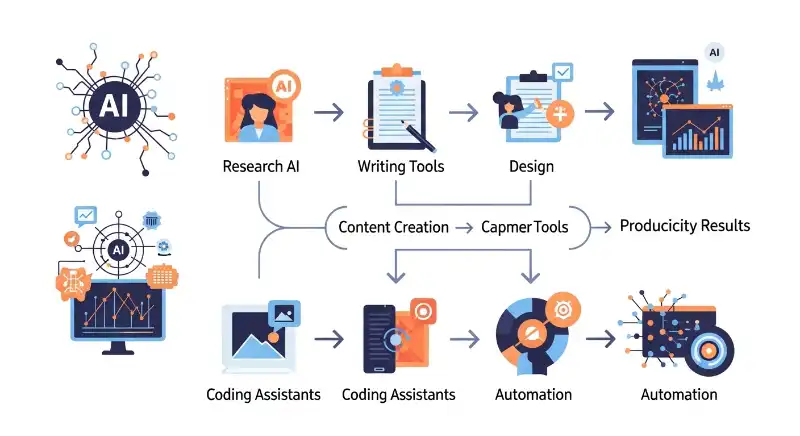
Content Creator Workflow
Content creators often combine multiple AI systems to produce articles, videos, and social media posts.
A typical workflow might look like this:
- Use an AI assistant to research topics.
- Generate an article outline using a writing tool.
- Create visuals using an AI image generator.
- Edit or polish the content with writing AI.
This workflow explains why searches like best AI tools for content creation and best AI tools for digital marketing continue to grow.
Instead of replacing creativity, AI tools simply remove the slowest parts of the process.
Creators can focus on storytelling, strategy, and audience engagement.
Small Business Workflow
Small businesses use AI to automate repetitive tasks and improve productivity.
A typical AI-powered workflow may include:
- generating marketing content
- creating product images
- answering customer emails
- analyzing marketing data
Entrepreneurs frequently search for best AI tools for small business or best AI tools for business productivity.
The reason is simple: AI allows small teams to operate like much larger companies.
Tasks that once required entire departments can now be handled by a small AI-powered workflow.
Developer Workflow
Developers are among the fastest adopters of AI tools.
Modern development workflows often include:
- AI coding assistants for writing code
- debugging tools for error detection
- AI documentation generators
- data analysis tools
Search interest around best AI tools for coding and best AI tools for software developers reflects this shift.
Many programmers now describe AI assistants as pair programmers that work alongside them.
The result is faster development and fewer repetitive coding tasks.
Best Free AI Tools That Actually Save Time
Not everyone wants to pay for AI tools immediately.
Fortunately, many of the best AI tools free versions are surprisingly powerful.
Free AI tools are especially popular among:
- students
- freelancers
- early-stage startups
- independent creators
Here are some common types of free AI tools people use every day.
Free AI writing tools
These tools help generate emails, articles, summaries, and social posts.
Many students rely on them for research and note-taking, which explains the popularity of searches like best free AI tools for email writing.
Free AI design tools
Creative AI platforms often offer limited free credits for image generation.
This allows beginners to experiment with AI design tools without purchasing subscriptions.
Free AI productivity tools
Some platforms focus on productivity features such as:
- task organization
- research summaries
- automated note creation
These tools are particularly useful for students looking for best AI tools for studying or best AI tools for education.
The key takeaway is simple:
Free tools are perfect for learning how AI works, while paid versions unlock advanced features.
How to Choose the Best AI Tool for Your Needs
With thousands of AI tools appearing online, choosing the right one can feel overwhelming.
The easiest strategy is to follow a simple decision framework.
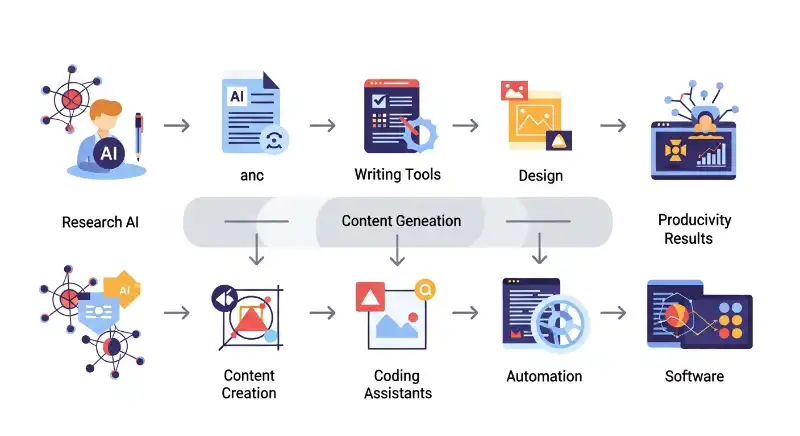
Step 1: Identify Your Goal
Start by asking one simple question:
What problem do I want AI to solve?
For example:
- writing content
- designing graphics
- coding software
- automating tasks
- researching information
This helps narrow down the search quickly.
Someone searching for best AI tools for presentations has completely different needs than someone searching for best AI tools for coding.
Step 2: Choose the Right Category
Next, identify the correct category of AI tools.
For example:
- Writing → AI writing tools
- Research → AI assistants
- Visuals → AI design tools
- Programming → coding assistants
- Business automation → workflow tools
This prevents confusion when comparing tools that serve different purposes.
Step 3: Start Small
Many beginners make the mistake of trying too many AI tools at once.
Instead, start with:
- one assistant
- one writing tool
- one creative tool
Once you become comfortable, you can expand your toolkit.
This approach ensures that AI becomes a productivity advantage rather than a distraction.
The Biggest AI Tool Trends in 2026
Artificial intelligence is evolving extremely quickly.
New platforms appear every month, and existing tools gain powerful new capabilities.
Here are the three biggest trends shaping the future of AI tools in 2026.
AI Agents
AI agents are systems that can perform tasks automatically without constant human instructions.
Instead of simply answering questions, they can:
- complete research tasks
- manage workflows
- run automated operations
Many experts believe AI agents will become the next major evolution of AI productivity tools.
Multimodal AI
Modern AI systems are increasingly able to understand multiple types of input at once.
For example:
- text
- images
- audio
- video
This means future tools may allow users to generate entire presentations, marketing campaigns, or product designs using simple prompts.
Search interest around best AI tools for presentations and best AI tools for video editing free reflects this growing demand.
AI Copilots
Another major trend is the rise of AI copilots integrated directly into software.
Instead of visiting a separate AI website, users will interact with AI directly inside:
- email apps
- design software
- coding environments
- office tools
These copilots quietly assist users while they work, making AI feel like a natural extension of everyday tools.
Frequently Asked Questions About Best AI Tools
What are the best AI tools right now?
The most useful AI tools today typically fall into five categories:
- AI assistants
- writing tools
- design tools
- coding assistants
- automation platforms
The best choice depends on your specific goal, whether it’s content creation, productivity, research, or software development.
Are there free AI tools available?
Yes. Many platforms offer free versions with limited features.
These are ideal for beginners who want to experiment with AI before committing to paid plans.
Students and freelancers frequently rely on best AI tools free versions for everyday tasks.
Which AI tools do professionals use?
Professionals often combine several AI tools into a workflow.
For example:
- content creators use writing and design tools
- developers use coding assistants
- entrepreneurs use automation platforms
Instead of relying on a single tool, professionals build AI tool stacks tailored to their work.
What AI tools are best for beginners?
Beginners should start with simple tools that handle common tasks like:
- research
- writing
- note organization
- image creation
Starting small helps avoid confusion and makes it easier to learn how AI fits into daily workflows.
The Future of AI Tools
Artificial intelligence is quickly becoming one of the most transformative technologies of the modern digital world.
Just a few years ago, AI tools were experimental and limited. Today, they help people write articles, design graphics, analyze data, and build software faster than ever before.
But the most important shift isn’t the technology itself.
It’s how humans are learning to collaborate with AI.
The smartest professionals in 2026 aren’t the ones using the most tools. They’re the ones who know which tools actually help them think, create, and work better.
Instead of chasing every new platform, focus on building a small AI toolkit that supports your goals.
Because the future of work won’t be humans competing with AI.
📚 Related Articles
How Perplexity AI Works (Step-by-Step)

Mush explores trending words, viral slang, and social media phrases, explaining them in simple English with fun examples for everyone.