Assalamu Alaikum!
Are you confused right now? Think about it: You open your banking app, and it shows a “Current Balance” of $5,000, but the “Available Balance” is only $3,000. Or you come home exhausted from work, and your family tells you to “find some balance.” Or maybe someone says “strike a balance,” and you aren’t sure what they mean.
All these confusions have one thing in common: not understanding the exact meaning of “Balance” in your specific situation.
This article is not a boring dictionary entry. It is a step-by-step problem solver. Whether you are stressed about your bank balance, struggling with work-life balance, or confused by common English phrases, every single heading below will answer your specific question. Let’s begin.
Balance Meaning in Simple Words – The Basic Definition
Let’s start with your most basic question: What does “balance” actually mean?
The Simple Definition of Balance
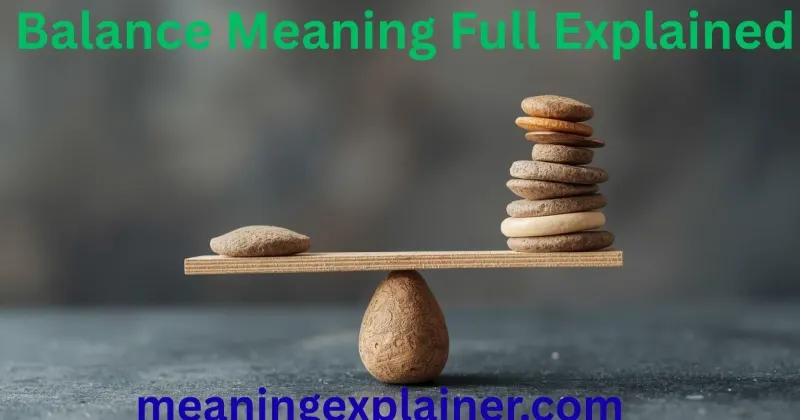
The simplest meaning of balance is “Tawazun” (Equilibrium) — meaning a fair distribution between two things, or keeping something steady so it doesn’t fall.
- If you place a glass of water on a table and don’t shake it, it is in balance (it is stable).
- If you work for 5 hours and rest for 5 hours, that is balance (fair distribution).
Why the Meaning Changes With Context
Here is the most important rule: The meaning of “balance” changes completely depending on the situation.
For example:
- Physical: Balance means not falling (staying upright).
- Financial: Balance means the amount of money in your account.
- Life: Balance means the fair distribution of your time.
So, when someone says “find balance,” you first have to understand what they are talking about. If you understand this one rule, half your confusion is already solved.
What Does Balance Mean in a Sentence? (Grammar Guide)
Many users get confused about whether “Balance” is a noun or a verb, which leads to mistakes in writing and speaking. Let’s solve this step-by-step.
Balance as a Noun (When it is a “Thing”)
When balance refers to a thing (an amount or a state), it is a noun.
- The Problem: You want to say “My bank account amount is $500.”
- The Solution: Say, “My account balance is $500.” (Here, balance is a noun meaning the amount).
- Example: “The balance on my credit card is $2,000.” (Here, it means the debt you owe).
Balance as a Verb (When it is an “Action”)
When balance refers to an action (doing something), it is a verb.
- The Problem: You want to say “I distribute my work and rest equally.”
- The Solution: Say, “I balance my work with my rest.”
- Example: “You need to balance your diet.” (Meaning: You need to fix your eating habits).
Balanced as an Adjective (When it is a “Quality”)
- Example: “She lives a very balanced life.” (Meaning: Her life has good proportions).
Step-by-Step Grammar Tip: If you can put “the” before it (the balance), it is a noun. If you are doing it to something, it is a verb.
What Does Balance Mean in a Bank Account or Credit Card?
This is probably your biggest headache. When you open your banking app, you see 4 different types of “balance.” Let’s break them down one by one and fix this confusion forever.
What Does Account / Current Balance Mean?
Current Balance (or Account Balance) is the total amount of money present in your account right now.
- The Problem: You deposited $5,000. The app shows $5,000. You withdraw $2,000, and now it shows $3,000. This is your Current Balance.
- Understand this: This is the “Live” (immediate) amount in your account.
What Does Available Balance Mean?
Available Balance is the amount of money you can use immediately (withdraw from an ATM or spend on shopping).
- The Problem (Happens very often): Your Current Balance is $5,000, but your Available Balance is only $3,000. Why?
- The Solution: This happens because of a “Hold.” For example, you swiped your card at a gas station, and the bank reserved $2,000 (it isn’t deducted yet, just held). Until that hold is released, you can only spend the remaining $3,000.
What Does Statement / Outstanding Balance Mean?
- Statement Balance: This is the amount that was on your account at the end of last month. For example, your credit card bill comes and shows $2,500 due. That is your Statement Balance.
- Outstanding Balance: This is the total debt you have not paid off yet. If you paid back $1,000, your Outstanding Balance will drop to $1,500.
Does a Balance Mean You Have Money or Owe Money?
This is the most important and confusing question. Read this step-by-step:
| If you are looking at… | Then it means… | What should you do? |
| Savings/Checking Account Balance | “You have money” (It is your asset). | You can spend this money freely. |
| Credit Card Balance | “You owe money” (It is your debt). | If your credit limit is $10,000 and the balance is $2,000, it means you have spent $2,000 of the bank’s money and you must pay it back. |
Critical Warning: If you look at your credit card app and see a “balance,” do NOT think the bank gave you money. That balance is your Debt (Qaraz). You must clear this on time, or the bank will charge you heavy interest.
What Does Balance Mean in Everyday Life, Work & Health?
Now let’s address the problems of your daily life. When people say “My life has no balance,” what exactly does that mean? Let’s understand.
Physical Balance (Body Stability)
This is the easiest one. Physical balance means handling your body weight so you don’t fall.
- The Problem: You are riding a bicycle and you keep falling.
- The Solution: This is “losing your balance.” The fix is to keep your body straight and centered.
Work-Life Balance Meaning
This is the biggest problem of the modern era.
- The Problem: Office work is so heavy that you have no time for your family, OR family problems are so big that you can’t focus at work.
- The Solution: Work-life balance does not mean 50% time at the office and 50% at home. It means giving time according to your current needs. If there is an emergency at work today, give it 80% of your time. But tomorrow, give your family 80% of your time.
- Step-by-Step Fix: (1) Write down your top 3 priorities for today. (2) Give just 30 minutes to your family without looking at your phone. (3) Keep one day a week completely for yourself.
Emotional & Mental Balance (Concise)
This means balance between your anger and your peace.
- The Problem: Getting angry over small things, or feeling anxious all the time.
- The Solution: Balance does NOT mean you never get angry. Balance means that after you get angry, you return to peace quickly.
- Step-by-Step: (1) When you feel angry, pause for 5 seconds. (2) Take a deep breath. (3) Ask yourself, “Will this matter in 5 years?”
What Does Balance Mean in Science, Math & Design?
You probably studied these in school and forgot them. If you encounter these contexts, here is the short, practical explanation.
- In Physics: Balance means “Equilibrium” (forces are equal). For example, a seesaw stays level if children of equal weight sit on both ends.
- In Math: Balance means “Equality.” For example, the equation 2 + 3 = 5 is balanced because both sides have the same value.
- In Art/Design: Balance means “Visual Harmony.” If a painting has a huge dome on one side, it needs small elements on the other side so the eye feels comfortable.
What Do Common Phrases With Balance Mean?
If you understand these English phrases, your overall language comprehension and daily conversations will improve significantly.
- “Keep your balance”: Meaning: Maintain your stability (physically or mentally). For example, hold the handle on a bus so you don’t fall.
- “Lose your balance”: Meaning: Lose stability (fall down or lose emotional control).
- “Strike a balance”: Meaning: To compromise. For example, “You need to strike a balance between studying and entertaining guests” — meaning you must do a little bit of both.
- “On balance”: Meaning: After considering everything (Overall). For example, “On balance, the team performed well this year” — meaning looking at all factors, this is the final opinion.
- “Hanging in the balance”: Meaning: The outcome is uncertain. For example, “His promotion is hanging in the balance” — meaning it might happen or it might not.
Synonyms and Opposites of Balance
If you want to use alternative words, here are the best synonyms and the differences between them.
- Stability: Only means “not falling” (physical). Balance is much broader.
- Harmony: Only means peace between people/emotions. Balance covers money and life too.
- Equilibrium: Specific to science and physics.
Opposites (Antonyms):
- Imbalance (lack of proportion)
- Chaos (total disorder)
Does Balance Always Mean Equal or 50/50? (Myth Buster)
Question: Does “balance” mean everything must be exactly half-and-half (50%)?
Answer: Absolutely not!
- Step 1: Understand that balance is about the right proportion, not an exact 50/50 split.
- Step 2: If you worked 80% hard and rested 20%, and you feel happy and healthy, then that is balance for you.
- Step 3: Balance is flexible. Some days it will be 70/30, other days 30/70. Perfect balance is impossible, so instead aim for “Adjusted Balance” — changing your proportions according to your current life situation.
Quick Guide – Which Meaning of Balance Do You Need?
(This is your quick navigation tool. If you are in a hurry, use this guide to jump straight to your problem):
| If Your Problem Is… | Then Read This Section… |
| Confused by Current vs Available balance in the banking app. | Finance Section (in Part 1). |
| Stuck between office work and family responsibilities. | Work-Life Balance (in Part 2). |
| Someone said an English phrase and you didn’t get it. | Phrases Section (in Part 2). |
| A school/college question about Physics or Math. | Science Section (in Part 2). |
| Unsure if “balance” is a noun or a verb. | Grammar Section (in Part 1). |
Frequently Asked Questions (PAA – People Also Ask)
Q: What does balance mean in simple English?
A: Balance means equilibrium, fair distribution, or the amount of money currently in your bank account.
Q: Is balance a noun or a verb?
A: Both! When it’s a “thing” (My balance), it’s a noun. When it’s an “action” (I balance my routine), it’s a verb.
Q: What is the difference between current balance and available balance?
A: Current = total money in the account. Available = the money you can withdraw/spend right now (after subtracting holds).
Q: Is my credit card balance my own money?
A: No! Your credit card balance is your debt (Qaraz) . It is the money you borrowed from the bank and must pay back.
Q: How do I bring balance into my life?
A: Don’t aim for perfect 50/50. Write down your priorities, divide your time accordingly, and review your routine every single week.
Conclusion – Balance is a Practice, Not a Destination
Throughout this article, we have solved every single problem related to the word “balance,” step-by-step.
Always remember: Balance is not a “Target” that you achieve once and forget about. Balance is a daily practice.
- Sometimes your bank balance drops, so you work harder to fix it (Financial balance).
- Sometimes work piles up, so you rest extra hard to fix it (Life balance).
The secret to understanding “balance” is context. Now that you have read this article, you will never look at a “balance” and feel confused again. InshaAllah!
If you still have any specific problem, feel free to ask! Jazakallah!