
If you searched for ancestry.com, you may be trying to figure out much more than just what the website is. You may want to build a family tree, search old records, sign in to your account, or understand whether you need a paid membership.
The confusing part is that Ancestry has several services, including family-history research and AncestryDNA. So before you pay for anything or start searching, it helps to understand what each part actually does.
If you are wondering what is ancestry.com, how does ancestry.com work, whether ancestry.com is free, or where ancestry.com login and ancestry.com search fit in, this guide will take you through those questions one at a time.
What Is Ancestry.com and What Can You Use It For?
If you are seeing Ancestry.com for the first time, the main question is simple: what does this website actually help you do?
Ancestry.com is a family-history and genealogy service. You can use it to build a family tree, search historical records, review information about relatives, and connect pieces of your family history.
The basic idea is easier than it may sound.
You start with information you already know. For example, you might know your grandmother’s full name, where she lived, and roughly when she was born. You can put those details into your tree and then use Ancestry’s search tools to look for records that may provide more information.
Ancestry says its platform currently provides access to billions of historical records and lets users create family trees and receive record hints.
What does Ancestry.com actually help you find?
The service can be useful when you are trying to answer questions such as:
- Where did my ancestors live?
- Who were my great-grandparents?
- When was a relative born or married?
- Did an ancestor move to another country?
- Are there historical documents connected to my family?
- Has another Ancestry member already researched part of my family?
Depending on the record collection, searches can include things such as census records, marriage records, military records, immigration records, newspapers, and other historical material.
That means Ancestry is not simply a website where you type your surname and get a finished family tree.
You are usually building the tree and checking evidence as you go.
Do you need to know a lot before starting?
No.
You can start with one person and a small amount of information. Ancestry says even a single name can be enough to begin, although additional details such as dates and locations can make searches more useful.
For example, suppose you only know:
Sarah Ahmed, born around 1940, possibly in Lahore.
That is not enough to prove a family connection, but it can be a starting point for research.
As you find reliable records, you can add the information to your tree and continue working backward through earlier generations.
The practical answer: Ancestry.com is most useful when you want to research your family history rather than simply look up a person’s name.
What Can You Find on Ancestry.com?
Once you understand what Ancestry is for, the next problem is knowing what you can actually search for.
This matters because seeing that a website has billions of records does not tell you whether it has the particular information you need.
Ancestry provides several types of material that can help with family-history research.
Historical records can provide clues about relatives
Historical records can contain names, dates, places, relationships, occupations, and other details.
For example, you might find a census record showing an ancestor living with parents or children. A marriage record might provide a spouse’s name. A military record might reveal information about a person’s service.
These records can help you move from one known relative to another.
Ancestry’s own search instructions recommend starting with an older known relative and using records to find additional names and details.
The important point is this:
A record is evidence to examine, not automatically proof that every detail is correct.
That difference becomes especially important when you find information copied from another family tree.
Family trees can help you discover possible connections
Ancestry members can create family trees and, depending on their privacy settings, make trees available to other users.
This can save time. Someone else may already have researched a relative you are trying to understand.
But there is a catch.
Ancestry says member-created family trees are not checked for accuracy and are only as accurate as the person who created them.
So if another person’s tree says your great-grandfather had a particular parent, don’t simply copy it because it looks convincing.
Use it as a clue.
Then look for supporting records.
That simple habit can prevent a wrong branch from spreading through your entire family tree.
Ancestry Hints can point you toward possible records
As you add people to your tree, Ancestry can provide hints for records that may relate to them.
For example, you might add your grandfather’s name and approximate birth information. A hint could point you toward a historical record that appears to match.
You then review the information and decide whether it actually belongs to your relative.
This is helpful because you do not have to manually search every possible record from the beginning. Ancestry says its hints can suggest records and other information connected to people in your tree.
Still, a hint is a suggestion, not a final answer.
Check the name, location, age, relatives, and other details before adding important information to your tree.
Can You Use Ancestry.com Without Paying?
This is where many new users get confused.
You may see ancestry.com free or is ancestry.com free in search results and assume the whole service is available without payment. That is not how it works.
You can create a family tree for free and start using some of Ancestry’s basic resources. Ancestry currently says a free tree lets you add people, receive hints, view record previews, connect with other members, and upload photos and documents.
However, full access to many historical records requires a membership.
What can you do with a free account?
A free account can be a sensible place to start if you are not sure whether Ancestry will be useful for you.
You can begin your family tree with information you already know.
You can also add:
- names
- dates
- places
- photos
- documents
- family relationships
You may also receive hints and see previews of some records.
This gives you a chance to understand how the service works before deciding whether you need more access.
When does a paid membership become useful?
A subscription becomes more relevant when the information you need is behind membership access.
For example, imagine that you have built your tree for free and then find a record that could answer an important family-history question. If the full record is part of a paid collection, you may need a membership to continue.
That is why the smartest approach is usually:
Start with what you know → build your tree → search → see what is missing → then decide whether paid access is necessary.
You do not need to subscribe simply because you are curious about Ancestry.
Is the Ancestry free trial the same as a free account?
No.
This is an important distinction if you search for ancestry.com free trial.
A free account can remain a free registered account with limited access. A free trial, on the other hand, gives temporary access to a selected paid membership.
Ancestry currently says its free trial lasts 14 days and requires a payment method. If you do not cancel during the trial period, the selected membership begins and can renew according to its terms.
So do not treat these two things as identical:
Free account ≠ free trial.
If you only want to explore the basic service, starting with a free account may be the simpler option.
How Does AncestryDNA Fit Into Ancestry.com?
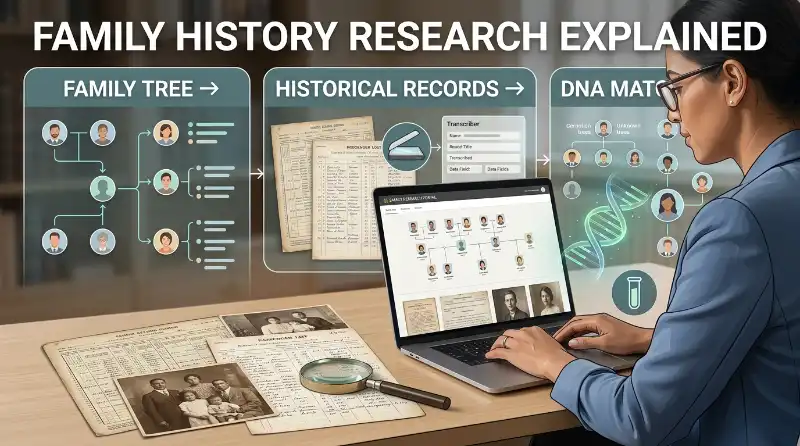
Another common source of confusion is ancestry.com DNA.
You may see AncestryDNA mentioned beside family trees and historical records and wonder whether it is simply another name for Ancestry.com.
It is better to think of them as connected services with different purposes.
Ancestry.com helps you research family history
The family-history side focuses on records, family trees, historical documents, and research.
You provide information you already know, search records, review possible matches, and gradually build a documented family history.
AncestryDNA uses a DNA test to provide genetic information
AncestryDNA works differently.
After a DNA test is processed, Ancestry can provide information such as ancestral regions and DNA matches. Its privacy statement explains that DNA data is also processed to provide information about relationships to other people in its DNA database and certain other features.
This can be useful when traditional records reach a dead end.
For example, you may have built a family tree back several generations but cannot determine how two branches connect. A DNA match may provide another clue.
But DNA results should not be treated as a replacement for documentary research.
What is ancestry.com/dna/register used for?
If you purchased an AncestryDNA kit, ancestry.com/dna/register is associated with registering the kit so it can be connected to your account.
This is different from simply creating a family tree.
So if your goal is only to research historical records, you do not need to take a DNA test just to build a basic family tree.
If your goal involves DNA matches or genetic ancestry information, then AncestryDNA becomes the relevant part of the service.
What about ancestry.com/dnaapp?
If you have seen ancestry.com/dnaapp in search results, do not assume it is a completely separate Ancestry service.
The important thing is the function you are trying to access. Ancestry provides DNA-related features through its website and mobile experience, while your account connects the relevant DNA information to your Ancestry profile.
So, honestly, the easier way to think about it is:
Family history = records and family trees.
AncestryDNA = genetic testing and DNA-related discoveries.
They can work together, but they answer different research questions.
What Should You Know About Ancestry Search Before Trusting a Result?
If your main goal is ancestry.com search, there is one mistake worth avoiding: assuming the first matching result must belong to your family.
Ancestry’s search system can help you find possible records, but the final decision still requires human judgment.
Start with information you already know
Use the strongest facts you have first:
- full name
- approximate birth year
- birthplace
- spouse
- parents
- children
- places where the person lived
Ancestry recommends starting with known relatives and using records to work backward through generations.
Compare several details before accepting a match
Suppose you find two people with the same name.
One lived in Pennsylvania while your known relative lived in Texas.
Another has the same name, similar age, and a spouse whose name matches your family records.
The second result may look stronger, but you should still verify it with additional evidence.
This is especially important with public family trees.
Ancestry itself says member-created trees are not checked for accuracy.
Treat hints as leads, not proof
Ancestry Hints can save time, but the final decision belongs to you.
Check whether the:
- age makes sense
- location makes sense
- family relationships match
- dates fit together
- original record supports the information
This is the safest way to use ancestry.com search without allowing one incorrect record to change your entire family tree.
At this point, you should know what Ancestry.com is, what you can find there, what is free, how its search works, and where AncestryDNA fits in.
How Much Does Ancestry.com Cost?
If you searched ancestry.com cost, how much is ancestry.com, or how much does ancestry.com cost, the answer depends on the membership you choose, your billing period, and any current offer.
Ancestry currently lists several membership options, including U.S. Discovery, World Explorer, and All Access. Its official pricing page shows different prices for monthly and longer billing periods, so there is no single price that applies to every user.
What does the membership pay for?
The main reason to pay is access to additional historical records and research features that go beyond the free account.
For example, if you have already built your tree and then need a historical record that is behind a membership, a subscription may allow you to continue that research.
The useful question is therefore not just:
“How much does Ancestry cost?”
It is:
“Do I need the paid records for the research I am trying to complete?”
That can save you from paying for access you may not actually use.
How much is Ancestry.com per month?
There is no single permanent monthly figure that applies to everyone.
The price can depend on:
- membership level
- monthly or longer-term billing
- promotional offers
- country or account
- whether you are starting a trial or regular membership
So if you see an old article quoting one exact price, do not assume it is still the price you will see at checkout.
For the most accurate ancestry.com cost, check the current membership offer displayed on Ancestry before confirming payment.
What Is the Ancestry.com Free Trial, and What Happens After It?
If you searched ancestry.com free trial, this is an important distinction from the normal free account.
A free account and a free trial are not the same thing.
Ancestry currently describes its free trial as temporary access to selected paid membership features. Its help information says a payment method is required, and if you do not cancel before the trial ends, the membership can convert to a paid subscription according to the applicable terms.
What should you do before starting a trial?
Before clicking the trial button, look at:
- the membership type
- trial duration
- price after the trial
- billing frequency
- renewal terms
- cancellation instructions
You know, this is one of those situations where reading the checkout screen for another minute can prevent an unwanted charge later.
If you only want to explore Ancestry, a free account may be enough to start. If you already know that you need paid records, a trial may make more sense.
How Do You Use Ancestry.com Login and Sign In?
If your goal is ancestry.com login, ancestry.com sign in, or ancestry.com login for members, you need to use the official Ancestry website or app and enter the credentials connected to your account.
The important thing is to make sure you are signing in to the genuine Ancestry service rather than a lookalike page.
What if your login does not work?
First check the basics:
- Make sure you are using the email address associated with your Ancestry account.
- Check your password carefully.
- Use the password-reset option if you cannot remember it.
- Check whether your browser or password manager has an old password saved.
- If the problem continues, use Ancestry’s official help resources.
Ancestry’s help center provides account and password assistance, including password-reset guidance.
Does login work differently for members?
The same account can be used to access the relevant Ancestry services and membership features available to that account.
If you paid for a membership but do not see the expected access after signing in, do not immediately buy another subscription. First check that you are using the same account that was used for the original purchase.
That simple check can prevent paying twice.
Who Owns Ancestry.com?
The query who owns ancestry.com is usually asking whether Ancestry is an independent website, who operates it, or which company is behind the service.
Ancestry is operated by Ancestry.com LLC, a genealogy company focused on family history and related services. Ancestry’s corporate information describes the company as a provider of family-history and DNA services.
The ownership history is more complicated than simply naming one individual. Ancestry has had major corporate ownership changes over the years, so older articles may contain outdated ownership information.
For a current article, it is better to rely on Ancestry’s current corporate information rather than an old “who owns Ancestry” page.
The practical answer: Ancestry.com is a real commercial genealogy service, not an anonymous website with no identifiable company behind it.
That addresses the ownership question, but ownership alone does not answer whether the service is worth using. That requires looking at legitimacy, accuracy, privacy, and cost separately.
Is Ancestry.com Legit and Safe to Use?
If you searched is ancestry.com legit or is ancestry.com safe, you are probably making a trust decision before creating an account, paying for membership, or submitting DNA.
Ancestry is a real genealogy service with established family-history, historical-record, and DNA products. Its official corporate and help resources provide information about its services, accounts, memberships, and privacy practices.
So the answer to “Is Ancestry.com legit?” is yes.
But “legitimate” does not mean that every record is correct, every customer experience is perfect, or every feature is free.
Those are separate questions.
Is Ancestry.com safe?
For ordinary account use, the better approach is to review the company’s current privacy and security information and use sensible account practices.
For DNA users, the privacy question becomes more important because genetic information is particularly sensitive.
Ancestry’s privacy documentation explains how it handles personal and genetic information and describes controls available to DNA users.
So instead of saying:
“Ancestry is 100% safe.”
a more accurate answer is:
Ancestry is a legitimate genealogy service, but users should understand its current privacy terms and account controls before sharing sensitive information, especially DNA data.
How Accurate Is Ancestry.com?
The searches how accurate is ancestry.com and is ancestry.com accurate need a more careful answer because “accuracy” can mean different things.
A historical record, a family tree, and a DNA result are not the same type of evidence.
Historical records
A record can contain errors from the original source, transcription, indexing, or later interpretation.
So finding a record on Ancestry does not automatically prove that every detail is correct.
Compare it with other evidence when the information matters.
Public family trees
Be particularly careful here.
Ancestry says member-created family trees are not checked for accuracy.
That means another person’s tree can be extremely useful as a research clue, but you should not treat it as independently verified evidence.
DNA results
DNA results answer a different kind of question.
They can provide genetic ancestry information and DNA matches, but they should not be treated as a perfect replacement for documented family history.
The practical rule is simple:
Use Ancestry to find evidence and clues, then evaluate those clues before adding important information to your family tree.
That is a much safer approach than assuming every search result is automatically correct.
Is Ancestry.com Worth It?
If you are asking is ancestry.com worth it, the honest answer depends on what you want to accomplish.
For someone actively researching family history, a paid membership can be useful when the records they need are behind membership access.
For someone who is simply curious, paying immediately may not be necessary.
Ancestry may be worth paying for if you:
- are seriously researching your family tree
- need access to historical records
- have specific ancestors you want to investigate
- want to combine records with DNA research
- have already used the free options and know what information you need
You may want to wait if you:
- are only exploring the service
- have not yet gathered basic family information
- do not know which records you need
- can start your research with free resources
- are considering a subscription only because you saw a trial offer
The best decision is to identify the specific research problem first.
If you know which record or information you need, paying for access can be easier to justify.
If you do not yet know what you are looking for, start with the free options and learn how the service works first.
What Should You Do If You Want to Cancel Ancestry.com?
The query how to cancel ancestry.com usually appears when someone has started a membership or trial and no longer wants it.
The first thing to understand is that cancellation and account deletion are not necessarily the same action.
Ancestry provides cancellation instructions through its help resources, and the exact steps can depend on how the membership was purchased.
Before cancelling, check how you subscribed
If you subscribed directly through Ancestry, manage the membership through your Ancestry account.
If the subscription was purchased through a third-party app store, the cancellation may need to be handled through that provider instead.
Do not assume that deleting the app from your phone cancels the membership.
Deleting an app and cancelling a subscription are two different actions.
What about a free trial?
If you started a free trial, check the trial’s end date and cancellation terms rather than waiting until the last minute.
Ancestry’s current trial information explains the relationship between the trial and subsequent membership billing.
How Do You Contact Ancestry.com Customer Service?
If you searched how to contact ancestry.com or ancestry.com customer service, use Ancestry’s official Help Center rather than relying on random phone numbers or support pages found in search results.
The official help system covers account, membership, DNA, records, and other support topics.
What should you have ready?
Before contacting support, have useful account information available, such as:
- the email associated with your account
- the problem you are experiencing
- membership details if your question is about billing
- relevant order or DNA-kit information when applicable
Never give a stranger your password or other sensitive account credentials just because they claim to provide Ancestry support.
What Does “Ancestry.com Pennsylvania” Mean?
A search such as ancestry.com Pennsylvania does not necessarily mean there is a separate Pennsylvania version of Ancestry.com.
It may simply mean that someone is searching Ancestry for Pennsylvania records or researching ancestors connected to Pennsylvania.
This is a good example of why search keywords can be misleading.
If your family member lived in Pennsylvania, you can use location information when searching relevant records. The location can help narrow results and make it easier to distinguish people with similar names.
So if Pennsylvania appears in your search, think of it as a research location, not a separate Ancestry website.
Is Ancestry.com Down?
If you searched is ancestry.com down or ancestry.com down, first determine whether the problem affects only you or everyone.
Try these basic checks:
- Refresh the page.
- Open Ancestry in another browser.
- Check your internet connection.
- Try the Ancestry app if you normally use the website.
- Check Ancestry’s official support information for service-related notices.
- Wait and try again if the problem appears temporary.
If other websites work normally but Ancestry repeatedly fails across different browsers or devices, the problem may be on the service side.
Do not immediately assume your account is broken.
Ancestry.com App vs Website: Which Should You Use?
If you searched ancestry.com app, the choice is mostly about how you prefer to research.
The website is generally more comfortable when you are doing detailed research, comparing records, or working on a large family tree on a computer.
The mobile app can be more convenient when you want to check your tree, review information, or work from your phone.
You do not need to treat the app as a completely different Ancestry service.
Think of it as another way to access your Ancestry account and its available features.
What Should You Take Away Before Using Ancestry.com?
At this point, the main questions have a much clearer answer.
Ancestry.com is a legitimate genealogy service that can help you build a family tree, search historical records, and explore family connections.
You can start without immediately paying, but some records and features require membership. A free trial is different from a normal free account, so check the terms before starting one.
AncestryDNA is connected to the wider Ancestry service but serves a different purpose: it uses DNA testing to provide genetic ancestry information and DNA matches.
And when you find information through Ancestry, especially information from another user’s family tree, treat it as evidence or a clue to investigate rather than automatically accepting it as fact.
The simplest way to approach Ancestry
Start with your research goal.
Then:
Build your tree → search the records → verify what you find → identify what you still need → decide whether paid access is necessary.
That approach keeps you from paying before you know what problem you are actually trying to solve.
Frequently Asked Questions About Ancestry.com
Can you use Ancestry.com without taking a DNA test?
Yes. You can build a family tree and conduct family-history research without taking an AncestryDNA test. DNA testing is an additional way to explore genetic ancestry and DNA matches.
Can you build an Ancestry family tree for free?
Yes. Ancestry currently allows users to create a free family tree, although access to many historical records and some features may require membership.
Does AncestryDNA automatically prove who your ancestor was?
No. DNA matches can provide useful evidence about biological relationships, but family-history conclusions are stronger when DNA evidence is considered alongside historical records and other reliable information.
Can you delete AncestryDNA information?
Ancestry provides DNA privacy controls and describes options for managing or deleting DNA-related information under its current policies. Because these policies can change, review the current official privacy information before making a deletion request.
Is Ancestry better than 23andMe?
They serve overlapping but different purposes, and the better option depends on what you want from a DNA service. If your main goal is detailed family-history research using historical records and family trees, Ancestry has a particularly strong genealogy focus. If your priority is comparing specific DNA features, compare the current offerings before choosing.
Conclusion
If you came to ancestry.com because you were unsure what the site does, whether it is free, how much it costs, or whether it is worth using, the answer is now much clearer.
Ancestry is mainly a family-history research service. You can start by creating a tree and searching available information without immediately committing to a paid membership. When you need records or features that require a subscription, you can then decide whether the cost makes sense for your particular research.
If you are interested in AncestryDNA, remember that DNA testing and historical-record research are related but different parts of the service. And when you find family information, especially in user-created trees, verify important details instead of accepting every match as fact.
The best approach is simple: start with what you know, research carefully, verify what you find, and only pay for access when it helps solve a specific family-history problem.


