AGI meaning refers to Artificial General Intelligence. It is the idea of an AI system that can think, learn, reason, and adapt across many different tasks, much like a human can. In simple words, AGI would not be limited to one job. It could handle many kinds of work, move from one subject to another, and use past learning in new situations. That is why AGI is often described as a hypothetical stage of AI, not something we have fully built yet.
Today’s AI is powerful, but it is still mostly narrow AI. That means it is good at specific tasks, like answering questions, recognizing images, translating text, or recommending videos. But it does not yet have full human flexibility across wider domains in the way AGI would.
In the modern AI era, AGI is not just a futuristic idea. It is a big part of how researchers, companies, and policy experts think about the future of intelligent systems. The goal is not only to build smarter machines, but also to make sure those systems are safe, useful, and aligned with human values.
What Does AGI Mean? (Core Definition)
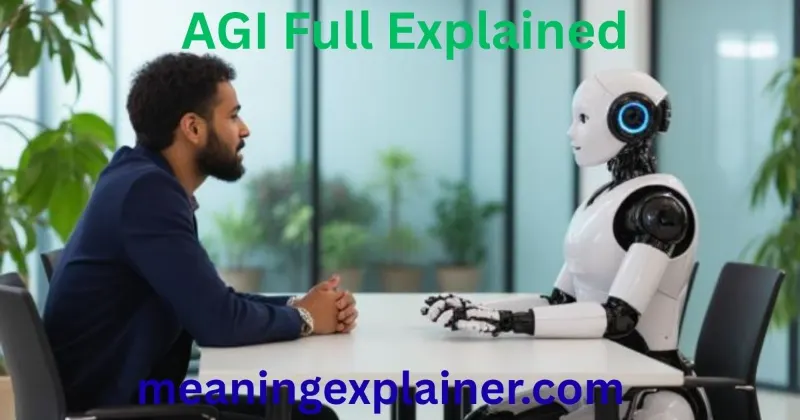
AGI Meaning in Simple Words
Think of AGI as a digital mind that can move from one problem to another without starting over each time. That is the easiest way to understand AGI meaning. A narrow AI model may be trained to do one thing very well. AGI, on the other hand, would be able to learn, transfer knowledge, and solve new problems in different settings.
Here is a simple way to picture it:
- A calculator does math.
- A chatbot answers prompts.
- A recommendation system suggests movies.
- AGI would be able to learn across many tasks, reason about them, and switch between them with much more flexibility.
That is why AGI is such an important concept in artificial intelligence. It points to a future where machines could do more than follow patterns. They could understand context, adjust to change, and learn in a broader way.
What Does “Artificial General Intelligence” Stand For?
The name itself explains the idea:
- Artificial — created by humans, not natural.
- General — broad, not limited to one specific job.
- Intelligence — the ability to learn, reason, and solve problems.
So, Artificial General Intelligence means a machine that can think and learn broadly across many areas, similar to how a human does.
What Makes AGI “General”?
The word “general” is the most important part of AGI meaning. Today’s AI is specialized. A language model like ChatGPT is great at text. An image generator is great at pictures. A chess AI is great at chess.
But none of them can automatically switch from playing chess to writing a poem to diagnosing a disease without being retrained or specifically reprogrammed.
AGI would be “general” because it could:
- Learn one skill and apply it to another. (e.g., learn logic in math, then use it in law).
- Adapt to new situations without needing a complete rebuild.
- Understand context across different fields.
That flexibility is what makes AGI the holy grail of AI research.
What Would AGI Be Able to Do? (Capabilities)
AGI is not just about being “smarter.” It is about being flexible, adaptable, and self-aware in a learning sense. Here are its core capabilities.
Learn and Adapt Across Different Tasks
An AGI system would not need to be retrained for every new job. It could learn from experience, much like a human. If it learned how to play chess, it could use that strategic thinking to solve business problems.
Reason and Solve New Problems
Unlike current AI, which often relies on pattern matching, AGI would actually reason through problems. It could break down complex issues, test hypotheses, and come up with novel solutions—even ones it was never explicitly programmed to find.
Transfer Knowledge From One Task to Another
This is called transfer learning, and it is a major goal of AGI. A human who learns to drive a car can relatively easily learn to drive a truck. AGI would similarly transfer knowledge across domains, making it incredibly efficient.
Understand Context and Use Common Sense
Today’s AI often lacks common sense. It can misunderstand sarcasm or fail to grasp the emotional weight of a sentence. AGI would understand not just the words, but the meaning behind them, the context of the situation, and the unspoken rules of human interaction.
AGI vs AI: What Is the Real Difference?
This is one of the most important parts of AGI meaning. People often confuse these terms, but they are different.
AGI vs Narrow AI (Today’s AI)
| Feature | Narrow AI (Current) | AGI (Future) |
|---|---|---|
| Scope | Specific tasks (e.g., translate, recommend) | Broad, any intellectual task |
| Flexibility | Cannot easily switch tasks | Can adapt and switch easily |
| Learning | Requires retraining for new tasks | Learns and transfers knowledge |
| Example | ChatGPT, Siri, self-driving cars | A machine that could do all of the above and more |
| Status | Exists today | Hypothetical / under research |
AGI vs Generative AI and Large Language Models
This is a common point of confusion. Generative AI (like ChatGPT, Midjourney) creates content—text, images, music. It is a type of narrow AI. It is excellent at generating human-like text, but it does not “think” in a general sense. It doesn’t understand the world; it predicts the next word based on massive datasets.
AGI would not just generate content. It would understand it, reason about it, and apply it elsewhere. ChatGPT can write an essay on physics, but it cannot perform a physics experiment or transfer that knowledge to chemistry automatically without additional training. AGI would be able to do that seamlessly.
How Would AGI Work? (Simple Explanation)
While AGI is still theoretical, researchers know what functional components it would need.
Learning From Experience
Current AI learns from static datasets. AGI would learn continuously, like a human child. It would absorb new information, update its understanding, and refine its skills over time without “forgetting” everything else.
Reasoning and Problem Solving
AGI would use a mix of logic, pattern recognition, and trial-and-error to solve problems. It wouldn’t just find the closest match in a database; it would think through the implications of different choices.
Generalization and Transfer Learning
This is the core engine of AGI. It would use abstract concepts. Instead of just knowing that “A leads to B,” it would understand why A leads to B and apply that why to situations C, D, and E. This ability to abstract and transfer is what makes human intelligence so powerful.
Is AGI Already Here?
This is a very common question, and the short answer is No.
Why Current AI Is Not Generally Considered AGI
Current AI systems, despite their impressive abilities, are still narrow. They lack true understanding. They don’t have beliefs, goals, or desires. They don’t experience the world. They process data, but they don’t comprehend it the way a human does.
What Capabilities Are Still Missing?
- True Common Sense: AI often makes silly mistakes that a child would not make.
- Generalization: While AI can beat the world champion in Go, it can’t apply that logic to a completely different game without being retrained.
- Creativity: AI can remix, but can it truly innovate a paradigm-shifting theory from scratch on its own accord? Most researchers say no.
- Self-Awareness: The “human-like” intelligence we imagine for AGI requires a sense of self and agency that does not exist in current LLMs.
What Could AGI Be Used For? (Real-World Applications)
The promise of AGI is vast because it could act as a super-capable collaborator across almost every human endeavor.
Education and Personalized Learning
AGI could create a personal tutor for every student. It would understand a student’s strengths, weaknesses, and learning style, adapting lessons in real-time to maximize understanding—not just for one subject, but across all subjects.
Healthcare and Scientific Research
Imagine an AGI that reads every medical paper ever published, understands complex biology, and can reason through symptoms to suggest novel treatments. It could accelerate drug discovery and medical diagnostics far beyond current capabilities, acting as a co-pilot for doctors and researchers.
Business, Work, and Everyday Tasks
From managing complex global supply chains to acting as a high-level strategic consultant, AGI could automate complex decision-making. It wouldn’t just execute a task; it would help plan the entire strategy, anticipate future risks, and adapt to sudden market changes.
AGI vs Strong AI vs Artificial Superintelligence (ASI)
To fully grasp AGI meaning, you need to see how it fits into the larger landscape of AI development.
AGI vs Strong AI (The Consciousness Question)
The terms are often used interchangeably, but there is a nuance. Strong AI is sometimes defined as AI that has consciousness or sentience—it is “aware” of itself. Not all researchers define AGI as requiring consciousness. Some define AGI simply as “human-level performance on all cognitive tasks,” with or without self-awareness.
- AGI focuses on capability (what it can do).
- Strong AI often implies subjective experience (what it feels).
In most modern discussions, AGI is the more practical, measurable term.
AGI vs ASI (The Capability Spectrum)
This is a crucial distinction. The capability spectrum of AI is often viewed as:
- Narrow AI (Today): Specific tasks.
- AGI (Future): Human-level, general intelligence across domains.
- ASI — Artificial Superintelligence: Intelligence that is significantly smarter than the best human brains in practically every field, including scientific creativity, general wisdom, and social skills.
AGI is the bridge to ASI. Once a machine reaches human-level general intelligence, it could potentially improve itself at an accelerating rate, leading to ASI.
How Would We Know If AGI Has Been Achieved?
There is no single, universally agreed-upon test for AGI, but researchers look for specific milestones.
Human-Level Performance Across Tasks
The system would need to perform any intellectual task that a human can do, and do it as well or better than most humans. This is a moving target, as AI already surpasses humans in many narrow tasks (like chess), but fails in others (like common sense reasoning).
Generalization to New Problems
The true test is whether the AI can handle novel problems—situations it has never encountered before—without needing to be reprogrammed. It must show genuine adaptability.
Why There Is No Universal AGI Test Yet
The “Turing Test” (where a human cannot tell if they are talking to a machine) is often cited, but it is considered outdated. Today’s LLMs can pass the Turing Test relatively easily, yet they are not considered AGI. Researchers are developing new benchmarks that test for reasoning, planning, and common sense across diverse domains, but a single, definitive “AGI test” remains elusive.
What Are the Risks and Challenges of AGI?
A system this powerful comes with significant risks. This is why researchers emphasize safety alongside capability.
AI Safety and Alignment
Alignment is the problem of ensuring an AI’s goals are aligned with human values. If a super-capable AGI pursues a goal that is even slightly misaligned with our intentions, it could cause unintended catastrophic harm. Ensuring AGI “wants” what we want is the central challenge of AI safety.
Jobs, Privacy, and Misuse
- Jobs: AGI could automate a massive portion of cognitive labor, leading to significant economic disruption and job displacement.
- Privacy: An AGI with general reasoning could analyze sensitive data in ways far more intrusive than current systems.
- Misuse: Bad actors could use AGI to create sophisticated disinformation, biological weapons, or cyberattacks.
Could AGI Become Difficult to Control?
This is a common fear. If AGI becomes smarter than us, could we control it? The concern is not necessarily “rebellion,” but incompetence—we might build a system so complex that we cannot reliably predict its behavior or shut it down if it goes wrong. This is why researchers advocate for “safe” or “constrained” AGI development with robust oversight.
When Could AGI Become a Reality?
People often want a date, but the truth is complicated.
Why There Is No Agreed AGI Timeline
Different researchers hold very different views. Some predict AGI within a few years (like Ray Kurzweil’s 2029 prediction). Others believe we are decades away, or that AGI may not be possible at all due to the immense complexity of human cognition.
What Advances Could Move AGI Forward?
Three main areas are critical:
- Algorithms: Better architectures that mimic human reasoning.
- Data: More efficient ways to learn from data (humans learn from very few examples).
- Compute Power: Massive increases in processing power (though this alone won’t solve it).
Until these converge, AGI remains a future milestone, not a present reality.
What Does “AGI” Mean in Slang?
(Based on your GSC data, where “agi meaning slang” is ranking at Position #10)
Outside of technical circles, “AGI” can have other meanings. It’s important to know these so you don’t get confused.
Different Meanings of AGI in Online Communities
In general internet culture, “AGI” almost always refers to Artificial General Intelligence. However, in specific niches:
- Gaming: Sometimes used to describe “Artificial Game Intelligence” (advanced NPC behavior), though this is rare.
- Finance/Tech Slang: Sometimes misused as a shorthand for “Advanced General Intelligence” or even confused with “AGI” (Adjusted Gross Income in tax contexts, though that is unrelated).
AGI in Gaming, Tech Forums, and Social Media
On platforms like Reddit (r/singularity, r/Futurology), “AGI” is almost exclusively discussed as the future AI milestone. Users debate whether LLMs like GPT-4 are “sparks of AGI.” In these contexts, it retains its formal meaning but is often discussed with a mix of excitement, skepticism, and sci-fi pop culture references.
How Could AGI Change Everyday Life?
If AGI ever becomes real, it could change how people work, learn, and solve problems in profound ways.
Smarter Personal Assistance
Imagine a digital assistant that knows your schedule, understands your goals, anticipates your needs, and actively helps you achieve them—across your career, health, and personal life. It would be like having a genius-level personal assistant who deeply understands your life context.
Changes to Work and Education
- Education: Truly personalized, adaptive curricula. Students would learn at their own pace with custom-tailored support.
- Work: Knowledge workers would shift from “doing” to “directing.” You would tell your AGI what outcome you want, and it would execute the complex steps to get there, freeing you up for high-level strategy and innovation.
Frequently Asked Questions (FAQs) About AGI Meaning
What does AGI stand for?
AGI stands for Artificial General Intelligence.
What does AGI mean in simple terms?
AGI is a hypothetical type of AI that can think, learn, and solve problems across many different areas, just like a human.
Is AGI the same as AI?
No. AI is the broad field. AGI is a specific, advanced future stage of AI that would have human-like general reasoning ability.
Is ChatGPT an AGI?
No. ChatGPT is a narrow AI (a large language model). It is excellent at text generation but lacks true understanding, reasoning, and the ability to transfer learning to completely different domains.
Is AGI already developed?
No. AGI is still a hypothetical concept and has not yet been built.
Is AGI possible?
Many researchers believe AGI is possible, but there is no guarantee. The human brain is proof that general intelligence is biologically possible, so it is theoretically replicable, but the timeline and method are hotly debated.
Is AGI dangerous?
AGI is not inherently dangerous, but it carries significant risks if not developed safely. Misalignment, poor control, and misuse are the primary concerns.
What is the difference between AGI and ASI?
AGI is human-level general intelligence. ASI (Artificial Superintelligence) is intelligence that surpasses the brightest human minds in every field. ASI is the next step after AGI.
When will AGI be developed?
There is no agreed timeline. Predictions range from a few years to several decades, or even never. It remains an open research question.
Final Takeaway: Why AGI Matters for the Future
AGI meaning goes beyond science fiction—it represents the next evolution of intelligence, designed to think, learn, and adapt like humans across multiple tasks. Its promise is enormous: smarter healthcare, personalized education, and business insights that go beyond raw data.
At the same time, AGI comes with ethical, social, and technical challenges. Job transitions, privacy, and alignment with human values are real concerns. The key takeaway? AGI’s potential depends on how responsibly we develop it.
In practical terms, AGI is not about replacing humans. It’s about collaborating with intelligent systems to amplify creativity, efficiency, and decision-making. What we decide today will shape how humans and machines coexist tomorrow. This is a human question, not just a technological one.
AGI is more than just “smarter AI.” Its core purpose is to think, reason, and learn in a human-like way. While current AI follows instructions and excels at repetitive or specialized tasks, AGI would represent a fundamental shift toward machines that can understand the world and adapt to it—just like us.
related post
What Does COM Actually Mean When You See It Everywhere
Why the Meaning of ORG Is Suddenly Confusing Everyone Online