Grace meaning is one of those rare ideas that feels soft on the surface—but becomes powerful once you truly understand it.
In everyday life, grace shows up in quiet moments: when someone forgives instead of reacting, stays calm under pressure, or treats others kindly without expecting anything back. It’s not loud, but it leaves a lasting impact.
Quick answer:
Grace means kindness, elegance, and unearned favor—shown through calm behavior, forgiveness, and emotional strength.
What Is Grace Meaning in English
Understanding grace meaning in English starts with simplicity. It’s a word used in daily life, literature, and even personality descriptions—but the idea behind it is deeply human.
Grace Definition Simple Explanation
In simple words, grace means:
- Being kind when it’s difficult
- Staying calm in stressful moments
- Acting with respect and dignity
- Showing forgiveness without ego
Think of grace as calm strength + gentle behavior.
For example:
If someone criticizes you and you respond politely instead of arguing—you are showing grace.
Is Grace a Virtue Meaning
Yes, grace is considered a virtue.
A virtue is a good quality that improves your character—and grace fits perfectly because it combines:
- Patience
- Kindness
- Self-control
It’s not about being perfect.
It’s about choosing better reactions, even when emotions are high.
Grace Meaning Personality
In personality terms, grace is something people feel when they are around you.
A graceful person often:
- Speaks calmly
- Listens carefully
- Avoids unnecessary conflict
- Makes others feel respected
It’s not about being quiet—it’s about being balanced and thoughtful.
Grace Meaning in Bible and Christianity
When people search for grace meaning in Bible, they’re usually looking for something deeper than a dictionary definition.
Meaning of Grace in Christianity
In Christianity, grace is understood as:
God’s love and kindness given freely—without being earned.
This idea is powerful because it removes pressure.
You don’t have to be perfect.
You are accepted, forgiven, and given a chance to grow.
Difference Between Grace and Forgiveness
Many people confuse grace with forgiveness—but they are not exactly the same.
- Forgiveness = letting go of anger after someone does wrong
- Grace = giving kindness even when it’s not deserved
Example:
Someone hurts you.
You forgive them (that’s forgiveness).
You still treat them kindly (that’s grace).
Grace goes one step further—it adds kindness after forgiveness.
Grace Meaning Spiritual
Spiritually, grace is often described as:
- A blessing
- A gift you didn’t earn
- A force that brings peace and healing
It’s like receiving help at the exact moment you need it.
In many belief systems, grace is seen as a bridge between human weakness and higher strength.
Grace Meaning Examples in Real Life
Understanding real life examples of grace meaning makes everything clearer. It turns a concept into something you can actually see and practice.
Real Life Examples of Grace Meaning
Here are simple, relatable examples:
- A teacher patiently helping a struggling student
- A friend forgiving a mistake without bringing it up again
- A leader staying calm during a crisis
- Someone choosing silence instead of reacting in anger
These are not dramatic actions—but they show emotional maturity.
Grace Meaning in Life Situations
Grace appears in everyday situations:
At work:
Instead of blaming others, you focus on solutions.
In relationships:
You listen to understand, not just to reply.
Online:
You avoid unnecessary arguments and respond respectfully.
In each case, grace is about control, respect, and awareness.
How to Use Grace in a Sentence
Here are a few natural examples:
- “He handled the failure with grace.”
- “She spoke with quiet grace and confidence.”
- “They accepted the decision with grace.”
These sentences show that grace is often linked with difficult moments, not easy ones.
Grace vs Mercy Meaning Difference (Comparison Table)
One of the most common questions is about grace vs mercy meaning. They are closely related—but different in a meaningful way.
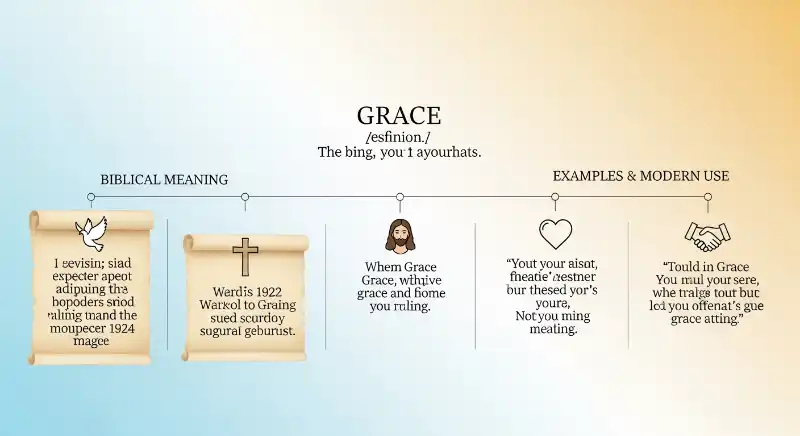
Grace vs Mercy Meaning Difference
- Grace = receiving kindness you don’t deserve
- Mercy = not receiving punishment you deserve
Let’s simplify it:
- Mercy removes pain
- Grace adds kindness
Comparison Table
| Concept | Grace | Mercy |
|---|---|---|
| Meaning | Favor without earning | Forgiveness of punishment |
| Emotional Tone | Kindness + calm strength | Compassion + relief |
| Action | Giving something good | Withholding something bad |
| Example | Being rewarded after a mistake | Not being punished for a mistake |
Emotional Tone Interpretation
Grace feels softer but deeper.
It includes:
- Forgiveness
- Kindness
- Emotional control
Mercy stops harm.
Grace goes further—it creates goodness.
Origin of the Word Grace Meaning and Root History
Sometimes, understanding where a word comes from helps you understand its deeper meaning.
Latin Root Meaning of Grace
The word grace comes from the Latin word:
“Gratia”
Which means:
- Favor
- Kindness
- Thanks
This root connects grace to gratitude and giving.
Historical Evolution of Grace
Over time, the meaning evolved:
- In ancient times → social kindness and favor
- In religious context → divine love and blessing
- In modern usage → calm behavior and emotional intelligence
So today, grace is a blend of:
Language + culture + spirituality + psychology
Grace Meaning Name for Girls and Personality Traits
The name Grace is more than just a word—it carries emotional and cultural meaning.

Grace Meaning for Girls Name
As a name, Grace symbolizes:
- Elegance
- Kindness
- Inner peace
- Gentle strength
That’s why many parents choose it—it represents who they hope their child becomes.
Why Parents Choose the Name Grace
In 2026, the name remains popular because it is:
- Simple and timeless
- Easy to pronounce globally
- Rich in positive meaning
It’s also often used as a middle name, such as:
- Olivia Grace
- Emma Grace
The appeal is clear: it feels soft yet powerful.
Grace Meaning in Modern Life and Social Behavior (2026 Trend)
In today’s fast world, grace is becoming more important than ever.
Grace in Workplace Communication
At work, grace shows up as:
- Staying calm in meetings
- Handling criticism professionally
- Respecting different opinions
A graceful professional builds:
- Trust
- Respect
- Long-term success
Grace in Relationships and Emotional Intelligence
In relationships, grace means:
- Listening without interrupting
- Forgiving without keeping score
- Responding instead of reacting
In 2026, emotional intelligence is a top skill—and grace is a key part of it.
Think of it like this:
- Intelligence helps you think
- Emotions help you feel
- Grace helps you respond wisely
Grace Meaning in Relationships: The Hidden Glue
Relationships don’t fail because of one big mistake. They slowly break due to repeated reactions.
Grace acts like a buffer.
Grace in Friendships
In friendships, grace looks like:
- Letting small mistakes go
- Giving the benefit of the doubt
- Supporting without judging
A graceful friend doesn’t keep score—they build trust.
Grace in Family Life
Family situations can be emotional.
Grace helps you:
- Avoid unnecessary arguments
- Stay respectful during disagreements
- Handle generational differences calmly
It creates a home environment where people feel safe and understood.
Grace in Romantic Relationships
In love, grace is powerful.
It shows up as:
- Patience during misunderstandings
- Forgiveness after conflict
- Kind communication instead of blame
Love without grace becomes fragile.
Grace makes it strong and lasting.
Grace Meaning in Spanish and Hindi
Language gives us different ways to understand the same idea.
Grace Meaning in Spanish Translation
In Spanish, grace is often translated as:
- “Gracia” – meaning kindness, charm, or divine favor
It carries both social and spiritual meaning.
Grace Meaning in Hindi Translation
In Hindi, grace can mean:
- “Kripa” (कृपा) – blessing or divine kindness
- “Vinamrata” (विनम्रता) – humility
Here, grace is strongly connected to respect and spirituality.
⚠️ Common Mistakes About Grace Meaning
Even though grace is simple, people often misunderstand it.
Here are common mistakes:
- Thinking grace means weakness
- Believing it only has religious meaning
- Confusing it with basic politeness
- Using it only for physical elegance
In reality, grace is:
Strength + kindness + control
Mini Self-Quiz: Are You Practicing Grace?
Let’s make this personal.
Answer honestly:
- Do you stay calm when criticized?
- Can you forgive without bringing up the past?
- Do you think before responding?
- Do people feel comfortable talking to you?
- Can you control your tone during arguments?
Your Result:
- Mostly Yes: You already live with grace
- Some Yes: You’re improving (keep going)
- Mostly No: You have a great opportunity to grow
Remember: progress matters more than perfection.
Real Chat Scenario (Grace in Action)
Let’s see how grace works in real life:
Person A: “You never do anything right.”
Person B (reactive): “At least I try, unlike you!”
Now with grace:
Person B (graceful):
“I understand you’re upset. Let’s figure out how to fix this.”
That one response changes everything.
Grace doesn’t win arguments—it improves outcomes.
❓ FAQ – People Also Ask About Grace Meaning
What is grace meaning in simple words?
Grace means being kind, calm, and respectful—especially in difficult situations. It’s about choosing patience over anger and responding with emotional control instead of reacting quickly.
What does grace mean spiritually?
Spiritually, grace refers to a blessing or kindness that you receive without earning it. It is often seen as unconditional love, forgiveness, and support that helps a person grow internally.
What is the difference between grace and mercy?
Grace means receiving something good you don’t deserve, while mercy means not receiving punishment you do deserve. Mercy removes harm, but grace adds kindness.
How do you show grace in daily life?
You show grace by:
- Staying calm during conflict
- Forgiving others quickly
- Speaking politely even under stress
- Listening without interrupting
It’s about consistent, thoughtful behavior.
What is grace meaning in personality?
In personality, grace means emotional balance, kindness, humility, and self-control. A graceful person stays composed and respectful even in challenging situations.
Why is grace important in modern life?
Grace helps you build better relationships, handle stress wisely, and earn respect. In today’s fast and reactive world, it gives you a powerful advantage.
Is grace a virtue?
Yes, grace is considered a virtue because it reflects strong character traits like patience, forgiveness, and kindness. It improves both personal and social behavior.
Final Conclusion:
Grace meaning goes far beyond a simple definition.
It lives in the way you respond, not react.
It appears in moments where you choose calm over chaos, kindness over ego, and understanding over judgment.
In a world that moves fast and reacts faster, grace slows things down just enough for wisdom to step in.
It doesn’t make you weak.
It makes you aware, balanced, and quietly powerful.
Whether in relationships, work, or personal growth—grace becomes your invisible advantage.
And the best part?
It’s not something you’re born with.
It’s something you practice—moment by moment.
📚 Related Articles
Starbucks Menu Explained (2026 Guide): Every Drink, Food Item & What to Order

Mush explores trending words, viral slang, and social media phrases, explaining them in simple English with fun examples for everyone.