Affect vs effect is one of the most confusing grammar pairs in English—and you’re definitely not alone if it trips you up.
At first glance, they sound almost identical. But the difference between affect and effect is actually simple once you see the pattern behind it. The problem? Most explanations are too technical or boring to stick.
Here’s the good news: you’re about to learn it in a way that actually makes sense—using real-life examples, easy rules, and a few memory tricks that work instantly.
✅ Quick Answer
- Affect is usually a verb (an action) → to influence something
- Effect is usually a noun (a result) → the outcome of something
Example:
- “Lack of sleep can affect your mood.”
- “Too much stress has a negative effect on health.”
Difference Between Affect vs Effect (Comparison Guide)
Let’s break this down in the simplest way possible—no confusing grammar jargon, just clarity.
Affect vs Effect Grammar Difference
The core difference comes down to action vs result.
- Affect = influence (something happens)
- Effect = result (something happens because of it)
Think of it like a chain reaction:
Something affects → and then it creates an effect
Real-life analogy:
Imagine you skip breakfast.
- Skipping breakfast affects your energy
- Low energy is the effect
That’s it. Cause → Result.
Affect vs Effect Noun or Verb
This is where most people get stuck.
| Word | Usually Used As | Meaning |
|---|---|---|
| Affect | Verb | To influence |
| Effect | Noun | A result |
But here’s a small twist (don’t worry—it’s rare):
- Effect can be a verb (formal): to bring something into existence
- Affect can be a noun (psychology): emotion or feeling
👉 For everyday writing, ignore the exceptions and stick to the simple rule.
Affect vs Effect Chart (Quick Visual Table)
| Feature | Affect | Effect |
|---|---|---|
| Part of Speech | Verb | Noun |
| Meaning | Influence | Result |
| Usage Frequency | Very common | Very common |
| Example | “This will affect you.” | “This has an effect.” |
When to Use Affect vs Effect (Quick Decision Rule)
This is the part most people wish they learned earlier—a quick way to decide instantly.
Affect vs Effect Easy Rule
Use this simple shortcut:
👉 A = Action (Affect)
👉 E = End Result (Effect)
If the word describes something happening, use affect.
If it describes what happened because of it, use effect.
Example:
- “Social media can affect your focus.”
- “The effect of social media is shorter attention spans.”
How to Remember Affect vs Effect Rule
Let’s make it stick with a story.
Imagine a domino chain:
- You push the first domino → that’s the affect
- The dominoes falling → that’s the effect
Or even simpler:
👉 Affect = Action (starts it)
👉 Effect = Ending (finishes it)
Once you see it this way, you rarely forget.
Affect or Effect Which Is Correct?
When you’re writing and stuck, ask yourself:
- Am I describing influence? → use affect
- Am I describing a result? → use effect
Quick test sentence:
“The new policy will ___ employees.”
Correct answer: affect (because it influences them)
Affect vs Effect Examples in Sentences and Real Life
Understanding grows when you see real situations—not just rules.
Affect vs Effect Sentence Examples
Let’s look at simple, everyday sentences:
- “Rain can affect your plans.”
- “The rain had a calming effect.”
- “Loud noise affects concentration.”
- “Noise has a negative effect on focus.”
- “What you eat affects your health.”
- “Healthy food has a positive effect.”
Affect vs Effect in Real Life Examples
Now let’s bring this into real 2026 life scenarios:
1. Social Media
- Endless scrolling affects your sleep
- Poor sleep is the effect
2. Work Life
- Stress affects productivity
- Burnout is the effect
3. AI & Technology (2026 Trend)
- AI tools affect how we write and work
- Increased efficiency is the effect
Affect vs Effect in Writing
In emails, essays, or content writing, clarity matters.
Wrong:
“The weather had a big affect on me.”
Correct:
“The weather had a big effect on me.”
👉 Why? Because it’s a result, not an action.
💬 Real Chat Scenario (2026 Style)
Person A: “This new app is affecting my daily routine.”
Person B: “Yeah, the effect is obvious—you’re always on your phone now.”
Notice how naturally both words fit when used correctly.
Common Mistakes in Affect vs Effect Usage
Even fluent English speakers get this wrong. Let’s fix that.
Common Mistakes Affect vs Effect
❌ “This will effect your decision.”
✔ “This will affect your decision.”
❌ “The affect was huge.”
✔ “The effect was huge.”
Why Affect vs Effect Is Confusing
There are three main reasons:
- They sound almost identical
- Both relate to cause and result
- Schools often teach them in a complicated way
But once you simplify it to action vs result, everything clicks.
Affect vs Effect Meaning Confusion
People often mix them because both exist in the same sentence.
Example:
“Lack of sleep affects your mood, and the effect can last all day.”
Both are correct—but used differently.
Affect vs Effect Grammar Explained Simply for Beginners
Let’s slow it down even more for complete clarity.
Affect vs Effect Explained Simply
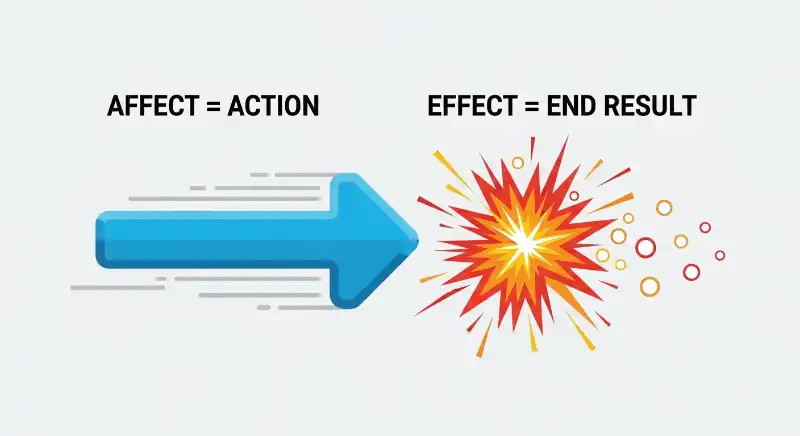
- Affect = doing something (verb)
- Effect = what happens (noun)
It’s like:
Push → Fall
Affect → Effect
What Is the Difference Between Affect and Effect in Grammar
Grammar-wise:
- A verb shows action → affect
- A noun shows thing/result → effect
You don’t need complex grammar rules—just identify the role.
Origin and Root Meaning of Affect and Effect
Both words come from Latin roots:
- Affect → to influence or act upon
- Effect → to bring about or produce
Interestingly, they’ve always been connected—just like cause and result.
🧠 Emotional Insight (Why This Matters More Than You Think)
Small grammar mistakes can quietly affect how people see your writing.
In job emails, academic work, or even social media posts—using the wrong word can make your message feel less polished.
But here’s the empowering part:
Once you understand this, you instantly sound more confident, clear, and professional.
And in a world where communication matters more than ever (especially in 2026’s AI-driven landscape), that’s a real advantage.
Affect vs Effect Quiz to Test Your Understanding
Let’s make this fun and practical. Try answering these before looking at the answers.
Affect vs Effect Quiz Questions
Fill in the blanks:
- “This decision will ______ your future.”
- “The medicine had an immediate ______.”
- “Lack of sleep can ______ your focus.”
- “The new law will ______ change across the country.” (tricky one)
- “What was the ______ of the meeting?”
Take a second. Trust your instinct.
Quick Answers and Explanations
- affect → It influences your future (action)
- effect → It’s the result of the medicine
- affect → Sleep influences focus
- effect → Here it means to bring about (formal verb usage)
- effect → Asking about the result
👉 If you got 4 or 5 right, you’ve basically mastered it.
If not, no stress—you’re already improving just by practicing.
Affect vs Effect Meaning in Spanish and Hindi
For multilingual learners, connecting meanings across languages makes things clearer and easier to remember.
Affect vs Effect Meaning in Spanish
- Affect (verbo) → afectar (influir en algo)
- Effect (sustantivo) → efecto (resultado)
Example:
- “Esto puede afectar tu salud.”
- “El efecto fue inmediato.”
Affect vs Effect Meaning in Hindi
- Affect (क्रिया / verb) → प्रभाव डालना
- Effect (संज्ञा / noun) → प्रभाव / परिणाम
Example:
- “यह आपकी सेहत को प्रभावित कर सकता है।”
- “इसका प्रभाव तुरंत दिखा।”
👉 Notice how both languages follow the same logic: influence vs result.
Affect vs Effect Memory Trick and Synonyms to Remember Easily
If you forget rules under pressure (like in exams or writing), this section will save you.
Affect vs Effect Memory Trick
Here are two powerful memory hacks:
✅ A = Action → Affect
✅ E = End → Effect
Or visualize this:
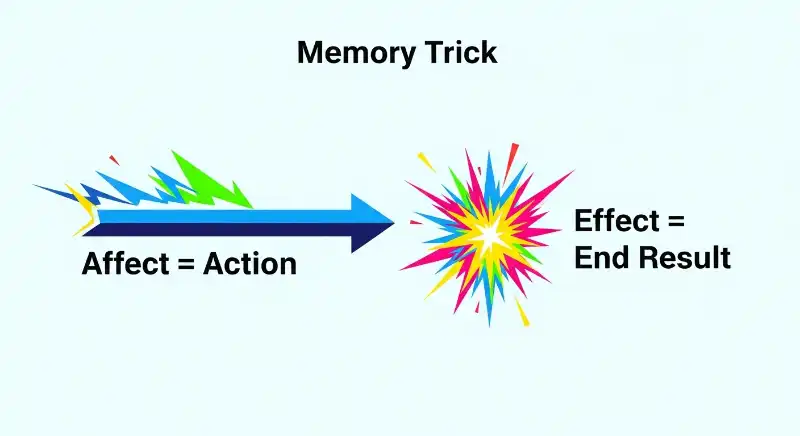
- Affect = Arrow (moving toward something)
- Effect = Explosion (final result)
Another quick trick:
👉 If you can replace the word with “influence”, use affect
👉 If you can replace it with “result”, use effect
Synonyms and Contextual Variations
Sometimes using synonyms makes your writing stronger and avoids confusion.
Instead of “affect”:
- influence
- impact
- change
- alter
Instead of “effect”:
- result
- outcome
- consequence
- impact (yes, this one overlaps!)
👉 Example:
- “Stress affects your sleep” → “Stress impacts your sleep”
- “The effect was noticeable” → “The result was noticeable”
Frequently Asked Questions
Is affect always a verb?
Most of the time, yes. In everyday writing, affect is used as a verb meaning “to influence.”
In psychology, it can be a noun meaning emotion—but that’s rare for general use.
Can effect be used as a verb?
Yes, but it’s formal.
It means “to bring about” or “to cause.”
Example:
“The new system will effect major changes.”
Why is affect vs effect confusing?
Because:
- They sound almost identical
- Both relate to cause and result
- Traditional grammar explanations are often too complex
But once you think action vs result, the confusion disappears.
What is the easiest rule to remember affect vs effect?
👉 Affect = Action
👉 Effect = End result
That one line solves most cases instantly.
Final Thoughts
At first, affect vs effect feels like a small grammar detail. Something easy to ignore.
But here’s the truth: small details shape big impressions.
In a job application, a business email, or even a simple message—using the right word quietly signals clarity, confidence, and intelligence.
And in 2026, where communication is faster, global, and often AI-assisted, precision matters more than ever.
The best part?
You don’t need to memorize complicated grammar rules.
Just remember this:
👉 Affect = influence (action)
👉 Effect = result (outcome)
That’s your shortcut. Your mental cheat code.
Once it clicks, you’ll start noticing it everywhere—in conversations, articles, and your own writing.
And that’s when learning turns into mastery.
📚 Related Articles
Fewer vs Less: The Simple Rule Most People Still Get Wrong (2026 Guide)

Mush explores trending words, viral slang, and social media phrases, explaining them in simple English with fun examples for everyone.